

Geriatric Care Services Market Size and Trends - 2026 to 2033
The Geriatric Care Services Market is estimated to be valued at USD 1,475 Bn in 2026 and is expected to reach USD 2,200 Bn by 2033, growing at a compound annual growth rate (CAGR) of 6.25% from 2026 to 2033.
Key Takeaways
- Based on Service Type, the Home Healthcare segment is expected to lead the market with 50.20% share in 2026, due to strong preference for aging‑in‑place and cost benefits.
- Based on Region, North America is set to lead the market with 42.50% share in 2026. While, Asia Pacific is anticipated to be the fastest growing region.
Market Overview
The geriatric care services market provides specialized healthcare, social, and psychological support services primarily for the elderly population requiring long-term help or chronic illness management. This market includes sophisticated home-based medical care, assisted living centers, and skilled nursing facilities, along with integrated remote patient monitoring tools, Ai-driven fall detection systems, and personalized end-of-life care.
The global demand for high-quality elderly care is increasing as healthcare systems shift toward aging-in-place models, which creates a greater need for comprehensive support among specialized nursing facilities and home health agencies. Service providers and healthcare organizations recognize the critical importance of specialized care for improving quality of life and ensuring long-term healthcare stability. The government regulatory agencies have established stricter standards for senior safety and digital health.
With the implementation of new long-term care insurance laws and improved payment policies, the market is expanding rapidly, particularly in the Asia Pacific region, where traditional family-based care structures are changing alongside rapid urban growth. The market remains highly significant in regions with advanced healthcare systems and established senior care networks, including North America, Europe, China, and Japan. Care providers are now deploying next-generation systems that integrate artificial intelligence for predictive health analysis and machine learning formulas for behavioral monitoring.
Current Events and Its Impacts on the Geriatric Care Services Market
Current Event | Description and the Impact |
Social and Cultural Attitudes Towards Elder Care
|
|
Geopolitical and Policy Developments |
|
Technological Advancements in Elder Care |
|
Role Of Artificial Intelligence (AI) In Geriatric Care Services Market
Artificial intelligence acts as a vital tool in Geriatric Care Services Market for early health management and operational efficiency. By using machine learning and data analysis, AI systems identify subtle patterns in health records to predict medical risks like falls or memory loss, often years before clear symptoms appear. AI-powered monitoring ranging from wearable sensors to smart home technologies provides constant and private oversight that alerts caregivers to emergencies instantly. This effectively supports the trend of staying at home while ensuring safety.
Furthermore, creative AI and companion robots address social loneliness by providing personalized emotional support and mental experiences. For healthcare providers, AI simplifies paperwork and improves staffing schedules. The use of these technologies is majorly reducing hospital visits and improving the overall daily life for the global elderly population.
For instance, in January 2024, Intuition Robotics released an upgraded version of its artificial intelligence companion, ElliQ, designed to support seniors in their health and autonomy needs. The new version is backed up by USD 25 million. It includes the implementation of generative AI to enhance instruction and overcome loneliness. As a result of these technological advancements, the device has become more accessible. It will enable the companion to form stronger relationships with users, and overall health will be ensured, keeping older individuals at home safely.
- Current Industry Events of 2026
- Market Size Estimation
- Regional Breakdown
- Competitive Landscape
- Customer Intelligence
- Segmental Analysis
- Pricing Analysis
- Key Market Drivers, Challenges & Future Trends
- Customized Insights Section
Segmental Insights
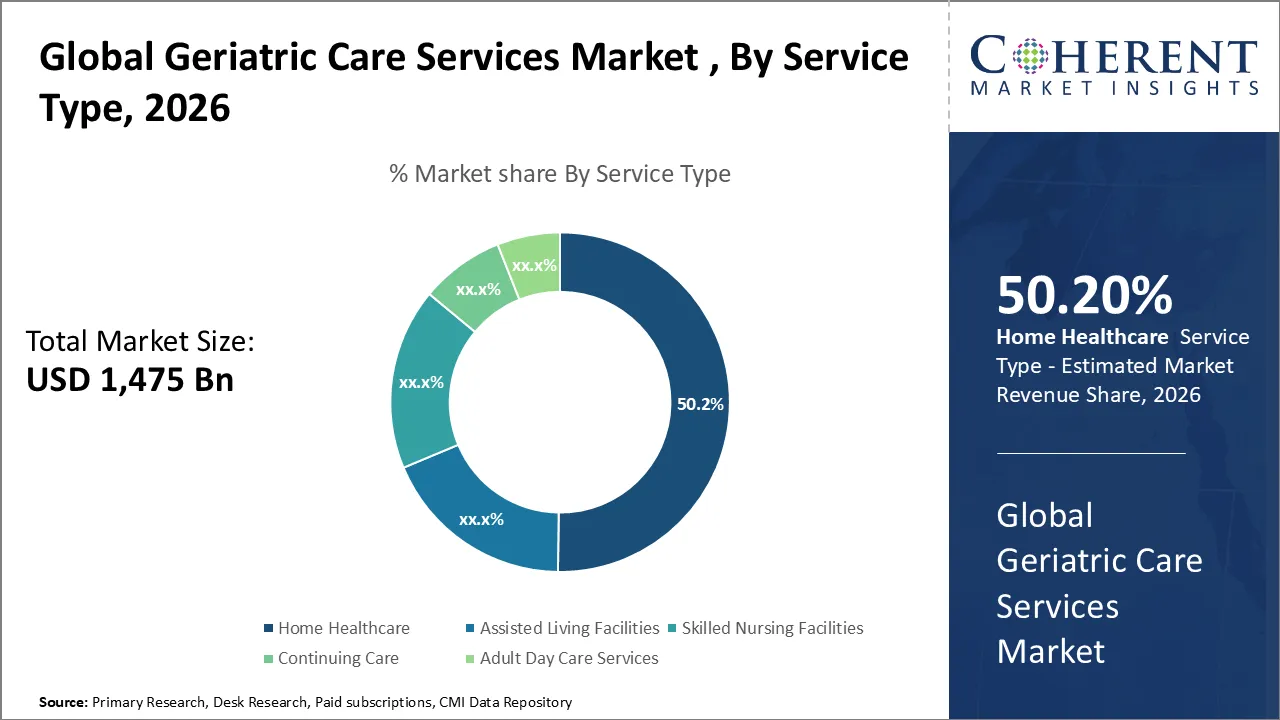
Geriatric Care Services Market Insights By, Service Type - Home Healthcare Leads with Strong Preference for Aging ‑ in ‑ place and Cost Benefits
In terms of service type, the home healthcare segment contributes the highest share of 50.20% in 2026 of the market owing to their ability to align with the strong preference for aging in place. This service type allows seniors to get professional medical and personal support at their own residences, thus preserving their independence and dignity. The preference for home care is attributable to its cost-effectiveness and personalized attention. These services are more affordable than institutional care and provide a dedicated one-to-one environment that minimizes the risk of hospital-acquired infections.
Moreover, familiar surroundings help mitigate cognitive stress and disorientation that are associated with nursing home facilities. The segment is growing due to its scalability and rapid technological integration. Complex chronic conditions now can be managed safely at home with the advancement of telehealth and remote monitoring. This efficiency makes it the primary solution for the rising global elderly population.
For instance, in September 2025, Apollo Home Healthcare, India’s major provider of home healthcare services, working together with Apollo Hospitals, has announced the commencement of its Senior First Geriatric Program to deliver specialized homecare services for senior citizens within the comfort of their own residences in Mumbai.
Regional Insights
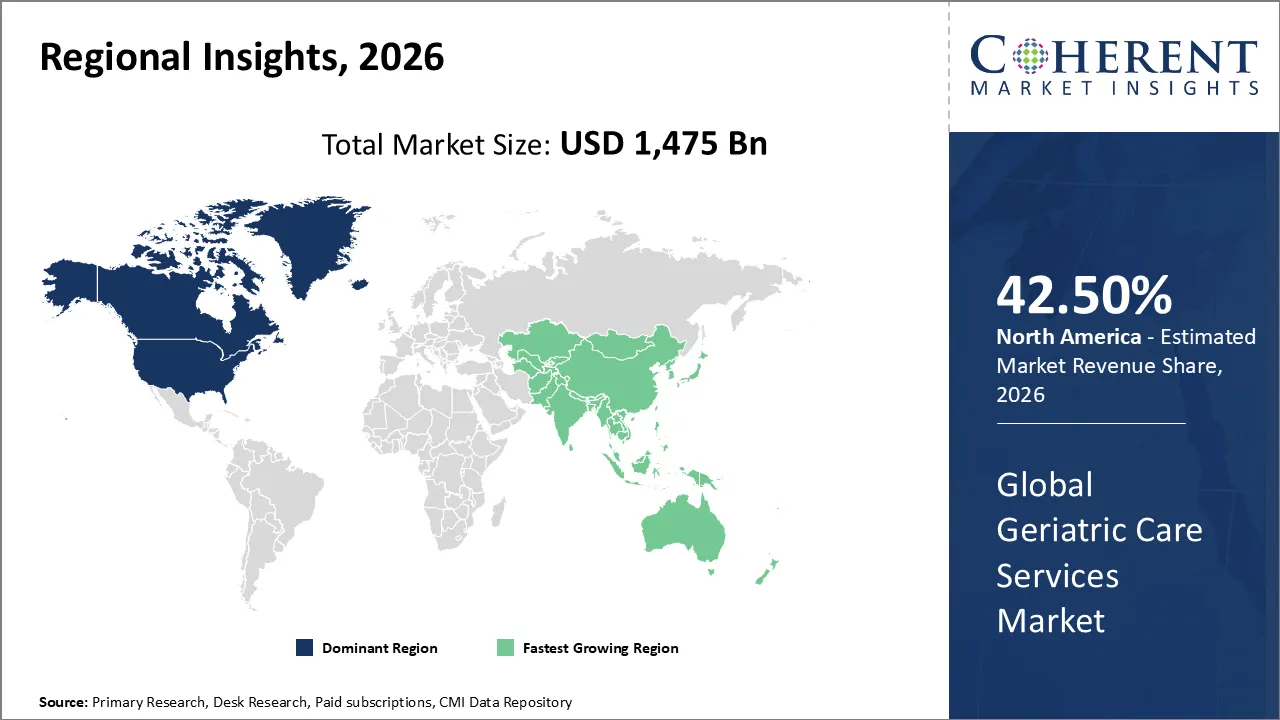
North America Geriatric Care Services Market Analysis & Trends
North America has remained the dominant region with 42.50% in 2026 of the global Geriatric Care Services Market over the past decade owing to its highly advanced healthcare systems and a rapidly aging population. The region benefits from broad government-funded programs like Medicare, which provide extensive payment coverage for long-term and skilled nursing care. This financial support ensures high access for a significant portion of the elderly population. The region serves as a main center for medical technology and creative solutions.
The early use of telehealth, AI-driven remote monitoring, and smart helpful devices has transformed patient management, particularly in the US. The strong presence of major industry companies and a shift toward quality-based healthcare delivery help in strengthening its leading position. The supportive rules and rising awareness regarding specialized senior care solutions continue to drive market growth.
For instance, in May 2025, Always Best Care Senior Services, one of the renowned senior care franchise networks in the US, revealed the official opening of its newest franchise location in New Bern, North Carolina. Led by the husband-and-wife team of Trinette and David Reo, the new franchise will offer premium senior care services, encompassing non-medical in-home care and senior living referral services to the local community of New Bern.
Asia Pacific Geriatric Care Services Market Analysis & Trends
Asia Pacific is currently the fastest growing region in the global Geriatric Care Services Market. This is due to a historic and rapid increase in the elderly population. Countries such as China, Japan, and India are experiencing a major demographic shift as life expectancy rises while birth rates decline. This trend creates an urgent and massive demand for professional healthcare services tailored specifically for seniors.
The growth in this region is fueled by changing social structures and economic pressures. As urbanization increases, traditional family-based care is being replaced by formal services like home healthcare and assisted living. Rising middle-class income allows more families to afford these specialized options. Furthermore, governments are heavily investing in healthcare infrastructure and expanding insurance coverage to support senior citizens. The region is also adopting modern technologies such as robots to help with care, telemedicine, and intelligent health monitoring tools to control chronic diseases.
For instance, in December 2025, Antara Senior Living Limited, a subsidiary of Max India Limited, has partnered with Max Estates to exclusively oversee the management of senior living residences and amenities at Estate 361, India. The recently launched Estate 361 will comprise a total of 360 senior living units and will feature a carefully curated integrated wellness centre that combines modern medicine with traditional Indian wisdom to enhance the quality of life for seniors.
Geriatric Care Services Market Outlook Country-Wise
The US Geriatric Care Services Market Trends
The US market is defined by a well-established healthcare system and a shift toward high-tech, personal solutions. A major driver is the large baby boomer generation, which is increasing the demand for home-based care and specialized memory support for conditions like Alzheimer’s. Helpful government programs such as Medicare and Medicaid provide essential financial support for long-term services. Moreover, the US is at the forefront when it comes to leveraging cutting-edge technology, including artificial intelligence and remote monitoring, to enable senior care at home. These factors create a stable market with a focus on older adults' independence and quality of life.
China Geriatric Care Services Market Trends
The China market is expanding at a fast rate as a result of its rapidly aging population. With a massive number of citizens above the age of sixty, society is currently experiencing a shift that current family structures cannot handle. As a result, the government has made senior care a top priority by investing heavily in buildings and insurance programs. The market is seeing a rise in smart care, using robots and digital health tools to help when there are not enough nursing staff. Additionally, private companies are quickly building modern retirement communities to meet the needs of a growing middle class.
Market Report Scope
Geriatric Care Services Market Report Coverage
| Report Coverage | Details | ||
|---|---|---|---|
| Base Year: | 2025 | Market Size in 2026: | USD 1,475 Bn |
| Historical Data for: | 2020 To 2024 | Forecast Period: | 2026 To 2033 |
| Forecast Period 2026 to 2033 CAGR: | 6.25% | 2033 Value Projection: | USD 2,200 Bn |
| Geographies covered: |
| ||
| Segments covered: |
| ||
| Companies covered: | LivHOME, Brookdale Senior Living Solutions, Revera Inc., Senior Care Centers, Amedisys, Genesis HealthCare, Home Instead Senior Care, Extendicare, and Portea Medical | ||
| Growth Drivers: |
| ||
| Restraints & Challenges: |
| ||
Geriatric Care Services Market Drivers
Rapidly aging global population
The geriatric care services market is experiencing swift expansion because of the massive demographic change taking place as the population of the world ages at an unprecedented pace. The rising lifespan in most global nations contributes to a boosting number of people who will need constant support, especially among those aged over eighty years.
The second most important factor boosting the geriatric care services market is the escalating number of seniors experiencing chronic conditions such as dementia, diabetes, and heart disease. These diseases have a propensity to appear together and hence demand comprehensive handling through professional medical and support access that conventional medical practice does not necessarily provide. Thus, there is a need for specialized facilities such as home health care and assisted living facilities where patients' conditions will be controlled while encouraging seniors to stay independent and live a quality life within a healthy environment.
Analyst Opinion (Expert Opinion)
The geriatric care services market is expanding steadily due to rapid population aging, rising life expectancy, and the increasing burden of age-related chronic conditions. Globally, individuals aged 65 years and above account for a growing share of the population, driving sustained demand for home healthcare, assisted living, nursing facilities, and specialized geriatric services. Epidemiological data indicates that chronic diseases such as cardiovascular disorders, arthritis, diabetes, and neurodegenerative conditions affect a majority of the elderly population, increasing long-term care requirements.
Home healthcare has emerged as a preferred care model, with studies showing that more than half of older adults with mobility or functional limitations rely on in-home medical or non-medical assistance. This shift toward aging-in-place is supported by wider adoption of remote patient monitoring, teleconsultations, and digital care coordination platforms, which have contributed to lower hospital readmission rates and improved continuity of care.
Assisted living and nursing care providers are increasingly focusing on specialized services, particularly memory care and post-acute rehabilitation. Dementia-related conditions represent a significant proportion of long-term residential care demand, influencing staffing intensity and service customization. Preventive care utilization among older adults has also increased, supported by structured screening, medication management, and multidisciplinary care programs.
Overall, the market is characterized by a transition toward integrated, patient-centric care models, supported by data analytics, standardized quality benchmarks, and policy initiatives aimed at improving clinical outcomes and long-term care efficiency.
Speak to the analyst
Want personalized insights?
Take the findings above to one of our principal consultants, or have the report rebuilt around the segments, geographies and competitors you actually track.
Geriatric Care Services Industry News
- In December 2025, KITES Senior Care, a subsidiary of Lifebridge Group, has inaugurated a specialized geriatric care centre in Kochi, augmenting capacity in Kerala, where 16.5% of the population is over 60 years old. The 48-bed facility offers post-hospital rehabilitation, palliative and respite care, physiotherapy, occupational therapies, Ayurveda, wellbeing support, healthy meals, and extensive home care services.
- In April 2025, Geri Care Health Services, India's leading integrated healthcare provider managed by geriatric specialists for senior citizens, announced the inauguration of a pioneering Assisted Living Centre in Bengaluru. This premium 100-bed skilled nursing care center represents a significant milestone in Geri Care's nationwide expansion and introduces an unprecedented eldercare solution to the city.
- In January 2025, InvAscent, a private equity investor specializing in healthcare and life sciences via India Life Sciences Fund IV (ILSF IV), funded INR 1,100 million in Geri Care Health Services. The organization is the first to specifically dedicate itself to providing comprehensive healthcare to senior citizens.
- In May 2024, the University of Helsinki Funds recently allocated €30,000 in investment to the startup Minnet Company. Minnet is a tablet-based platform developed to assist elderly individuals experiencing memory difficulties, promoting their independence while offering reassurance to their caregivers.
Market Segmentation
- Service Type Insights (Revenue, USD Bn, 2026 - 2033)
- Home Healthcare
- Assisted Living Facilities
- Adult Day Care Services
- Continuing Care
- Skilled Nursing Facilities
- Regional Insights (Revenue, USD Bn, 2026 - 2033)
- North America
- U.S.
- Canada
- Latin America
- Brazil
- Argentina
- Mexico
- Rest of Latin America
- Europe
- Germany
- U.K.
- France
- Italy
- Russia
- Rest of Europe
- Asia Pacific
- China
- India
- Japan
- Australia
- South Korea
- ASEAN
- Rest of Asia Pacific
- Middle East
- GCC
- Israel
- Rest of Middle East
- Africa
- North Africa
- Central Africa
- South Africa
- Key Players Insights
- LivHOME
- Brookdale Senior Living Solutions
- Revera Inc.
- Senior Care Centers
- Amedisys
- Genesis HealthCare
- Home Instead Senior Care
- Extendicare
- Portea Medical
Sources
Primary Research Interviews
- Home Healthcare Service Providers
- Assisted Living & Nursing Home Operators
- Geriatric Hospitals & Long-Term Care Centers
- Palliative & Hospice Care Providers
- Telehealth & Remote Patient Monitoring Providers
- Care Coordination & Case Management Professionals
- Healthcare Policy & Reimbursement Consultants
- Others
Databases
- Bloomberg Terminal
- Thomson Reuters Eikon
- OECD Health Statistics
- Others
Magazines
- Modern Healthcare
- Healthcare Executive
- Long-Term Living Magazine
- Home Health Care News
- Aging Today
- Others
Journals
- Journal of the American Geriatrics Society
- The Gerontologist
- Age and Ageing
- BMC Geriatrics
- Journal of Aging & Social Policy
- International Journal of Geriatric Psychiatry
- Others
Newspapers
- Financial Times
- The Wall Street Journal
- Reuters
- Bloomberg News
- The New York Times
- Others
Associations
- American Geriatrics Society (AGS)
- International Association of Gerontology and Geriatrics (IAGG)
- Global Ageing Network
- LeadingAge
- National Association for Home Care & Hospice (NAHC)
- Others
Public Domain Sources
- World Health Organization (WHO) – Ageing & Health
- World Bank Open Data
- U.S. Centers for Medicare & Medicaid Services (CMS)
- National Institute on Aging (NIA)
- Organisation for Economic Co-operation and Development (OECD)
- Others
Proprietary Elements
- CMI Data Analytics Tool
- Proprietary CMI Existing Repository of Information for the Last 8 Years
Get access to 250+ pages report
Every segment, forecast, competitor profile and data table behind the analysis above — available for instant download.
- ESOMAR Member
- ISO 9001:2015 Certified
- D-U-N-S Registered
- GDPR & CCPA Compliant
Missing comfort of reading report in your local language? Find your preferred language:
Transform your Strategy with Exclusive Trending Reports
Frequently Asked Questions
The Geriatric Care Services Market is estimated to be valued at USD 1,475 Bn in 2026, and is expected to reach USD 2,200 Bn by 2033.
The CAGR of the Geriatric Care Services Market is projected to be 6.25% from 2026 to 2033.
Increasing geriatric population prone to the risk of chronic diseases is one of the major factors driving the growth of the Geriatric Care Services Market.
High cost of geriatric care services is one of the major factors hampering the growth of the Geriatric Care Services Market.
In terms of service type, the home healthcare segment is estimated to dominate the market revenue share in 2026.
LivHOME, Brookdale Senior Living Solutions, Revera Inc., Senior Care Centers, Amedisys, Genesis HealthCare, Home Instead Senior Care, Extendicare, and Portea Medical are the major players.
North America is expected to lead the Geriatric Care Services Market in 2026.