

Patient Portal Software Market Size and Forecast: 2026-2033
The Patient Portal Software Market is estimated to be valued at USD 3.16 Bn in 2026 and is expected to reach USD 6.43 Bn by 2033, exhibiting a compound annual growth rate (CAGR) of 12.1% from 2026 to 2033.
Key Takeaways
- By Portal Type, Integrated hold the largest market share of 53.8% in 2026 owing to the integration with EHR and healthcare IT systems.
- By Software Mode, Web/cloud based expected to hold largest market share of 52.8% in 2026 owing to the flexibility, scalability & cost-efficiency.
- By End User, Hospitals & Clinics acquired the prominent market share of 43.8% in 2026 owing to its improving patient engagement & satisfaction.
- By Region, North America dominates the overall market with an estimated share of 41.5% in 2026 owing to the advanced healthcare IT infrastructure.
Market Overview
Healthcare providers are rapidly advancing the Patient Portal Software Market by adopting digital platforms that improve patient engagement, streamline clinical and administrative workflows, and strengthen care coordination. Patient portals give users secure, convenient access to medical records, appointments, test results, and direct communication with providers through web and mobile platforms. Providers increasingly integrate these portals with electronic health records and telehealth services, while prioritizing patient-centric care, which continues to accelerate adoption across hospitals, clinics, and modern healthcare systems.
Current Events and Its Impact on the Patient Portal Software Market
Current Events | Description and its impact |
Regulatory and Policy Developments in Healthcare Data Privacy |
|
Technological Advancements in AI and Interoperability |
|
Geopolitical Events Affecting Global Healthcare Technology Supply Chains |
|
Role of AI (Artificial Intelligence) in Patient Portal Software
- AI is transforming patient portal software by making medical information easier to understand and more actionable. It can summarize complex health records, translate clinical language into plain terms, and highlight key trends like lab result changes or medication interactions. AI-powered chat tools also allow patients to ask questions about their diagnoses, test results, and treatment plans within the portal, improving engagement and reducing confusion. Additionally, AI can personalize health guidance, streamline appointment scheduling, and support secure data access.
- In September 2025, Oracle added AI-powered features to its Health Patient Portal that helped patients better understand their medical records. Users were able to view their complete health information and receive secure, plain-language explanations of diagnoses, test results, and treatment options. Patients could also ask follow-up questions about their personal records directly within the portal.
- Current Industry Events of 2026
- Market Size Estimation
- Regional Breakdown
- Competitive Landscape
- Customer Intelligence
- Segmental Analysis
- Pricing Analysis
- Key Market Drivers, Challenges & Future Trends
- Customized Insights Section
Segmental Insights
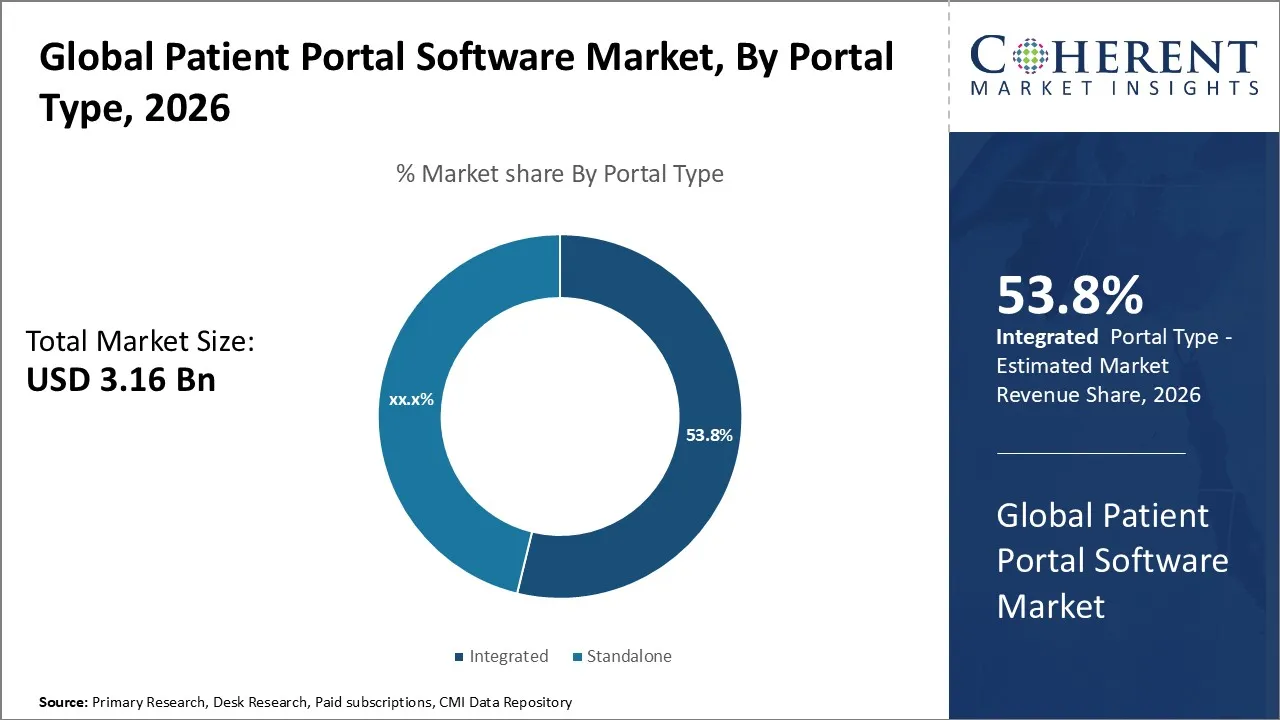
Patient Portal Software Market Insights, By Portal Type - Integrated contribute the highest share of the market owing to its healthcare digital transformation & cloud adoption
Integrated hold the largest market share of 53.8% in 2026. Healthcare organizations increasingly adopt integrated patient portal software to unify clinical, administrative, and financial operations. By connecting with electronic health records, providers access real-time patient data, reduce duplication, and make informed decisions. These solutions enable secure data exchange, improve care coordination, and streamline workflows. Growing demands for interoperability, accurate data, and digital care drive hospitals to implement fully integrated portals.
For instance, in September 2025, Patients using the Oracle Health Patient Portal can now access AI features that provide secure, plain-language explanations of diagnoses, test results, and treatments, and ask questions directly within the portal.
Patient Portal Software Market Insights, By Software Mode - Web/Cloud based contribute the highest share of the market owing to its enhanced interoperability and data sharing
Web/cloud based expected to hold largest market share of 52.8% in 2026. Healthcare providers drive the adoption of web- and cloud-based patient portals by prioritizing flexible, accessible, and cost-efficient digital solutions. Cloud deployment accelerates implementation, enables remote patient data access, and allows continuous system updates without heavy infrastructure. These portals support real-time patient-provider interactions across devices, and as telehealth and scalable IT expand, organizations increasingly use them to enhance care delivery and operational efficiency.
For instance, in September 2025, Milliman MedInsight® launches the MedInsight Innovation Portal, offering healthcare organizations advanced analytics, intuitive workflows, and cloud services to accelerate innovation and support data-driven decisions.
Patient Portal Software Market Insights, By End User - Hospitals & Clinics contribute the highest share of the market owing to its supporting telehealth and virtual services
Hospitals & Clinics acquired the prominent market share of 43.8% in 2026. Hospitals and clinics adopt patient portal software to enhance operational efficiency and strengthen patient relationships. The portals streamline administrative tasks like scheduling and billing while providing patients secure access to records and test results. By enabling clear communication and coordinated care, providers improve outcomes and satisfaction. Growing emphasis on digital healthcare, engagement, and compliance drives portals as a core component of modern care.
For instance, in October 2025, Healthcare organizations across Louisiana launched MyChart Central statewide, providing patients with a secure, unified platform to access medical records, communicate with care teams, and manage their care.
Regional Insights
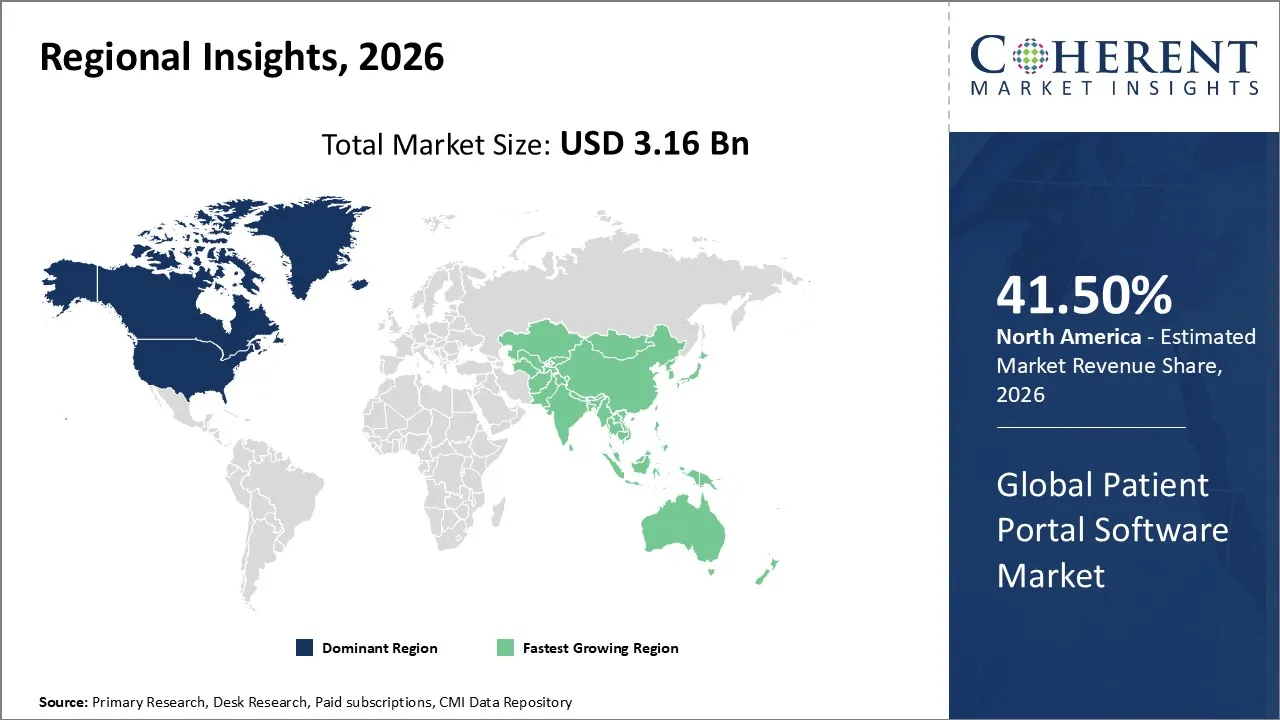
North America Patient Portal Software Market Trends
North America dominates the overall market with an estimated share of 41.50% in 2026. Healthcare providers in North America are shaping the Patient Portal Software Market by adopting advanced health IT systems and prioritizing greater interoperability. They are enhancing patient engagement through secure messaging, mobile access, and integrated digital services. Telehealth integration, along with regulatory initiatives promoting data access and transparency, is driving continuous innovation. Vendors are actively improving user experience with intuitive interfaces and advanced analytics. These developments demonstrate the region’s commitment to delivering patient-centric, connected care across hospitals, clinics, and healthcare networks. For instance, in November 2025, Novartis unveiled a direct-to-patient platform in the US, allowing cash-paying patients prescribed Cosentyx® (secukinumab) to buy it at a 55% discount.
Asia Pacific Patient Portal Software Market Trends
Healthcare providers across the Asia Pacific region are driving the adoption of patient portal software as they digitize services and expand telehealth and mobile health offerings. Rising internet and smartphone usage is prompting patients to schedule appointments, access medical records, and communicate with providers online. Governments and healthcare organizations are investing in IT infrastructure to enhance access and efficiency, while demand grows for scalable, cloud-based portals in both urban and emerging markets. These trends highlight the region’s push toward modern, patient-focused digital healthcare. For instance, in July 2025, AIIMS Jhajjar launched the digital portal www.Sahaym.in to provide senior citizens with health resources, preventive care tools, and mental wellness support.
United States Patient Portal Software Market Trends
Healthcare providers in the United States are driving trends in the patient portal software market by enhancing patient engagement and expanding digital access to care. They are integrating portal features directly into electronic health record systems to enable secure access to medical records, manage appointments, and facilitate direct communication, meeting growing patient demand for convenient online healthcare tools. Providers are also incorporating telehealth services and strengthening data security, while leading U.S. vendors actively innovate to streamline workflows and enhance the overall user experience. For instance, in May 2025, Sanford Health enables patients to register as organ, eye, and tissue donors through MyChart, simplifying the process for those who wish to become registered donors.
India Patient Portal Software Market Trends
Healthcare providers and government initiatives in India are driving the growth of patient portal software by digitizing health services. The expansion of the Ayushman Bharat Digital Mission is promoting connected digital health systems, enabling patients to access records and communicate with providers online. Increasing internet and smartphone usage is fueling demand for mobile-friendly, cloud-based portal tools, while hospitals, clinics, and remote communities are adopting telehealth and healthcare IT investments to improve digital access and streamline patient communication.
Patient Portal Software Market Trend
Shift Toward Personalized Patient Experiences
Healthcare providers are tailoring portal functions to individual needs, offering customized dashboards, targeted health reminders, and patient‑specific care recommendations. This personalization improves engagement and makes portals feel more relevant to users. Patients increasingly expect features like tailored wellness content, reminders for preventive care, and visuals that help interpret their health records. This trend is pushing vendors to embed adaptive interfaces and intelligent patient insights into their platforms.
Seamless Clinical and Administrative Integration
Hospitals and clinics are prioritizing portals that integrate not just with electronic health records, but also with scheduling, billing, laboratory, and pharmacy systems. This unified approach eliminates double entry and improves workflow efficiency for staff while presenting a single, cohesive view of healthcare activities to patients. The focus is on interoperability and real‑time data exchange, enabling smoother transitions between care settings and enhancing overall clinical coordination.
Patient Portal Software Market Opportunity
Enhancing Patient Engagement Through AI and Personalization
Patient portals can leverage artificial intelligence to deliver tailored health insights, predictive care suggestions, and adaptive learning tools. By offering personalized health recommendations, automated reminders, and intuitive interfaces that adjust to user behavior, portals create deeper engagement. This opportunity extends to building chatbots, smart triage support, and tailored preventive care nudges, helping patients take proactive control of their health and driving long‑term portal adoption and loyalty.
Market Report Scope
Patient Portal Software Market Report Coverage
| Report Coverage | Details | ||
|---|---|---|---|
| Base Year: | 2025 | Market Size in 2026: | USD 3.16 Bn |
| Historical Data for: | 2020 To 2024 | Forecast Period: | 2026 To 2033 |
| Forecast Period 2026 to 2033 CAGR: | 12.1% | 2033 Value Projection: | USD 6.43 Bn |
| Geographies covered: |
| ||
| Segments covered: |
| ||
| Companies covered: | Napier Healthcare Solutions, Inc., Allscripts Healthcare Solutions Inc., Curemd Healthcare, Athenahealth Inc., Cerner Corporation, Nextgen Healthcare Information Systems LLC, GE Healthcare, Greenway Health LLC, Medfusion Inc., Eclinicalworks LLC, and PrognoCIS. | ||
| Growth Drivers: |
| ||
| Restraints & Challenges: |
| ||
Patient Portal Software Market News
- In January 2026, OpenAI unveiled ChatGPT Health, a new feature that lets users link medical records and wellness apps to ChatGPT for more personalized health responses. OpenAI said the feature includes extra privacy protections and that conversations in ChatGPT Health will not be used to train its foundational models. The feature is currently in testing and has regional limitations on which health apps can be connected.
Analyst Opinion (Expert Opinion)
- The Patient Portal Software Market is undergoing a substantive transformation from transactional access points to strategic clinical engagement platforms. Recent data from national health surveys indicate that 57% of individuals in the United States now access their medical records via mobile apps, a marked increase from 38% in 2020, reflecting a clear patient preference shift toward mobile‑first access and real‑time interaction capabilities. This evolution underscores that portals are no longer peripheral but central to digital health workflows.
- Healthcare systems that fail to invest in intuitive, integrated portal experiences will cede competitive positioning. For example, more than 90% of U.S. hospitals now offer online access to patient records, with over 70% enabling downloads or transmission of complete records, a compliance response to interoperability mandates such as the 21st Century Cures Act Final Rule. These regulatory forces have elevated portals from optional conveniences to de facto expectations for providers.
- However, fragmentation persists: a significant share of patients maintain multiple portal logins across providers, and less than 10% use third‑party frameworks to aggregate this information into a single view. This fragmentation not only dampens user experience but imposes administrative burdens on IT teams and highlights the critical unmet need for interoperable aggregation layers. Failure to address this will undermine patient engagement objectives and obscure the true value of digital transformation investments.
- Security remains both a market risk and investment area. High‑profile breaches, such as the Change Healthcare incident affecting tens of millions of records, have heightened provider vigilance and driven adoption of AI‑driven threat detection. Yet widespread concerns around privacy and breach exposure signal that vendors must prioritize robust governance frameworks to preserve trust and sustain adoption, especially as portals expand into telehealth, analytics, and IoT data aggregation.
- Overall, the market’s trajectory confirms that portals are no longer auxiliary offerings but strategic infrastructure essential to achieving patient‑centered, interoperable, and digitally resilient health systems. End‑user expectations are accelerating innovation cycles, and failure to align product roadmaps with these demands will materially erode competitive differentiation.
Speak to the analyst
Want personalized insights?
Take the findings above to one of our principal consultants, or have the report rebuilt around the segments, geographies and competitors you actually track.
Market Segmentation
- By Portal Type
- Integrated
- Standalone
- By Software Mode
- Web/Cloud based
- On Premise
- By End User
- Hospitals & Clinics
- Home Care Service
- Ambulatory service
- By Regional Insights
- North America
- U.S.
- Canada
- Latin America
- Brazil
- Argentina
- Mexico
- Rest of Latin America
- Europe
- Germany
- U.K.
- Spain
- France
- Italy
- Russia
- Rest of Europe
- Asia Pacific
- China
- India
- Japan
- Australia
- South Korea
- ASEAN
- Rest of Asia Pacific
- Middle East
- GCC Countries
- Israel
- Rest of Middle East
- Africa
- South Africa
- North Africa
- Central Africa
- North America
- Key Players Insights
- Napier Healthcare Solutions, Inc.
- Allscripts Healthcare Solutions Inc.
- Curemd Healthcare
- Athenahealth Inc.
- Cerner Corporation
- Nextgen Healthcare Information Systems LLC
- GE Healthcare
- Greenway Health LLC
- Medfusion Inc.
- Eclinicalworks LLC
- PrognoCIS.
Sources
Primary Research interviews
- Hospital IT heads
- Healthcare providers (physicians, nurses)
- Health insurance IT managers
- Patient experience coordinators
- Hospital administrators and executives
Databases
- PubMed
- ClinicalTrials.gov
- WHO Global Health Observatory
- CDC WONDER database
- HealthData.gov
Magazines
- Healthcare IT News
- Health Management Technology
- Modern Healthcare
- Health Data Management
- Healthcare Informatics
Journals
- Journal of Medical Internet Research (JMIR)
- International Journal of Medical Informatics
- Journal of the American Medical Informatics Association (JAMIA)
- BMC Health Services Research
- Telemedicine and e-Health
Newspapers
- The New York Times (Health Section)
- The Washington Post (Health & Science)
- The Guardian (Healthcare coverage)
- USA Today (Health section)
- The Times (Healthcare news)
Associations
- Healthcare Information and Management Systems Society (HIMSS)
- American Medical Association (AMA)
- American Hospital Association (AHA)
- National eHealth Collaborative
- European Health Telematics Association (EHTEL)
Public Domain sources
- FDA official website
- National Institutes of Health (NIH) publications
- World Health Organization (WHO) reports
- Government health policy documents
- Open-access datasets on patient portals
Proprietary Elements:
- CMI Data Analytics Tool
- Proprietary CMI Existing Repository of information for last 8 years
Get access to 250+ pages report
Every segment, forecast, competitor profile and data table behind the analysis above — available for instant download.
- ESOMAR Member
- ISO 9001:2015 Certified
- D-U-N-S Registered
- GDPR & CCPA Compliant
Missing comfort of reading report in your local language? Find your preferred language:
Transform your Strategy with Exclusive Trending Reports
Frequently Asked Questions
The global patient portal software market is estimated to surpass USD 6.43 Bn by 2033.
Major players operating in the global patient portal software market include Napier Healthcare Solutions, Inc., Allscripts Healthcare Solutions Inc., Curemd Healthcare, Athenahealth Inc., Cerner Corporation, Nextgen Healthcare Information Systems LLC, GE Healthcare, Greenway Health LLC, Medfusion Inc., Eclinicalworks LLC, and PrognoCIS
Data privacy and security issues, which include data leaks, breaches, and others are some of the major factors that are expected to hamper growth of the market over the forecast period.
Increasing awareness and user-friendly features is driving demand for patient portal softwareand theseare some of the major factors that are expected to propel growth of the market over the forecast period.
The global patient portal software market is estimated to exhibit a CAGR of 12.1% over the upcoming years.
Among regions, North America is expected to hold dominant position in the global patient portal software market over the forecast period