

Europe Telerehabilitation Skilled Nursing Care Center Market Size and Forecast – 2026 to 2033
The Europe Telerehabilitation Skilled Nursing Care Center Market is anticipated to grow at a CAGR of 8.1% with USD 3.4 Bn share in 2026 and is expected to reach USD 5.3 Bn in 2033. Europe’s aging population drives higher demand for post-acute rehabilitation, while rising chronic diseases increase care needs. Chronic diseases, including cancer, cardiovascular disorders, chronic respiratory diseases, diabetes, and mental health conditions, account for 85% of all deaths in the EU.
Key Takeaways
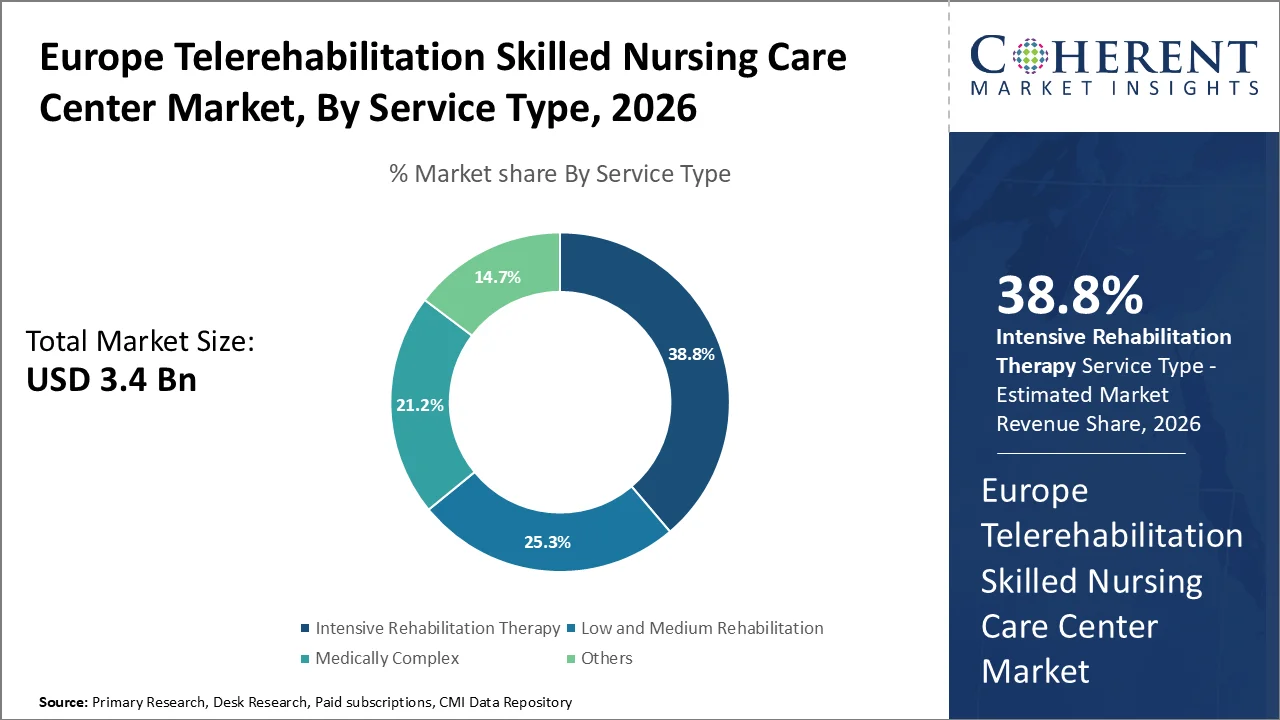
- Intensive Rehabilitation Therapy hold the largest market share of 38.8% in 2026 owing to the aging population & rising post-acute care demand. As of January 2025, 22% of the EU’s 450.6 million population was aged 65 years or older.
- Hospital expected to hold largest market share of 42.2% in 2026 owing to its central role of hospitals in rehabilitation pathways. Germany has approximately 1,100–1,500 specialized rehabilitation hospitals and clinics nationwide.
- Germany is expected to acquire the dominant share of 39.2% in 2026 owing to the strong government policy & reimbursement framework. In January 2025, Germany’s Federal Ministry of Health launched the Action Plan for a Diverse, Inclusive, and Barrier-Free Healthcare System to improve healthcare accessibility for people with disabilities, underserved populations, and families with caregiving responsibilities.
Current Events and Their Impact on the Europe Telerehabilitation Skilled Nursing Care Center Market
Current Event | Description and its Impact |
EU Adoption of the EHDS Regulation for Cross-Border Healthcare Data Access (January–March 2025) |
|
Germany’s Digital Healthcare Expansion and Telemedicine Reimbursement Support |
|
Segmental Insights
- Current Industry Events of 2026
- Market Size Estimation
- Regional Breakdown
- Competitive Landscape
- Customer Intelligence
- Segmental Analysis
- Pricing Analysis
- Key Market Drivers, Challenges & Future Trends
- Customized Insights Section
Why is Intensive Rehabilitation Therapy Acquiring the Largest Market Share?
Intensive Rehabilitation Therapy hold the largest market share of 38.8% in 2026. An aging population, the rising prevalence of chronic and neurological conditions, and growing demand for continuous post-acute care drive intensive rehabilitation therapy in the Europe telerehabilitation skilled nursing care center market. Healthcare providers increasingly adopt digital healthcare and remote monitoring to deliver high-frequency therapy beyond traditional settings. Skilled nursing centers use telerehabilitation to improve patient outcomes, reduce hospital burden, and maintain continuity of care, while leveraging AI, wearables, and virtual platforms to deliver more personalized and scalable rehabilitation programs. For instance, in August 2025, Griffith University launched a groundbreaking spinal cord injury treatment trial in which patients complete intensive rehabilitation for three months before receiving a transplantation, followed by another eight months of rehabilitation after the procedure to help stimulate regeneration.
Which End User segment dominates the market?
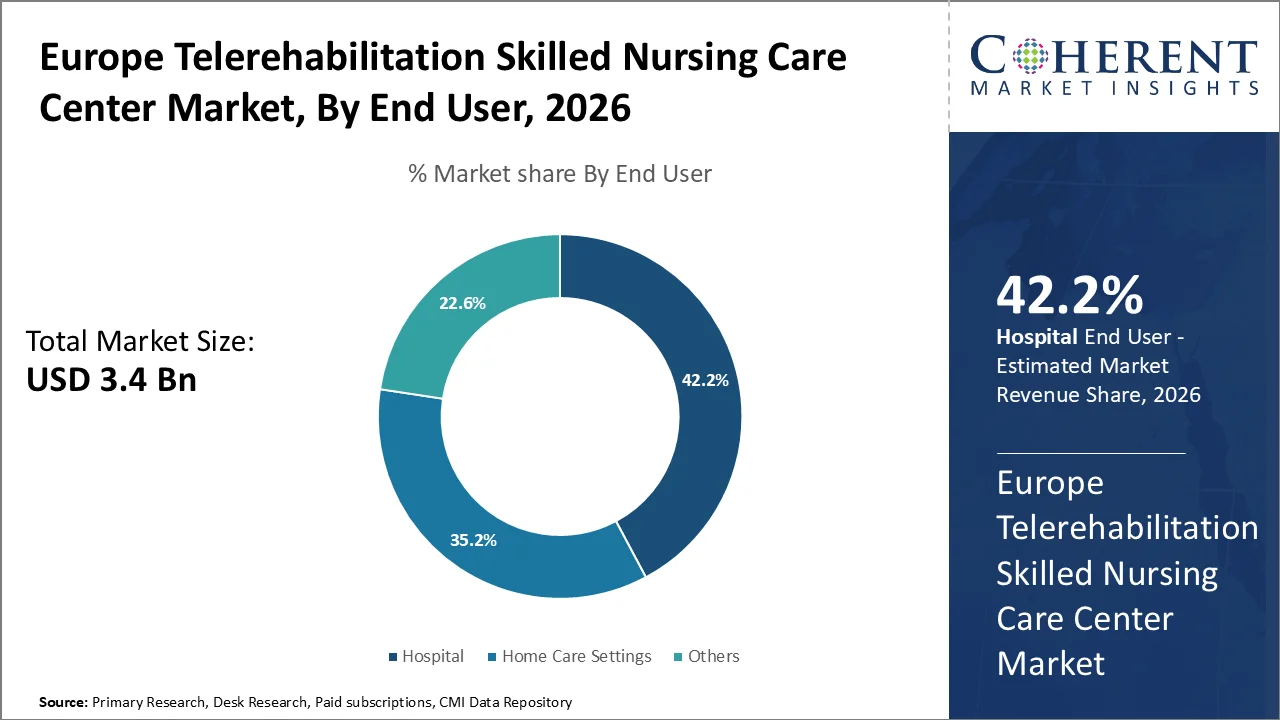
Hospital expected to hold largest market share of 42.2% in 2026 owing to its growing prevalence of chronic & neurological disorders. Rising post-acute care demand, an increasing chronic disease burden, and pressure to shorten hospital stays drive hospitals in the Europe telerehabilitation skilled nursing care center market. Hospitals adopt telerehabilitation to enable early discharge while ensuring continuous patient monitoring and rehabilitation. They use digital tools to extend therapist reach amid workforce shortages. Additionally, hospitals integrate telehealth with IT systems and focus on reducing readmissions, while improving care coordination across skilled nursing facilities and home-based settings.
Europe Telerehabilitation Skilled Nursing Care Center Market Trends
- Rising adoption of remote rehabilitation platforms enables continuous therapy delivery, improving patient engagement and reducing dependency on in-person visits.
The European Health Data Space (EHDS) Regulation entered into force in March 2025, supporting interoperable digital healthcare services and facilitating broader deployment of remote rehabilitation solutions across EU healthcare systems. This regulatory framework is accelerating digital rehabilitation adoption in long-term and skilled nursing care settings. - Expansion of hybrid care models combining in-person and virtual therapy improves flexibility and treatment adherence across skilled nursing settings. According to the World Health Organization (WHO) Europe, nearly 76,000 children die before the age of five annually in the European Region, while chronic diseases remain a major healthcare burden. Healthcare providers are increasingly adopting hybrid rehabilitation models to improve long-term patient management and reduce pressure on healthcare resources.
- Expansion of rehabilitation infrastructure supports greater integration of telerehabilitation services. Germany alone has approximately 1,500 specialized rehabilitation hospitals and clinics, making it one of Europe's largest rehabilitation markets. Many facilities are incorporating telehealth and remote rehabilitation technologies to extend care beyond facility walls and improve continuity of treatment after discharge.
Germany dominates owing to rapid digital health adoption
Germany is expected to acquire the dominant share of 39.2% in 2026. Strong government support for digital health adoption drives Germany in the Europe telerehabilitation skilled nursing care center market, as authorities reimburse telehealth services and integrate digital care tools into statutory insurance systems. A large aging population and high prevalence of chronic and neurological diseases increase demand for long-term rehabilitation. Germany's population aged 65 and above is expected to reach 24 million by 2050, a 41% increase from current levels, representing nearly one-third of the country's total population. Advanced healthcare infrastructure, widespread electronic health record usage, and established skilled nursing facilities support adoption. Workforce shortages and the need for cost-efficient care further encourage the use of telerehabilitation solutions.
U.K. Telerehabilitation Skilled Nursing Care Center Market Trends
The rising elderly population in the U.K. drives demand for long-term and post-acute care services within skilled nursing care centers. Increasing cases of chronic conditions such as stroke and musculoskeletal disorders further fuel the need for rehabilitation support. The UK records over 100,000 stroke cases annually, approximately one every five minutes, with stroke causing around 34,000 deaths each year. The NHS faces growing pressure to reduce hospital readmissions, which encourages wider use of alternative care models. Healthcare providers adopt digital health technologies, remote monitoring, and virtual rehabilitation platforms to improve service delivery. Workforce shortages and the demand for cost-effective home-based recovery solutions continue to strengthen market growth across care settings.
Who are the Major Companies in Europe Telerehabilitation Skilled Nursing Care Center Industry
Some of the major key players in Europe Telerehabilitation Skilled Nursing Care Center Market are DyCare, Costaisa, Meditouch, Signo Motus srl, MEYTEC GmbH Informationssysteme, and Raccoon Technologies Poland LLC.
Market Report Scope
Europe Telerehabilitation Skilled Nursing Care Center Market Report Coverage
| Report Coverage | Details | ||
|---|---|---|---|
| Base Year: | 2025 | Market Size in 2026: | USD 3.4 Bn |
| Historical Data for: | 2020 To 2024 | Forecast Period: | 2026 To 2033 |
| Forecast Period 2026 to 2033 CAGR: | 8.1% | 2033 Value Projection: | USD 5.3 Bn |
| Geographies covered: |
| ||
| Segments covered: |
| ||
| Companies covered: | DyCare, Costaisa, Meditouch, Signo Motus srl, MEYTEC GmbH Informationssysteme, and Raccoon Technologies Poland LLC. | ||
Analyst Opinion
- Europe’s telerehabilitation skilled nursing care center market is being shaped less by “digital adoption trends” and more by structural care delivery pressure. Europe’s population aged 65+ already exceeds 21% of total population, and Eurostat projects this cohort will approach nearly 30% by 2050, directly intensifying post-acute and long-term rehabilitation demand in skilled nursing settings.
- Post-stroke and musculoskeletal rehabilitation needs are the core clinical driver, not optional care expansion. The European Stroke Organization reports more than 1.1 million strokes annually across Europe, and stroke remains one of the leading causes of adult disability, with a large share of survivors requiring prolonged physiotherapy that skilled nursing facilities increasingly cannot deliver onsite due to staffing constraints.
- Workforce shortages are actively reshaping care delivery models. OECD data shows several European countries reporting nursing vacancy pressures that force reliance on remote supervision models. For example, the UK alone has over 40,000 nursing vacancies in the NHS, while Germany and France continue to report sustained shortages in geriatric and rehabilitation nursing, pushing facilities toward telerehabilitation platforms as a practical substitution rather than an upgrade.
- Telerehabilitation adoption is being validated through real-world hospital discharge models rather than experimental pilots. The NHS Community Virtual Ward programs have demonstrated that remote monitoring and virtual physiotherapy pathways can safely support early discharge for older patients, reducing inpatient burden and shifting rehabilitation into home-linked skilled nursing coordination.
- Clinical evidence is reinforcing this shift with measurable functional outcomes. Studies across European rehabilitation networks show that home-based and hybrid telerehabilitation for post-stroke patients can achieve comparable functional recovery scores to in-person therapy for selected patient groups, especially when combined with wearable monitoring and structured physiotherapy protocols.
Speak to the analyst
Want personalized insights?
Take the findings above to one of our principal consultants, or have the report rebuilt around the segments, geographies and competitors you actually track.
Market Segmentation
- By Service Type (Revenue, USD Bn, 2021-2033)
- Intensive Rehabilitation Therapy
- Low and Medium Rehabilitation
- Medically Complex
- Others
- By End User (Revenue, USD Bn, 2021-2033)
- Hospital
- Home Care Settings
- Others
- By Region (Revenue, USD Bn, 2021-2033)
- Germany
- U.K.
- Spain
- France
- Italy
- Russia
- Rest of Europe
Sources
Primary Research interviews
- Interviews with rehabilitation physicians working in skilled nursing care centers across Europe
- Discussions with physiotherapists, occupational therapists, and speech-language pathologists involved in telehealth delivery
- Inputs from nursing home administrators and long-term care facility managers implementing telerehabilitation programs
- Feedback from healthcare IT managers responsible for digital health integration in European elder care facilities
- Consultations with policymakers and digital health advisors involved in EU telehealth initiatives
Databases
- PubMed Central – biomedical and clinical studies on telerehabilitation outcomes in elderly and post-acute care populations
- European Health Information Gateway (WHO/Europe) – regional healthcare system data and aging population statistics
- OECD Health Statistics – comparative healthcare infrastructure and digital health adoption metrics
- ClinicalTrials.gov – ongoing and completed clinical trials on remote rehabilitation and telemonitoring systems in Europe
- arXiv – research publications on telerehabilitation systems, AI-based rehabilitation tools, and remote therapy platforms
Magazines
- Healthcare IT-focused digital publications covering telemedicine and remote patient monitoring trends in Europe
- European digital health and medical technology magazines reporting on innovation in rehabilitation technologies
- Elder care and nursing care industry magazines highlighting skilled nursing facility transformation
- Public health and aging-focused periodicals covering post-acute rehabilitation care trends
Journals
- Digital Health – studies on telerehabilitation adoption, patient readiness, and caregiver involvement in Europe
- Journal of Telemedicine and Telecare – peer-reviewed research on remote rehabilitation systems and clinical outcomes
- Disability and Rehabilitation: Assistive Technology – studies on assistive devices and telerehabilitation effectiveness
- IEEE Journal of Biomedical and Health Informatics – research on AI-enabled rehabilitation systems and remote monitoring technologies
- BMC Geriatrics – studies on elderly care, rehabilitation needs, and digital health integration in nursing facilities
Newspapers
- European Union health policy coverage in major financial newspapers
- UK and Germany national newspapers reporting on NHS digital health and elder care modernization initiatives
- French and Italian healthcare reform coverage focusing on nursing home digitization and telehealth adoption
- Business-focused European newspapers covering healthcare infrastructure investments and aging population challenges
Associations
- European Association of Geriatric Medicine (EuGMS) – guidelines on elderly rehabilitation and long-term care practices
- European Society of Physical and Rehabilitation Medicine (ESPRM) – clinical standards and research in rehabilitation medicine
- International Society for Telemedicine & eHealth (ISfTeH) – global standards for telehealth and telerehabilitation adoption
- European Connected Health Alliance (ECHAlliance) – ecosystem development for digital health transformation in Europe
- National rehabilitation and physiotherapy associations across EU member states
Public Domain sources
- European Commission – eHealth and digital transformation initiatives in healthcare systems
- World Health Organization (WHO) – aging population trends and rehabilitation care frameworks
- National Health Service (NHS, UK) publications on telehealth integration in post-acute care
- Government health ministry reports from Germany, France, Spain, and Italy on long-term care modernization
- Open-access academic repositories such as arXiv and institutional university research papers
Proprietary Elements
- CMI Data Analytics Tool
- Proprietary CMI Existing Repository of information for last 10 years
Get access to 250+ pages report
Every segment, forecast, competitor profile and data table behind the analysis above — available for instant download.
- ESOMAR Member
- ISO 9001:2015 Certified
- D-U-N-S Registered
- GDPR & CCPA Compliant
Missing comfort of reading report in your local language? Find your preferred language:
Transform your Strategy with Exclusive Trending Reports
Frequently Asked Questions
The Europe Telerehabilitation Skilled Nursing Care Center Market is anticipated to grow at a CAGR of 8.1% with USD 3.4 Bn share in 2026 and is expected to reach USD 5.3 Bn in 2033.
Rising aging population and incidence of chronic diseases are expected to drive the market growth over the forecast period.
Intensive rehabilitation therapy segment is expected to hold the major market share during the forecast period.
Germany holds the largest market share in the market.
Major factors hampering growth of the market include lack of awareness among healthcare professionals about novel technologies and advanced therapies.
Major players operating in the market include DyCare, Costaisa, Meditouch, Signo Motus srl, MEYTEC GmbH Informationssysteme, and Raccoon Technologies Poland LLC.