

Global Healthcare Mobility Solutions Market Size and Share Analysis – Growth Trends and Forecasts (2026-2033)
Healthcare Mobility Solutions Market is estimated to be valued at USD 217.7 Mn in 2026 and is expected to reach USD 845.9 Mn in 2033, exhibiting a compound annual growth rate (CAGR) of 21.4% from 2026 to 2033.
Key Takeaways
- By Type, the Mobile Application Segment is set to hold around 46.0% shares in the global market in 2026.
- North America is estimated to hold a dominant position in the global healthcare mobility solutions market with 47.3% of the market share. This is because key market players operating in North America are adopting strategies such as partnerships to expand their business globally.
Market Overview
The healthcare mobility solutions market is fueled by the increasing requirement for real-time patient data access, increased penetration of mobile devices into healthcare environments, and the need to automate clinical processes and reduce administrative complexities. The solutions enhance patient-provider communication, enable remote monitoring, and overall operational efficiency. It is also propelled by telehealth growth, electronic health records (EHRs), and mobile health (mHealth) app growth. Increased investments in digital infrastructure, AI-fueled integration into mobile health applications, and hospital and clinic adoption of BYOD (Bring Your Own Device) policies are reshaping care delivery.
Current Events and Its Impact on Healthcare Mobility Solutions Market
Current Events | Description and its impact |
Philips Introduces Mobile Patient Monitoring Solution in U.S. |
|
Cerner Unveils Smart Mobile Health Platform in 2024 |
|
Pipeline Analysis
The pipeline for healthcare mobility solutions is getting deeper and broader, driven by technology advancements in wearables, AI apps, and 5G/6G networks. Legacy players such as GE HealthCare, Withings, Philips, and Samsung are using wireless vital-sign monitoring and telehealth platforms—e.g., GE's FDA-cleared Portrait Mobile, a smartphone-sized cable-free patient monitor that enables enhanced post-surgery mobility and reduced hospital stays.
Future technology ventures and startups are creating conversational AI wearables (such as The ValueCare Group's wristwatch, MICA) and passive gait-analysis devices, enabling proactive patient engagement and early disease detection.
Entrenchment of 5G-enabled telemedicine, AI chatbots, and RPM apps within an integrated mobile ecosystem is gaining pace, especially among Asia-Pacific markets where smartphone penetration and 5G penetration are still high.
In the corporate sector, enterprise mobility platforms and rugged mobile computers (such as Zebra Technologies' healthcare-class tablets) are on the anvil to facilitate better asset tracking, medication processes, and secure access to EHRs. Indian healthcare mobility solution providers are also contributing to this transformation by offering scalable, localized platforms tailored to clinical and operational needs.
Regulatory innovation, such as the FDA's pre-approved change-control for adaptive AI, is inviting growth in learning systems with safety ensured. In the near term, within the next 3–5 years, the pipeline should introduce embedded mobility solutions and wearable-RPM-app-platform systems that combine real-time monitoring, predictive analysis, and triage/teleconsultation tools, transforming patient-focused and clinical workflows.
- Current Industry Events of 2026
- Market Size Estimation
- Regional Breakdown
- Competitive Landscape
- Customer Intelligence
- Segmental Analysis
- Pricing Analysis
- Key Market Drivers, Challenges & Future Trends
- Customized Insights Section
Patent Landscape
The patent landscape in healthcare mobility is changing rapidly, driven by wearables technology, wireless sensors, AI analytics, telehealth, and remote patient monitoring technologies. According to the 2024 "Digital Patient Monitoring Devices Patent Landscape Report," there are over 6,000 patents globally, of which U.S. patents are over 3,000—primarily focused on wireless sensor technology, AI-based analytics, and connectivity systems.
Lead patent owners include Medtronic (2,500+ patents) and Philips (2,200+), both aiming at AI-enhanced monitoring systems, secure mHealth platforms, and interoperable telehealth infrastructure. Other key players are Medi media, Edwards Lifesciences, and Ethicon.
By product type, diagnostic monitoring (including vital sign wearables) leads the way with over 3,000 patents, followed by therapeutic monitoring. Technology segments show wearables dominating (2,500+ filings), with mHealth and Remote Patient Monitoring showing rising growth.
Regionally, the U.S. leads with innovation in sensor accuracy and analytics; Europe concentrates on device interoperability and data security (Germany/UK); and Asia-Pacific (China/Japan) contributes ~1,500 patents emphasizing low-cost, scalable mobile health solutions.
Globally, the patent landscape unequivocally demonstrates a trajectory towards secure, AI-powered, real-time, connected mobile health ecosystems that epitomize the strategic shift of the industry toward patient-centric, digitally-enabled care.
Global Healthcare Mobility Solutions Market – Driver
- Increasing partnerships between key market players
An increase in the number of partnerships by key market players is expected to propel the growth of the market over the forecast period. For instance, in June 2024, Germans Trias i Pujol University Hospital in Badalona, Spain, initiated a groundbreaking telehealth and remote patient management program. The hospital, serving over 800,000 residents in the north Barcelona area, deployed up to 1,000 Masimo W1™ medical watches and 100 Radius VSM™ wearable continuous vital signs monitors as part of the SESHAT project. This initiative aims to enable clinicians to remotely monitor patients' physiological data in near real-time, whether they are in the hospital or at home.
- Increasing number of acquisitions by market players
An increase in the adoption of strategies such as acquisitions by key market players is expected to drive the global mobility healthcare solutions market growth.
Global Healthcare Mobility Solutions Market Key Trends
- mHealth application is expected to witness significant growth of market owing to increasing number of collaborations
The mHealth application segment is expected to witness significant growth due to the increasing number of collaborations between market players.
Segmental Insights
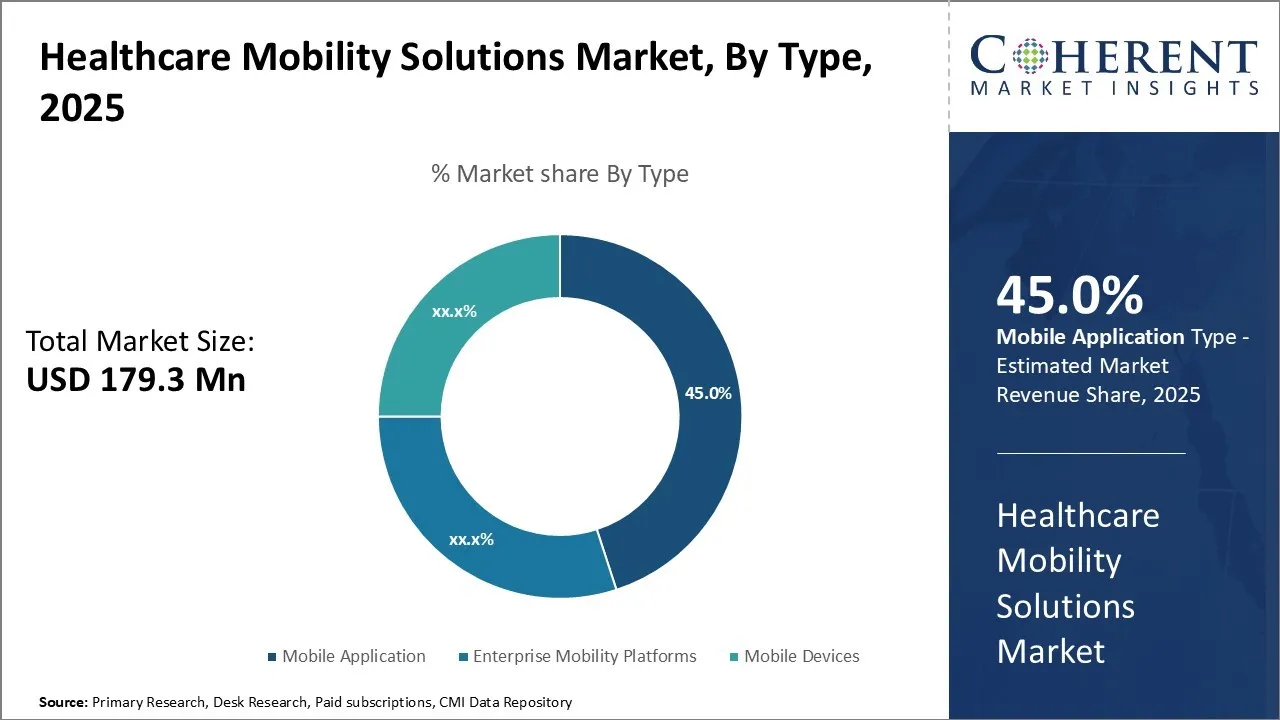
Global Healthcare Mobility Solutions Market Insights, By type
By Type, the market is segmented into Mobile Devices, Mobile Applications, and Enterprise Mobility Platforms. Out of which, the mobile applications Platforms segment is expected to hold a dominant position in the global healthcare mobility solutions market during the forecast period, and this is attributed to the technological advancements in the field of healthcare mobility solutions.
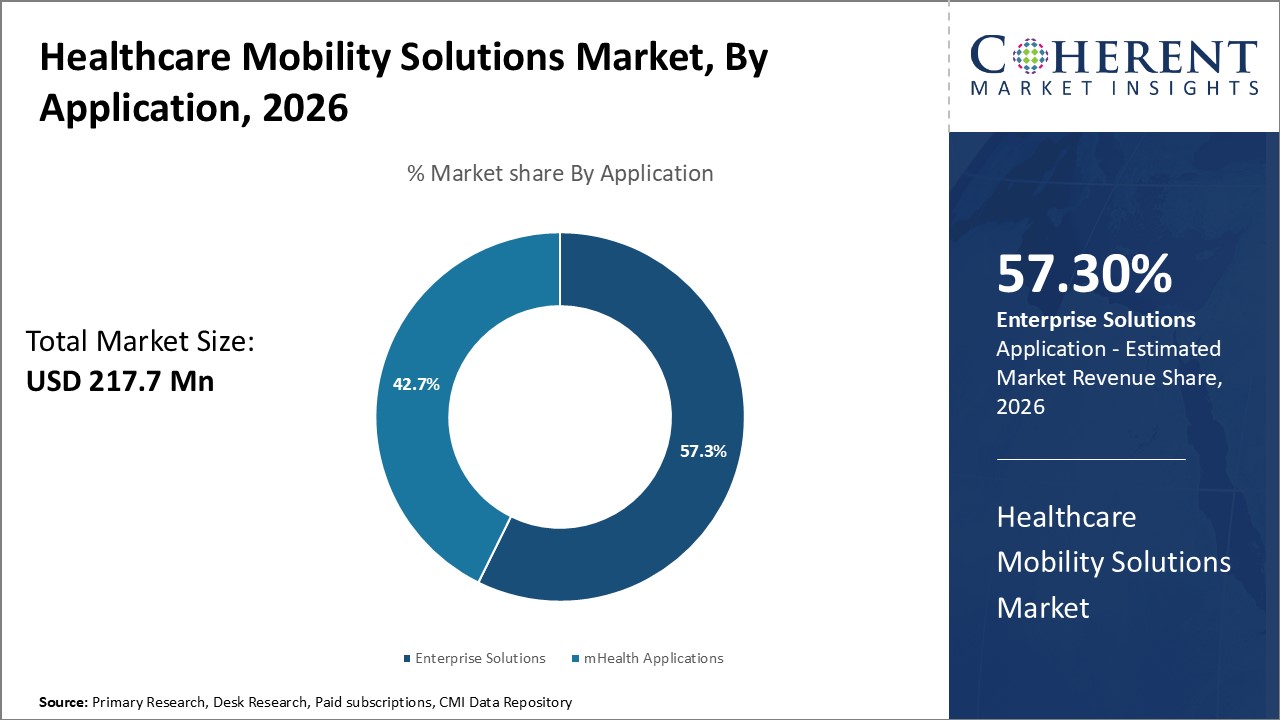
Global Healthcare Mobility Solutions Market Insights, By Application
By Application, the market is segmented into Enterprise Solutions and mHealth Applications. Out of which, the mHealth Applications segment is expected to hold a dominant position in the market during the forecast period, and this is attributed to the increasing product launches such as mobile applications.
Global Healthcare Mobility Solutions Market Insights, By End User
By End User, the market is segmented into Payers, Providers, and Patients. Out of which, the Payers segment is expected to hold a dominant position in the healthcare mobility solutions market during the forecast period, and this is attributed to the increasing awareness of healthcare mobility solutions.
Global Healthcare Mobility Solutions Market Cross Sectional Analysis
In the application segment, mHealth applications held a dominant position in the Asia Pacific region due to the increasing number of partnerships between key market players. For instance, in July 2021, Mobile Health, an employee screening and occupational health provider, announced that has signed an eight-year agreement to be the Preferred Partner for employer health and wellbeing program customization for Sydney, the member engagement tool offered to members of Anthem Blue Cross and Blue Shield's plans.
Regional Insights
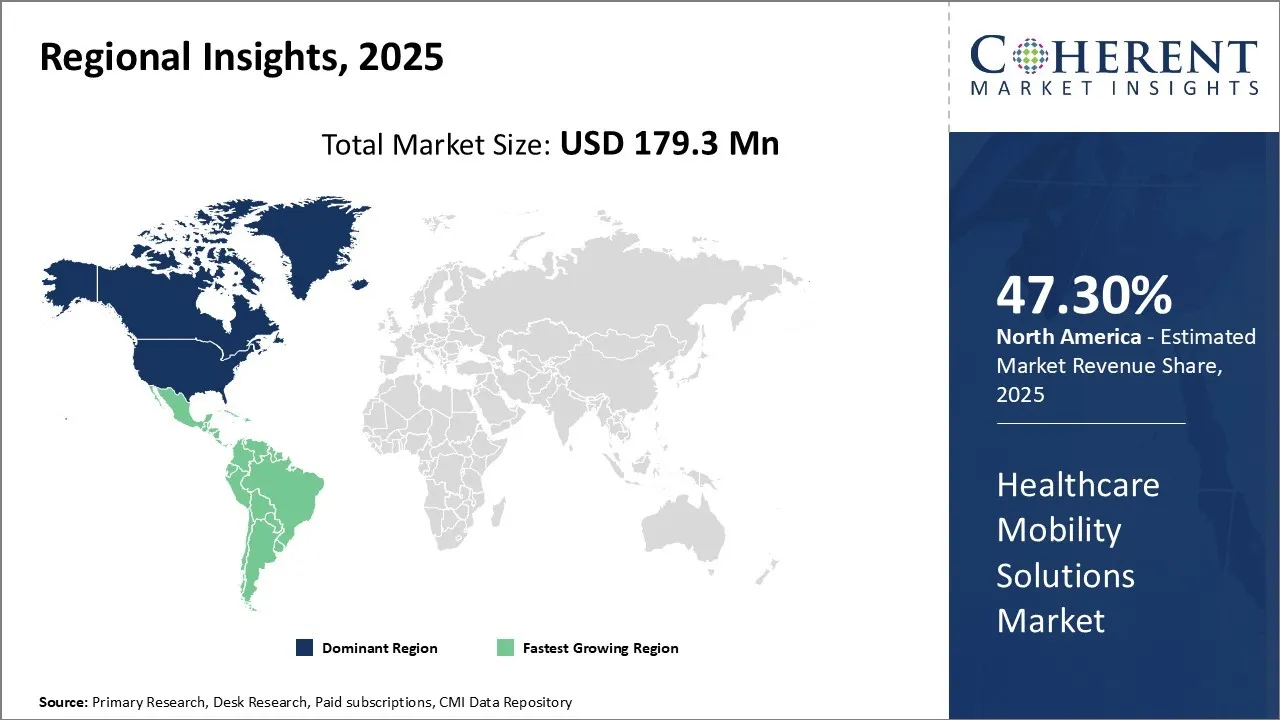
North America Healthcare Mobility Solutions Market Analysis and Trends
Among regions, North America is estimated to hold a dominant position in the global healthcare mobility solutions market over the forecast period. North America is estimated to hold 47.30% of the market share. The key market players operating in North America are adopting strategies such as partnerships to expand their business globally, and this is expected to drive the market growth in the region over the forecast period.
For instance, in May 2026, Renovotec, a software and services company, announced a partnership with Social Mobile, a U.S.-based provider of enterprise mobility solutions. Social Mobile’s fast-to-market mobility solutions will support Renovotec’s rapid expansion in the doorstep delivery and field service markets. Target sectors for the new partnership include transportation, logistics, healthcare, retail, and hospitality.
Healthcare Mobility Solutions Market Dominating Countries
United States Healthcare Mobility Solutions Market Analysis and Trend
The U.S. leads the market for healthcare mobility solutions due to its advanced healthcare infrastructure, prevalent usage of EHR systems, and strong tech and healthcare IT firm base. Companies like Cerner, Epic Systems, Apple, and GE HealthCare are driving mobile health platform, wearables, and remote patient monitoring advancements. Government policies supporting digital health and HIPAA-compliant mobile data integration also fuel the market's growth.
Germany Healthcare Mobility Solutions Market Analysis and Trend
Germany dominates the European healthcare mobility market, led by extensive digital health changes and accelerating demand for interoperable, mobile-enabled patient records. The strong medical device industry and regulatory promotion of digital therapeutics and telemedicine in Germany make the country a lead in healthcare mobility innovation. Hospitals and clinics are adopting mobile solutions to improve efficiency and reduce costs.
China Healthcare Mobility Solutions Market Analysis and Trend
China is rapidly expanding its healthcare mobility footprint, fueled by government digital health policy nationwide, 5G deployment, and smartphone penetration. The Chinese government's focus on AI healthcare adoption in healthcare and mobile-first telemedicine investment has enabled mass consumption, especially in tier-2 cities and rural communities. Domestic technology giants like Tencent and Huawei are investing heavily in mHealth apps and smart diagnostics.
India Healthcare Mobility Solutions Market Analysis and Trend
India is an emerging leader due to its booming telehealth sector, governmental support through initiatives like Ayushman Bharat Digital Mission, and rapidly increasing smartphone penetration. With increasing population and shortages in healthcare infrastructure in traditional healthcare, mobile solutions are offering scalable, low-cost ways to reach out further with care, especially in underserved areas. Startups and digital health firms are thriving in this high-growth market.
Market Report Scope
Healthcare Mobility Solutions Market Report Coverage
| Report Coverage | Details | ||
|---|---|---|---|
| Base Year: | 2025 | Market Size in 2026: | USD 217.7 Mn |
| Historical Data for: | 2020 To 2024 | Forecast Period: | 2026 To 2033 |
| Forecast Period 2026 to 2033 CAGR: | 21.4% | 2033 Value Projection: | USD 845.9 Mn |
| Geographies covered: |
| ||
| Segments covered: |
| ||
| Companies covered: | AirStrip Technologies, Inc., AT & T, Inc., Cerner Corporation, McKesson Corporation, Koninklijke Philips N.V, Cisco Systems, Inc., Oracle Corporation, SAP SE, Omron Corporation, and Zebra Technologies Corporation | ||
| Growth Drivers: |
| ||
| Restraints & Challenges: |
| ||
Healthcare Mobility Solutions Market Key Development
- In 2024, Philips Healthcare introduced a next-generation mobile telehealth platform with AI-driven diagnostics and remote consultation capabilities, further propelling the intersection of AI and mobile platforms for enterprise healthcare.
- In April 2024, Medtronic introduced a diabetes management app update that features real-time personalized care tools and enhanced remote monitoring, adding strength to the trend toward chronic-care mobility and ongoing patient engagement through mobile solutions.
Analyst View
- The healthcare mobility solutions market is witnessing record-breaking momentum, profoundly changing the delivery and access of healthcare services worldwide. The key driver propelling market growth is the surging need for remote patient monitoring and telehealth service. Healthcare organizations are embracing mobile technologies at a rapid pace to improve patient engagement, optimize clinical workflows, and enhance operational efficiency across the care continuum.
- Some opportunities arise from evolving technologies like artificial intelligence, Internet of Medical Things (IoMT), and 5G-supported of healthcare mobility solution, which have the potential to dramatically change patient care delivery capabilities via mobile. The increasing focus on value-based care models offers valuable opportunities for mobility solutions that establish quantifiable patient outcomes as well as cost savings.
- North America leads the healthcare mobility solution market for caregivers today, spurred by strong healthcare IT infrastructure, good regulatory environments, and heavy investments in technology by healthcare providers. The Asia-Pacific region, however, is the quickest-growing market, spurred by increased healthcare digitization initiatives, rising smartphone penetration, and heightened government investments in digital health infrastructure. This regional trend means a global shift towards mobile-first healthcare delivery models.
Market Segmentation
- Global Healthcare Mobility Solutions Market, By Type (Revenue, USD Mn, 2021 - 2033)
- Mobile Devices
- Mobile Applications
- Enterprise Mobility Platforms
- Global Healthcare Mobility Solutions Market, By (Revenue, USD Mn, 2021 - 2033) Application
- Enterprise Solutions
- mHealth Applications
- Global Healthcare Mobility Solutions Market, By End User (Revenue, USD Mn, 2021 - 2033)
- Payers
- Providers
- Patients
- Global Healthcare Mobility Solutions Market, By Region (Revenue, USD Mn, 2021 - 2033)
- North America
- U.S.
- Canada
- Latin America
- Brazil
- Argentina
- Mexico
- Rest of Latin America
- Europe
- Germany
- U.K.
- Spain
- France
- Italy
- Russia
- Rest of Europe
- Asia Pacific
- China
- India
- Japan
- Australia
- South Korea
- ASEAN
- Rest of Asia Pacific
- Middle East
- GCC Countries
- Israel
- Rest of Middle East
- Africa
- South Africa
- North Africa
- Central Africa
- North America
- Company Profiles
- AirStrip Technologies, Inc
- AT & T, Inc.
- Cerner Corporation
- McKesson Corporation
- Koninklijke Philips N.V
- Cisco Systems, Inc.
- Oracle Corporation
- SAP SE
- Omron Corporation
- Zebra Technologies Corporation
Sources
Primary Research Interviews
- Healthcare IT Directors and CIOs
- Mobile Health Application Developers
- Hospital Administration Executives
- Healthcare Technology Consultants
- Others
Databases
- Healthcare Information and Management Systems Society (HIMSS) Database
- Global Health Observatory (GHO) Database
- Healthcare Financial Management Association (HFMA) Database
- Others
Magazines
- Healthcare IT News
- mHealth Intelligence
- Modern Healthcare
- Healthcare Finance
- Others
Journals
- Journal of Medical Internet Research (JMIR)
- Health Affairs
- International Journal of Medical Informatics
- Others
Newspapers
- Healthcare Finance News
- FierceHealthcare
- Health Data Management
- Healthcare IT Today
- Others
Associations
- Healthcare Information and Management Systems Society (HIMSS)
- American Medical Informatics Association (AMIA)
- Healthcare Financial Management Association (HFMA)
- American Hospital Association (AHA)
- Others
Public Domain Sources
- World Health Organization (WHO) Publications
- U.S. Department of Health and Human Services Reports
- Centers for Medicare & Medicaid Services (CMS) Data
- FDA Mobile Medical Applications Guidance
- Others
Proprietary Elements
- CMI Data Analytics Tool
- Proprietary CMI Existing Repository of information for last 8 years
*Definition: The goal of healthcare mobility is to alter and replace antiquated or conventional medical techniques with mobile technologies. Implementing healthcare mobility has numerous advantages such as real time tracking of a patient’s records which could help professionals make decisions, etc.
Get access to 250+ pages report
Every segment, forecast, competitor profile and data table behind the analysis above — available for instant download.
- ESOMAR Member
- ISO 9001:2015 Certified
- D-U-N-S Registered
- GDPR & CCPA Compliant
Missing comfort of reading report in your local language? Find your preferred language:
Transform your Strategy with Exclusive Trending Reports
Frequently Asked Questions
The Healthcare Mobility Solutions Market size is estimated to be valued at USD 217.7 Mn in 2026, and is expected to reach USD 845.9 Mn by 2033.
The CAGR of the global Market is projected to be 21.4% from 2026 to 2033.
Increasing number of partnerships between market players and increasing number of acquisitions by market players are expected to drive the global market growth.
mHealth applications is the leading application segment in the market.
Privacy and security concerns are expected to hinder the market over the forecast period.
AirStrip Technologies, Inc., AT & T, Inc., Cerner Corporation, McKesson Corporation, Koninklijke Philips N.V, Cisco Systems, Inc., Oracle Corporation, SAP SE, Omron Corporation, Zebra Technologies Corporation.
Healthcare Mobility Solutions enhance patient care by enabling real-time access to medical records and seamless communication among providers.