

Materiovigilance Market Size and Share Analysis- Growth Trends and Forecasts (2026-2033)
The Materiovigilance Market size is anticipated to grow at a CAGR of 8.0% with USD 97.4 Bn in 2026 and is expected to reach USD 167.0 Bn by 2033. The primary drivers are defined by increasing adoption of medical devices, rising regulatory focus on post-market surveillance, growing incidence of device-related adverse events, and increasing emphasis on patient safety. According to the U.S. Food and Drug Administration (FDA), the Center for Devices and Radiological Health (CDRH) emphasized in its Annual Report 2024 that safety of medical devices, digital health, and post-market surveillance continue to be critical areas, as increasing funds are being directed towards materiovigilance and monitoring programs.
Key Takeaways
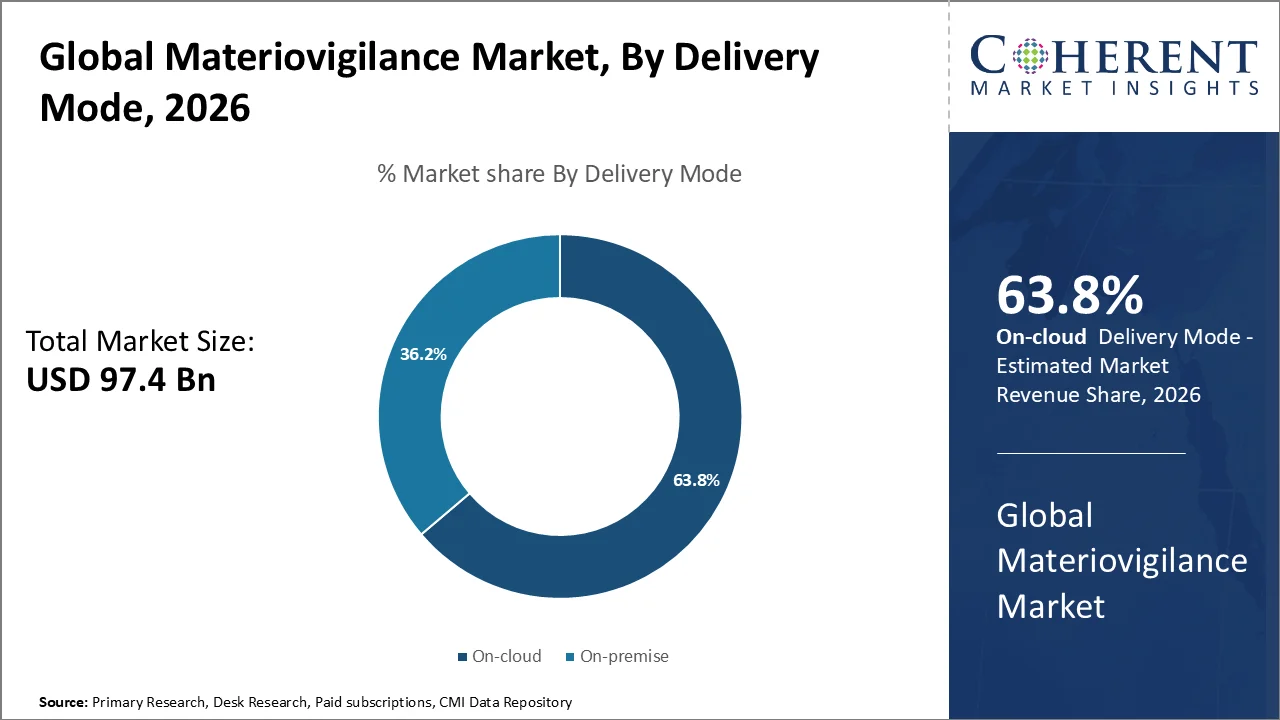
- The on-cloud segment is expected to dominate the market, accounting for 63.8% share in 2026. The segment’s growth is owing to increasing adoption of cloud-based safety surveillance platforms, AI-enabled signal detection tools, real-time adverse event reporting, and lower infrastructure costs. In 2026, the U.S. FDA continues to enhance adverse event monitoring systems such as MAUDE and related modernization initiatives, in line with the growing trend towards digital and cloud-based ecosystems for pharmacovigilance and materiovigilance.
- The therapeutic application segment is predicted to lead with 38.4% in 2026. The segment is expected to grow due to increasing use of cardiovascular devices, infusion pumps, glucose monitoring systems, orthopedic implants, and AI-enabled therapeutic devices that require constant post-market supervision. Therapeutic device monitoring and surveillance is needed as a 2026 Reuters study found 182 recalls for 60 FDA-approved AI-enabled medical devices, with 43% of recalls occurring within 1 year of approval.
- The Original Equipment Manufacturers (OEMs) segment is expected to lead with 44.6% in 2026. The segment growth is fueled by tight post-market surveillance rules, growing regulatory scrutiny, and mandatory adverse event reporting duties. The BMJ reported in 2025 that nearly one-third of medical device manufacturers submitted adverse event reports to the FDA, with 54.8% of the late reports originating from just three manufacturers and 13 devices, highlighting the increasing need for OEMs to enhance their materiovigilance systems and compliance infrastructure.
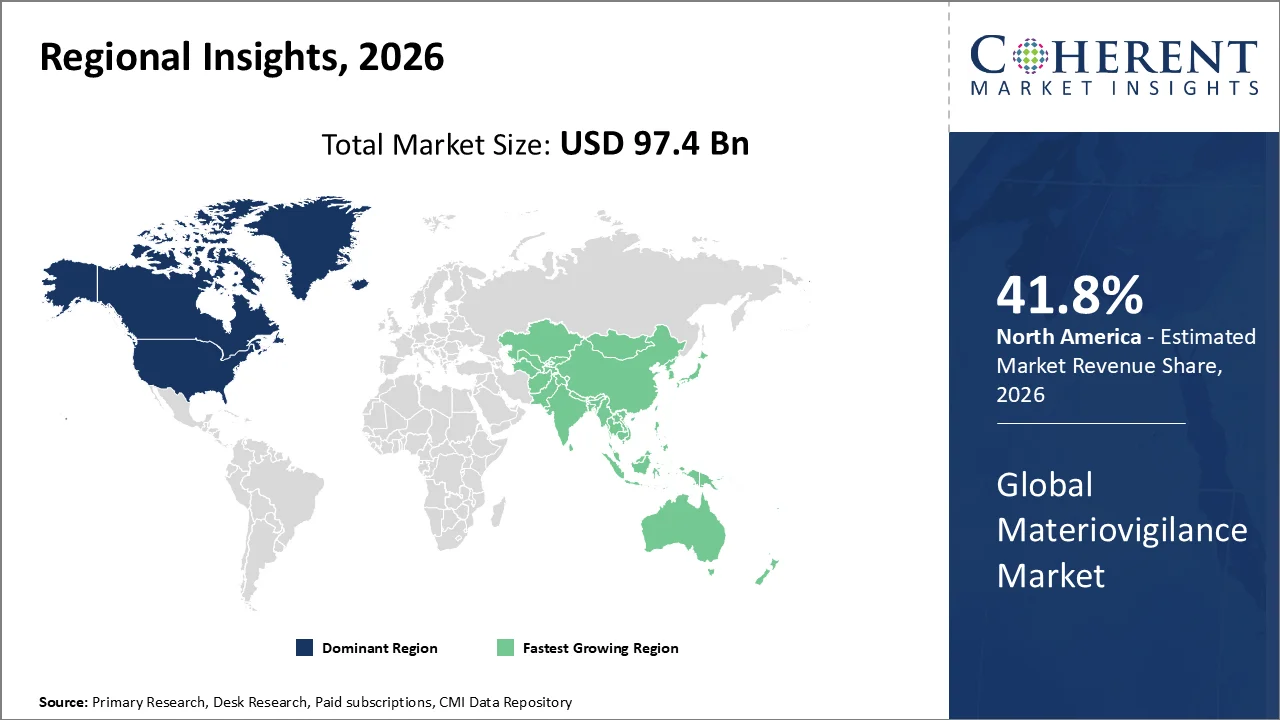
- North America is anticipated to have 41.8% share of the global materiovigilance market by 2026. The region is supported by strong regulatory frameworks, increased use of digital health technologies, rising consumption of medical devices and robust post-market surveillance infrastructure. By February 2026, the U.S. FDA approved 1,357 AI-enabled medical devices, more than double the amount approved through 2022, showing the increasing demand for advanced materiovigilance systems and continued safety monitoring.
Market Drivers
Rising Medical Device Recalls and Safety Events are Accelerating Growth of the Materiovigilance Market
The global materiovigilance market is being driven mostly by the increasing incidence of medical device recalls, adverse occurrences and product safety concerns. As the use of implanted devices, AI-enabled systems, wearable sensors, infusion pumps and cardiovascular devices grows, there is an increased demand for effective post-market surveillance and real-time monitoring of adverse events. Regulatory bodies over the world are demanding more reporting and are encouraging industries to implement proactive risk management frameworks to enhance patient safety.
In September 2025, the Center for Devices and Radiological Health (CDRH) expanded its Communications Pilot to Enhance the Medical Device Recall Program to include all medical devices, allowing the government to issue Early Alerts prior to a formal recall classification. The intent of this endeavor is to allow earlier discussion of potential high risk device problems.
Expansion of Unique Device Identification (UDI) and Digital Traceability is Supporting Materiovigilance Market Growth
The rising adoption of Unique Device Identification (UDI) systems and digital traceability systems would create lucrative prospects for the materiovigilance market. These technologies enhance device tracking, enable quicker recalls, improve signal detection, and promote interoperability between makers, hospitals and regulators. The growing digitalization of healthcare infrastructure is significantly enhancing post-market surveillance capabilities.
According to the FDA states that the Global Unique Device Identification Database (GUDID) is a reference library for all medical devices with a Unique Device Identifier (UDI). The database contains only the Device Identifier (DI) portion of the UDI and has flags for the Production Identifier (PI) that describe the PI attributes for the device. Device labelers can provide information via human data entry or bulk HL7 SPL submissions.
Current Events and Their Impact on the Materiovigilance Market
Current Event | Description and its Impact |
FDA Expansion of Adverse Event Reporting & Early Alert System (2025–2026) |
|
Rising AI-Enabled Medical Device Approvals and Safety Surveillance (2026) |
|
- Current Industry Events of 2026
- Market Size Estimation
- Regional Breakdown
- Competitive Landscape
- Customer Intelligence
- Segmental Analysis
- Pricing Analysis
- Key Market Drivers, Challenges & Future Trends
- Customized Insights Section
Segmental Insights
Why is the On-Cloud Segment Dominating the Materiovigilance Market?
Based on delivery mode, the on-cloud segment is expected to hold the greatest materiovigilance market share of 63.8% in 2026. The growth of this category is driven by increased adoption of cloud-based pharmacovigilance and materiovigilance platforms, AI-enabled signal detection systems, real-time adverse event reporting and scalable infrastructure that decreases operational and IT costs for manufacturers and healthcare providers. Cloud systems also provide seamless integration of regulatory databases including FDA reporting systems, EUDAMED, and hospital electronic health records, boosting traceability and speedier safety decisions.
According to the U.S. FDA’s MAUDE database modernization initiative continues to process millions of medical device adverse event reports annually (over 2 million reports in recent reporting cycles), strengthening the case for scalable cloud infrastructure to efficiently handle increasing safety surveillance data volumes. The rising digitization of regulatory reporting is driving the move to cloud-native materiovigilance systems.
In November 2025, GE HealthCare announced the acquisition of Intelerad, a medical imaging software developer specializing in cloud-based enterprise imaging and SaaS solutions for outpatient and hospital networks.
Why are Therapeutic Devices the Core Focus of Materiovigilance Systems?
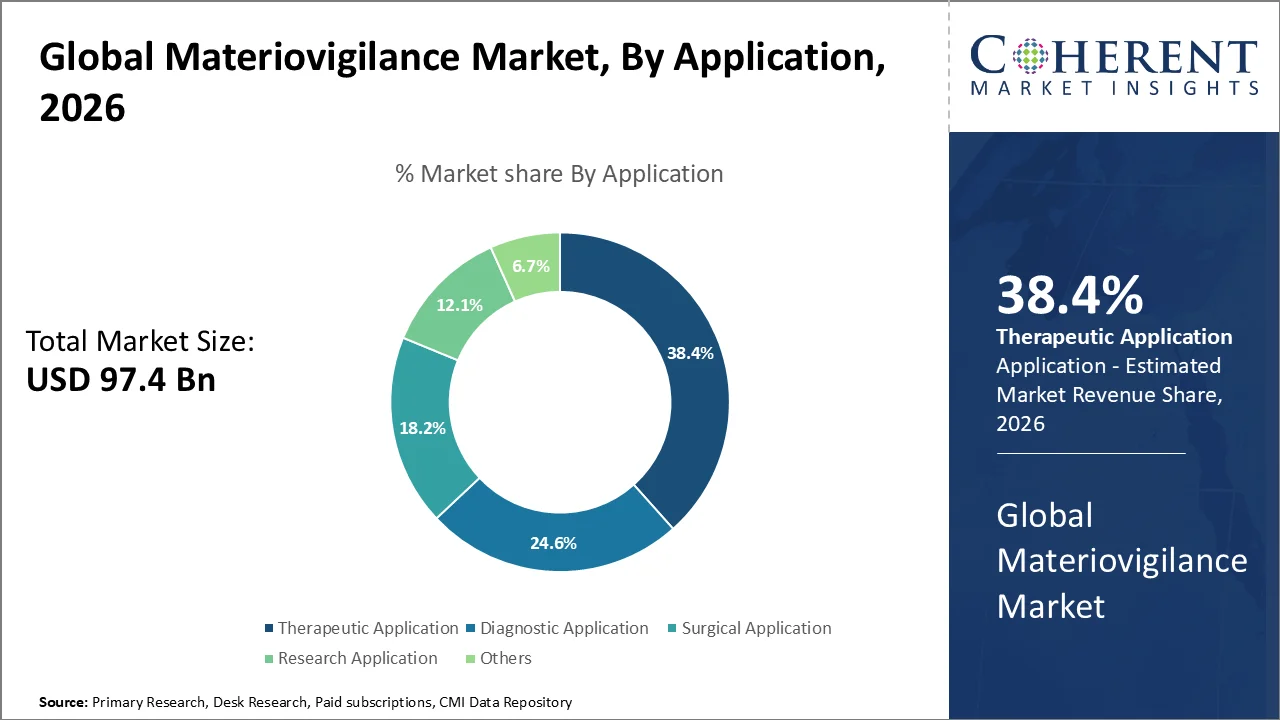
Based on application, the therapeutic application segment is estimated to lead with 38.4% market share in 2026. The growth is mostly attributed to the increasing use of high-risk therapeutic devices such as cardiovascular implants, infusion pumps, insulin delivery systems, orthopedic implants and respiratory support equipment. Due to continuous use, long-term implantation and higher risk of complications, these devices produce the largest number of adverse event reports and need rigorous post-market surveillance and risk management.
According to FDA-adapted MAUDE analysis (updated 2026) revealed that infusion pump devices alone represented more than 1.8 million adverse event reports, including 23,875 incidents of injury and 1,709 deaths, ranking among the most reported therapeutic device categories worldwide.
In April 2026, Philips received FDA permission for its AI-enabled CT imaging system, which is intended to improve diagnostic accuracy and treatment planning in cardiovascular and oncology care pathways.
Why are OEMs the Primary Drivers of Materiovigilance Adoption?
Based on end user, the Original Equipment Manufacturers (OEMs) category is predicted to account for the biggest market of 44.6% in 2026. The segment’s dominance is fueled by strict regulatory requirements for post-market surveillance, obligatory adverse event reporting, and rising global scrutiny from organizations such as FDA, EMA and PMDA. OEMs are responsible for device safety throughout the product lifetime, from design and manufacture to post-market monitoring and recall management.
Additionally, regulatory requirements like the FDA Quality System Regulation (21 CFR Part 820) and the EU Medical Device Regulation (EU MDR 2017/745) mandate that OEMs have continuous post-market surveillance systems, leading to spending on advanced safety monitoring platforms, AI-enabled analytics, and automated compliance solutions.
In November 2025, Zimmer Biomet announced FDA clearance for an upgraded version of its ROSA Knee robotic surgical system, designed for precision-assisted orthopedic procedures.
Materiovigilance Market Trends
- Safety surveillance in hospitals is necessitated by the fact that medical devices malfunction. In a 2026 study in a Materiovigilance Programme of India (MvPI) hospital, 18.75% of the recorded adverse events were related to patient monitors, followed by IV catheters (10%) and syringes (5%). This implies that device-level safety problems are a persistent challenge in clinical practice.
- Regulatory challenges of late adverse event reporting are creating need for automation. Analysis of the FDA MAUDE data in 2025 showed a substantial percentage of manufacturers submitting reports outside of the mandated 30 days reporting window. This adds to the regulatory demand for automated digital reporting systems and real time monitoring capabilities.
- AI is increasingly being used to detect undesirable events and this is boosting the accuracy of signal recognition. New regulatory research in 2025 shows that AI and machine learning are being used more and more to look for trends in adverse event databases, minimize delays in reporting and increase the effectiveness of safety signal identification.
Regional Insights
North America Dominates the Materiovigilance Market Due to Advanced Regulatory Infrastructure and High Device Surveillance Volume
North America is estimated to hold the maximum share of 41.8% of the global materiovigilance market in 2026. The region is supported by a highly developed regulatory ecosystem, high adoption of digital health technologies, high penetration of sophisticated medical devices, and mature post-market surveillance systems such as FDA MAUDE, GUDID, and recall monitoring systems.
According to the U.S. FDA Adverse Event Monitoring System (AEMS) transition data, before consolidation, the agency processed 6 million adverse event reports annually across different FDA safety systems.
Asia Pacific is the Fastest-Growing Region Driven by Expanding Healthcare Infrastructure and Digital Surveillance Adoption
The Asia Pacific region is anticipated to be the fastest growing market in the materiovigilance industry throughout the forecast period. The growth is fueled by increased healthcare expenditure, rapid growth in the manufacturing of medical devices, increasing regulatory harmonization, and strengthening of the national materiovigilance systems in India, China, Japan, and South Korea.
In India, the Materiovigilance Programme of India (MvPI) has made rapid strides, with the number of reported cases of adverse events increasing as more hospitals and medical colleges are being integrated into structured reporting systems. A recent analysis by MvPI found that those orthopedic implants and cardiovascular devices together accounted for a large share of adverse events reported in India, underscoring increased device surveillance activities in the region.
U.S. Materiovigilance Market Trends
The US Materiovigilance Market is growing at a rapid pace due to presence of enhanced regulatory surveillance systems, proliferation of digital health technologies, and rising complexity of medical devices. The expansion is driven by the highly organized post-market surveillance ecosystem in the US FDA including MAUDE, MDR reporting and recall monitoring frameworks which create large-scale real-world device safety data needing advanced analytics and AI-enabled monitoring solutions.
In March 2026, Medtronic expanded FDA clearance of their Stealth AXiS surgical navigation system for cranial and ENT surgeries as well as spinal surgery. The system includes AI-enabled imaging and navigation support during difficult surgical procedures.
China Materiovigilance Market Trends
China’s Materiovigilance Market is growing at an incredible pace owing to healthcare modernization under the leadership of the Chinese government, adoption of innovative medical devices, and increased surveillance over high-risk medical technology products. The National Medical Products Administration in China is improving its framework for surveillance after the market through continuous efforts.
In March 2026, China's National Medical Products Administration (NMPA) approved the world's first invasive brain-computer interface (BCI) medical equipment produced by Neuracle Medical Technology (Shanghai). NEO is a wearable assistive glove that translates brain signals to mechanical movement to recover hand movement in patients with spinal cord injuries.
Who are the Major Companies in Materiovigilance Industry
Some of the major key players in Materiovigilance Market are AssurX, Sparta Systems, Oracle Corporation, Xybion Corporation, Sarjen Systems Pvt. Ltd., MDI Consultants, AB-Cube, QVigilance, Qserve, and ZEINCRO.
Key News
- In January 2026, Oracle announced enhancements to its Oracle Argus Safety platform, integrating AI-driven automation for adverse event intake, case processing, and regulatory reporting across life sciences organizations.
- In May 2025, Sparta Systems (a Honeywell company) expanded its TrackWise Digital Quality Management System (QMS) with enhanced modules for complaint handling, CAPA management, and post-market quality surveillance.
Market Report Scope
Materiovigilance Market Report Coverage
| Report Coverage | Details | ||
|---|---|---|---|
| Base Year: | 2025 | Market Size in 2026: | USD 97.4 Bn |
| Historical Data for: | 2020 To 2024 | Forecast Period: | 2026 To 2033 |
| Forecast Period 2026 to 2033 CAGR: | 8.0% | 2033 Value Projection: | USD 167.0 Bn |
| Geographies covered: |
| ||
| Segments covered: |
| ||
| Companies covered: | AssurX, Sparta Systems, Oracle Corporation, Xybion Corporation, Sarjen Systems Pvt. Ltd., MDI Consultants, AB-Cube, QVigilance, Qserve, and ZEINCRO | ||
| Growth Drivers: |
| ||
| Restraints & Challenges: |
| ||
Analyst Opinion
- The rising use of AI-powered and software-based medical devices is making post-market surveillance much more complicated. According to studies within the industry, medical devices based on artificial intelligence/machine learning technology are some of the most rapidly growing sources of safety alerts issued by regulators.
- Regulatory modernization is fueling need for structured, interoperable surveillance solutions. The FDA’s move to consolidated platforms such as AEMS (Adverse Event Monitoring System) is a move towards consolidated real-time reporting infrastructure to enhance speed, accuracy, and scalability of adverse event analysis.
- Increasing adoption of cloud-based healthcare infrastructure and interoperable device ecosystems is enhancing real-world data gathering. Studies indicate that connected medical devices will considerably improve continuous monitoring, remote diagnostics or early detection of device malfunction, thereby directly promoting the spread of materiovigilance.
- Analyst insight suggests that the materiovigilance industry is evolving toward a predictive, AI-enabled safety ecosystem, where regulatory compliance, real-time monitoring, and automated signal identification are becoming fundamental necessities rather than optional features. The trend is being pushed by escalating device recalls, software-dependent medical technology, and greater global harmonization of safety laws.
Speak to the analyst
Want personalized insights?
Take the findings above to one of our principal consultants, or have the report rebuilt around the segments, geographies and competitors you actually track.
Market Segmentation
- By Delivery Mode (Revenue, USD Bn, 2021-2033)
- On-premise
- On-cloud
- By Application (Revenue, USD Bn, 2021-2033)
- Diagnostic Application
- Therapeutic Application
- Surgical Application
- Research Application
- Others
- By End User (Revenue, USD Bn, 2021-2033)
- Contract Research Organization
- Business Process Outsourcing
- Original Equipment Manufacturers
- Others
- By Region (Revenue, USD Bn, 2021-2033)
- North America
- U.S.
- Canada
- Latin America
- Brazil
- Mexico
- Argentina
- Rest of Latin America
- Europe
- Germany
- U.K.
- France
- Italy
- Spain
- Russia
- Rest of Europe
- Asia Pacific
- China
- India
- Japan
- Australia
- South Korea
- ASEAN
- Rest of Asia Pacific
- Middle East
- GCC
- Israel
- Rest of Middle East
- Africa
- South Africa
- Central Africa
- North Africa
- North America
Sources
Primary Research Interviews
- Medical Device Manufacturers (OEMs)
- Regulatory Affairs Specialists (FDA, EMA, PMDA consultants)
- Pharmacovigilance & Materiovigilance Service Providers
- Hospital Safety & Risk Management Officers
- Quality Assurance & Quality Control (QA/QC) Managers
- Clinical Research Organizations (CROs)
- Post-Market Surveillance (PMS) Consultants
- Healthcare IT & Digital Health Solution Providers
- Others
Databases
- U.S. Food and Drug Administration (FDA – MAUDE, MDR, GUDID databases)
- European Medicines Agency (EMA Eudamed resources)
- World Health Organization (WHO – Global Device Safety Data)
- World Bank Open Data
- OECD Health Statistics
- Others
Magazines
- MedTech Dive
- Fierce MedTech
- Medical Device + Diagnostic Industry (MD+DI)
- Health IT Analytics
- Clinical Leader
- Regulatory Focus (RAPS)
- Others
Journals
- Journal of Medical Devices (ASME)
- Biomedical Engineering Online
- Journal of Clinical Engineering
- IEEE Journal of Biomedical and Health Informatics
- BMC Medical Informatics and Decision Making
- Safety Science Journal
- Others
Newspapers
- Reuters Health
- Bloomberg Health News
- Financial Times – Healthcare Section
- The Wall Street Journal – Health Industry Coverage
- The Economic Times – Healthcare
- Business Standard – Healthcare & Pharma
- Others
Associations
- U.S. Food and Drug Administration (FDA – CDRH)
- European Commission – Medical Device Regulation (MDR) Bodie
- International Medical Device Regulators Forum (IMDRF)
- World Health Organization (WHO)
- Health Level Seven International (HL7)
- Global Medical Technology Alliance (GMTA)
- Others
Public Domain Sources
- FDA Medical Device Reporting (MDR) System
- FDA MAUDE Database
- FDA Unique Device Identification (UDI) System / GUDID
- European Commission Medical Device Coordination Group (MDCG)
- WHO Global Medical Device Nomenclature (GMDN)
- Government of India – Materiovigilance Programme of India (MvPI)
- OECD Health Data Repository
- World Bank Healthcare Indicators
- Others
Proprietary Elements
- CMI Data Analytics Tool
- Proprietary CMI Existing Repository of Information for Last 10 Years
Get access to 250+ pages report
Every segment, forecast, competitor profile and data table behind the analysis above — available for instant download.
- ESOMAR Member
- ISO 9001:2015 Certified
- D-U-N-S Registered
- GDPR & CCPA Compliant
Missing comfort of reading report in your local language? Find your preferred language:
Transform your Strategy with Exclusive Trending Reports
Frequently Asked Questions
The Materiovigilance Market is expected to reach USD 167.0 Bn in 2033.
Major players operating in the global Materiovigilance Market include Oracle Corporation, Sparta Systems (Honeywell), AssurX, Xybion Corporation, Sarjen Systems Pvt. Ltd., AB Cube, QVigilance, Qserve, ZEINCRO, and MDI Consultants.
The high cost of implementing advanced surveillance systems, lack of standardized global reporting frameworks, cybersecurity risks in cloud-based platforms, and integration challenges with legacy healthcare IT systems are key factors hampering market growth.
Rising adoption of medical devices, increasing adverse event reporting volumes, strict regulatory requirements (FDA, EU MDR), growing use of AI-enabled devices, and expansion of cloud-based healthcare infrastructure are driving market growth.
The Materiovigilance Market is anticipated to grow at a CAGR of 8.0% between 2026 and 2033.
North America is expected to account for the largest market share in the global Materiovigilance Market over the forecast period.
Healthcare organizations are adopting materiovigilance systems to ensure patient safety, comply with regulatory requirements, improve adverse event reporting efficiency, and enable real-time monitoring of medical device performance.