

India Geriatric Care Services Market Size and Share Analysis: (2026 - 2033)
The India geriatric care services market size is estimated to reach around USD 50.16 Bn in 2026 and is projected to grow at a CAGR of 10% during the forecast period (2026-2033), totalling USD 97.3 Bn by 2033.
Key Takeaways from the India Geriatric Care Services Market Report
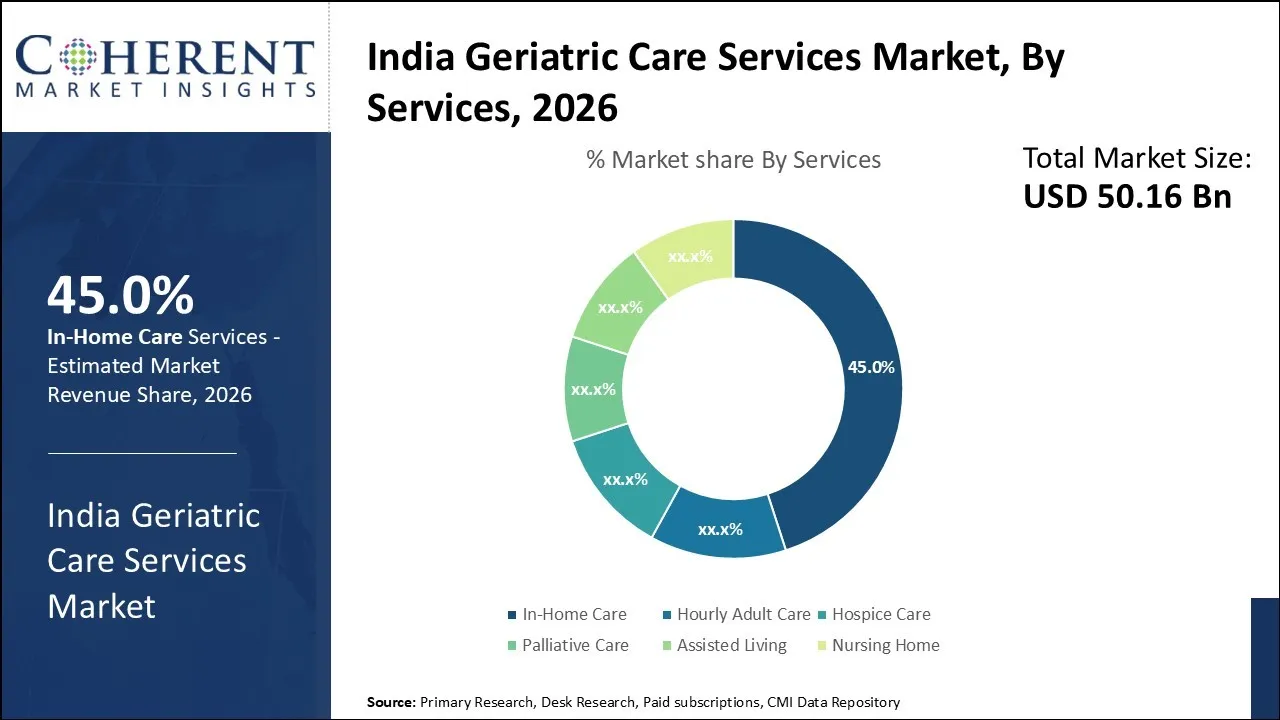
- In-Home Care is expected to remain the most sought-after services, accounting for a market revenue share of 45% in 2026, due to increasing availability of professional home care services.
- By service provider, private segment is slated to dominate the market during the forecast period.
- By disease indication, cancer segment is slated to dominate the market during the forecast period.
India Geriatric Care Services Market Overview
The India Geriatric Care Services Market is witnessing significant growth, fueled by the country’s rapidly aging population, increasing prevalence of chronic diseases among the elderly, and rising awareness regarding geriatric healthcare. This growth is further supported by government initiatives, expanding healthcare infrastructure, and rising disposable incomes among the elderly.
Key trends shaping the Indian geriatric care market include the increasing adoption of technologically integrated solutions such as telemedicine and remote monitoring, expansion of home-based care services, and rising popularity of assisted living and specialized geriatric nursing homes. Furthermore, holistic wellness approaches focusing on mental health, physiotherapy, and nutrition tailored for elderly patients are gaining traction. Digital health platforms and AI-driven diagnostics are poised to transform service delivery, improving accessibility and efficiency.
India's demographic transformation presents a compelling narrative for the expansion of geriatric care services, driven by an unprecedented shift in age distribution and longevity patterns. The nation is experiencing a rapid transition where the elderly population (60+ years) is growing at an accelerated pace compared to younger cohorts. For instance, according to October 2025, PIB reports, India is undergoing a rapid demographic transition, with the elderly population (60 years and above) projected to more than double from100 million in 2011 to 230 million by 2036. This evolution indicates that by 2036, nearly one in seven Indians will be aged 60 years or older, representing a fundamental restructuring of the country's population composition.
Chronic disease management (including diabetes, arthritis, cardiovascular diseases) and post-acute care services represent the most lucrative application segments. Services addressing neurodegenerative disorders such as Alzheimer’s and Parkinson’s disease are expanding rapidly. Preventive care, including routine health check-ups and wellness programs tailored for the elderly, also sees growing demand.
Current Events and Their Impact on the India Geriatric Care Services Market
Current Event | Description and its Impact |
Regulatory and Policy Changes |
|
Technological Advancements and Innovation |
|
Segmental Insights
- Current Industry Events of 2026
- Market Size Estimation
- Regional Breakdown
- Competitive Landscape
- Customer Intelligence
- Segmental Analysis
- Pricing Analysis
- Key Market Drivers, Challenges & Future Trends
- Customized Insights Section
India Geriatric Care Services Market Insights, By Services - In-Home Care Remain Top-Selling Service
Based on service, in-home segment is expected to dominate the market, with a revenue share of about 45% in 2026. This trend is driven by the deeply ingrained cultural preference for family-based care, as well as the comfort and psychological well-being seniors derive from remaining in familiar surroundings.
Hourly Adult Care also constitutes an important subsector within the market, catering specifically to older adults who do not require continuous caregiving but benefit from assistance during specific hours of the day. This segment attracts families balancing work commitments and caregiving responsibilities by providing flexible, modular care solutions tailored to the elder’s fluctuating needs.
India Geriatric Care Services Market Insights, By Service Provider - Private Dominates Service Provider Segment
By service provider, private segment is slated to hold a dominant position in market over the forecast period. the Private segment presently commands the largest share, while the Public segment is emerging as the fastest-growing and increasingly influential contributor in this domain.
Understanding the reasons behind this divergence and the attributes fueling each segment’s performance necessitates a thorough examination of service delivery models, funding mechanisms, accessibility, quality of care, and demographic trends impacting geriatric healthcare across India.
India Geriatric Care Services Market Insights, By Disease Indication - Cancer Dominates Disease Indication Segment
By disease indication, cancer segment is slated to hold a dominant position in market over the forecast period. Cancer contributes the highest share in the market, owing predominantly to several socio-economic and health-related factors that underscore the increasing burden of oncological diseases among the elderly population in India. The growing prevalence of various cancers in the geriatric population, combined with advancements in diagnostic and therapeutic services, has led to a more sustained and expansive demand for specialized care services.
The increasing awareness created by public health campaigns by organizations like the Indian Cancer Society and Tata Memorial Centre has helped improve early detection and screening rates, which in turn increases patient inflow into specialized geriatric cancer care services. Additionally, government programs such as Ayushman Bharat have begun to focus on the accessibility of cancer care for the elderly, further consolidating the segment's leading position.
India Geriatric Care Services Industry News
- In November 2025, BVG India planned to enter the senior living sector. The company aims to launch a new platform called ‘Amrut Anand’ to provide services for older adults. This move marks BVG’s first step into senior care and assisted living.
- In January 2025, Geri Care Health Services, India’s first healthcare company focused on seniors, said that InvAscent, a private equity investor in healthcare and life sciences, has invested INR 110 crore in the company. This is for a small ownership share and is the company’s first big fundraising from investors.
Market Report Scope
India Geriatric Care Services Market Report Coverage
| Report Coverage | Details | ||
|---|---|---|---|
| Base Year: | 2025 | Market Size in 2026: | USD 50.16 Bn |
| Historical Data for: | 2020 To 2024 | Forecast Period: | 2026 To 2033 |
| Forecast Period 2026 to 2033 CAGR: | 10% | 2033 Value Projection: | USD 97.3 Bn |
| Segments covered: |
| ||
| Companies covered: | Emoha Elder Care, AntaraSeniorCare, Nisarg Care, Tata Trust, Ashiana Housing Ltd., Heritage Eldercare Services Pvt. Ltd., ASLI (Association of Senior Living India), Nema Care, Age Ventures India, Piramal Swasthya, Jeevan Suraksha, and Kriti Elder Care | ||
| Growth Drivers: |
| ||
| Restraints & Challenges: |
| ||
India Geriatric Care Services Market Drivers
Rising prevalence of chronic diseases among elderly
The rising prevalence of chronic diseases among India's elderly population is fundamentally reshaping the healthcare landscape and driving unprecedented demand for specialized geriatric care services. The complexity of managing multiple chronic conditions simultaneously among elderly patients has created a specialized niche for geriatric care services that offer integrated, patient-centric approaches.
According to the NITI Ayog, over 75% of elderly people in India have long-term health problems. This shows that there is a big opportunity for home-based care. The home healthcare market in India was worth USD 6.2 billion (₹50,840 crore) in 2020 and is expected to grow to USD 21.3 billion (₹1.74 lakh crore) by 2027.
India Geriatric Care Services Market Drivers
Stringent Government and Law Enforcement Regulations
Strong DUI laws and regulatory mandates in the U.S. and Canada require alcohol and drug testing in specific settings, such as roadside enforcement and safety-sensitive workplaces. This drives demand for portable alcohol and drug abuse testing equipment. Federal and state agencies, as well as public safety programs, routinely deploy portable devices for compliance and monitoring.
Governments and healthcare organizations across North America are running awareness campaigns and increasing funding for substance abuse treatment programs. For example, according to an article published by the PolicyCircle in March 2025, the share of nuclear families in India rose from 56% in 2016 to 58.2% in 2019–21, while the average household size fell from 4.6 to 4.4 members. In southern states, nuclear families already make up nearly 69% of all households.
India Geriatric Care Services Market Trends
Home-based care services gaining popularity
The increasing popularity of home-based care services is significantly reshaping the landscape of India’s geriatric care services market, reflecting broader socio-economic and demographic shifts within the country. This preference is driven by multiple factors including cultural tendencies favoring familial care, the desire for elderly individuals to maintain independence, and the perceived comfort of aging in familiar surroundings. Additionally, the COVID-19 pandemic accelerated this trend as many older adults and their families grew wary of potential health risks associated with communal living environments, thereby boosting demand for home-based care.
India Geriatric Care Services Market Opportunities
Integration of technology and telemedicine in geriatric care
The integration of technology and telemedicine in geriatric care presents a transformative opportunity in India’s rapidly evolving healthcare landscape, especially given the country’s aging population. Telemedicine, powered by advancements in digital health platforms, wearable devices, and remote monitoring tools, can play a pivotal role in bridging the gap between geriatric patients and healthcare providers.
Development of affordable assisted living facilities
The development of affordable assisted living facilities presents a significant opportunity in the Indian geriatric care services market due to the rapidly aging population and the evolving socio-economic landscape. Affordable assisted living facilities, which provide a blend of medical support, daily living assistance, and social engagement at manageable costs, could address this gap effectively.
The socio-demographic transition combined with increasing awareness about elderly rights and healthcare needs also fuels demand for professional and affordable eldercare. Government initiatives such as the National Programme for Health Care of the Elderly (NPHCE) emphasize improving health infrastructure for seniors, but infrastructural and coverage gaps remain wide, especially in semi-urban and rural areas.
Analyst Opinion (Expert Opinion)
- The India Geriatric Care Services Market is witnessing significant shifts driven by the country’s rapidly aging population and increasing life expectancy. As the elderly demographic grows, there is a rising demand for specialized healthcare services tailored to age-related conditions such as dementia, arthritis, and cardiovascular diseases. Urbanization and changing family structures, with nuclear families becoming more prevalent, have further intensified the need for professional geriatric care, as traditional caregiving by extended families diminishes.
- A key driver of market expansion is the increasing awareness among seniors and their families regarding the benefits of professional geriatric care, including home-based care, assisted living, and rehabilitation services. Additionally, government initiatives aimed at improving elderly welfare and healthcare infrastructure add momentum to the sector’s development. However, challenges such as limited trained healthcare professionals specializing in geriatrics and affordability issues in rural areas act as significant restraints.
- Opportunities abound in integrating technology-driven solutions like telemedicine and remote health monitoring, which can enhance access to care in underserved regions. Moreover, private sector participation and healthcare startups focusing on innovative eldercare services represent promising growth avenues.
- Geographically, metropolitan regions such as Mumbai, Delhi, and Bengaluru dominate the market due to better healthcare infrastructure and greater disposable incomes, while tier-2 cities present the fastest-growing segments, reflecting expanding awareness and service penetration beyond major urban centers. Overall, India’s geriatric care services market is poised for robust transformation, driven by demographic trends and evolving healthcare demands.
Speak to the analyst
Want personalized insights?
Take the findings above to one of our principal consultants, or have the report rebuilt around the segments, geographies and competitors you actually track.
India Geriatric Care Services Market Segmentation
- By Services Insights ( Revenue, USD Bn, 2020 - 2033)
- In-Home Care
- Hourly Adult Care
- Hospice Care
- Palliative Care
- Assisted Living
- Nursing Home
- By Service Provider Insights ( Revenue, USD Bn, 2020 - 2033)
- Public
- Private
- By Disease Indication Insights ( Revenue, USD Bn, 2020 - 2033)
- Dementia
- Parkinson’s Disease
- Cancer
- Stroke
- Osteoarthritis
- Others
- Key Players
- Emoha Elder Care
- AntaraSeniorCare
- Nisarg Care
- Tata Trust
- Ashiana Housing Ltd.
- Heritage Eldercare Services Pvt. Ltd.
- ASLI (Association of Senior Living India)
- Nema Care
- Age Ventures India
- Piramal Swasthya
- Jeevan Suraksha
- Kriti Elder Care
Sources
Primary Research interviews
- Healthcare Providers
- Geriatric Care Service Providers
- Healthcare Technology Vendors
- Policy Makers in Healthcare
- Others
Databases
- CMIE (Centre for Monitoring Indian Economy)
- Ministry of Health and Family Welfare Database
- National Sample Survey Office (NSSO)
- Others
Magazines
- Healthcare India Magazine
- Elderly Care Magazine
- India Medical Times
- Gerontology Today
- Others
Journals
- Indian Journal of Gerontology
- Journal of Aging & Social Policy
- Journal of Geriatric Mental Health
- International Journal of Health Care Quality Assurance
- Others
Newspapers
- The Times of India (Health Section)
- The Hindu (Health & Wellness)
- Economic Times (Healthcare)
- Indian Express (Health News)
- Others
Associations
- Indian Association of Geriatric Care
- All India Institute of Medical Sciences (AIIMS) Geriatrics Department
- Indian Council of Medical Research (ICMR)
- National Programme for Health Care of the Elderly (NPHCE)
- Others
Public Domain sources
- Ministry of Health and Family Welfare Reports
- Census of India 2011 & Updates
- WHO Global Ageing Reports
- National Health Portal of India
- Others
Proprietary Elements
- CMI Data Analytics Tool
- Proprietary CMI Existing Repository of information for last 8 years
Get access to 250+ pages report
Every segment, forecast, competitor profile and data table behind the analysis above — available for instant download.
- ESOMAR Member
- ISO 9001:2015 Certified
- D-U-N-S Registered
- GDPR & CCPA Compliant
Missing comfort of reading report in your local language? Find your preferred language:
Transform your Strategy with Exclusive Trending Reports
Frequently Asked Questions
The market is estimated to be valued at USD 50.16 Bn in 2026.
India geriatric care services market value is expected to surpass USD 97.3 Bn by 2033.
The market is poised to exhibit a CAGR of 10% from 2026 to 2033.
Increasing geriatric population and increasing range of services by geriatric care centers are some of the driving factors, which are expected to drive growth of the market.
Lack of geriatric care centers in rural areas
In-Home Care segment, with about 45% market share in 2026, dominates the market.
Emoha Elder Care, AntaraSeniorCare, Nisarg Care, Tata Trust, Ashiana Housing Ltd., Heritage Eldercare Services Pvt. Ltd., ASLI (Association of Senior Living India), Nema Care, Age Ventures India, Piramal Swasthya, Jeevan Suraksha, and Kriti Elder Care are the major players.