

Digital Biomanufacturing Market Size and Share Analysis: 2026 - 2033
The digital biomanufacturing market was valued at USD 2.8 Bn in 2026 and is forecast to reach a value of USD 8.7 Bn by 2033 at a CAGR of 18.5% between 2026 and 2033.
Key Takeaways
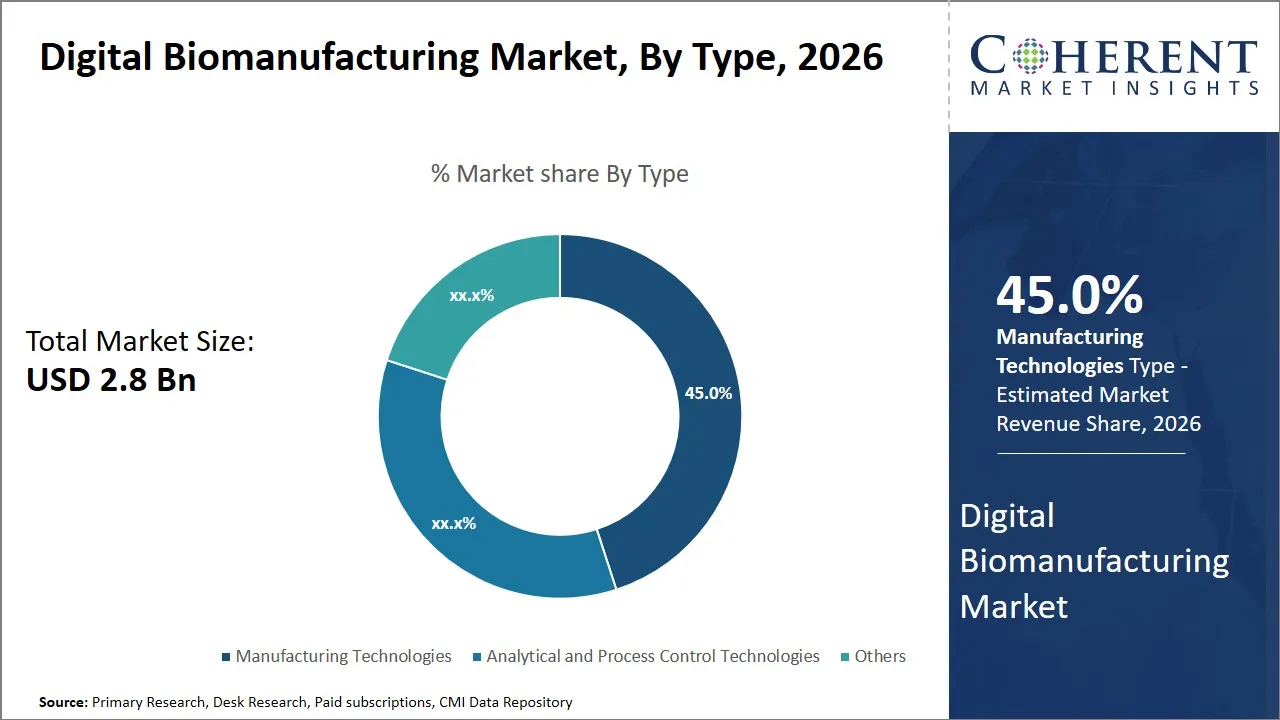
- Based on type, the manufacturing technologies segment is expected to hold 45% share of the market in 2026.
- Based on application, the bioprocess optimization segment is projected to account for 55% share of the market in 2026.
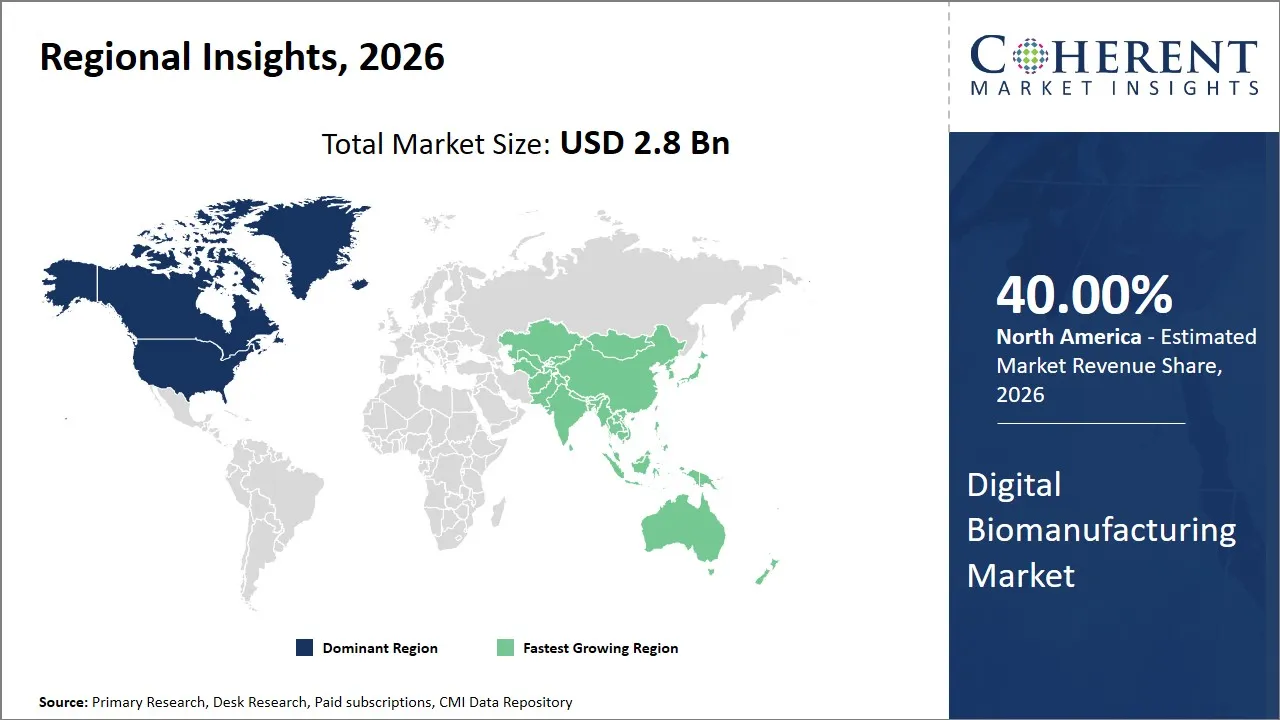
- Based on Region, North America is set to lead the Digital Biomanufacturing market with 40% share in 2026. While, Asia Pacific is anticipated to have the fastest growing region.
Market Overview
Digital biomanufacturing involves the digital technologies to improve the manufacturing process. It helps to enhanced the biological manufacturing by using computer aided design, verification and manufacture. Digital biomanufacturing addresses unique aspects of biological activities and increase the data collection, monitoring, process control algorithms, automation, etc. Advances such as artificial intelligence (AI), automation, and robotics, are changing concepts of manufacturing in general from product development and factory operations to materials supply
Current Events and their Impacts on the Digital Biomanufacturing Market
Current Event | Description and its Impact |
Expansion of Bioprocess Scale-Up Centers and Advanced Biomanufacturing Facilities |
|
Regulatory and Funding Support for Advanced Biomanufacturing Technologies |
|
Segmental Insights
- Current Industry Events of 2026
- Market Size Estimation
- Regional Breakdown
- Competitive Landscape
- Customer Intelligence
- Segmental Analysis
- Pricing Analysis
- Key Market Drivers, Challenges & Future Trends
- Customized Insights Section
Digital Biomanufacturing Market Insights, By Type - Manufacturing technologies represent the largest share in the market
In terms of type, the manufacturing technologies segment is expected to lead the market with 45% share in 2026, owing to their critical role in the core production processes of biomanufactured products. This segment encompasses advanced digital tools and platforms that directly influence the fabrication and synthesis of biologics, cells, and biomaterials. Manufacturing Technologies include automation solutions, digital twins, robotics integration, and high-throughput bioprocessing systems that dramatically improve efficiency, precision, and scalability in biomanufacturing operations.
The adoption of digital manufacturing technologies is widely encouraged and supported by several international non-profit organizations and government bodies focused on advancing biopharmaceutical production, such as the U.S. National Institute of Standards and Technology (NIST) and the International Alliance for Biological Standardization (IABS).
Digital Biomanufacturing Market Insights, By Application - Bioprocess Optimization dominate the market
In terms of application, the bioprocess optimization segment is expected to hold 55% share of the market in 2026. This is because it holds a critical role in improving the efficiency and productivity of biomanufacturing workflows across pharmaceutical, biotech, and industrial biotechnology sectors. The need to optimize complex biological production systems using digital tools comes from the growing demand for precision and cost-effectiveness in producing biologics, vaccines, enzymes, and other bioproducts.
For instance, in March 2026, Sartorius, a life science company, launched a complete system to produce and check the quality of personalized cell therapies, showing how digital tools can improve efficiency and reliability in real-world biomanufacturing.
Regional Insights
North America Digital Biomanufacturing Market Analysis & Trends
North America is expected to dominate the Digital Biomanufacturing market with 40% share in 2026, owing to its advanced infrastructure, well-established biotechnology and pharmaceutical industry, and significant investments in digital transformation technologies. The U.S., being the largest economy within North America, is a pioneer in adopting Industry 4.0 concepts within biomanufacturing, integrating cyber-physical systems, IoT, as well as AI-driven process analytics.
For instance, in May 2025, the American Alliance for Biomanufacturing (AAB) was officially launched to bring together industry leaders focused on advancing innovation, digital technologies, as well as automation in U.S. biomanufacturing. This coalition aims to strengthen the country’s leadership, competitiveness, as well as resilience in the rapidly growing digital biomanufacturing market.
Asia Pacific Digital Biomanufacturing Market Analysis & Trends
Asia Pacific is expected to exhibit the fastest growth, propelled by the region’s expanding bioeconomies, rising healthcare infrastructure investments, and increasing adoption of cutting-edge digital technologies in bioprocessing. Countries such as China, India, and South Korea have experienced a considerable surge in digitalization across their biomanufacturing industries in recent years.
For instance, in November 2025, China moved from planning to action in biomanufacturing. In June, it was reported that the Ministry of Industry and Information Technology (MIIT) and the National Development and Reform Commission (NDRC) had planned to make over 20 pilot biomanufacturing platforms by 2027. These platforms were expected to support more than 200 companies and aid develop over 400 products, including biopharmaceuticals, food additives, cosmetics, chemicals, energy, and enzymes, helping advance digital and automated biomanufacturing in the country.
Digital Biomanufacturing Market Outlook Country-Wise
The U.S. Digital Biomanufacturing Market Trends
The U.S. contributes the highest share in the digital biomanufacturing market owing to its unparalleled infrastructure, technological innovation, as well as established ecosystem for biotechnology and pharmaceutical manufacturing. The country has many big biotech companies, lots of research centers, and government plans that help use digital tools in making medicines.
For instance, in September 2025, the Advanced Research Projects Agency for Health (ARPA-H), part of the U.S. Department of Health and Human Services (HHS), released a new funding program called GIVE. The program aimed to use advanced production technologies to help the U.S. lead in making high-quality genetic medicines.
China Digital Biomanufacturing Market Trends
China contributes the highest share in the digital biomanufacturing market owing to several critical factors that uniquely position it as the leading subsegment. The Chinese strategic focus by government authorities on biotechnology innovation and digital transformation initiatives has propelled the country to the forefront of biomanufacturing advancements. China’s 'Made in China 2025' plan focuses on high-tech industries like biopharma and digital manufacturing. The country is investing a lot to grow medicine-making using digital tools like AI, IoT, and smart data analysis.
Big biopharmaceutical companies like WuXi Biologics use digital systems to make medicines. These systems combine automatic processes with live data checks, which helps them make more products faster and with better quality.
Market Report Scope
Digital Biomanufacturing Market Report Coverage
| Report Coverage | Details | ||
|---|---|---|---|
| Base Year: | 2025 | Market Size in 2026: | USD 2.8 Bn |
| Historical Data for: | 2020 To 2024 | Forecast Period: | 2026 To 2033 |
| Forecast Period 2026 to 2033 CAGR: | 18.5% | 2033 Value Projection: | USD 8.7 Bn |
| Geographies covered: |
| ||
| Segments covered: |
| ||
| Companies covered: | 3M, ABB, Cytiva, Siemens, immersciobio, Sanofi, BIOMÉRIEUX, Agilent Technologies, Inc., GE Healthcare, Culture Biosciences | ||
| Growth Drivers: |
| ||
| Restraints & Challenges: |
| ||
Digital Biomanufacturing Market Driver
Increasing adoption of advanced digital technologies like AI and IoT
The increasing adoption of advanced digital technologies such as Artificial Intelligence (AI) and the Internet of Things (IoT) is significantly accelerating the evolution of the digital biomanufacturing market by enabling smarter, more efficient, and scalable production processes. AI facilitates the optimization of complex biological automation by analyzing large datasets made during bioprocessing, allowing manufacturers to predict outcomes, enhance yield, as well as enhance product quality with unprecedented precision.
Rising demand for personalized medicine
The high demand for personalized medicine is significantly propelling the growth of the digital biomanufacturing market by reshaping how biologics and advanced therapies are developed as well as produced. Personalized medicine, which tailors treatment strategies based on an individual’s genetic profile, lifestyle, or specific disease characteristics, needs highly customizable and flexible manufacturing processes.
Digital Biomanufacturing Market Opportunity
Integration of machine learning for process optimization
The integration of machine learning (ML) for process optimization represents a transformative opportunity within the digital biomanufacturing sector, fundamentally reshaping production efficiency and product quality. By leveraging vast datasets generated throughout biomanufacturing processes, machine learning algorithms can identify complex patterns and predict critical parameters with unprecedented accuracy.
Analyst Opinion (Expert Opinion)
- The digital biomanufacturing market is witnessing significant transformation driven by advancements in digital technologies such as AI, machine learning, and IoT integration within bioprocessing workflows. These technologies enable enhanced process monitoring, automation, along with real-time data analytics, which overall improves product quality, lower manufacturing costs, as well as accelerates time-to-market. A major driver is the high demand for personalized medicine as well as biologics, compelling manufacturers to adopt flexible and scalable digital solutions. Additionally, the growing emphasis on sustainable as well as efficient production processes aligns well with digital biomanufacturing tools that optimize resource utilization.
- However, challenges remain, including high initial capital investment and concerns over data security and regulatory compliance, which may slow the use in certain regions. Furthermore, the complexity of integrating digital platforms with traditional biomanufacturing systems requires skilled personnel, having a barrier for some companies.
- North America is the leader in digital biomanufacturing because it has strong technology, big companies, and supportive rules. At the same time, Asia-Pacific is growing the fastest because it is investing a lot in biopharma, building more healthcare facilities, and creating rules that help use new technologies.
- There are many chances to use digital biomanufacturing in growing countries and for small and medium biopharma companies that want cheaper ways to make medicines. New tools like digital twins and predictive analytics are making it easier to improve manufacturing processes. Overall, digital biomanufacturing is a big step forward in making medicines and could change many areas of healthcare.
Speak to the analyst
Want personalized insights?
Take the findings above to one of our principal consultants, or have the report rebuilt around the segments, geographies and competitors you actually track.
Global Digital Biomanufacturing Market: Key Developments
- In February 2026, PreferCo and Glatt opened a new center in Hyderabad’s Genome Valley to help companies make bioprocesses bigger and better. The new Centre of Excellence (CoE) will work on precise microbial fermentation and help move processes smoothly from lab research to small- and pre-commercial production. This project improves India’s biomanufacturing facilities at an important time, as the country works to turn scientific discoveries into competitive biomanufacturing products.
Market Segmentation
- By Type
- Manufacturing Technologies
- Analytical and Process Control Technologies
- Others
- By Application
- Bioprocess Optimization
- Biomanufacturing Process Automation and Control
- Others
- By Region
- North America
- U.S.
- Canada
- Latin America
- Brazil
- Argentina
- Mexico
- Rest of Latin America
- Europe
- Germany
- U.K.
- Spain
- France
- Italy
- Russia
- Rest of Europe
- Asia Pacific
- China
- India
- Japan
- Australia
- South Korea
- ASEAN
- Rest of Asia Pacific
- Middle East & Africa
- GCC Countries
- Israel
- Rest of Middle East & Africa
- North America
- Key Players
- 3M
- ABB
- Cytiva
- Siemens
- immersciobio
- Sanofi
- BIOMERIEUX
- Agilent Technologies, Inc
- GE Healthcare
- Culture Biosciences
Sources
Primary Research Interviews
- Biomanufacturing Process Engineers
- Digital Transformation Officers in Biotech Firms
- Biopharmaceutical Manufacturing Managers
- Technology Providers in Biomanufacturing Automation
- Others
Databases
- Global Biomanufacturing Data Repository
- IndustryARC
- EvaluatePharma
- Others
Magazines
- BioProcess International
- Genetic Engineering & Biotechnology News
- Pharmaceutical Technology
- Others
Journals
- Journal of Biotechnology
- Biotechnology Advances
- Trends in Biotechnology
- Others
Newspapers
- The Wall Street Journal - Health Section
- Financial Times - Biotech Coverage
- The New York Times - Science Section
- Others
Associations
- International Society for Pharmaceutical Engineering (ISPE)
- Biotechnology Innovation Organization (BIO)
- Parenteral Drug Association (PDA)
- Others
Public Domain Sources
- U.S. Food and Drug Administration (FDA) Reports
- European Medicines Agency (EMA) Publications
- World Health Organization (WHO) Resources
- Others
Proprietary Elements
- CMI Data Analytics Tool
- Proprietary CMI Existing Repository of Information for the Last 8 Years
Get access to 250+ pages report
Every segment, forecast, competitor profile and data table behind the analysis above — available for instant download.
- ESOMAR Member
- ISO 9001:2015 Certified
- D-U-N-S Registered
- GDPR & CCPA Compliant
Missing comfort of reading report in your local language? Find your preferred language:
Transform your Strategy with Exclusive Trending Reports
Frequently Asked Questions
The global Digital Biomanufacturing Market size was valued at USD 2.8 Bn in 2026 and is expected to reach USD 8.7 Bn in 2033.
Major players operating in the market include 3M, ABB, Cytiva, Siemens, immersciobio, Sanofi, BIOMÉRIEUX, Agilent Technologies, Inc., GE Healthcare, Culture Biosciences
Among type, the manufacturing technologies segment estimated significant revenue in 2026.
Emerging role of digital biomanufacturing and expansion of digital biomanufacturing plants are the factors expected to drive the market growth over the forecast period.
The market is estimated to exhibit a CAGR of 18.5% till 2033.
Among region, North America is expected to witness significant growth over the forecast period.