

Healthcare Edi Market Size and Forecast – 2026 to 2033
The Healthcare Edi Market is anticipated to grow at a CAGR of 10.4% with USD 5.3 Bn in 2026 and is expected to reach USD 8.8 Bn in 2033. Healthcare providers are driving EDI market growth by automating claims processing, billing, eligibility verification, and payment transactions. Automated claims processing can reduce cycle times by 50–80%, cutting routine claim processing from 7–10 days to approximately 24–48 hours.
Key Takeaways
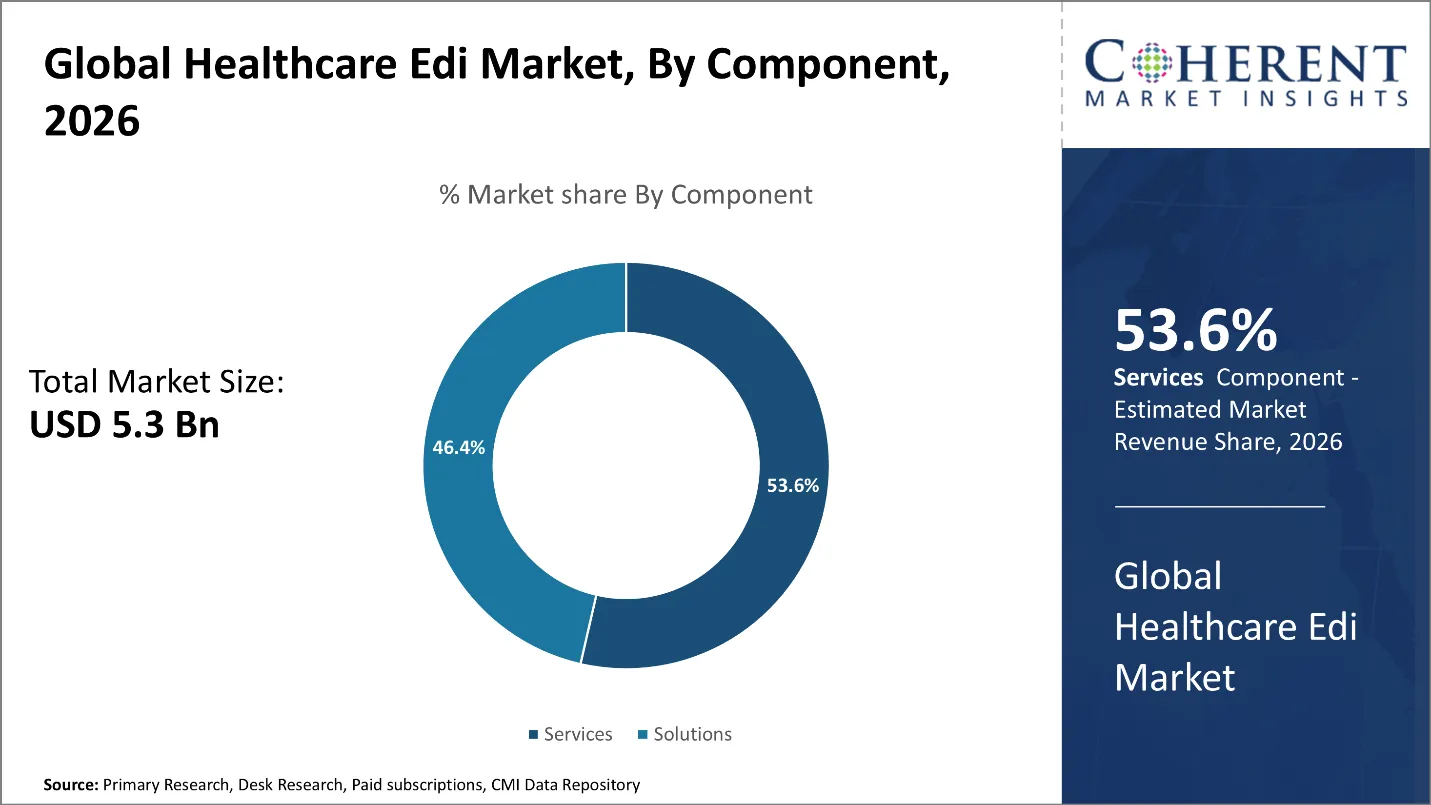
- Services hold the largest market share of 53.6% in 2026 owing to the growing healthcare digitization. Digital health adoption in the United States has reached record levels, with 71.4% of physicians using telehealth services weekly and 86.9% reporting telehealth use overall.
- Web & Cloud-based EDI expected to hold largest market share of 38.8% in 2026 owing to its growing adoption of cloud healthcare IT. In 2022, 88% of healthcare organization (HCO) decision-makers worldwide were adopting cloud technology.
- Claims Management acquired the largest market share of 54.3% in 2026 owing to the increasing healthcare claims volumes. In FY25, health insurance claims in India increased by 21%, while claim payouts rose by only 12.8%.
- Healthcare Providers captures the largest market share of 41.3% in 2026 owing to the reduction in administrative costs.
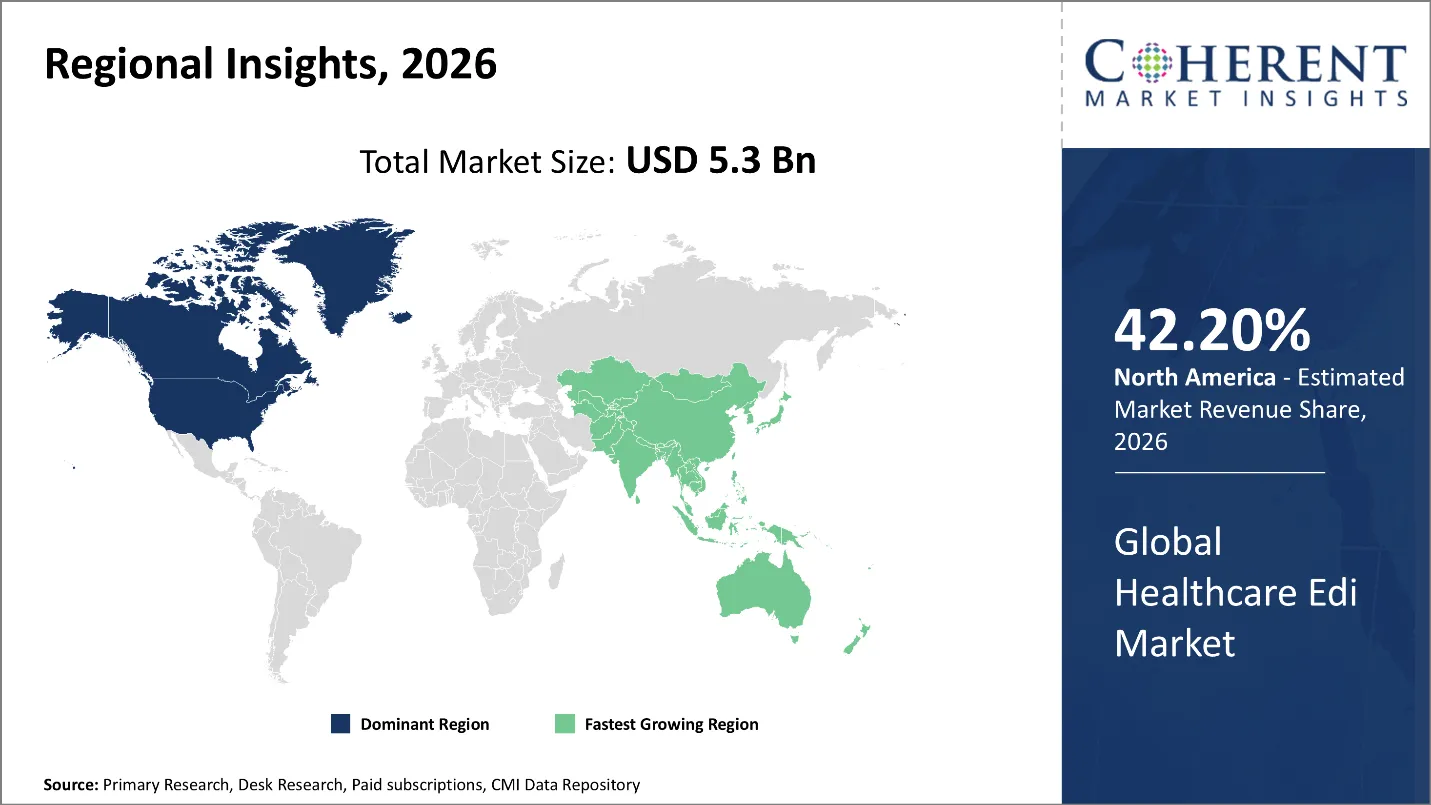
- North America is expected to acquire the dominant share of 42.2% in 2026 owing to the growing demand for interoperability.
Current Events and Their Impact on the Healthcare Edi Market
Current Event | Description and its Impact |
U.S. CMS Finalizes HIPAA Standards for Electronic Claims Attachments — 2026 |
|
CMS Proposes FHIR-Based Standards for Prior Authorization Transactions — 2026 |
|
Segmental Insights
- Current Industry Events of 2026
- Market Size Estimation
- Regional Breakdown
- Competitive Landscape
- Customer Intelligence
- Segmental Analysis
- Pricing Analysis
- Key Market Drivers, Challenges & Future Trends
- Customized Insights Section
Why is Services Acquiring the Largest Market Share?
Services hold the largest market share of 53.6% in 2026. Healthcare organizations drive the services segment of the Healthcare EDI market by adopting solutions that automate administrative transactions, reduce manual work, and improve interoperability among providers, payers, and clearinghouses. Regulatory requirements for standardized electronic transactions further encourage organizations to implement EDI services. Rising volumes of claims, eligibility checks, payments, and authorization transactions increase demand for efficient transaction management. Organizations also use outsourced EDI services to minimize infrastructure and technical-management needs while achieving secure data exchange, faster processing, greater accuracy, and lower administrative workloads. Substrate AI, a provider of Agentic AI solutions for healthcare revenue cycle management, announced the general availability of the Substrate Claim Status Agent. The AI-native solution combines EDI 276/277 transactions, browser agents for payer portals, and direct APIs to deliver a unified claim-status response across more than 3,500 healthcare payers.
Web & Cloud-based EDI expected to hold largest market share
Web & Cloud-based EDI expected to hold largest market share of 38.8% in 2026 owing to its demand for managed services. Healthcare organizations drive the adoption of web and cloud-based EDI by seeking scalable, cost-effective, and secure ways to exchange electronic data with providers, payers, and clearinghouses. They use cloud platforms to automate claims, eligibility, payment, and authorization transactions while reducing manual workloads and infrastructure costs. Regulatory standards encourage organizations to adopt standardized electronic transactions, while growing interoperability requirements increase demand for cloud connectivity. HIPAA EDI transactions are standardized electronic data exchanges that comply with HHS requirements under HIPAA Part 162.
Claims Management acquired the largest market share
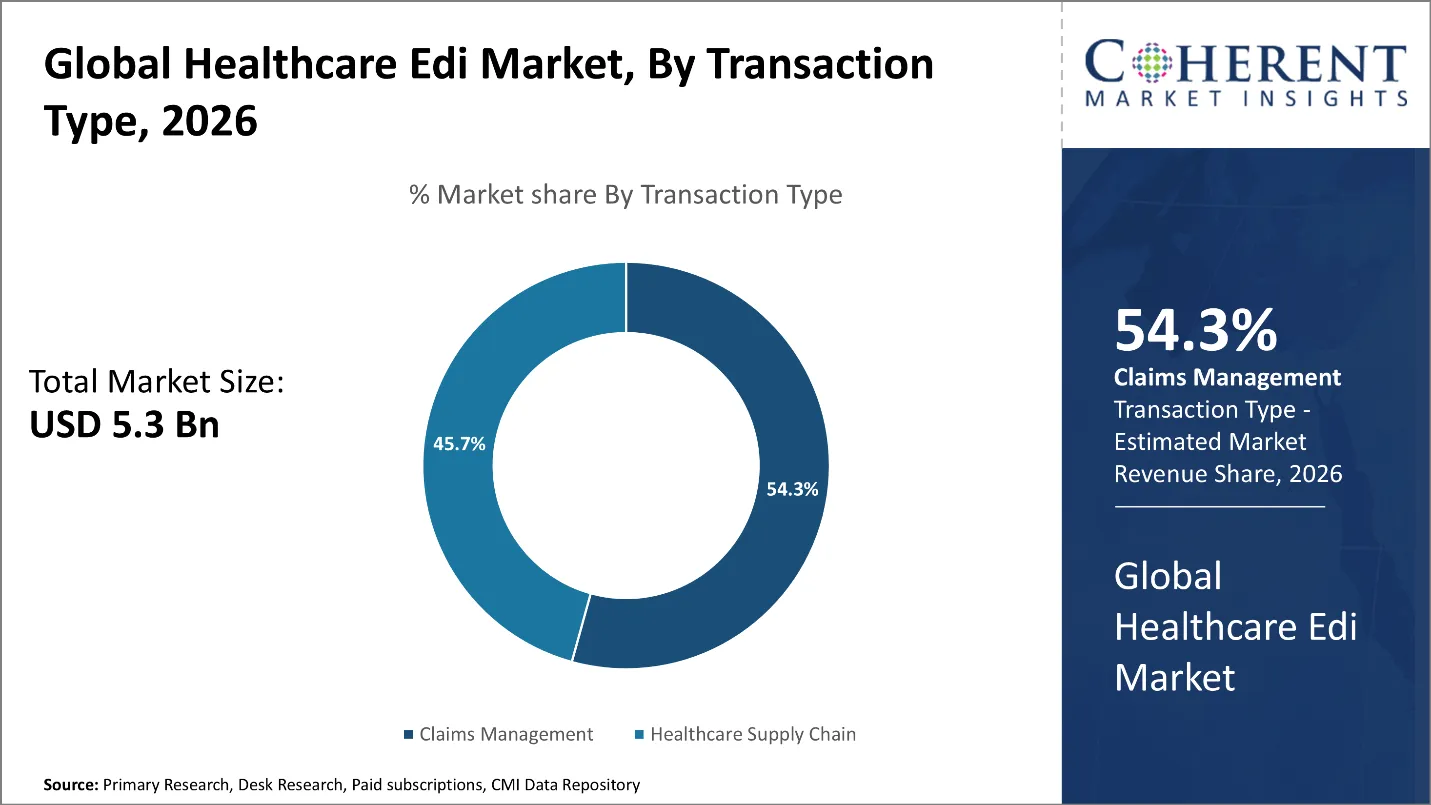
Claims Management acquired the largest market share of 54.3% in 2026 owing to the real-time and near-real-time data exchange. The Healthcare EDI market benefits from increasing demand for efficient and transparent claims workflows. Providers and insurers adopt EDI-enabled claims management to exchange claim information seamlessly, identify discrepancies earlier, accelerate reimbursement, and improve payment reconciliation. The growing complexity of healthcare billing and insurance processes also encourages automation and standardized data exchange. According to WEDI, EDI adoption can reduce administrative costs per claim by approximately USD 1.00 for health plans, $1.49 for physicians, USD 0.86 for hospitals, and USD 0.83 for other healthcare stakeholders. In addition, organizations seek to strengthen revenue-cycle performance, minimize claim rework, and improve coordination between trading partners, making electronic claims management an increasingly important component of healthcare administration.
Healthcare Edi Market Trends
- Growing adoption of electronic healthcare transactions: Electronic claim submission is approaching full adoption in the U.S. medical sector. The 2023 CAQH Index reported 98% electronic adoption for medical claim submissions, while claim volume increased 8% year over year. This continued shift toward electronic transactions supports demand for EDI platforms connecting providers, payers, and clearinghouses.
- Increasing interoperability across healthcare organizations: In 2023, 70% of U.S. non-federal acute care hospitals reported engaging in all four interoperability activities—sending, receiving, finding, and integrating electronic health information—either routinely or sometimes. Routine engagement alone reached 43%, up from 28% in 2018. This broader interoperability infrastructure supports integration between EDI, EHR, payer, and other healthcare systems.
- Greater emphasis on automated administrative processing: The 2024 CAQH Index found measurable time differences between manual and electronic transactions. For example, providers spent an average of 12 minutes on manual eligibility and benefit verification versus 4 minutes electronically, while manual claim-status inquiries averaged 18 minutes compared with 6 minutes electronically. These differences reinforce the role of automation in reducing administrative processing time.
- Expansion of electronic claims attachments: In March 2026, CMS finalized HIPAA standards for electronic healthcare claims attachments and electronic signatures under CMS-0053-F. The standards cover supporting documentation such as medical records, imaging, clinical notes, telemedicine documentation, and laboratory results. This creates a new regulatory requirement for standardized electronic exchange of documentation associated with healthcare claims.
Regional Insights
North America dominates owing to large and mature healthcare IT ecosystem
North America is expected to acquire the dominant share of 42.20% in 2026. North America’s Healthcare EDI market is driven by widespread healthcare IT adoption, established payer-provider networks, and increasing use of electronic transactions. Regulatory standards encourage organizations to exchange healthcare data electronically and consistently. Growing claims volumes and rising demand for efficient revenue-cycle management further support EDI adoption. Healthcare providers and payers also seek to lower administrative costs, accelerate reimbursements, improve interoperability, and reduce transaction errors. Additionally, cloud-based EDI platforms and secure digital healthcare infrastructure are expanding adoption across North America. Ebix launched a Verified Medical Data Platform under its EbixONE AI initiative, enabling healthcare organizations and AI firms to train models using trusted content from A.D.A.M. and Oakstone CME.
Asia Pacific Healthcare Edi Market Trends
Rapid healthcare digitization, expanding hospital networks, broader health insurance coverage, and the need to streamline administrative processes drive the Asia Pacific healthcare EDI market. Governments support EDI adoption by promoting healthcare interoperability and digital infrastructure. Healthcare providers increasingly integrate electronic health records, cloud platforms, and hospital information systems to improve data exchange. In 2024, 91% of office-based physicians and more than 99% of U.S. non-federal acute care hospitals had adopted certified EHRs. Growing patient volumes, rising chronic disease cases, and stronger demand for efficient communication between healthcare providers and payers further encourage organizations across the region to adopt EDI solutions.
United States Healthcare Edi Market Trends
The U.S. healthcare EDI market grows as HIPAA Administrative Simplification rules encourage standardized electronic transactions between healthcare providers, insurers, and clearinghouses. Healthcare organizations increasingly automate claims, eligibility checks, payments, remittance, and prior authorization to streamline operations and reduce administrative workloads. The wider use of electronic health records and interoperability standards also supports EDI adoption. Furthermore, CMS initiatives promoting electronic claims attachments and prior authorization encourage healthcare organizations to adopt secure, standardized, and efficient data exchange solutions. Ontrak Health launched its Ontrak Advanced Engagement System, combining AI with an evidence-based clinical framework to deliver personalized, human-centered member engagement.
Japan Healthcare Edi Market Trends
Japan’s healthcare EDI market is driven by rapid digitalization, government initiatives promoting healthcare interoperability, and the growing need for efficient electronic data exchange. The Healthcare DX roadmap supports standardized electronic medical records, online eligibility verification, electronic prescriptions, and nationwide health-information sharing. Healthcare providers and organizations increasingly adopt EDI to reduce paperwork, streamline administrative processes, enhance data security, and improve communication. Growing connectivity among hospitals, clinics, pharmacies, insurers, and government agencies further supports the adoption of healthcare EDI solutions across Japan.
Who are the Major Companies in Healthcare Edi Industry
Some of the major key players in Healthcare Edi are Optum Inc., Dell Technologies Inc., General Electric Company, Emdeon Inc., The SSI Group, LLC, ZirMed, Inc., Tallan, Inc., Quadax, and Allscripts Healthcare Solutions Inc.
Key News
- In September 2026, Logsync launched PNr.365, a healthcare app that analyzes medicines and supplements for ingredient overlaps and intake precautions while supporting pharmacists with personalized health-management consultations.
Market Report Scope
Healthcare Edi Market Report Coverage
Report Coverage | Details | ||
Base Year: | 2025 | Market Size in 2026: | USD 5.3 Bn |
Historical Data for: | 2020 to 2024 | Forecast Period: | 2026 to 2033 |
Forecast Period 2026 to 2033 CAGR: | 10.4% | 2033 Value Projection: | USD 8.8 Bn |
Geographies covered: |
| ||
Segments covered: |
| ||
Companies covered: | Optum Inc., Dell Technologies Inc., General Electric Company, Emdeon Inc., The SSI Group, LLC, ZirMed, Inc., Tallan, Inc., Quadax, and Allscripts Healthcare Solutions Inc. | ||
Analyst Opinion
- Healthcare EDI is no longer a technology upgrade — it is becoming the operating layer for administrative healthcare. The strongest evidence is the penetration of standardized electronic transactions: in 2024, 98% of medical claim submissions were fully electronic, while eligibility and benefit verification reached 96% and remittance advice reached 89%. This makes basic claims EDI a mature necessity rather than a discretionary IT investment.
- Prior authorization is the biggest unresolved EDI opportunity because the industry has digitized claims far faster than it has digitized utilization management. Only 35% of medical-plan prior authorization transactions were fully electronic in 2024, compared with 98% for claim submission. Even more telling, the remaining workflow is still heavily dependent on portals, phone, fax, and other manual processes. CAQH data shows that prior-authorization volume reached approximately 280 million transactions in 2023, including 90 million electronic, 103 million partially electronic, and 87 million manual transactions.
- The economics of manual healthcare administration are becoming too difficult for providers to ignore. CMS estimates that requesting prior authorization costs providers $20–$50 per hour and consumes an average of 13 hours per week, equivalent to approximately 700 administrative hours per provider annually. That is a powerful commercial argument for EDI automation because the return on investment is no longer limited to faster data transmission; it is tied directly to recovering staff capacity.
- The most attractive EDI growth is moving beyond the claim itself and into the “messy middle” of healthcare administration. Medical claim submission is already 98% fully electronic, leaving relatively little room for transformational adoption gains. By contrast, attachments were only 32% electronic, prior authorization was 35%, and claim payment was 77% in 2024.
- Regulatory standardization is turning electronic prior authorization from a “nice-to-have” into a forced workflow change. CMS requires impacted payers to implement APIs supporting electronic prior authorization, with major API requirements beginning January 1, 2027. CMS also established electronic-prior-authorization reporting requirements and is pushing FHIR-based interoperability into payer-provider workflows.
- The clearest proof that automation still has substantial headroom is the persistence of manual prior authorization despite mature EDI infrastructure elsewhere. In a 2024 AMA survey, nearly 90% of physicians reported that prior authorization interferes with continuity of care, while only 23% reported that their EHR offered electronic prior authorization for prescription medications. This is a striking disconnect: healthcare organizations have highly automated claims submission but still rely extensively on manual intervention for authorization.
Speak to the analyst
Want personalized insights?
Take the findings above to one of our principal consultants, or have the report rebuilt around the segments, geographies and competitors you actually track.
Market Segmentation
- By Component (Revenue, USD Bn, 2021-2033)
- Services
- Solutions
- By Delivery Mode (Revenue, USD Bn, 2021-2033)
- Web & Cloud-based EDI
- EDI VAN
- Point-to-Point EDI
- Mobile EDI
- By Transaction Type (Revenue, USD Bn, 2021-2033)
- Claims Management
- Claims Submission
- Claim Status
- Eligibility Verification
- Payment Remittance
- Referral Certification & Authorization
- Claim Payments
- Others
- Healthcare Supply Chain
- Claims Management
- By End User (Revenue, USD Bn, 2021-2033)
- Healthcare Providers
- Healthcare Payers
- Medical Device & Pharmaceutical Industries
- Pharmacies
- By Region (Revenue, USD Bn, 2021-2033)
- North America
- U.S.
- Canada
- Latin America
- Brazil
- Mexico
- Argentina
- Rest of Latin America
- Europe
- Germany
- U.K.
- France
- Italy
- Spain
- Russia
- Rest of Europe
- Asia Pacific
- China
- India
- Japan
- Australia
- South Korea
- ASEAN
- Rest of Asia Pacific
- Middle East
- GCC
- Israel
- Rest of Middle East
- Africa
- South Africa
- Central Africa
- North Africa
- North America
Sources
Primary Research interviews
- Healthcare providers, hospitals, physician groups, and revenue-cycle management executives
- Healthcare payers and health insurance administrators
- EDI clearinghouses and transaction-processing specialists
- Healthcare IT and interoperability professionals
- EDI solution providers and implementation specialists
- Healthcare billing and claims-management professionals
- Pharmacy and healthcare supply-chain executives
- Information technology and data-exchange decision makers
Databases
- Centers for Medicare & Medicaid Services (CMS) EDI Performance Statistics
- CMS Medicare Electronic Billing & EDI Transactions database
- U.S. Department of Health & Human Services (HHS) administrative simplification and transaction data
- CAQH Index data on electronic healthcare administrative transactions
- U.S. Census Bureau databases
- OECD Health Statistics
- World Health Organization (WHO) Global Health Observatory
- World Bank Health and healthcare-related databases
- National Center for Health Statistics (NCHS)
- Agency for Healthcare Research and Quality (AHRQ) databases
Magazines
- Healthcare IT News
- Health Data Management
- Modern Healthcare
- Becker's Hospital Review
- InformationWeek
- Healthcare Dive
- HIT Consultant
- HealthTech Magazine
Journals
- Journal of the American Medical Informatics Association (JAMIA)
- International Journal of Medical Informatics
- Journal of Medical Systems
- BMC Medical Informatics and Decision Making
- Applied Clinical Informatics
- Journal of Healthcare Information Management
- Health Affairs
- The American Journal of Managed Care
- Journal of the American Medical Association (JAMA)
Newspapers
- The Wall Street Journal
- The New York Times
- Financial Times
- Reuters
- The Washington Post
- The Guardian
- Bloomberg
Associations
- American Hospital Association (AHA)
- American Medical Association (AMA)
- Workgroup for Electronic Data Interchange (WEDI)
- CAQH CORE
- ASC X12
- Healthcare Financial Management Association (HFMA)
- Medical Group Management Association (MGMA)
- National Council for Prescription Drug Programs (NCPDP)
- Healthcare Information and Management Systems Society (HIMSS)
- American Health Information Management Association (AHIMA)
- HL7 International
- National Association of Health Data Organizations (NAHDO)
Public Domain sources
- Centers for Medicare & Medicaid Services (CMS) — EDI transaction standards, Medicare EDI statistics, electronic billing and administrative simplification resources.
- U.S. Department of Health & Human Services (HHS) — HIPAA adopted standards and operating rules, including ASC X12 Version 5010 and NCPDP standards.
- Office of the Assistant Secretary for Planning and Evaluation (ASPE), HHS — healthcare information standards and EDI standards documentation.
- Agency for Healthcare Research and Quality (AHRQ)
- National Center for Health Statistics (NCHS)
- U.S. Food and Drug Administration (FDA)
- U.S. Census Bureau
- U.S. Government Accountability Office (GAO)
- Congressional Research Service (CRS)
- OECD
- World Health Organization (WHO)
- World Bank
- National Institutes of Health (NIH)
- PubMed / National Library of Medicine (NLM)
- Federal Register
- U.S. Government Publishing Office (GPO)
- State health departments and insurance regulators
- CMS Medicare Fee-for-Service EDI Companion Guides, which provide transaction-specific requirements for claims, claim acknowledgments, remittance, claim status, and eligibility transactions.
Proprietary Elements
- CMI Data Analytics Tool
- Proprietary CMI Existing Repository of information for last 10 years
Get access to 250+ pages report
Every segment, forecast, competitor profile and data table behind the analysis above — available for instant download.
- ESOMAR Member
- ISO 9001:2015 Certified
- D-U-N-S Registered
- GDPR & CCPA Compliant
Missing comfort of reading report in your local language? Find your preferred language:
Transform your Strategy with Exclusive Trending Reports
Frequently Asked Questions
Healthcare EDI adoption is primarily driven by the need to automate claims, eligibility verification, payment, remittance, and authorization workflows.
Prior authorization represents one of the largest gaps between healthcare transaction volumes and automation levels. Approximately 280 million prior-authorization transactions were recorded in 2023, with around 87 million still handled manually.
Services account for 53.6% of the market in 2026, reflecting healthcare organizations' preference for outsourced transaction management, monitoring, and technical support.
Web and cloud-based EDI is projected to hold 38.8% share in 2026 because healthcare organizations increasingly require scalable connectivity without maintaining extensive on-premise infrastructure.
Claims Management holds 54.3% share in 2026, reflecting the central role of claims in payer-provider financial workflows.