

IT-enabled Healthcare Market Size and Share Analysis - 2026 To 2033
The IT-enabled Healthcare Market size is anticipated to grow at a CAGR of 14.6% with USD 500 Bn share in 2026 and is expected to reach USD 1,300 Bn in 2033. Driven by the need for cost-efficient care, high-speed digital transformation (telehealth, EHRs), and AI integration. Rising chronic diseases (responsible for 74% of all deaths worldwide) requiring remote monitoring, demand for value-based, patient-centric care, and government initiatives are some of the major factors that are expected to propel growth of the market over the forecast period.
Key Takeaways
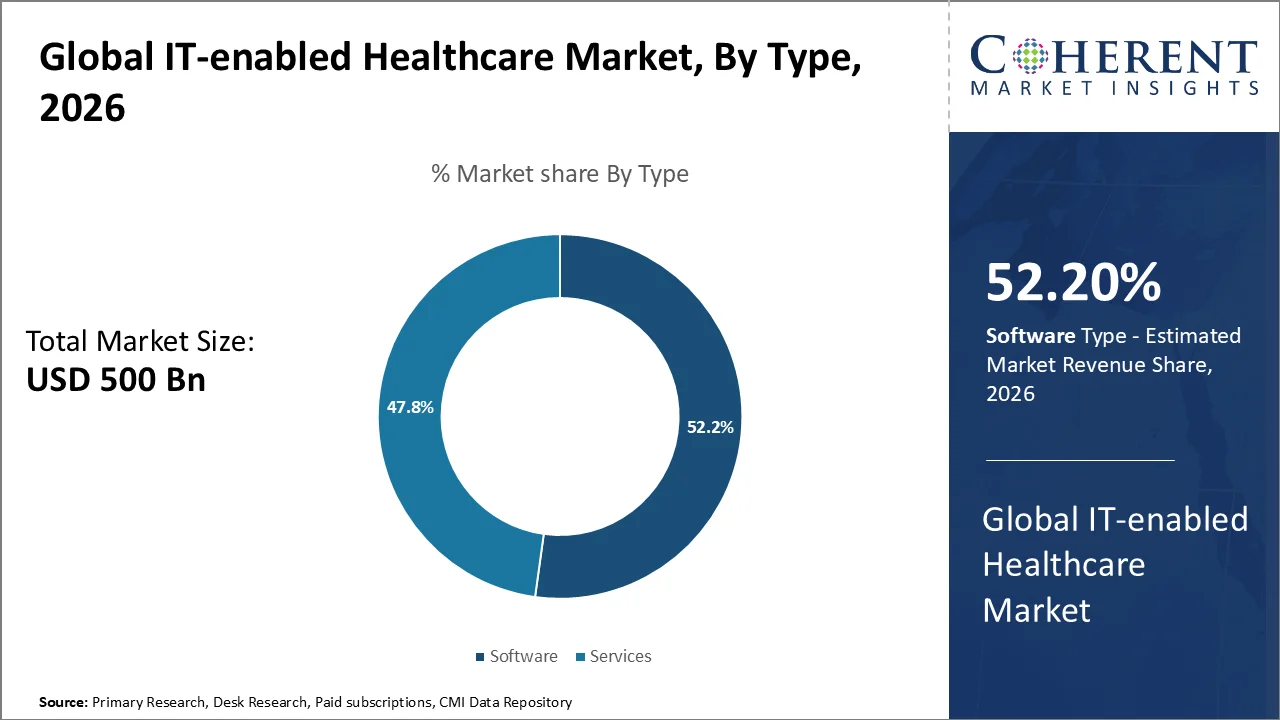
- Software is expected to account the largest share of 52.20% in 2026, due to its critical role in enhancing operational efficiency, improving patient care, and facilitating the transition to digital, value-based care models. Nearly all (96%) non-federal acute care hospitals in the United States had implemented certified electronic health record (EHR) systems.
- Based on End User, Public/Private healthcare institutions will dominate with 70.10% in 2026. Heavy demand for electronic health records (EHRs) to streamline operations, government initiatives to improve digital infrastructure, and the necessity to manage large patient datasets and improve service delivery are some of the factors constituting to segment’s growth. Governments are spending heavily in digital health infrastructure. For instance, in February 2025, India had generated more than 73.98 crore Ayushman Bharat Health Accounts (ABHA) and around 5.64 lakh healthcare professionals were registered.
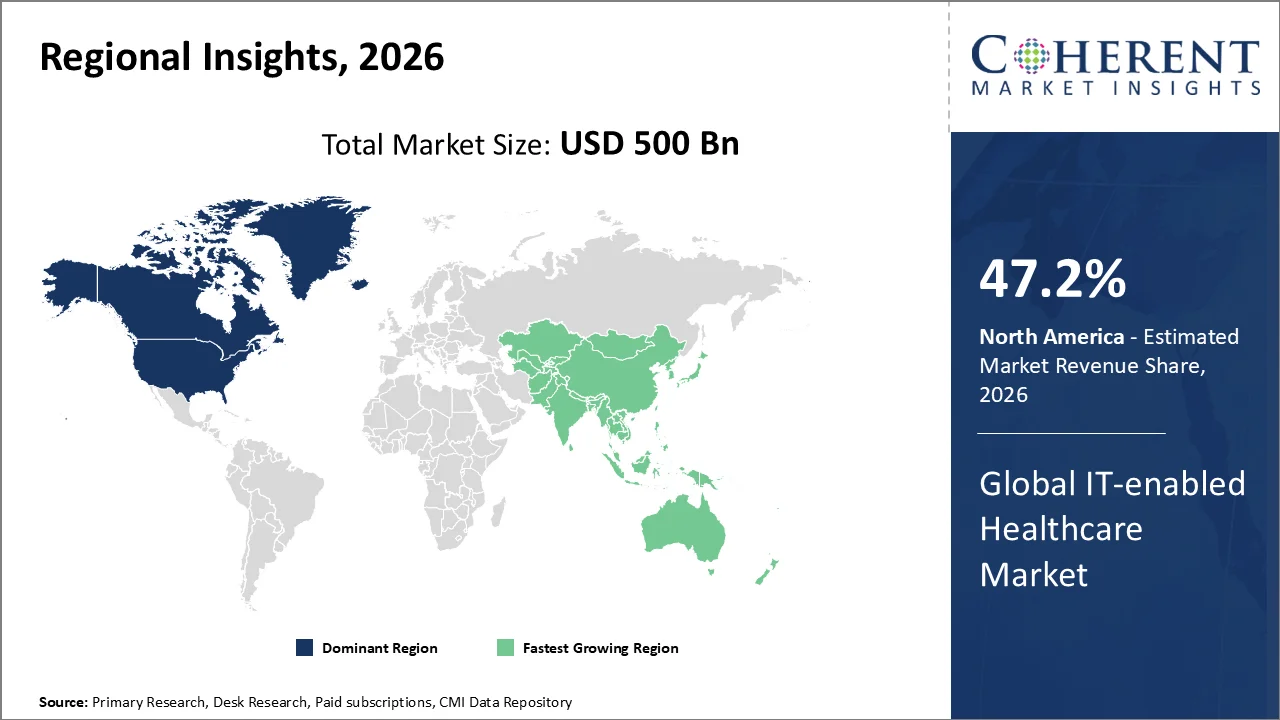
- North America is expected to acquire the dominant share of 47.20% in 2026, backed by cutting edge digital infrastructure, high healthcare IT spending, as well as fast adoption of AI and cloud solutions. In the United States, most hospitals have broadly implemented patient-facing features, with (about 95%) allowing individuals to access their clinical notes electronically and (nearly 92%) delivering secure messaging with healthcare providers.
Segmental Insights
Why is Software Acquiring the Largest Market Share?
Software is projected to account for the largest share of product type in 2026, representing approximately 52.20% of the total volume. The segment’s growth is owing to the rapid adoption of electronic health records (EHR), telemedicine platforms (37.0% of adults used telemedicine in 2021 in the U.S.), healthcare analytics, as well as cloud-based clinical management systems. There is a growing demand for systems that can work together, AI-driven diagnostics, and access to real-time data. The increase is speeding up the incorporation of cutting-edge healthcare software solutions in hospitals, clinics, and other care providers. This trend is also facilitated by the move toward value-based and patient-centric healthcare models.
As per the OECD Health at a Glance 2023 report, 13 out of 17 surveyed countries stated that 95% or more of patients are treated in primary care practices which use electronic medical records (EMRs). The numbers indicate very high adoption levels of the technology. By 2021, more than 93% of primary care practices on average were using EMRs and 11 countries reported full (100%) adoption.
For instance, in March 2026, Amazon announced the launch of Amazon Connect Health, a purpose-built agentic AI solution to handle high volume administrative tasks. These include appointment scheduling, clinical documentation, and medical coding. The solution keeps providers informed as well as in control while delivering proven results across the care continuum.
- Current Industry Events of 2026
- Market Size Estimation
- Regional Breakdown
- Competitive Landscape
- Customer Intelligence
- Segmental Analysis
- Pricing Analysis
- Key Market Drivers, Challenges & Future Trends
- Customized Insights Section
Public/Private Healthcare Institutions holds the Largest Market Share
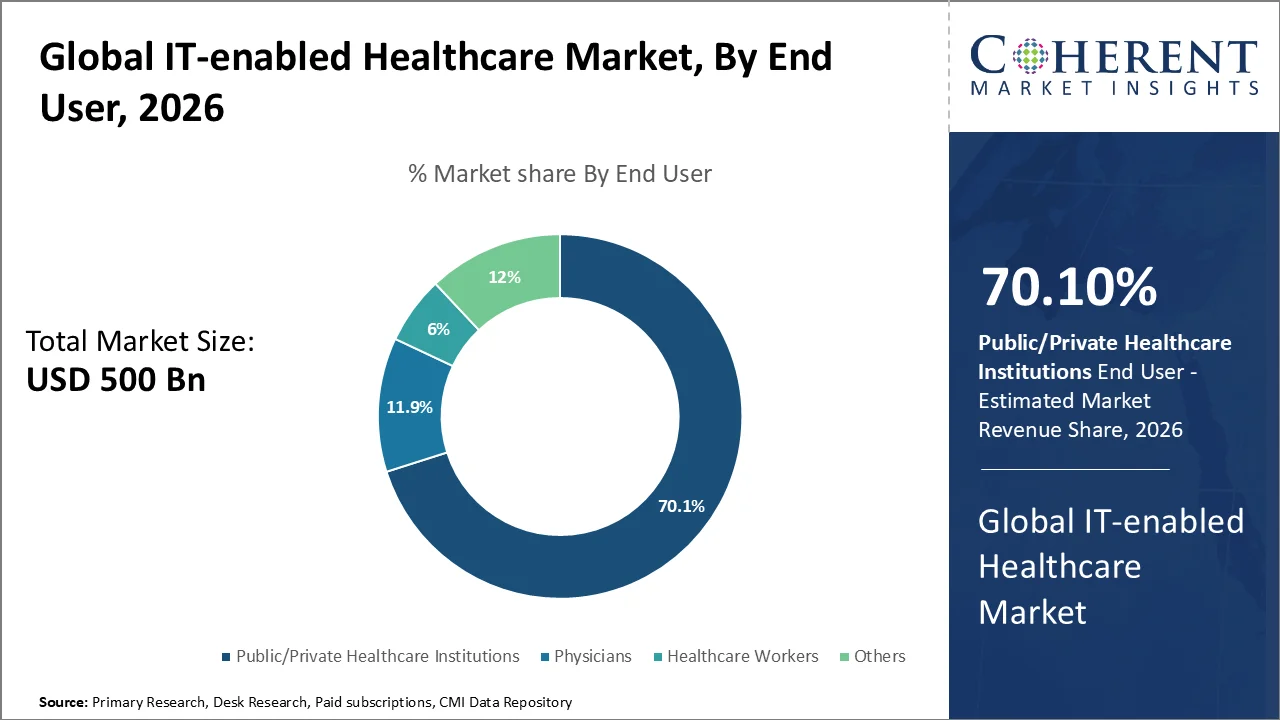
Based on end user, Public/Private healthcare institutions occupy the leading position in the market. They account for a significant 70.10% IT-enabled healthcare market share in 2026. Public/Private healthcare institution have proved themselves as key service delivery points and provided various health services including medical, preventive, and wellness services. These institutions, having a robust infrastructure, capable professionals, and using state of the art healthcare solutions serve a vast range of patients, ranging from routine care seekers to patients requiring specialized and critical treatments, thereby reinforcing their leading position in the market.
In January 2025, Iswarya Hospital was launched in Chennai in a twelve-storey building. It includes 14 operation theatres and 72 clinical service departments. It is also equipped with AI-powered CT and MRI machines, a catheterization lab, advanced surgical facilities. It offers specialized treatments in cardiology, orthopedics, and neurology.
Convergence of Generative AI, Agentic AI, and Advanced Data Analytics: A major breakthrough in IT-enabled Healthcare Market
The integration of generative AI, agentic AI, and advanced data analytics is transforming the IT-enabled healthcare sector by assisting in decision-making based on data analysis in real-time. Generative AI simplifies clinical documentation, summarizes patient records, and supports diagnostic procedures. On the other hand, agentic AI systems autonomously monitor the patients, assist in the management of workflows, and issues alerts for timely interventions. With the use of advanced analytics processes, large amounts of data can be analyzed and used in the prediction of disease risks and the optimization of treatment options. This integration ensures that fewer errors occur, diagnosis is done quickly, costs are reduced, and personalized care is provided. As a result, it leads to more efficient, accurate, as well as proactive healthcare delivery systems which are aimed at better patient outcomes and operational efficiency.
According to the research conducted by McKinsey, as of April 2026, almost half of the surveyed healthcare organizations in the United States reported adopting generative AI and more than 80% have implemented at least one use case. Also, 82% of leaders are anticipating a positive return on their investment in AI.
Current Events and Their Impact on the IT-enabled Healthcare Market
Current Event | Description and its Impact |
Strengthened EU Artificial Intelligence Act Enforcement (2024–2025) |
|
Expansion of the European Health Data Space (EHDS) Framework (2025) |
|
IT-enabled Healthcare Market Trends
- The demand for telehealth services has surged dramatically, with more than 60% patients using video consultations at least once in the past year. Convenience, safety, and improved access are propelling sustained growth in virtual care platforms.
- AI and big data analytics are enabling personalized treatment plans and early disease prediction. More than 70% of healthcare organizations are investing in predictive analytics to improve patient outcomes as well as reduce costs.
- Wearables and IoT health devices (like smartwatches and remote patient monitors) are seeing a 25% annual growth rate. This is backed by chronic disease management and patient demand for real-time health tracking.
- With rising cyber threats, end-to-end encryption, multi-factor authentication, and advanced cybersecurity solutions are now top priorities, and 80% of providers list data privacy as their main technology concern.
- Seamless sharing of health data across platforms and providers is now a must, with interoperability solutions showing a 15%+ yearly increase in adoption due to regulatory mandates and the need for coordinated care.
- Patients are expecting digital-first, user-friendly healthcare experience like mobile appointment booking, access to health records, and personalized health reminders mirroring trends in other consumer industries.
- Migration to cloud infrastructure is growing at a fast rate. The global healthcare cloud computing market is expected to reach double-digit annual growth with organizations seeking scalability, disaster recovery, and cost efficiency.
- Digital pharmacies, online therapy, and remote diagnostics are expanding, with direct-to-patient models capturing 20%+ growth as consumers embrace convenience and control over their care pathways.
Regional Insights
North America dominates owing to Growing prevalence of cataract surgeries
North America account 47.2% market share in 2026, driven by a combination of advanced digital health infrastructure, strong healthcare spending capacity (grew 7.2% to USD 5.3 trillion in 2024), and rapid adoption of next-generation healthcare technologies. One notable factor strengthening the region’s leadership position is the high level of integration of electronic health records (EHRs), telemedicine platforms, and AI-powered clinical decision support systems across hospitals and healthcare networks in the U.S. and Canada.
In addition, increasing regulatory emphasis on data security and interoperability (HIPAA compliance in the United States) has encouraged healthcare providers and technology vendors to invest in secure, scalable, and standardized digital health ecosystems, thereby speeding up market maturity. Another quintessential attribute fueling the segment’s growth is the strong consumer inclination towards accessible, on-demand, and personalized healthcare services, which has propelled the widespread adoption of remote patient monitoring, virtual consultations, and connected care solutions across the region.
According to a recently released AMA survey, physicians’ use of healthcare augmented intelligence (AI) for certain tasks nearly doubled, rising by 78% from 38% within just one year (between 2023 and 2024). It also notes that enthusiasm for the technology is increasing, even though some concerns still remain.
In October 2025, HealthTap, a leading virtual healthcare provider delivering accessible, high-quality primary care, and Samsung Health, have announced a strategic partnership to embed access to virtual primary and urgent care directly into the Samsung Health app.
Asia Pacific IT-enabled Healthcare Market Trends
The Asia Pacific region is poised to be as the fastest-growing region through 2026-2033, driven by rapid digital health adoption, rising internet use (969.10 million internet subscribers by March 2025), and growing healthcare needs across developing economies. One such factor is the vast young population in countries like China, India, and Indonesia. This results in increasing demand for telemedicine, mobile health apps, as well as digital care services.
In addition, rising health awareness and focus on wellness are promoting wider use of digital healthcare tools, thus constituting to the IT-enabled healthcare market growth . In China, a large share of consumers prefers natural and preventive health solutions. This reflects strong demand for wellness-oriented products and increasing interest in digital health engagement.
In India, government support via the Ayushman Bharat Digital Mission (ABDM) and initiatives by the Ministry of AYUSH is strengthening digital healthcare systems and promoting integration of traditional wellness practices with modern healthcare technologies. This is also driving the growth of IT-enabled healthcare solutions across the Asia Pacific region.
Emphasize Digital Health Innovation is Accelerating the IT-enabled Healthcare Market Demand in United States
The American market is seeing strong growth in digital health solutions such as telemedicine, remote patient monitoring, and mobile health apps. This growth is owing to a focus on better access, convenience, and personalized care. The U.S. Department of Health and Human Services (HHS) as well as the Food and Drug Administration (FDA) provide regulations for health data privacy, telehealth services, and approval of certain digital health tools, which helps maintain clear standards in the sector.
The firms like Teladoc Health are witnessing growth as more patients use virtual consultations and digital care services. The U.S. market is also backed by a strong network of health tech startups in innovation hubs like Silicon Valley, Boston, and Austin, where they often partner with hospitals, insurers, and employers. Notable examples include Collective Health and Twin Health in the Bay Area, Kyruus Health and Cohere Health in Boston, and Sana Benefits and Wheel in Austin.
According to Deloitte’s 2026 US Health Care Outlook Survey, around 70% of the healthcare executives surveyed plan to form partnerships with technology or digital companies in 2026.
India IT-enabled Healthcare Market Trends
India is rapidly emerging as a key market for IT-enabled healthcare. This is backed by strong digital adoption, government initiatives like the Ayushman Bharat Digital Mission (ABDM), along with a growing health-tech ecosystem. The country is coming up with an integrated digital health infrastructure which allows efficient exchange of medical records between patients, hospitals, and healthcare providers, thereby improving overall care coordination.
Telemedicine platforms like eSanjeevani have expanded access to healthcare services across urban and rural regions, thus reducing barriers to timely consultation. The growth in the sector is also attributable to the growing smartphone usage (85.5% of households owned at least one smartphone as of early 2026) and improved internet connectivity. These factors are fueling the adoption of online consultations, e-pharmacies, as well as digital health applications.
In January 2025, Innovaccer Inc. raised Rs. 2,356 crore (USD 275 million) in a Series F funding round to scale its Healthcare Intelligence Cloud. The funds are aimed at developing new AI and cloud features, such as copilots and agents for clinical decision support and utilization management, expanding its developer ecosystem, and strengthening collaboration with its 130+ healthcare customers.
Who are the Major Companies in IT-enabled Healthcare Market Industry
Some of the major key players in McKesson Corporation, eHealth Technologies, GE Healthcare, Johnson and Johnson Healthcare Systems, Inc., Aerotel Medical Systems, Ltd., Siemens AG, EHealthLine.Com, Inc., Allscripts Healthcare Solutions, Inc., AT&T Inc., Apple, Inc., MedShift, RxSafe, LLC, Sectra, Wellbeing Software, and AirStrip Technologies LP.
Key News
- In April 2026, the Pension Fund Regulatory and Development Authority (PFRDA) allowed subscribers under ‘NPS Swasthya’, a multi-partner initiative that links retirement savings with healthcare access, to receive coverage for inpatient care and hospitalisation expenses.
- In October 2025, the Purchaser Business Group on Health launched a large data project aimed at helping employers better understand what they are paying for healthcare. The group introduced its Health Care Data Demonstration Project, which uses hospital price transparency data and coverage information to build tools that help employers estimate a “fair price” for healthcare services more accurately.
Market Report Scope
IT-enabled Healthcare Market Report Coverage
| Report Coverage | Details | ||
|---|---|---|---|
| Base Year: | 2025 | Market Size in 2026: | USD 500 Bn |
| Historical Data for: | 2020 To 2024 | Forecast Period: | 2026 To 2033 |
| Forecast Period 2026 to 2033 CAGR: | 14.6% | 2033 Value Projection: | USD 1,300 Bn |
| Geographies covered: |
| ||
| Segments covered: |
| ||
| Companies covered: | McKesson Corporation, eHealth Technologies, GE Healthcare, Johnson and Johnson Healthcare Systems, Inc., Aerotel Medical Systems, Ltd., Siemens AG, EHealthLine.Com, Inc., Allscripts Healthcare Solutions, Inc., AT&T Inc., Apple, Inc., MedShift, RxSafe, LLC, Wellbeing Software, and AirStrip Technologies LP. | ||
| Growth Drivers: |
| ||
| Restraints & Challenges: |
| ||
Analyst Opinion
- The expansion of IT-enabled healthcare is fueled by a real need for accessible, convenient care. In 2025, more than 60% of patients in Brazil and South Africa reported using telehealth services monthly. These statistics show the strong adoption of virtual consultations as well as remote monitoring in emerging markets.
- Tighter data privacy and health IT regulations in the U.S. and Europe are also driving innovation. For example, in 2025, the EU mandated cross-border interoperability for electronic health records. Thus prompting vendors to build secure, standardized data exchange systems, transforming digital health infrastructure.
- Online consultations and digital health app downloads in Southeast Asia jumped by 35% in 2025, propelled by targeted digital advertising and partnerships with local influencers. This shift is enabling fast growth for new telemedicine startups, intensifying competition and speeding up the move toward personalized, patient-centric care.
Speak to the analyst
Want personalized insights?
Take the findings above to one of our principal consultants, or have the report rebuilt around the segments, geographies and competitors you actually track.
Market Segmentation
- By Type
- Software
- Administrative Information Systems (AIS)
- Electronic Medical Record (EMR)
- Nursing Information Systems (NIS)
- Computer Assisted Diagnosis (CAD)
- Ancillary Information Systems
- Others
- Services
- Tele-Health
- Healthcare Diagnostics
- Remote Patient Monitoring
- Healthcare Education
- mHealth
- Software
- By End User
- Public/Private healthcare institutions
- Physicians
- Healthcare workers
- Others
- By Region
- North America
- U.S.
- Canada
- Latin America
- Brazil
- Mexico
- Argentina
- Rest of Latin America
- Europe
- Germany
- U.K.
- France
- Italy
- Spain
- Russia
- Rest of Europe
- Asia Pacific
- China
- India
- Japan
- Australia
- South Korea
- ASEAN
- Rest of Asia Pacific
- Middle East
- GCC
- Israel
- Rest of Middle East
- Africa
- South Africa
- Central Africa
- North Africa
- North America
Sources
Primary Research Interviews
- Healthcare IT Solution Providers
- Hospital CIOs & IT Administrators
- Telemedicine Platform Providers
- Electronic Health Record (EHR) Vendors
- Healthcare Data Analytics Experts
- Digital Health Startups & Innovators
- Medical Device Integration Specialists
- Healthcare Cloud Service Providers
- Others
Databases
- Bloomberg Terminal
- Thomson Reuters Eikon
- IHS Markit
- S&P Global Market Intelligence
- PitchBook
- CB Insights
- Statista Healthcare Database
- Others
Magazines
- Healthcare IT News
- Modern Healthcare Magazine
- HealthTech Magazine
- Digital Health Today
- Healthcare Business & Technology Magazine
- Others
Journals
- Journal of Medical Internet Research (JMIR)
- International Journal of Medical Informatics
- Journal of Healthcare Informatics Research
- IEEE Journal of Biomedical and Health Informatics
- BMC Medical Informatics and Decision Making
- Others
Newspapers
- Financial Times
- The Wall Street Journal
- Reuters
- Bloomberg News
- The Economic Times (Healthcare/IT section)
- Others
Associations
- Healthcare Information and Management Systems Society (HIMSS)
- American Medical Informatics Association (AMIA)
- International Medical Informatics Association (IMIA)
- Digital Health Society
- Healthcare Data & Analytics Association (HDAA)
- Others
Public Domain Sources
- World Health Organization (WHO) – Digital Health Division
- World Bank Open Data (Healthcare & IT indicators)
- National Health Authority (India) – Digital Health Mission (NDHM)
- U.S. Department of Health & Human Services (HHS)
- Centers for Medicare & Medicaid Services (CMS)
- European Commission – eHealth Digital Services
- Others
Proprietary Elements
- CMI Data Analytics Tool
- Proprietary CMI Existing Repository of Information for the Last 8 Years
Get access to 250+ pages report
Every segment, forecast, competitor profile and data table behind the analysis above — available for instant download.
- ESOMAR Member
- ISO 9001:2015 Certified
- D-U-N-S Registered
- GDPR & CCPA Compliant
Missing comfort of reading report in your local language? Find your preferred language:
Transform your Strategy with Exclusive Trending Reports
Frequently Asked Questions
The IT-enabled Healthcare Market is expected to reach USD 1,300 Bn in 2033.
Major players operating in the global IT-enabled Healthcare Market include McKesson Corporation, eHealth Technologies, GE Healthcare, Johnson and Johnson Healthcare Systems, Inc., Aerotel Medical Systems, Ltd., Siemens AG, EHealthLine.Com, Inc., Allscripts Healthcare Solutions, Inc., AT&T Inc., Apple, Inc., MedShift, RxSafe, LLC, Sectra, Wellbeing Software, and AirStrip Technologies LP.
Data privacy and security concerns, particularly regarding patient data, is the major factor that is expected to hamper growth of the market over the forecast period.
urgent need for cost-effective care, widespread adoption of Electronic Health Records is one of the major factors that is expected to propel growth of the market over the forecast period.
The IT-enabled Healthcare Market is anticipated to grow at a CAGR of 14.6% between 2026 and 2033.
Among regions, North America is expected to account for a largest market share in the global IT-enabled Healthcare Market over the forecast period.
Electronic health records (EHR) help hospitals improve efficiency, reduce errors, and enhance care coordination. It delivers quicker, safer, and more personalized care with convenient access to the patient's health information.