

Healthcare Cloud Computing Market Size and Share Analysis- (2026 - 2033)
Healthcare cloud computing market is estimated to be valued at USD 97,365.7 Mn in 2026 and is expected to reach USD 268,586.6 Mn in 2033, exhibiting a compound annual growth rate (CAGR) of 15.6% from 2026 to 2033.
Key Takeaways
- Based on Cloud Deployment, the Public Cloud segment is expected to lead the 47.3% share of the market in 2026.
- Based on Application, the Clinical Information Systems segment is projected to capture 66.9% share of the market in 2026.
- Based on End User, the Healthcare Providers segment is projected to account for 72.4% share of the market in 2026.
- Based on Region, North America is set to lead the healthcare cloud computing market with 41% share in 2026, While, Asia Pacific is anticipated to be the fastest growing region.
Market Overview
The practice of establishing remote computers that can be accessed online to store, manage, and analyze healthcare-related data is known as cloud computing in the industry. This contrasts with setting up a data center on-site with servers or hosting the data on a personal computer. Healthcare-related technology including IoT (Internet of Things) devices, mobile apps, patient portals, electronic medical records, and big data analytics are made possible by the cloud. It offers hassle-free flexibility and scalability, which enhances the final decision-making process
Current Events and Its Impacts on the Healthcare Cloud Computing Market
Current Events | Description and its Impact |
Regulatory and Compliance Transformation Events |
|
AI and Advanced Technology Integration Events |
|
Will Cloud-Native Platforms Redefine Telehealth and Medical Imaging By 2026?
Imaging & AI Integration
- Growth of medical imaging data: Imaging data is growing at a rate of 30–40% per year, so cloud storage and compute must be able to handle it.
- AI diagnostics: By 2026, 70% of AI imaging solutions (radiology, pathology, and ophthalmology) will be available through cloud platforms, which will make on-premise servers insignificant.
- Collaboration in real time: Cloud-native imaging lets radiologists share scans instantly across different locations, which speeds up and improves the accuracy of diagnoses.
Benefits of Being Cloud-Native
- Video consultations in real time: Cloud-native telehealth platforms support low-latency video and safe patient data exchange, which are both essentials for remote care.
- Scalability: During pandemics and other instances of high patient demand, providers can handle it without encountering issues with their infrastructure.
- Interoperability: Cloud systems work with EHRs, billing, and scheduling, which makes things easier for administrators.
- Cost-effectiveness: Switching to the cloud can lower the cost of IT infrastructure by 20–30% while also making disaster recovery and uptime better.
- Current Industry Events of 2026
- Market Size Estimation
- Regional Breakdown
- Competitive Landscape
- Customer Intelligence
- Segmental Analysis
- Pricing Analysis
- Key Market Drivers, Challenges & Future Trends
- Customized Insights Section
Segmental Insights
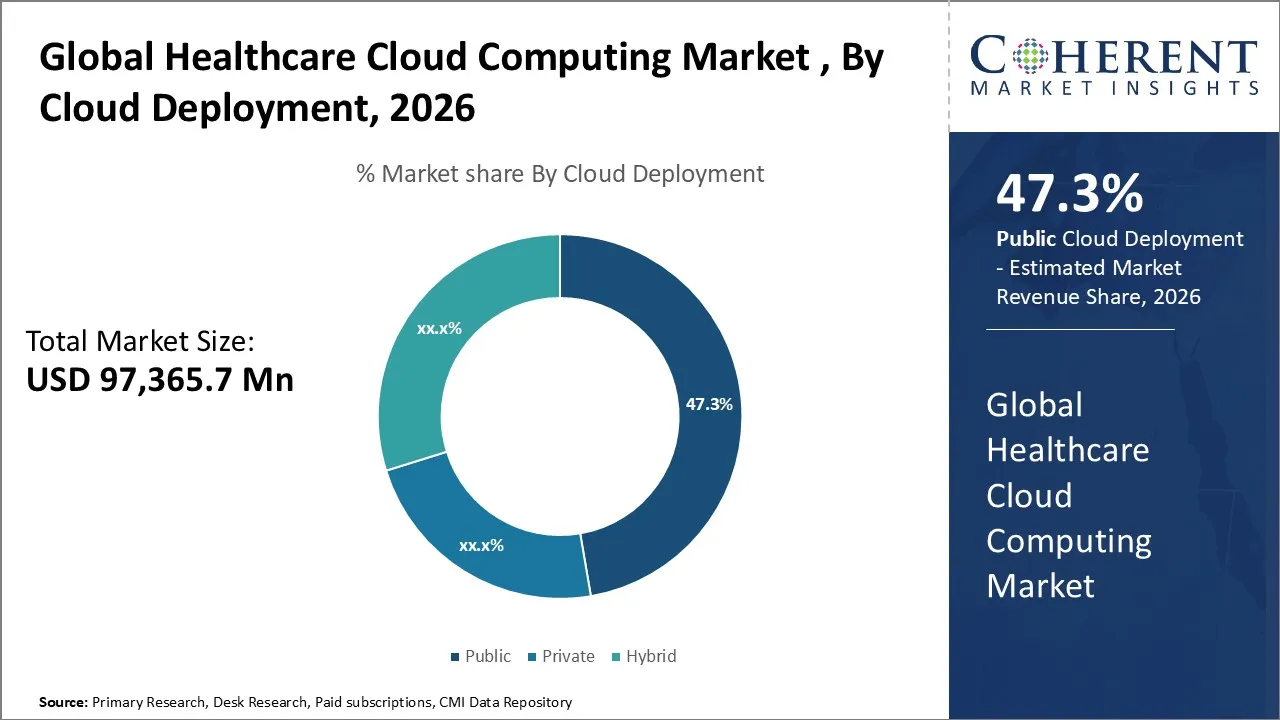
Healthcare Cloud Computing Market Insights, By Cloud Deployment - Public cloud dominates with scalable, cost‑efficient solutions for hospitals and clinics
In terms of cloud deployment, the public cloud segment is expected to lead the 47.3% share of the market in 2026. Its dominance stems from cost efficiency, scalability, and ease of access for hospitals and clinics. Providers like the public cloud for storing electronic health records, enabling telemedicine, and supporting AI-driven diagnostics because it does not require an excessive amount of infrastructure investment.
For instance, in May 2025, The Oracle, Cleveland Clinic, and G42 partnership that was announced in 2025 is focused on creating a global healthcare delivery platform based on AI and powered by Oracle Cloud Infrastructure. This project shows how public cloud is becoming increasingly vital in healthcare by making it possible to manage patient data securely, do advanced analytics, and create digital health solutions that can grow around the world.
Healthcare Cloud Computing Market Insights, By Application - Clinical systems dominate applications by securing patient data and improving care outcomes
In terms of application, the clinical information systems segment is projected to capture 66.9% share of the market in 2026, driven by demand for electronic health records, PACS, and telemedicine platforms. These systems have a direct effect on patient outcomes, following the rules, and coordinating care. They will continue to be the most important application segment because they have significance for safely handling patient data and making clinical decisions in real time.
For instance, the Genesis portfolio from GE Healthcare, which was released in 2025, improves clinical information systems as part of the company's cloud strategy. It accelerates the adoption of digital innovation by focusing on imaging, diagnostics, and AI-enabled workflows. Using cloud computing, Genesis makes it easier for different systems to work together, speeds up deployment, and improves patient care. This makes clinical applications a major player in healthcare cloud computing.
Healthcare Cloud Computing Market Insights, By End User - Healthcare providers lead adoption, using cloud for diagnostics, monitoring, and patient‑centric care
In terms of end user, the healthcare providers segment is projected to account for 72.4% share of the market in 2026. Cloud computing is used by hospitals, clinics, and diagnostic centers to monitor patient data, monitor patients from afar, and help with AI-assisted diagnoses. Providers put cloud solutions at the top of their lists as they want to improve efficiency, patient care, and compliance, making them the top segment.
For instance, in November 2025, the five-year partnership between TCS and NHS Supply Chain uses AI and the cloud to change the manner in which healthcare is delivered. The initiative focuses on providers and modernizes hospital operations, improves patient care, and makes the supply chain more efficient. Cloud computing makes sure that data is safe, can grow, and is always up-to-date. This makes healthcare providers the most likely to use it in 2026.
Regional Insights
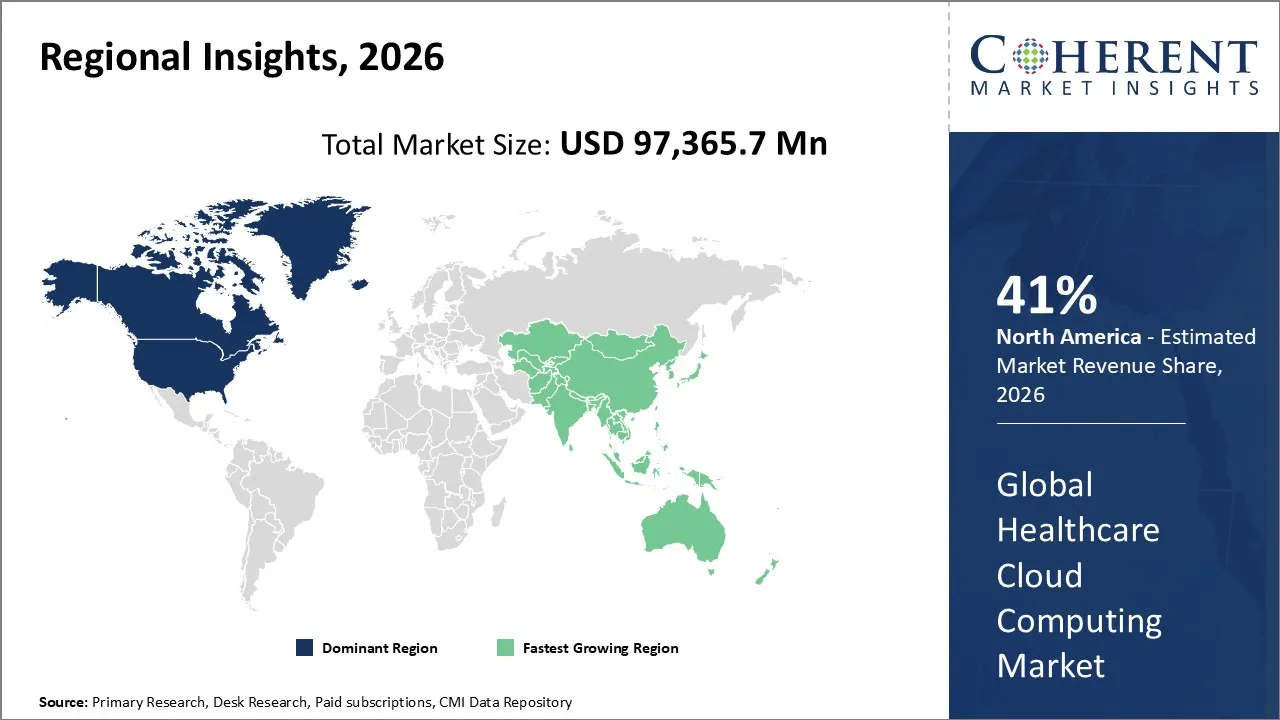
North America Healthcare Cloud Computing Market Analysis & Trends
North America is expected to dominate the healthcare cloud computing market with 41% share in 2026, due to advanced IT infrastructure, strict rules like HIPAA that protect patient data, the widespread use of electronic health records, and the rapid growth of telemedicine. The fact that most major cloud providers are based in the U.S. helps drive innovation, scalability, and fast deployment.
For instance, in October 2025, BD's AI-enabled solutions are going to enhance connectivity in healthcare settings, especially in North America. Using cloud computing, these new technologies combine patient data, make systems work better together, and help AI-driven insights. The project improves the digital healthcare infrastructure, making workflows more scalable, secure, and efficient. It also sets BD up for global growth in cloud-based healthcare.
Asia Pacific Healthcare Cloud Computing Market Analysis & Trends
Asia Pacific is expected to exhibit the fastest growth, owing to government-led digital health initiatives, the quick growth of telemedicine, and a large number of patients who need solutions that can grow with them. The demand is growing even faster because of greater resources going into healthcare IT, more people using smartphones, and better access to healthcare in rural areas. This makes it the fastest-growing regional market.
For instance, by January 2026, HMI Medical will have all of its non-clinical operations on a single AI-powered cloud platform called Workday. The system will make it easier to manage contracts, finances, planning, and the workforce. It will also automate repetitive tasks and give real-time insights, which will improve efficiency, forecasting, and talent management across its healthcare network in Southeast Asia.
Healthcare Cloud Computing Market Outlook Country-Wise
The U.S. Healthcare Cloud Computing Market Trends
The U.S. healthcare cloud computing market will be highly competitive in 2026 because more people are using electronic health records, telemedicine, and AI-driven analytics. Providers want platforms that can grow with their needs, are safe, and monitor patient data, make billing easier, and make sure they are following the rules.
For instance, in November 2025, the goal of the partnership between PwC and AWS is to use AI and the cloud to transform the way healthcare revenue cycle management works. The project is based in North America and updates providers' billing, claims, and financial processes. By using AWS's public cloud, it makes healthcare cloud computing's role in administrative innovation stronger by improving efficiency, scalability, and compliance.
China Healthcare Cloud Computing Market Trends
In 2026, China's healthcare cloud computing market will be highly profitable as more people are using digital health, the government is supporting smart hospitals, and AI is being used steadily for diagnostics. The need for secure, scalable data platforms, more patients, and the growth of telemedicine all drive demand. This makes sure that healthcare systems are efficient, compliant, and innovative.
For instance, in January 2026, Bupa and Tencent have started Hong Kong's first palm-based check-in service to make healthcare better. Patients can easily and safely get services with a simple palm scan thanks to biometric technology. The new technology makes registration easier, boosts productivity, and makes data more secure. This is a big step forward in the digital transformation of healthcare.
Market Report Scope
Healthcare Cloud Computing Market Report Coverage
| Report Coverage | Details | ||
|---|---|---|---|
| Base Year: | 2025 | Market Size in 2026: | USD 97,365.7 Mn |
| Historical Data for: | 2020 To 2024 | Forecast Period: | 2026 To 2033 |
| Forecast Period 2026 to 2033 CAGR: | 15.6% | 2033 Value Projection: | USD 268,586.6 Mn |
| Geographies covered: |
| ||
| Segments covered: |
| ||
| Companies covered: | IBM Corporation, Athenahealth, Siemens Healthcare GmbH, Koninklijke Philips NV, Allscripts Healthcare Solutions, Fujifilm Holdings, General Electric Company, AGFA Healthcare, Carestream Health, Inc., and Carecloud Corporation | ||
| Growth Drivers: |
| ||
| Restraints & Challenges: |
| ||
Healthcare Cloud Computing Market Driver
AI & Big Data Integration
Cloud computing gives healthcare organizations the tools they need to use AI and big data for predictive analytics, which leads to better patient outcomes and personalized medicine. AI-powered tools help doctors make better decisions, and big data helps manage population health and cut costs. By adding these technologies to scalable cloud infrastructures, providers get useful information that helps them be more efficient and come up with new ideas. The Healthcare Cloud Computing Market demand is growing because increasingly more organizations are using AI-powered solutions to improve care and make operations run more smoothly.
In September 2025, Oracle Health launched the Oracle AI Center of Excellence for Healthcare to support organizations in leveraging rapid advances in AI.
Healthcare Cloud Computing Market Opportunity
Interoperability & Data Integration
Cloud solutions are revolutionizing healthcare by enabling seamless data exchange across electronic health records (EHRs), laboratories, imaging systems, and payer platforms. This interoperability makes sure that patient information moves safely and quickly between different parties, which cuts down on fragmentation in healthcare delivery. Cloud platforms help providers make better decisions by breaking down silos. As integration becomes more important, the Healthcare Cloud Computing Market forecast shows that vendors who offer advanced interoperability solutions have an extensive amount of room to grow.
Analyst Opinion (Expert Opinion)
- The healthcare cloud computing market is undergoing pronounced expansion, driven by the broad adoption of digital health technologies and the increasing volume of clinical and administrative data managed by healthcare organizations. Several individuals use cloud solutions to store, process, and share electronic health records (EHRs), support telehealth platforms, and perform advanced analytics for managing population health and predicting care needs. EHR and clinical information systems are still important applications as they are the building blocks for sharing patient data and coordinating care. Hospitals are a major end-use segment because they handle an extensive amount of data and offer a considerable number of different services.
- North America is the largest market contributor in terms of regional dynamics, due to cloud-enabled healthcare IT infrastructure is widely used and there is a strong network of technology providers and health systems. As investments in healthcare digitization and cloud readiness rise in major economies, the Asia-Pacific region is becoming a rapidly growing market. In practice, public, private, and hybrid cloud models all exist at the same time. Hybrid configurations are becoming more popular as companies look for the scalability of public resources and the data governance controls of private environments.
- Trends in service adoption indicate that Software-as-a-Service (SaaS) models are becoming more popular. These models make IT less complicated and allow for iterative improvements to applications without the need for heavy on-premises maintenance. Infrastructure-as-a-Service and Platform-as-a-Service are also becoming more important as health systems want cloud environments that are faster and more customizable. The growing focus on making data easier to access, work with, and follow the rules is speeding up the move to the cloud for healthcare providers, payers, and life sciences organizations.
Speak to the analyst
Want personalized insights?
Take the findings above to one of our principal consultants, or have the report rebuilt around the segments, geographies and competitors you actually track.
Global Healthcare Cloud Computing Market: Key Developments
- In November 2025, Hoppr has released its AI Foundry, a safe and scalable platform that will accelerate the development of AI in medical imaging. The solution allows researchers and healthcare providers build, test, and deploy AI models more quickly, which makes medical imaging more accurate, efficient, and innovative.
- In June 2025, Amazon is investing $10 billion in North Carolina to improve the AWS cloud infrastructure and make progress in AI. The project will create 500 high-skilled jobs and support thousands more in the supply chain. It will additionally provide funding for training, STEM education, and community development, making the state a stronger technology hub.
Market Segmentation
- By Cloud Deployment
- Public
- Private
- Hybrid
- By Offerings
- Services
- Platform as a service (Paas)
- Infrastructure as a service (IaaS)
- Software as a service (Saas)
- Hardware
- Services
- By Application
- Clinical Information System
- Non-clinical Information System
- By End User
- Healthcare Providers
- Healthcare Payers
- By Region
- North America
- U.S.
- Canada
- Latin America
- Brazil
- Argentina
- Mexico
- Rest of Latin America
- Europe
- Germany
- U.K.
- Spain
- France
- Italy
- Russia
- Rest of Europe
- Asia Pacific
- China
- India
- Japan
- Australia
- South Korea
- ASEAN
- Rest of Asia Pacific
- Middle East & Africa
- GCC Countries
- Israel
- Rest of Middle East & Africa
- North America
- Key Players
- IBM Corporation
- Athenahealth
- Siemens Healthcare GmbH
- Koninklijke Philips NV
- Allscripts Healthcare Solutions
- Fujifilm Holdings
- General Electric Company
- AGFA Healthcare
- Carestream Health, Inc.
- Carecloud Corporation
Sources
Primary Research Interviews
- Healthcare IT Solution Providers
- Cloud Service Providers (CSPs) for Healthcare
- Hospital & Clinic IT Departments
- Healthcare Data Security Consultants
- Medical Device Cloud Integration Specialists
- Others
Databases
- Bloomberg Terminal
- Thomson Reuters Eikon
- IHS Markit
- Euromonitor International
- Others
Magazines
- Healthcare IT News
- MHealth Intelligence
- Health Data Management
- Modern Healthcare
- Others
Journals
- Journal of Medical Internet Research
- International Journal of Medical Informatics
- Healthcare Informatics Research
- Health Systems Journal
- Others
Newspapers
- Financial Times
- The Wall Street Journal
- Reuters
- Bloomberg News
- Others
Associations
- Healthcare Information and Management Systems Society (HIMSS)
- American Health Information Management Association (AHIMA)
- International Society for Telemedicine & eHealth (ISfTeH)
- Healthcare Information Technology Standards Panel (HITSP)
- Others
Public Domain Sources
- U.S. Department of Health & Human Services (HHS)
- World Health Organization (WHO)
- Centers for Medicare & Medicaid Services (CMS)
- National Institutes of Health (NIH)
- European Commission – Health & Digital Policy
- Others
Proprietary Elements
- CMI Data Analytics Tool
- Proprietary CMI Existing Repository of Information for the Last 8 Years
Get access to 250+ pages report
Every segment, forecast, competitor profile and data table behind the analysis above — available for instant download.
- ESOMAR Member
- ISO 9001:2015 Certified
- D-U-N-S Registered
- GDPR & CCPA Compliant
Missing comfort of reading report in your local language? Find your preferred language:
Transform your Strategy with Exclusive Trending Reports
Frequently Asked Questions
Healthcare cloud computing market is estimated to be valued at USD 97,365.7 Mn in 2026 and is expected to reach USD 268,586.6 Mn in 2033.
Telehealth & remote patient monitoring AI & big data integration are expected to drive the market growth.
Public is the leading offerings segment in the market.
The major factor hampering the market growth include data security & privacy concerns.
Major players operating in the market include IBM Corporation, Athenahealth, Siemens Healthcare GmbH, Koninklijke Philips NV, Allscripts Healthcare Solutions, Fujifilm Holdings, General Electric Company, AGFA Healthcare, Carestream Health, Inc., and Carecloud Corporation.