

Veterinary Telemedicine Market Size and Share Analysis- Growth Trends and Forecasts (2026-2033)
The Veterinary Telemedicine Market size is anticipated to grow at a CAGR of 19.1% with USD 500 Mn in 2026 and is expected to reach USD 1,700 Mn in 2033. The primary drivers are largely defined by rising pet ownership, expanding companion-animal healthcare spending, limited access to veterinarians in rural and after-hours settings, and growing use of video consultation, teletriage, e-prescription support, and remote follow-up in veterinary practices. Veterinary telemedicine enables licensed veterinarians to deliver medical advice through digital communication when a valid VCPR exists. AVMA notes telemedicine should be used within an established VCPR. In the U.S., APPA reports 95 million pet-owning households in 2025, supporting sustained demand for convenient veterinary consultation and care globally.
Key Takeaways
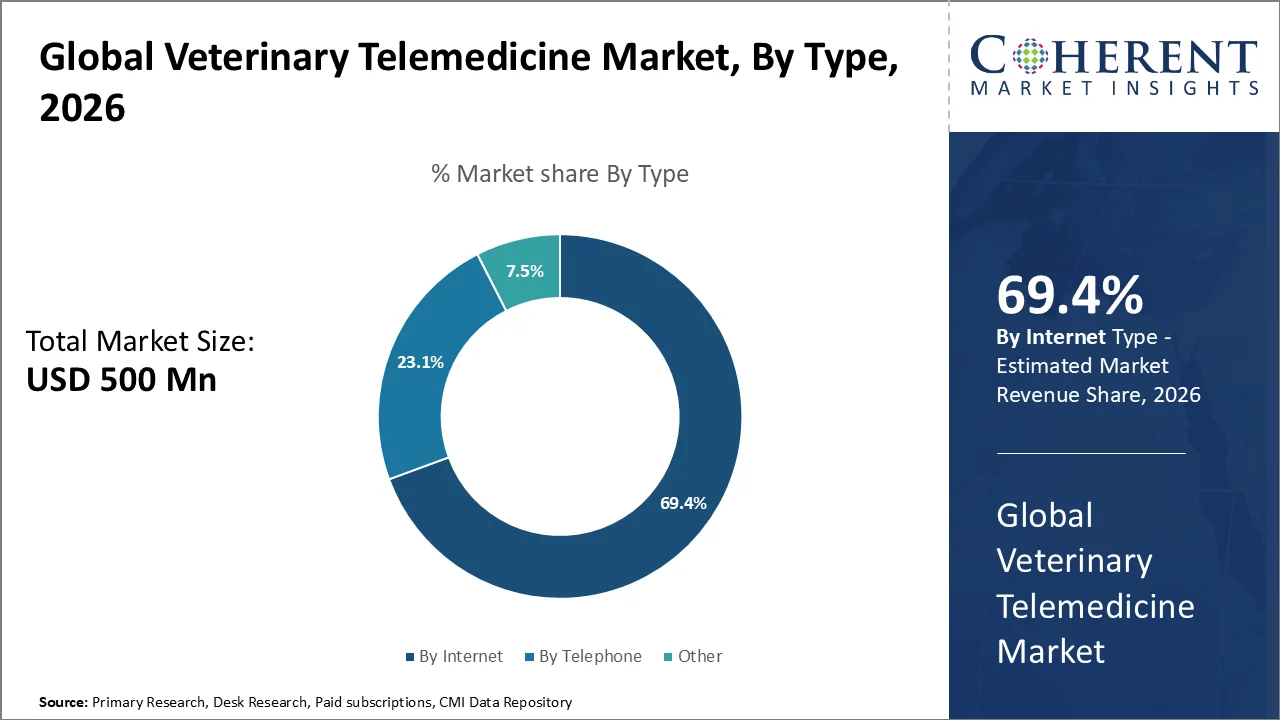
- By internet segment is likely to dominate the market with 69.4% in 2026. The segment’s growth is owing to the rising use of remote imaging interpretation, digital radiology, and specialist consultation across veterinary hospitals. According to the International Telecommunication Union (ITU), there were more than 5.4 billion internet users globally in 2023, thereby highlighting the scale of digital accessibility supporting the tele-veterinary adoption.
- The radiographic reporting segment is set to lead with 38.2% in 2026. The segment’s growth is owing to video consultations, app-based triage, live chat, and cloud-based medical records. The American College of Veterinary Radiology reports more than 800 accredited veterinary radiologists and radiation oncologists, creating a specialist base for remote imaging interpretation.
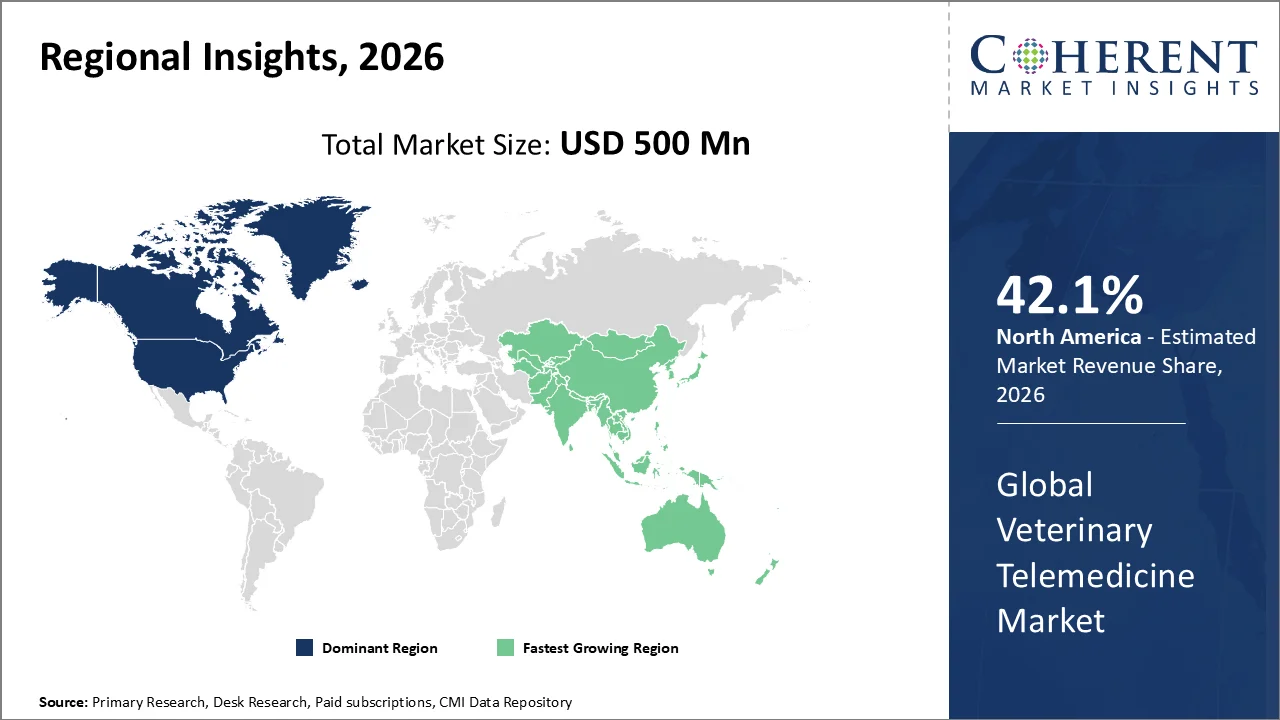
- North America is expected to acquire the prominent share of 42.1% in 2026. The region’s growth is owing to the high pet ownership, strong pet insurance adoption, digital veterinary startups, and regulatory discussions around telemedicine access. The AVMA reports that 56.3 million U.S. households own dogs and 43.1 million own cats, strengthening the addressable base for virtual veterinary care.
Segmental Insights
Why is By Internet Acquiring the Largest Share?
On the basis of type, the by internet segment is projected to account for the largest Veterinary Telemedicine Market share of 69.4% in 2026. These platforms are preferred owing to their ability to provide richer interaction than phone-only services. This allows pet parents to share videos, images, symptom histories, medical records, as well as follow-up information.
In the U.S., the Census Bureau reported that nearly 90% of households had broadband internet subscriptions and 95% had a computer. This makes the video consultations and app-based pet-care interactions more practical for owners. This large digital base directly supports the adoption of virtual veterinary services.
Company models also show the strength of internet-led care. Chewy’s virtual vet service connects customers with licensed veterinarians through video in selected U.S. states, with virtual visits priced at USD 49.99 and same-day appointments usually available.
- Current Industry Events of 2026
- Market Size Estimation
- Regional Breakdown
- Competitive Landscape
- Customer Intelligence
- Segmental Analysis
- Pricing Analysis
- Key Market Drivers, Challenges & Future Trends
- Customized Insights Section
Radiographic Reporting hold the Largest Market Share
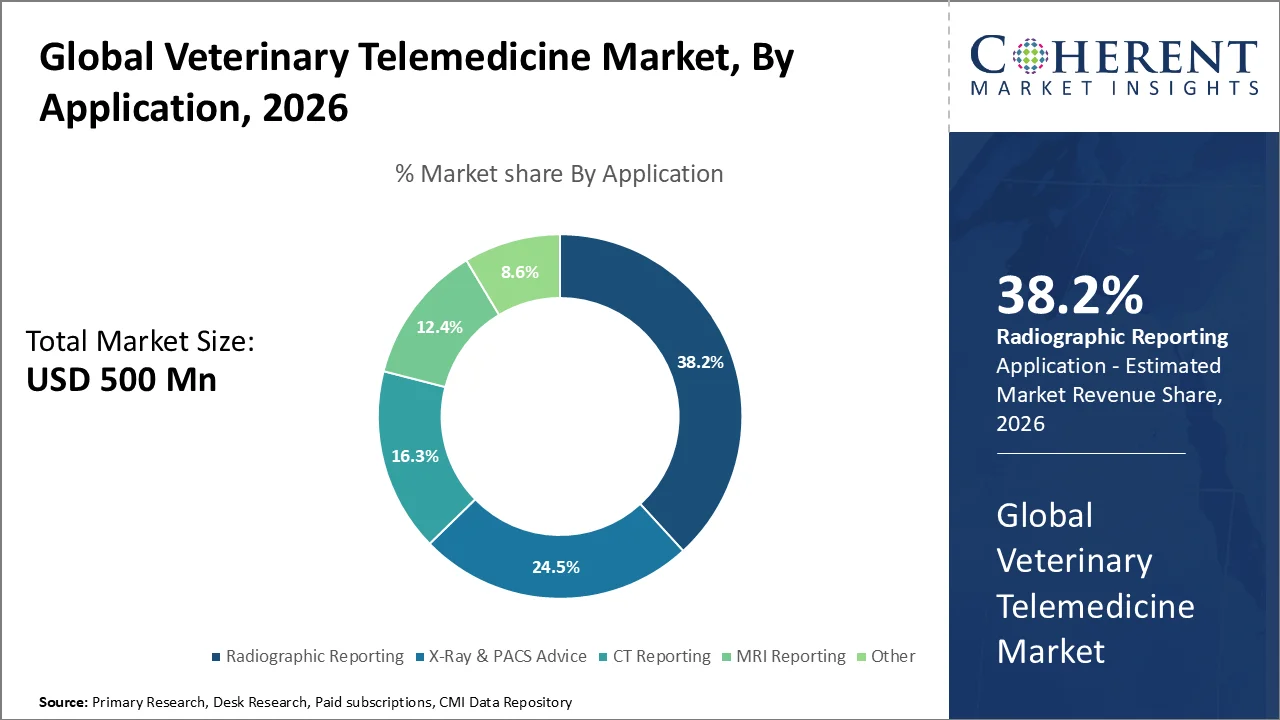
On the basis of application, the radiographic reporting segment lead with a major 38.2% share in 2026. The segment’s growth is owing to the rising use of digital imaging, remote specialist interpretation, and online second-opinion reporting across veterinary hospitals and specialty clinics. Many general veterinary practices do not have in-house board-certified radiologists, creating demand for external image review services. Radiographic reporting also supports faster clinical decisions in orthopedics, oncology, trauma, dental disease, and emergency care.
The segment is also supported by the wider digitization of veterinary diagnostics. Mars Veterinary Health stated in January 2026 that its 2025 Science Impact Report included more than 500 peer-reviewed publications from clinician scientists across its global network. This reflects the growing importance of evidence-based diagnostics as well as data-rich clinical platforms.
Market Drivers
Innovations in 24/7 Virtual Pet Care are Transforming the Veterinary Telemedicine Market in the US
The U.S. is becoming a key innovation hub for veterinary telemedicine. This is owing to the strong pet ownership, high digital adoption, and growing pressure on in-person veterinary capacity. Virtual platforms are moving beyond basic advice into integrated care models that combine teleconsultation, triage, insurance support, wellness plans, as well as pharmacy links.
According to APPA, the U.S. pet industry expenditure reached USD 158 billion in 2025 while the pet ownership remained stable at around 95 million households. This creates a large serviceable base for remote veterinary solutions.
In October 2025, Healthy Paws, a Chubb firm, announced a partnership with Airvet to provide pet insurance policyholders with 24/7 instant access to Airvet’s nationwide network of licensed veterinarians through the Airvet app. The development supports the insurance-embedded veterinary telehealth by combining financial protection with immediate access to veterinary support.
AI-powered Veterinary Triage: A Major Breakthrough in Veterinary Telemedicine Market
AI-powered veterinary triage is emerging as a major breakthrough in the Veterinary Telemedicine Market. This technology uses structured symptom inputs, images, clinical history, and veterinary protocols to guide pet owners toward the right level of care. AI triage is mainly useful for high-volume, repetitive queries related to vomiting, diarrhea, skin issues, mobility concerns, behavior changes, and nutrition.
Vet-AI’s Joii platform shows that AI has the ability to improve remote veterinary services. According to a Google Cloud case study, Vet-AI built an AI-powered triage system using Google Cloud, Gemini, BigQuery, Cloud Run, Pub/Sub, as well as Firebase. The system was developed with data from more than 400,000 video consultations and 100,000 labeled images. It achieved around 81% clinical accuracy, reduced consultation time by 8%, and delivered a 94% customer satisfaction score among users.
In November 2025, the public coverage of Vet-AI’s deployment highlighted that the triage system went live after a 10-week development cycle and operated at 81% clinical accuracy. This is strengthening the role of generative AI in the scalable pet healthcare support.
Current Events and Their Impact
Current Event | Description and its Impact |
2026 U.S. state-level telemedicine movement and E-VCPR expansion |
|
2025 USDA Rural Veterinary Action Plan |
|
Veterinary Telemedicine Market Trends
- Pet insurers are bundling virtual veterinary access into policies, improving customer experience, supporting early triage, and reducing avoidable clinic claims.
- AI-enabled symptom checkers and triage tools are helping platforms in shortening the consultation time and guiding pet owners toward urgent, routine, or follow-up care.
- Pet humanization continues to strengthen the demand for convenient digital veterinary care, as owners expect faster access, flexible scheduling, and ongoing health support.
- Pet retailers are integrating virtual veterinary support to improve in-store care standards. In January 2026, Vetster announced a virtual veterinary support program for select PetSmart stores in the U.S. This gives associates real-time access to licensed veterinarians for pets in stores, salons, hotels, and small-animal departments.
- Telemedicine adoption is shaped by VCPR rules and prescription requirements. The FDA states that prescription animal drugs require licensed veterinarian involvement and advises veterinarians to consult state licensing boards for state-specific requirements. This creates compliance complexity and opportunities for regulated platforms.
Regional Insights
North America Dominates Owing to the Growing Pet Ownership and Digital Veterinary Care Adoption
The North America region accounts for 42.1% of the market share in 2026. The region’s growth is owing to the high pet ownership, widening veterinary workforce pressure, employer-sponsored pet benefits, and strong adoption of digital health platforms.
In the U.S., BLS projects veterinarian employment to grow 10% during 2024–2034, with about 3,000 openings annually, supporting demand for virtual triage, follow-up consultations, and remote specialist access. In Canada, Agriculture and Agri-Food Canada reported around 17.2 million cats and dogs in 2024, including 8.9 million cats and 8.3 million dogs, thereby expanding the addressable base for digital veterinary care.
In April 2025, Airvet raised USD 11 million in Series B-2 funding after reporting more than 4x year-over-year growth in enterprise annual recurring revenue. The funding supports Airvet’s goal of delivering virtual veterinary care as an employee benefit and pet family support platform.
Asia Pacific Veterinary Telemedicine Market Trends
Asia Pacific is expected to witness strong growth in Veterinary Telemedicine Market over the forecast period. The region’s growth is owing to the rising pet ownership, expanding livestock healthcare needs, uneven access to veterinary professionals, and increasing use of digital consultation platforms across urban and rural areas.
In addition, WOAH reports that veterinary professionals in rural Asia-Pacific regions increasingly rely on community-based animal health workers (CAHWs) to deliver frontline care, especially vaccination, disease monitoring, and referral support in underserved geographies.
A notable regulatory development came in Singapore, where the Animal & Veterinary Service and the Singapore Veterinary Association jointly issued Veterinary Telehealth Guidelines on November 2025, supporting remote/virtual veterinary care while setting boundaries for animal welfare, safety, informed use, and professional responsibility.
Hybrid Care Adoption, High Pet Ownership, and Digital Ecosystem Integration Driving U.S. Veterinary Telemedicine Growth
The U.S. Veterinary Telemedicine Market is witnessing strong structural growth. This is owing to shift toward hybrid care, where virtual triage, follow-up consultations, prescription guidance, and chronic-condition monitoring support clinic capacity without replacing in-person VCPR needs. The demand is supported by AVMA survey data showing 56.3 million U.S. households owned dogs, thereby creating a large recurring-care base for remote advice and refill workflows.
In April 2026, Chewy signed an agreement to acquire Modern Animal, a technology-forward veterinary platform with 29 owned clinics and 24/7 virtual care. This signals stronger integration of e-commerce, pharmacy, clinic networks, and telehealth into one U.S. pet healthcare ecosystem.
China Veterinary Telemedicine Market Trends
China is emerging as a high-potential market for veterinary telemedicine. The growth is due to urban pet ownership, younger pet parents, and strong digital ecosystem adoption. According to the 2026 China Pet Industry White Paper, China had 126 million urban pet dogs and cats in 2025 including 53.43 million dogs and 72.89 million cats. The country’s urban dog and cat consumption market reached RMB 312.6 billion in 2025, supported by rising per-pet spending as well as premiumization.
The White Paper also noted that the medical care accounted for nearly 27.6% of pet consumption in 2025, while younger consumers relied on digital channels for information and purchasing. This supports growth opportunities for online consultations, tele-triage, digital prescription support where permitted, and remote wellness monitoring.
Who are the Major Companies in Veterinary Telemedicine Industry
Some of the major key players in Veterinary Telemedicine Market are Agora.io, Anipanion, Linkyvet, Oncura Partners, TeleVet, Vetchat, VetCT., Vetoclock, WellHaven Pet Health, Petriage, PawSquad, and Petpro Connect.
Key News
- In May 2025, PetPace and TelmyVet launched a Quality-of-Life Consultation service integrating AI-powered wearable monitoring with telemedicine. The initiative supports end-of-life pet care through real-time health insights and compassionate veterinary guidance for families making critical care decisions.
- In July 2024, Vetster expanded its veterinary telemedicine services in Florida. This enables the pet owners to access online diagnoses, treatment plans, and prescriptions under new state legislation. The platform enhances accessibility by connecting users with licensed veterinarians for 24/7 virtual care as well as improved convenience in the region.
Market Report Scope
Veterinary Telemedicine Market Report Coverage
| Report Coverage | Details | ||
|---|---|---|---|
| Base Year: | 2025 | Market Size in 2026: | USD 500 Mn |
| Historical Data for: | 2020 To 2024 | Forecast Period: | 2026 To 2033 |
| Forecast Period 2026 to 2033 CAGR: | 19.1% | 2033 Value Projection: | USD 1,700 Mn |
| Geographies covered: |
| ||
| Segments covered: |
| ||
| Companies covered: | Agora.io, Anipanion, Linkyvet, Oncura Partners, TeleVet, Vetchat, VetCT., Vetoclock, WellHaven Pet Health, Petriage, PawSquad, and Petpro Connect | ||
| Growth Drivers: |
| ||
| Restraints & Challenges: |
| ||
Analyst Opinion
- Veterinary telemedicine adoption accelerated sharply with U.S. small animal practices increasing video consultations from 4.2% to 29.6%, showing a nearly 7× rise in virtual care usage and establishing telemedicine as a mainstream clinical support channel in veterinary care delivery.
- Pet ownership reached a record scale in the United States with about 94 million households owning pets in 2025, driven by millennial and Gen Z adoption trends that treat pets as family members and actively demand digital-first veterinary access including video consultations and remote monitoring.
- Nearly 37% of the U.S. pet owners express willingness to use video or phone-based veterinary appointments. This indicates a strong latent demand for tele-veterinary services alongside traditional clinic visits, especially for non-emergency care, follow-ups, as well as behavioral consultations.
Speak to the analyst
Want personalized insights?
Take the findings above to one of our principal consultants, or have the report rebuilt around the segments, geographies and competitors you actually track.
Market Segmentation
- By Type (Revenue, USD Mn, 2021-2033)
- By Telephone
- By Internet
- Other
- By Application (Revenue, USD Mn, 2021-2033)
- Radiographic Reporting
- CT Reporting
- X-Ray & PACS Advice
- MRI Reporting
- Other
- Global Veterinary Telemedicine Market, By Region (Revenue, USD Mn, 2021-2033)
- North America
- U.S.
- Canada
- Latin America
- Brazil
- Mexico
- Argentina
- Rest of Latin America
- Europe
- Germany
- U.K.
- France
- Italy
- Spain
- Russia
- Rest of Europe
- Asia Pacific
- China
- India
- Japan
- Australia
- South Korea
- ASEAN
- Rest of Asia Pacific
- Middle East
- GCC
- Israel
- Rest of Middle East
- Africa
- South Africa
- Central Africa
- North Africa
- North America
- Key Players
- Agora.io
- Anipanion
- Linkyvet
- Oncura Partners
- TeleVet
- Vetchat
- VetCT
- Vetoclock
- WellHaven Pet Health
- Petriage
- PawSquad
- Petpro Connect
Sources
Primary Research Interviews
- Veterinary practitioners and tele-veterinary service providers
- Companion animal veterinarians and mixed-animal veterinarians
- Veterinary radiologists involved in radiographic, CT, MRI, X-ray, and PACS reporting
- Veterinary hospital administrators and clinic managers
- Animal diagnostic imaging center managers
- Veterinary software/platform providers
- Animal health technology companies
- Veterinary regulatory and compliance consultants
- Key opinion leaders (KOLs) in veterinary medicine and telehealth
Databases
- World Organisation for Animal Health (WOAH)
- U.S. Department of Agriculture – Animal and Plant Health Inspection Service (USDA APHIS)
- U.S. Food and Drug Administration – Center for Veterinary Medicine (FDA CVM)
- Centers for Disease Control and Prevention (CDC) – One Health Resources
- Food and Agriculture Organization (FAO)
- Organisation for Economic Co-operation and Development (OECD)
Magazines
- Veterinary Practice News
- dvm360
- Today’s Veterinary Business
- Veterinary Times
- Vet Times
- Veterinary Practice
Journals
- Journal of the American Veterinary Medical Association
- Frontiers in Veterinary Science
- Veterinary Record
- Journal of Veterinary Internal Medicine
- Veterinary Radiology & Ultrasound
- Journal of Small Animal Practice
- Animals
- BMC Veterinary Research
Newspapers
- The New York Times
- The Guardian
- The Wall Street Journal
- Financial Times
- The Economic Times
Associations
- American Veterinary Medical Association
- American Animal Hospital Association
- World Small Animal Veterinary Association
- Federation of Veterinarians of Europe
- Royal College of Veterinary Surgeons
- American Association of Veterinary State Boards
- Canadian Veterinary Medical Association
- British Veterinary Association
Public Domain Sources
- Company annual reports and investor presentations
- Government animal health and veterinary ministry publications
- Veterinary licensing board guidelines and telemedicine regulations
- Public veterinary telehealth policy documents
- Clinical and diagnostic imaging service provider publications
- Regulatory updates related to veterinary telemedicine and digital animal health
Proprietary Elements
- CMI Data Analytics Tool, Proprietary CMI Existing Repository of Information for the Last 10 Years
Get access to 250+ pages report
Every segment, forecast, competitor profile and data table behind the analysis above — available for instant download.
- ESOMAR Member
- ISO 9001:2015 Certified
- D-U-N-S Registered
- GDPR & CCPA Compliant
Missing comfort of reading report in your local language? Find your preferred language:
Transform your Strategy with Exclusive Trending Reports
Frequently Asked Questions
The Veterinary Telemedicine Market is expected to reach USD 1,700 million in 2033.
The limitations in clinical examinations, fragmented and strict licensing regulations, and high implementation costs are the key factors hampering growth of the market.
The surging humanization of pets, significant technological advancements in AI and IoT, and a growing shortage of veterinarians is boosting the demand for Veterinary Telemedicine.
The Veterinary Telemedicine Market is anticipated to grow at a CAGR of 19.1% between 2026 and 2033.
Among regions, North America is expected to account for a largest market share in the global Veterinary Telemedicine Market over the forecast period.
Veterinary telemedicine refers to the use of digital platforms, video calls, phone consultations, mobile apps, and online tools to provide veterinary advice, diagnosis support, follow-up care, and pet health monitoring remotely.
Pet owners prefer telemedicine because it saves travel time, reduces clinic visits for minor concerns, offers faster access to veterinarians, and supports continuous care for chronic conditions or post-treatment follow-ups.