

U.S. Physical Therapy Virtual and Telerehabilitation Services Market Forecast – 2026 to 2033
The U.S. Physical Therapy Virtual and Telerehabilitation Services Market is estimated to be valued at USD 263.2 Mn in 2026 and is expected to reach USD 387.7 Mn by 2033, exhibiting a compound annual growth rate (CAGR) of 8.7% from 2026 to 2033.
Key Takeaways
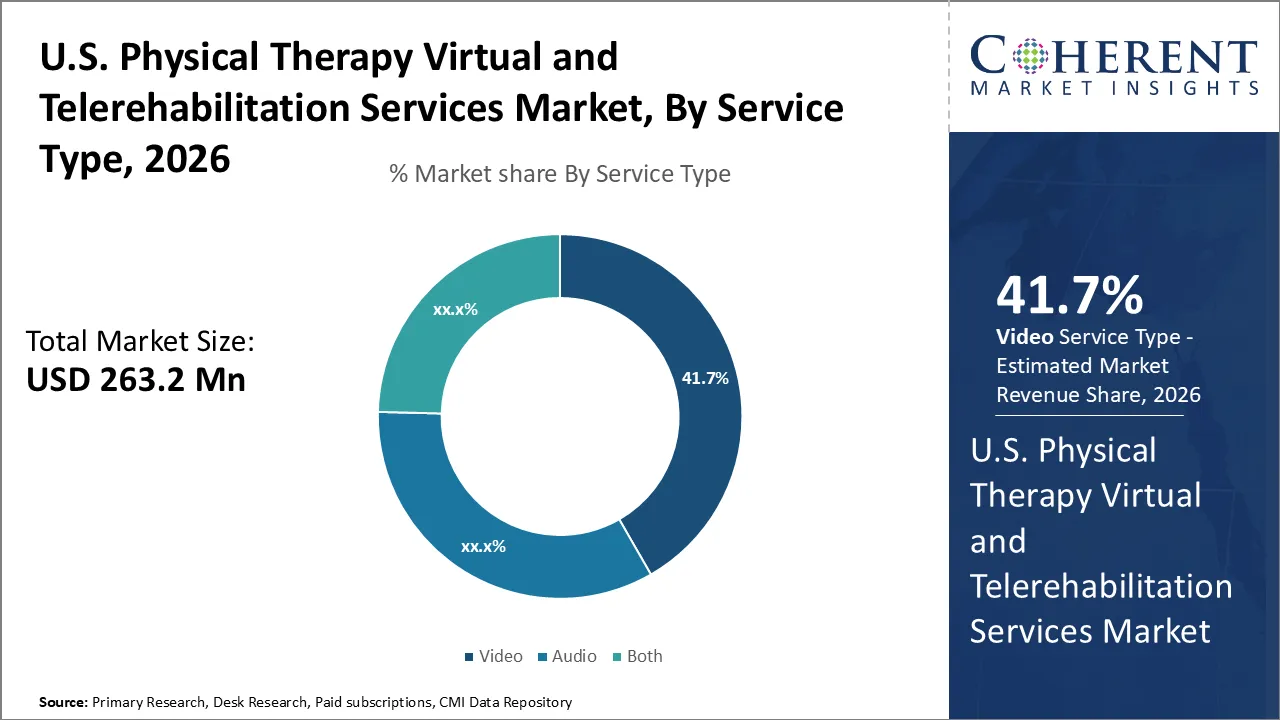
- By Service Type, Video hold the largest market share of 41.7% in 2026 owing to its rapid adoption of telehealth technologies.
- By Application, Cardiovascular Physical Therapy expected to hold largest market share of 33.7% in 2026 owing to its growth of telehealth adoption overall.
- By End User, Hospitals acquired the prominent market share of 36.6% in 2026 owing to the need to reduce readmissions & improve continuity of care.
Market Overview
The U.S. Physical Therapy Virtual and Telerehabilitation Services Market is reshaping rehabilitation care as digital platforms and video technology actively connect therapists with patients remotely. Broader telehealth adoption, rising demand for convenient and accessible care, and the use of advanced monitoring tools drive this transformation. Hospitals, clinics, and homecare providers actively deliver virtual therapy across diverse applications—from orthopedic to neurological care—improving patient outcomes and expanding the reach of rehabilitation services.
Current Events and their Impact on the U.S. Physical Therapy Virtual and Telerehabilitation Services Market
Current Events | Description and its impact |
Regulatory and Policy Developments |
|
Technological Advancements |
|
Demographic and Social Shifts |
|
Segmental Insights
- Current Industry Events of 2026
- Market Size Estimation
- Regional Breakdown
- Competitive Landscape
- Customer Intelligence
- Segmental Analysis
- Pricing Analysis
- Key Market Drivers, Challenges & Future Trends
- Customized Insights Section
U.S. Physical Therapy Virtual and Telerehabilitation Services Market Insights, By Service Type: Video contribute the highest share of the market owing to its technology innovations.
Video hold the largest market share of 41.7% in 2026. In the U.S. Physical Therapy Virtual and Telerehabilitation Services Market, providers increasingly deliver video-based services that allow therapists to interact with patients in real time, closely mimicking in-clinic sessions. Patients drive demand by seeking flexible, at-home care, while clinicians actively monitor progress and adjust therapy. Innovations in video technology, wearable sensor integration, and secure digital platforms boost engagement, adherence, and treatment outcomes. Healthcare professionals use video to widen access, minimize travel challenges, and ensure continuous care for diverse patient populations.
U.S. Physical Therapy Virtual and Telerehabilitation Services Market Insights, By Application: Cardiovascular Physical Therapy contribute the highest share of the market owing to its cost effectiveness and accessibility.
Cardiovascular Physical Therapy expected to hold largest market share of 33.7% in 2026. In the U.S. Physical Therapy Virtual and Telerehabilitation Services Market, hospitals and clinics are actively expanding cardiovascular physical therapy by delivering remote cardiac rehabilitation to patients recovering from heart conditions. Patients drive adoption by seeking convenient, home-based programs that let clinicians safely monitor heart rate, exercise intensity, and recovery progress. Providers use video sessions, wearable devices, and digital tracking tools to guide therapy and ensure adherence. This model enhances accessibility, promotes long-term health management, and enables clinicians to maintain consistent oversight without frequent in-person visits.
In January 2026, the Advanced Research Projects Agency for Health (ARPA-H), part of the U.S. Department of Health and Human Services (HHS), announced a new funding opportunity under its Agentic AI-Enabled Cardiovascular Care Transformation (ADVOCATE) program. The initiative seeks to develop the first FDA-authorized agentic AI system capable of delivering 24/7 specialty care for cardiovascular disease, the leading chronic cause of death in the United States.
U.S. Physical Therapy Virtual and Telerehabilitation Services Market Insights, By End User: Hospitals contribute the highest share of the market owing to its response to chronic disease burden & patient volume.
Hospitals acquired the prominent market share of 36.6% in 2026. In the U.S. Physical Therapy Virtual and Telerehabilitation Services Market, hospitals are expanding the use of virtual and telerehabilitation services to deliver better patient care and boost operational efficiency. They actively provide therapy beyond discharge, prevent readmissions, and handle high patient volumes in orthopedics, neurology, and cardiac care. By combining digital tools, video sessions, and remote monitoring, hospitals optimize workflows while maintaining clinical oversight. This strategy improves patient access, ensures continuous care, and enables healthcare teams to deliver tailored rehabilitation more effectively.
Role of AI in U.S. Physical Therapy Virtual and Telerehabilitation Services Market
Artificial intelligence (AI) is transforming the U.S. physical therapy virtual and telerehabilitation services market by enhancing remote patient assessment, personalized treatment planning, and real-time progress monitoring. AI-powered computer vision and wearable technologies enable therapists to analyze patient movements, provide instant feedback, and track rehabilitation outcomes from a distance. Machine learning algorithms also help predict recovery patterns and optimize therapy plans based on patient data. Additionally, AI-driven chatbots and virtual assistants improve patient engagement, appointment scheduling, and adherence to exercise programs.
In February 2026, Kinaxa, a provider of software for physical therapy clinics, partnered with ASENSEI, a company specializing in AI-powered 3D computer vision and real-time movement coaching. The collaboration enables clinics to conduct computer vision–based movement assessments using only a smartphone or tablet, without requiring additional hardware, IT integration, or workflow changes, allowing therapists to perform accurate real-time assessments.
U.S. Physical Therapy Virtual and Telerehabilitation Services Market Trend
Expansion of Hybrid Rehabilitation Models
Healthcare providers across the U.S. are increasingly adopting hybrid rehabilitation models that combine virtual therapy sessions with periodic in-person visits. This approach allows therapists to conduct detailed assessments during clinic appointments while using virtual sessions for follow-up exercises and progress monitoring. Patients benefit from greater flexibility and reduced travel while maintaining clinical supervision. Hybrid models also help clinics optimize therapist schedules and extend services to more patients without increasing physical infrastructure or facility capacity.
Integration of Wearable and Remote Monitoring Technologies
The use of wearable devices and remote monitoring tools is becoming more common in virtual physical therapy programs. These technologies allow therapists to track patient activity levels, heart rate, posture, and movement patterns outside the clinic. By collecting continuous data, clinicians can adjust treatment plans and identify recovery issues earlier. Integration of digital monitoring with telerehabilitation platforms improves patient engagement and provides therapists with deeper insights into how patients perform exercises in their daily environments.
Market Report Scope
U.S. Physical Therapy Virtual and Telerehabilitation Services Market Report Coverage
| Report Coverage | Details | ||
|---|---|---|---|
| Base Year: | 2025 | Market Size in 2026: | USD 263.2 Mn |
| Historical Data for: | 2020 To 2024 | Forecast Period: | 2026 To 2033 |
| Forecast Period 2026 to 2033 CAGR: | 8.7% | 2033 Value Projection: | USD 387.7 Mn |
| Geographies covered: |
| ||
| Segments covered: |
| ||
| Companies covered: | MTI America, VPT (Virtual Physical Therapists), Conversa Health, MindStreet, Inc., MEDRISK, Global Outreach TeleRehabilitation Services, Inc., Empatha, GestureTek Inc., Neuro Rehab Vr, American Well, LiteGait, Doctor On Demand, Inc., Hinge Health, Inc., Care Innovations LLC., and Jintronix. | ||
| Growth Drivers: |
| ||
| Restraints & Challenges: |
| ||
U.S. Physical Therapy Virtual and Telerehabilitation Services Market News
In May 2025, VSee Health, Inc. launched Project MAMA (Mom’s AI for Maternity Aid), a telehealth initiative designed to reduce maternal mortality in rural and isolated communities in Zamboanga Sibugay, Philippines by leveraging AI-enabled virtual care and real-time health data monitoring.
In October 2025, Institute of Clinical Excellence launched the ICE Physio App, a platform that provides physical therapists and rehabilitation professionals with easier access to its educational resources. The app integrates coursework, faculty interaction, and professional discussions, supporting continuous, evidence-based learning to strengthen clinical skills and improve patient outcomes.
Analyst Opinion (Expert Opinion)
- The evolution of the U.S. Physical Therapy Virtual and Telerehabilitation Services market reflects a structural shift in rehabilitation delivery rather than a temporary response to healthcare disruptions. Evidence from national healthcare datasets demonstrates the durability of this transformation. Data from the Centers for Medicare & Medicaid Services indicates that telehealth utilization expanded dramatically during the pandemic, with telehealth visits among Medicare beneficiaries rising from roughly 840,000 in 2019 to more than 52 million in 2020. A meaningful share of this expansion included rehabilitation and therapy services delivered through digital platforms. This sustained behavioral change among providers and patients suggests that virtual rehabilitation has become an embedded component of care pathways rather than an auxiliary option.
- From a clinical operations perspective, telerehabilitation is increasingly being integrated into post-acute care strategies, particularly in large hospital networks and rehabilitation systems. Organizations such as Hinge Health and Sword Health have demonstrated the scalability of digital physical therapy by delivering guided exercise therapy supported by motion tracking and remote clinical oversight. Employer-sponsored musculoskeletal programs using these platforms have reported adherence rates exceeding 60 percent and measurable reductions in pain scores among participants. These outcomes highlight the capacity of structured virtual therapy ecosystems to address one of the most persistent challenges in rehabilitation: patient adherence outside the clinic environment.
- The long-term opportunity in this market is closely tied to the scale of musculoskeletal disorders in the United States. According to estimates from the Centers for Disease Control and Prevention, nearly one in two adults reports a musculoskeletal condition that affects daily functioning, while the Bureau of Labor Statistics consistently identifies musculoskeletal injuries as the leading category of workplace health issues. The magnitude of this patient population makes conventional clinic-based therapy capacity insufficient in many regions. Virtual rehabilitation platforms offer a pragmatic method to expand therapy access while enabling therapists to monitor patients asynchronously and prioritize high-risk cases for in-person care.
- Nevertheless, the sustainability of virtual rehabilitation adoption depends heavily on regulatory stability and reimbursement clarity. During the public health emergency, the Centers for Medicare & Medicaid Services temporarily broadened telehealth coverage for therapy services, enabling physical therapists to bill for remote care interactions. While many of these policies have been extended, long-term regulatory certainty remains critical. Without permanent reimbursement frameworks, healthcare systems may hesitate to scale digital rehabilitation programs despite demonstrated patient demand and operational benefits.
Speak to the analyst
Want personalized insights?
Take the findings above to one of our principal consultants, or have the report rebuilt around the segments, geographies and competitors you actually track.
Market Segmentation
- By Service Type
- Audio
- Video
- Both
- By Application
- Cardiovascular Physical Therapy
- Orthopedic Physical Therapy
- Neurological Physical Therapy
- Pressure Ulcers
- Cognitive Rehabilitation
- Others
- By End User
- Hospitals
- Rehabilitation Centers
- Homecare Settings
- Others
- Key Players Insights
- MTI America
- VPT (Virtual Physical Therapists)
- Conversa Health
- MindStreet, Inc.
- MEDRISK
- Global Outreach TeleRehabilitation Services, Inc.
- Empatha
- GestureTek Inc.
- Neuro Rehab Vr
- American Well
- LiteGait
- Doctor On Demand, Inc.
- Hinge Health, Inc.
- Care Innovations LLC.
Sources
Primary Research Interviews
- Physical Therapists and Rehabilitation Specialists
- Telehealth Platform Executives and Product Managers
- Hospital Rehabilitation Department Heads
- Digital Health Technology Providers
- Healthcare IT Integration Experts
- Home Healthcare Service Providers
Databases
- Centers for Medicare & Medicaid Services Healthcare Data and Statistics
- National Institutes of Health Clinical Research Database
- Centers for Disease Control and Prevention Health Statistics and Surveillance Systems
- National Library of Medicine Medical Literature and Telehealth Records
- Agency for Healthcare Research and Quality Healthcare Utilization Data
Magazines
- Physical Therapy Products Magazine
- Healthcare IT News
- Modern Healthcare
- Rehabilitation Management Magazine
Journals
- Journal of Telemedicine and Telecare
- Archives of Physical Medicine and Rehabilitation
- Physical Therapy Journal
- Journal of Medical Internet Research
Newspapers
- The New York Times
- The Wall Street Journal
- USA Today
- The Washington Post
Associations
- American Physical Therapy Association
- American Telemedicine Association
- American Hospital Association
- National Association for Home Care & Hospice
Public Domain Sources
- U.S. Department of Health and Human Services
- Centers for Medicare & Medicaid Services Policy and Telehealth Updates
- National Institutes of Health Research Publications
- Centers for Disease Control and Prevention Healthcare Statistics Reports
Proprietary Elements
- CMI Data Analytics Tool
- Proprietary CMI Existing Repository of information for last 8 years
Get access to 250+ pages report
Every segment, forecast, competitor profile and data table behind the analysis above — available for instant download.
- ESOMAR Member
- ISO 9001:2015 Certified
- D-U-N-S Registered
- GDPR & CCPA Compliant
Missing comfort of reading report in your local language? Find your preferred language:
Transform your Strategy with Exclusive Trending Reports
Frequently Asked Questions
The U.S. Physical Therapy Virtual and Telerehabilitation Services Market is estimated to be valued at USD 263.2 Mn in 2026 and is expected to reach USD 387.7 Mn by 2033.
Factors such as the increasing prevalence of cardiovascular, orthopedic, neurological, and other disorders, low price of physical therapy and telerehabilitation solutions, and launch and approval of novel telerehabilitation solutions are expected to drive the market growth during the forecast period.
Video is the leading service type segment in the market.
Major factors hampering the growth of the market include limited awareness and lack of skilled professionals in developing countries.
Major players operating in the market include MTI America, VPT (Virtual Physical Therapists), Conversa Health, MindStreet, Inc., MEDRISK, Global Outreach TeleRehabilitation Services, Inc., Empatha, GestureTek Inc., Neuro Rehab Vr, American Well, LiteGait, Doctor On Demand, Inc., Hinge Health, Inc., Care Innovations LLC., and Jintronix.