

Medical Automation Market Size and Forecast — 2026-2033
The Global Medical Automation Market size is estimated to be valued at USD 31.55 billion in 2026 and is expected to reach USD 58.7 billion by 2033, exhibiting a compound annual growth rate (CAGR) of 10.7% from 2026 to 2033.
Overview
Medical automation products encompass a wide range of technologies designed to improve accuracy, efficiency, and consistency in healthcare operations. These include automated laboratory analyzers, robotic surgical systems, pharmacy dispensing units, and automated diagnostic imaging systems. Such equipment minimizes human error, accelerates workflows, and supports high-throughput patient testing. Automation in laboratories has advanced from simple mechanical pipetting systems to fully integrated robotics linked with information management software. In surgical and therapeutic settings, robotic systems now combine AI-driven motion control, haptic feedback, and real-time imaging, enhancing procedural precision and reducing invasiveness.
Key Takeaways
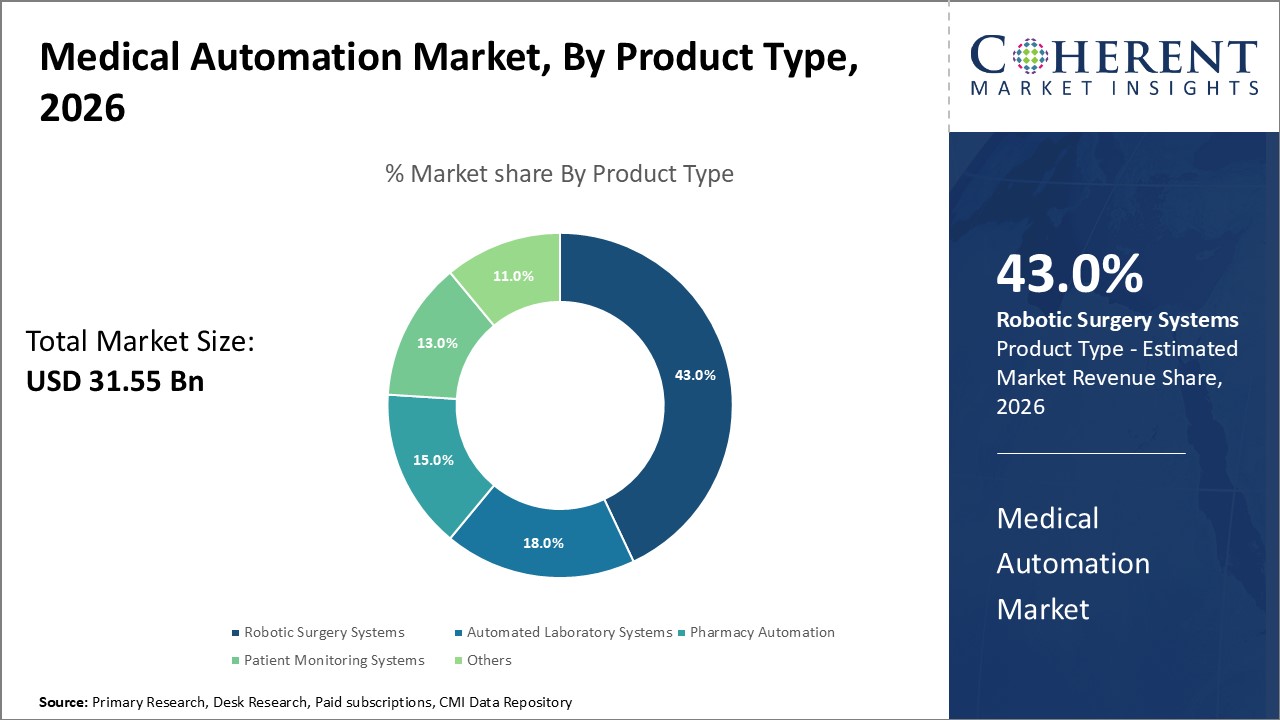
Robotic Surgery Systems dominate the product segment with 43% industry share, highlighting ongoing investments in precision surgical automation technologies. Automated Laboratory Systems show rapid growth due to increasing demand for high-throughput testing and faster diagnosis.
Hospital automation holds the highest revenue contribution, supported by higher budgets and extensive deployment of complex automation systems.
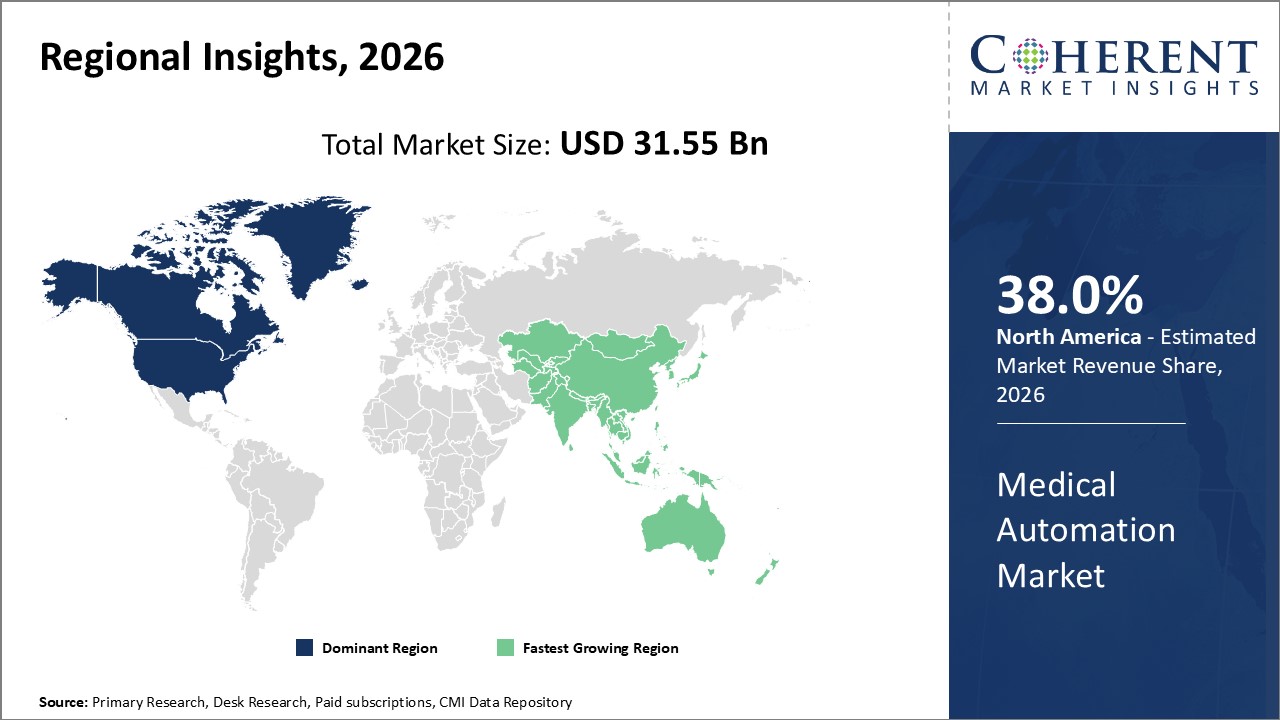
North America leads the market, accounting for over 38% market share, driven by strong infrastructure and regulatory support. Asia Pacific emerges as the fastest-growing region with a CAGR surpassing 12%, fueled by expanding healthcare infrastructure and digital adoption in countries such as India and China.
Market growth strategies are increasingly centered on partnerships and technology co-development, creating new avenues for business growth while tackling market challenges like cost and integration complexities.
Medical Automation Market Segmentation Analysis
Medical Automation Market Insights, By Product Type
Robotic Surgery Systems dominate the market share at 43%, reflecting the shift towards minimally invasive and precision surgeries. This subsegment's growth is driven by the increasing demand for reducing surgical errors and improving patient outcomes through technologies like da Vinci Surgical Systems. Pharmacy Automation is steadily advancing, helping reduce medication errors and improving inventory management.
Medical Automation Market Insights, By Application
Hospitals hold the largest market share due to consistent demand for fully integrated robotic surgery suites, automated patient workflows, and lab automation tools that improve efficiency and reduce costs. Hospitals also benefit from higher budgets and regulatory incentives that facilitate the adoption of cutting-edge automation. Ambulatory Care Centers form the fastest growing application subsegment, capitalizing on outpatient surgery automation and remote patient monitoring systems. Diagnostic Labs are witnessing steady growth driven by automation needs to handle increasing sample volumes with accuracy. Research Institutes incorporate automation primarily for experimental and clinical trial workflows.
Medical Automation Market Insights, By End-User
Public Healthcare Institutions dominate the market share, benefiting from government funding and large patient bases that justify investments in automation infrastructure. This subsegment leads the deployment of robotic surgery and patient monitoring systems across hospitals and health networks. Private Clinics grow at the fastest pace given their increasing interest in adopting automation for competitive differentiation and quality enhancement, focusing on outpatient procedures and niche specialties. Specialized Treatment Centers, including oncology and cardiology care units, adopt highly advanced automation for precise diagnostics and therapy.
Medical Automation Market Trends
The market trends prominently highlight the rising convergence of cloud computing and AI, resulting in smarter, more adaptive automation tools.
For instance, cloud-based medical device management has enhanced remote operational capability, notably gaining traction in the U.S. market, where real-time monitoring systems captured strong adoption rates in 2025.
The surge in demand for personalized patient care technologies is driving R&D investment, facilitating more automated workflows tailored to individual patient needs.
Medical Automation Market Insights, By Geography
North America Medical Automation Market Analysis and Trends
In North America, the dominance in the Medical Automation market can be attributed to established healthcare infrastructure, advanced technology ecosystems, and substantial government incentives. The U.S. healthcare sector alone accounts for approximately 30% of the global market revenue, with major players like Medtronic and Intuitive Surgical actively expanding regional market share through product innovation and strategic hospital partnerships. Regulatory approvals and reimbursement frameworks further stimulate automation adoption across private and public healthcare facilities.
Asia Pacific Medical Automation Market Analysis and Trends
Meanwhile, the Asia Pacific exhibits the fastest growth, with a CAGR exceeding 12%. Market expansion is catalyzed by increasing healthcare digitization, government initiatives to modernize medical infrastructure, and rising chronic disease prevalence in populous countries such as China and India. Rising investments from leading companies establishing localized manufacturing and distribution have propelled market penetration, with China emerging as a critical hub for both market consumption and production. Growing government support in India for healthcare automation technologies underpins accelerated business growth in this region.
Medical Automation Market Outlook for Key Countries
USA Medical Automation Market Analysis and Trends
The U.S. Medical Automation market remains the largest single-country contributor, driven by vast investments in AI-enabled surgical robotics and hospital automation systems. In 2025, the U.S. market saw a 15% increase in the adoption of automated patient monitoring devices, supported by favorable reimbursement policies and integration with electronic health records (EHR). Industry leaders such as Intuitive Surgical expanded clinical robotic system installations to over 600 units nationwide. The robust innovation ecosystem and large clinical trial activity further augment the U.S. market's competitive advantage and revenue potential.
China Medical Automation Market Analysis and Trends
China's market growth is propelled by government initiatives such as "Healthy China 2030," focusing on modernizing healthcare facilities through advanced automation technologies. Rising middle-class demand for high-quality healthcare drives investments in automated diagnostic laboratories and robotic-assisted surgeries. Leading multinational players have partnered with domestic firms to tap into this expanding market, with China accounting for nearly 18% of the Asia Pacific’s market share in 2025. Additionally, favorable regulatory changes and increased healthcare spending contribute to sustained market expansion.
Analyst Opinion
Demand-Side Indicators: The adoption of automated lab instruments and robotic surgery systems has surged, particularly in oncology and cardiology, accounting for approximately 35% of new installations in North America alone during 2025. This demand stems from the need for precision, reduced turnaround times, and cost-efficiency in treatment protocols, driving the market revenue upward substantially.
Production Capacity Expansion: Several leading manufacturing units reported capacity enhancements in 2023, with an average annual production increase of 16%, catering to both domestic and export demands. This expansion helps address supply chain constraints and supports wider deployment across emerging economies.
Pricing Dynamics: Despite initial high costs, the relative pricing of integrated automation solutions has seen a 8% decline year-over-year, as competitive production and technological innovations reduce unit costs, making deployment feasible for mid-sized healthcare providers. This decline positively affects the overall market share for automation equipment.
- Current Industry Events of 2026
- Market Size Estimation
- Regional Breakdown
- Competitive Landscape
- Customer Intelligence
- Segmental Analysis
- Pricing Analysis
- Key Market Drivers, Challenges & Future Trends
- Customized Insights Section
Market Scope
| Report Coverage | Details | ||
|---|---|---|---|
| Base Year: | 2025 | Market Size in 2026: | USD 31.55 billion |
| Historical Data for: | 2020 To 2024 | Forecast Period: | 2026 To 2033 |
| Forecast Period 2026 to 2033 CAGR: | 10.7% | 2033 Value Projection: | USD 58.7 billion |
| Geographies covered: |
| ||
| Segments covered: |
| ||
| Companies covered: | Medtronic plc, Intuitive Surgical, Inc., Siemens Healthineers AG, Stryker Corporation, GE Healthcare, Philips Healthcare, Boston Scientific Corporation, Smith & Nephew plc, Olympus Corporation, Cerner Corporation, Becton Dickinson and Company, Terumo Corporation. | ||
| Growth Drivers: |
| ||
Medical Automation Market Growth Factors
Increasing healthcare digitization remains one of the prime market drivers; integration of AI with automation systems in patient diagnostics and treatment has improved accuracy and reduced clinician workload, boosting demand. Regulatory support for technology adoption in developed markets—such as CMS reimbursement policies in the U.S.—accelerates market revenue growth. The rising prevalence of chronic diseases requiring automated long-term management solutions propels market share expansion. Lastly, cost optimization through automation has incentivized healthcare providers in emerging economies to invest in medical automation technologies, resulting in steady revenue gains in these regions.
Medical Automation Market Development
In July 2026, Indegene launched NEXT Medical Writing Automation, an AI-powered platform designed to streamline and accelerate the creation of compliant medical and regulatory documents. Leveraging generative AI and natural language processing, the platform automates content generation, ensures adherence to global regulatory standards, and enhances efficiency and accuracy in clinical and medical writing workflows for life sciences organizations.
In October 2025, Doppelio introduced a comprehensive test automation platform for connected medical devices and the Internet of Medical Things (IoMT). The solution enables companies to virtualize devices, simulate real-world operating conditions, and automate software validation, ensuring faster, more reliable, and regulatory-compliant testing. This platform supports end-to-end quality assurance in the development of next-generation connected healthcare technologies.
Key Players
Leading Companies of the Market
Medtronic plc
Intuitive Surgical, Inc.
Siemens Healthineers AG
Stryker Corporation
GE Healthcare
Philips Healthcare
Boston Scientific Corporation
Smith & Nephew plc
Olympus Corporation
Cerner Corporation
Becton Dickinson and Company
Terumo Corporation
Several leading companies have leveraged aggressive innovation-driven growth strategies. For instance, Intuitive Surgical expanded its market share by launching next-gen robotic platforms tailored for minimally invasive procedures, raising adoption rates by 26% in 2025. Siemens Healthineers focused on strategic partnerships with hospitals across the Asia Pacific to deliver scalable automation solutions, which boosted their regional revenue by 19%. Philips Healthcare intensified its AI-driven patient monitoring investments, resulting in an increase of integrated system deployments by 31% in North America during the last fiscal year.
Medical Automation Market Future Outlook
The future of the market is defined by the convergence of artificial intelligence, robotics, and cloud-based data analytics. Increasing adoption of robotic-assisted surgeries, automated drug dispensing, and AI-driven diagnostic tools will continue to reshape the healthcare ecosystem. Demand for precision, patient safety, and cost-efficiency will encourage investment in adaptive robotic systems, automated specimen handling, and machine-learning-based predictive care. As healthcare systems expand telemedicine and digital health infrastructure, automation will become essential for streamlining operations and managing growing patient volumes efficiently.
Medical Automation Market Historical Analysis
The medical automation market has evolved significantly from the early use of basic mechanical systems in laboratories to the present era of intelligent, interconnected healthcare solutions. Automation first gained traction in the 1990s with automated laboratory analyzers and robotic pharmacy dispensers designed to enhance accuracy and throughput. Over the years, the growing need for efficiency and error reduction across clinical workflows has led to broader adoption of automated systems in surgical procedures, diagnostics, and hospital administration. The integration of robotics, imaging, and IT infrastructure transformed medical operations, enabling faster test results, minimally invasive surgeries, and optimized patient management.
Sources
Primary Research Interviews:
Biomedical Engineers
Hospital IT Directors
Robotic System Manufacturers
Laboratory Managers
Clinical Pathologists
Databases:
U.S. FDA Medical Device Database
WHO Global Health Observatory
OECD Health Data
ClinicalTrials.gov
Magazines:
MedTech Insight
Healthcare IT News
Robotics Business Review
Medical Device Network
Journals:
Journal of Medical Systems
IEEE Transactions on Automation Science and Engineering
- Journal of Healthcare Engineering
The Lancet Digital Health
Newspapers:
The Wall Street Journal (Health)
The Hindu (Science & Tech)
Financial Times (Healthcare)
The New York Times (Health)
Associations:
International Federation of Robotics (IFR)
Association for the Advancement of Medical Instrumentation (AAMI)
World Health Organization (WHO)
American Hospital Association (AHA)
Get access to 250+ pages report
Every segment, forecast, competitor profile and data table behind the analysis above — available for instant download.
- ESOMAR Member
- ISO 9001:2015 Certified
- D-U-N-S Registered
- GDPR & CCPA Compliant
Missing comfort of reading report in your local language? Find your preferred language:
Transform your Strategy with Exclusive Trending Reports
Frequently Asked Questions
The market is led by key companies, including Medtronic plc, Intuitive Surgical, Siemens Healthineers, and GE Healthcare, each making significant technology advancements and expanding global footprints.
The Medical Automation Market size is estimated at USD 31.55 billion in 2026, with forecasts projecting growth to USD 58.7 billion by 2033 at a CAGR of 10.7%.
Hospitals represent the largest and most lucrative end-user segment, accounting for significant investment in complex automation technologies, with emerging growth opportunities observed in outpatient and home care settings.
Increasing integration of AI, cloud-enabled automation, and personalized diagnostics is expected to shape evolving trends, along with expansion into emerging markets driven by healthcare infrastructure development.
The competitive landscape is technology-driven with a strong focus on innovation, collaborations, and cost optimization; challenges include high initial investment costs and integration complexity with legacy systems.
Leading market players adopt strategies such as strategic partnerships with healthcare providers, regional expansion, tech co-development, and focused investments in emerging technologies like AI-enabled automation.