

U.K. Drug for Abuse Testing Devices Market Size and Forecast – 2026 to 2033
The U.K. Drug for Abuse Testing Devices Market is anticipated to grow at a CAGR of 7.1% with USD 269.6 Mn share in 2026 and is expected to reach USD 387.7 Mn in 2033. Rising substance abuse cases drive the UK drug abuse testing devices market, while strict workplace drug screening regulations support adoption.
Key Takeaways
- Consumables hold the largest market share of 42.2% in 2026 owing to the high testing volume across end-use sectors. About 60–70% of clinical decisions on diagnosis, treatment, and discharge are based on medical laboratory test results.
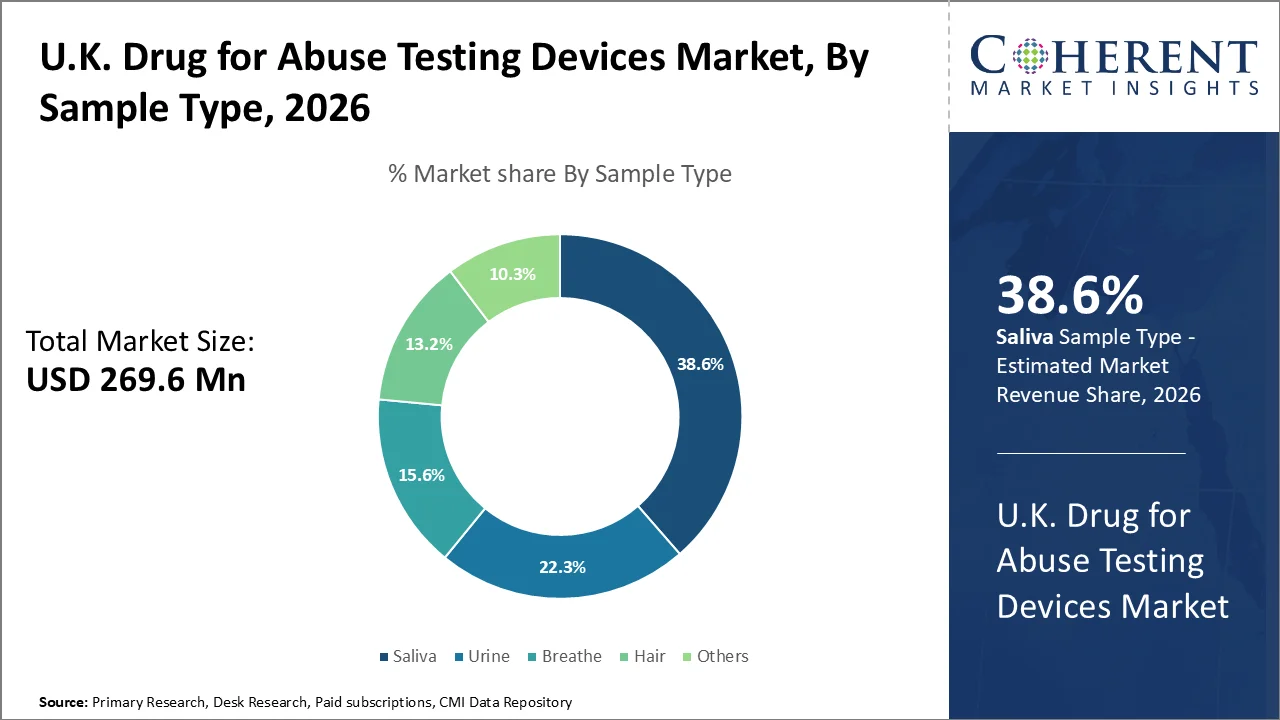
- Saliva expected to hold largest market share of 38.6% in 2026 owing to its rising demand for non-invasive and quick testing.
- Hospitals acquired the largest market share of 42.2% in 2026 owing to the rising emergency admissions linked to substance abuse. According to the World Health Organization (WHO), alcohol and drug use causes over 3 Mn deaths worldwide each year.
Current Events and Their Impact on the U.K. Drug for Abuse Testing Devices Market
Current Event | Description and its Impact |
MHRA Medical Devices Regulatory Reform (Ongoing, 2025–2026) |
|
ICO Guidance on Workplace Drug and Alcohol Testing (Updated Guidance) |
|
Segmental Insights
- Current Industry Events of 2026
- Market Size Estimation
- Regional Breakdown
- Competitive Landscape
- Customer Intelligence
- Segmental Analysis
- Pricing Analysis
- Key Market Drivers, Challenges & Future Trends
- Customized Insights Section
Saliva expected to hold largest market share
Saliva expected to hold largest market share of 38.6% in 2026 owing to its growth in workplace drug screening programs. Law enforcement agencies and workplaces in the U.K. increasingly adopt saliva-based testing because they prefer non-invasive and easy-to-use methods. They use these tests for quick roadside and on-site drug screening. Hospitals and clinical settings apply saliva testing for rapid toxicology assessments during emergencies. The short detection window helps identify recent drug use and supports faster safety decisions. In the UK, police use roadside saliva drug tests to screen for cannabis and cocaine, with results available in minutes. During enforcement campaigns, around 42% of tests return positive results.
Which End User segment dominates the market?
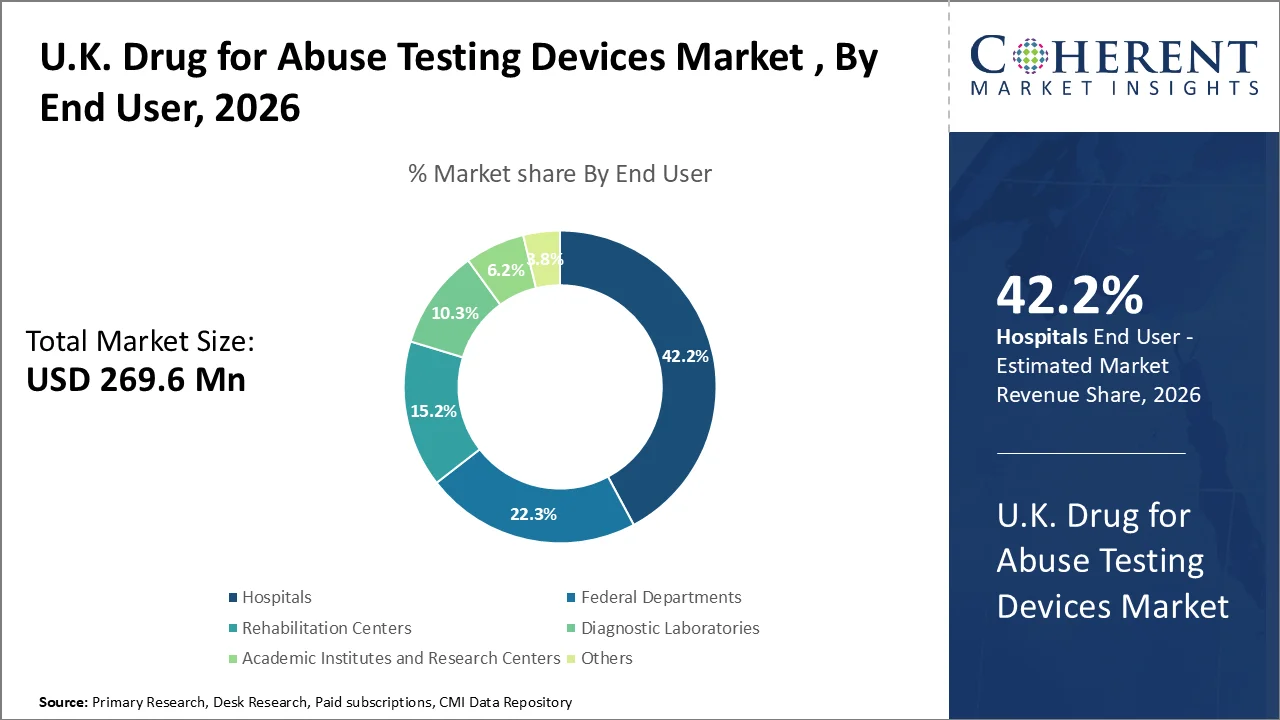
Hospitals acquired the largest market share of 42.2% in 2026. Hospitals in the U.K. generate demand for drug for abuse testing devices as they handle increasing emergency admissions involving drug overdose, poisoning, and substance-related psychiatric cases. They conduct toxicology screening to enable quick clinical decisions in emergency departments and to support safe treatment planning. Rising substance use disorders and growing needs for patient monitoring in addiction treatment programs further drive testing. Hospitals also use drug screening in pre-surgical assessments and inpatient care, while adopting point-of-care testing to improve workflow efficiency and patient management.
Why is Consumables Acquiring the Largest Market Share?
Consumables hold the largest market share of 42.2% in 2026. Workplaces, hospitals, and law enforcement agencies in the U.K. drive consumables demand in the drug of abuse testing devices market by conducting drug screening more frequently. Each test requires fresh kits, reagents, and strips, which creates steady and recurring consumption. Rapid adoption of point-of-care testing and stricter drug control regulations further increase usage. Rising substance abuse cases, along with the expansion of forensic and clinical testing infrastructure, continue to support the ongoing demand for disposable testing materials. For instance, the Loop has launched the drug-testing service in Bristol in partnership with the Bristol Drugs Project and Bristol City Council.
U.K. Drug for Abuse Testing Devices Market Trends
- Increasing substance abuse and drug-related mortality continue to drive demand for drug screening across healthcare, forensic, and workplace settings. According to the Office for National Statistics (ONS), 3,736 drug misuse deaths were registered in England and Wales in 2024, while 5,565 drug-poisoning deaths were recorded overall, representing the highest rate since records began in 1993.
- High prevalence of illicit drug use further supports testing demand. The Crime Survey for England and Wales estimates that 8.7% of adults aged 16–59 years reported using an illicit drug in the past year, with cannabis (6.5%) and cocaine (2.1%) remaining the most commonly used substances.
Who are the Major Companies in U.K. Drug for Abuse Testing Devices Industry
Some of the major key players in U.K. Drug for Abuse Testing Devices are Abbott Laboratories, Thermo Fisher Scientific, Inc, Drägerwerk AG & Co. KGaA, Laboratory Corporation of America Holdings, Quest Diagnostics, Alfa Scientific Designs, Inc, Lifeloc Technologies Inc, Lion Laboratories Limited, OraSure Technologies, Inc, Omega Laboratories, Inc., Shimadzu Corporation, Siemens Healthineers, F. Hoffmann-La Roche AG, Premier Biotech, Inc, Psychemedics Corporation, Innovative Testing Solutions, Biopanda Reagents Ltd, Alpha Laboratories, Matrix Diagnostics, Atlas Medical, Rapid Labs Limited, and Randox Laboratories Ltd.
Key News
- In March 2026, The Loop launched London's first drug checking service in Camden and Hackney, providing free drug analysis, harm reduction advice, and health support to people who use drugs, particularly those with drug dependence.
Market Report Scope
U.K. Drug for Abuse Testing Devices Market Report Coverage
| Report Coverage | Details | ||
|---|---|---|---|
| Base Year: | 2025 | Market Size in 2026: | USD 269.6 Mn |
| Historical Data for: | 2020 To 2024 | Forecast Period: | 2026 To 2033 |
| Forecast Period 2026 to 2033 CAGR: | 7.1% | 2033 Value Projection: | USD 387.7 Mn |
| Geographies covered: |
| ||
| Segments covered: |
| ||
| Companies covered: | Abbott Laboratories, Thermo Fisher Scientific, Inc, Drägerwerk AG & Co. KGaA, Laboratory Corporation of America Holdings, Quest Diagnostics, Alfa Scientific Designs, Inc, Lifeloc Technologies Inc, Lion Laboratories Limited, OraSure Technologies, Inc, Omega Laboratories, Inc., Shimadzu Corporation, Siemens Healthineers, F. Hoffmann-La Roche AG, Premier Biotech, Inc, Psychemedics Corporation, Innovative Testing Solutions, Biopanda Reagents Ltd, Alpha Laboratories, Matrix Diagnostics, Atlas Medical, Rapid Labs Limited, and Randox Laboratories Ltd. | ||
Analyst Opinion
- The U.K. drug of abuse testing devices market is fundamentally driven by escalating public health and safety pressures rather than cyclical demand. Drug-related deaths in England and Wales reached 5,448 registered deaths in 2023, the highest on record, underscoring a persistent and worsening substance misuse burden that directly translates into sustained toxicology screening requirements across hospitals, forensic labs, and enforcement agencies.
- Drug-impaired driving enforcement is becoming a structural demand pillar rather than an occasional intervention. In the U.K., roadside drug testing powers introduced under the Crime and Courts Act have enabled police to conduct over 100,000 roadside drug screening tests annually in recent years, with a significant proportion returning positive results for substances such as cannabis and cocaine. This reinforces continuous reliance on rapid saliva-based testing devices in field operations.
- Workplace drug screening is shifting from policy-based compliance to operational necessity, particularly in safety-critical sectors. For example, transport and logistics operators increasingly adopt pre-employment and random drug testing after evidence from U.K. safety studies shows drug use contributes to impaired performance risks comparable to alcohol intoxication. Industry programs such as rail and aviation safety screening frameworks continue to normalize routine testing rather than incident-triggered testing.
- The clinical burden is intensifying within NHS emergency care, where toxicology screening is becoming a standard triage tool rather than an optional test. NHS hospital data consistently shows rising admissions linked to opioid poisoning and polysubstance misuse, with heroin and synthetic opioid involvement remaining a key driver of acute toxicology screening demand in emergency departments and critical care units.
- Technological reliability is strengthening adoption rather than creating the demand itself. Modern immunoassay-based and LC-MS confirmatory systems now achieve high analytical sensitivity for multi-drug detection panels, enabling clinicians and forensic teams to confidently detect low-dose and synthetic drug exposure. This capability is critical given the rise of novel psychoactive substances in the U.K., where over 900 new psychoactive substances have been identified in Europe over the past decade, forcing continuous updates in testing panels and consumable demand.
Speak to the analyst
Want personalized insights?
Take the findings above to one of our principal consultants, or have the report rebuilt around the segments, geographies and competitors you actually track.
Market Segmentation
- By Product Type (Revenue, USD Mn, 2021-2033)
- Immunoassay Analyzers
- Chromatography Instruments
- Breathalyzers
- Semiconductor-based Breathalyzer
- Infrared (IR) Based Breathalyzer
- Fuel Cell-based Breathalyzer
- Oral Fluid Testing Devices
- Urine Testing Devices
- Drug Testing Cup
- DIP Cards
- Drug Testing Cassettes
- Consumables
- Assay Kits
- Calibrators and Controls
- Others
- By Sample Type (Revenue, USD Mn, 2021-2033)
- Urine
- Breathe
- Saliva
- Hair
- Others
- By End User (Revenue, USD Mn, 2021-2033)
- Hospitals
- Federal Departments
- Rehabilitation Centers
- Diagnostic Laboratories
- Academic Institutes and Research Centers
- Others
Sources
Primary Research interviews
- Interviews with hospital toxicology laboratory professionals, emergency medicine physicians, forensic science practitioners, workplace compliance officers, and U.K. law enforcement drug screening units
- Discussions with procurement managers in NHS trusts and private diagnostic laboratories involved in toxicology testing
- Inputs from occupational health specialists in transport, construction, and industrial safety sectors
Databases
- U.K. Office for Health Improvement and Disparities (OHID) drug misuse datasets
- Office for National Statistics (ONS) drug-related deaths and prevalence data
- NHS Digital clinical activity and emergency admissions datasets
- European Monitoring Centre for Drugs and Drug Addiction (EMCDDA) databases
- PubMed and clinical toxicology research repositories
Magazines
- Clinical laboratory and diagnostics industry magazines
- Public health and emergency medicine practice publications
- Forensic science and toxicology trade publications
- Healthcare operations and hospital management magazines
Journals
- Journal of Analytical Toxicology
- Clinical Toxicology Journal
- Addiction (Oxford Academic)
- Drug Testing and Analysis (Wiley)
- International Journal of Legal Medicine
Newspapers
- The Guardian (public health and drug misuse reporting)
- BBC News (health, crime, and drug policy coverage)
- The Telegraph (drug driving and enforcement reporting)
- Financial Times (healthcare system and NHS operational reporting)
- The Times (crime and public safety reporting)
Associations
- UK Home Office drug policy and enforcement bodies
- National Crime Agency (NCA)
- Royal College of Pathologists
- British Association for Forensic Medicine
- Society of Forensic Toxicologists (SOFT)
- International Association of Forensic Toxicologists (TIAFT)
Public Domain sources
- NHS.uk official publications and clinical guidelines
- GOV.UK drug misuse and testing regulations
- Parliamentary reports on substance misuse and drug policy
- WHO substance abuse and toxicology reports
- EMCDDA annual drug reports and policy briefs
Proprietary Elements
- CMI Data Analytics Tool
- Proprietary CMI Existing Repository of information for last 10 years
Get access to 250+ pages report
Every segment, forecast, competitor profile and data table behind the analysis above — available for instant download.
- ESOMAR Member
- ISO 9001:2015 Certified
- D-U-N-S Registered
- GDPR & CCPA Compliant
Missing comfort of reading report in your local language? Find your preferred language:
Transform your Strategy with Exclusive Trending Reports
Frequently Asked Questions
The U.K. Drug for Abuse Testing Devices Market is anticipated to grow at a CAGR of 7.1% with USD 269.6 Mn share in 2026 and is expected to reach USD 387.7 Mn in 2033.
Factors such as rising incidence of drunk and drive cases & drug addiction and increasing government initiatives to reduce the incidence of driving under influence of drugs and alcohol are expected to drive the market growth during the forecast period.
Consumable segment is expected to hold a major market share during the forecast period.
The major factors hampering growth of the market include inaccurate and false results by breath analyzers and testing devices and availability of low cost alcohol Breathalyzer and drug testing devices manufactured by local players.
Major players operating in the market include Abbott Laboratories, Thermo Fisher Scientific, Inc, Drägerwerk AG & Co. KGaA, Laboratory Corporation of America Holdings, Quest Diagnostics, Alfa Scientific Designs, Inc, Lifeloc Technologies Inc, Lion Laboratories Limited, OraSure Technologies, Inc, Omega Laboratories, Inc., Shimadzu Corporation, Siemens Healthineers, F. Hoffmann-La Roche AG, Premier Biotech, Inc, Psychemedics Corporation, Innovative Testing Solutions, Biopanda Reagents Ltd, Alpha Laboratories, Matrix Diagnostics, Atlas Medical, Rapid Labs Limited, and Randox Laboratories Ltd.