

Drug For Abuse Testing Devices Market Size and Forecast — 2026 - 2033
The Global Drug for Abuse Testing Devices Market size is estimated to be valued at USD 1.8 billion in 2026 and is projected to reach USD 3.2 billion by 2033, registering a compound annual growth rate (CAGR) of 8.5% during the forecast period from 2026 to 2033.
Overview
The drug of abuse testing devices market is driven by the rising prevalence of substance use disorders involving drugs like Opioids and Cannabis, increasing the need for rapid screening. Strict workplace safety regulations and government mandates for drug testing in industries such as transportation and law enforcement boost demand. Growing adoption of roadside testing and forensic applications further supports market growth. Technological advancements, including rapid and point-of-care testing devices, improve accuracy and turnaround time. Additionally, increasing awareness, rehabilitation initiatives, and expanding healthcare infrastructure contribute to wider adoption globally.
Key Takeaways
The urine sample type holds dominance with a substantial market share of 60%, driven by ease of collection and established accuracy, while saliva testing shows the fastest CAGR due to non-invasive advantages.
Immunoassay-based devices lead by capturing over half of the market revenue share, with chromatography-based devices gaining traction for confirmatory testing.
In North America, the market accounts for approximately 38% of global industry share, supported by stringent regulatory frameworks and vast industry presence.
Asia Pacific exhibits the highest growth rate of around 10% CAGR, propelled by expanding healthcare infrastructure and rising government initiatives against substance abuse.
Drug for Abuse Testing Devices Market Segmentation Analysis
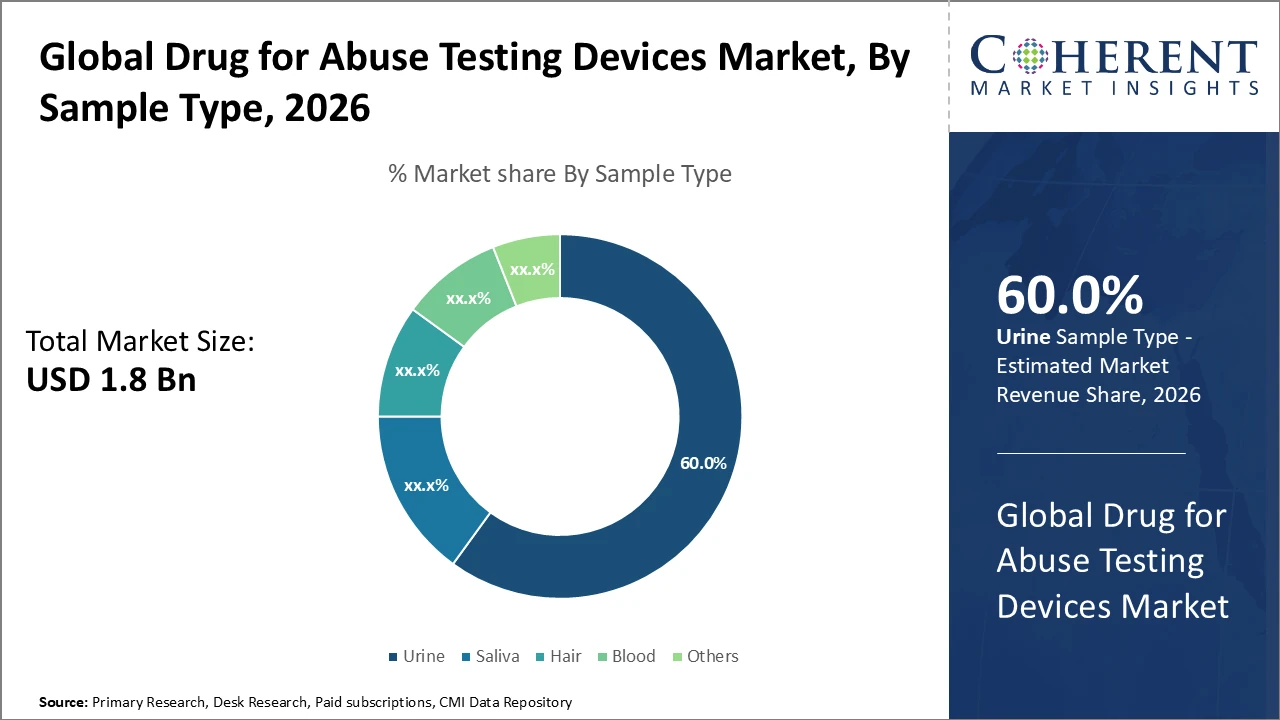
Drug for Abuse Testing Devices Market Insights, By Sample Type
Urine sample testing leads the Drug for Abuse Testing Devices market with a share of 60% due to its ease of collection, affordability, and established use in workplace and clinical environments. Saliva testing is the fastest-growing segment, driven by its non-invasive collection and rapid onsite results, making it increasingly popular for roadside and criminal justice testing. Hair sampling, which provides long-term substance use history, remains a niche option primarily in forensic and rehabilitation settings. Blood testing, valued for high accuracy, is used selectively in clinical diagnostics. Emerging sample types like sweat and oral fluids are gaining interest through wearable biosensor innovations but currently hold a small market share.
Drug for Abuse Testing Devices Market Insights, By Product Type
Immunoassay-based devices dominate the Drug for Abuse Testing Devices market due to their high accuracy, affordability, and widespread use across workplaces, clinics, and rehabilitation centers. They offer rapid qualitative results, making them the preferred choice for initial drug screening. Chromatography-based devices, though smaller in market share, are growing fastest because of their superior sensitivity and specificity, ideal for confirmatory testing in forensic and clinical laboratories. Spectrometry devices provide precise quantitative analysis but face limitations from high costs and operational complexity. Emerging electrochemical sensors focus on portable, real-time applications, while other niche devices serve specialized or evolving testing needs.
Drug for Abuse Testing Devices Market Insights, By End User
Workplace testing dominates the Drug for Abuse Testing Devices market, contributing nearly 40% of revenue, driven by regulatory mandates in safety-sensitive sectors like manufacturing, transportation, and construction. Strict compliance requirements and widespread implementation of mandatory screening programs support this segment’s prominence. Forensic laboratories are the fastest-growing segment, fueled by increasing case complexity and adoption of multiplex and high-sensitivity confirmatory devices. Pain management clinics are expanding demand due to rising prescription drug abuse, requiring frequent and targeted monitoring. Rehabilitation centers, though smaller in share, are embracing advanced technologies for patient oversight and relapse prevention. Law enforcement and medical examiner offices also contribute to overall market demand.
Drug for Abuse Testing Devices Market Trends
The Drug for Abuse Testing Devices market is experiencing transformative trends like digitization and integration with telehealth platforms, enabling remote monitoring and data analysis.
In 2026, approximately 28% of devices featured wireless connectivity, marking an 18% increase from 2024.
Automation in sample handling and AI-assisted result interpretation has significantly reduced human error in forensic testing laboratories.
Growing demand in emerging economies is driven by government initiatives targeting substance abuse, such as India’s National Action Plan launched in 2025, which boosted device demand by 22%.
Drug for Abuse Testing Devices Market Insights, By Geography
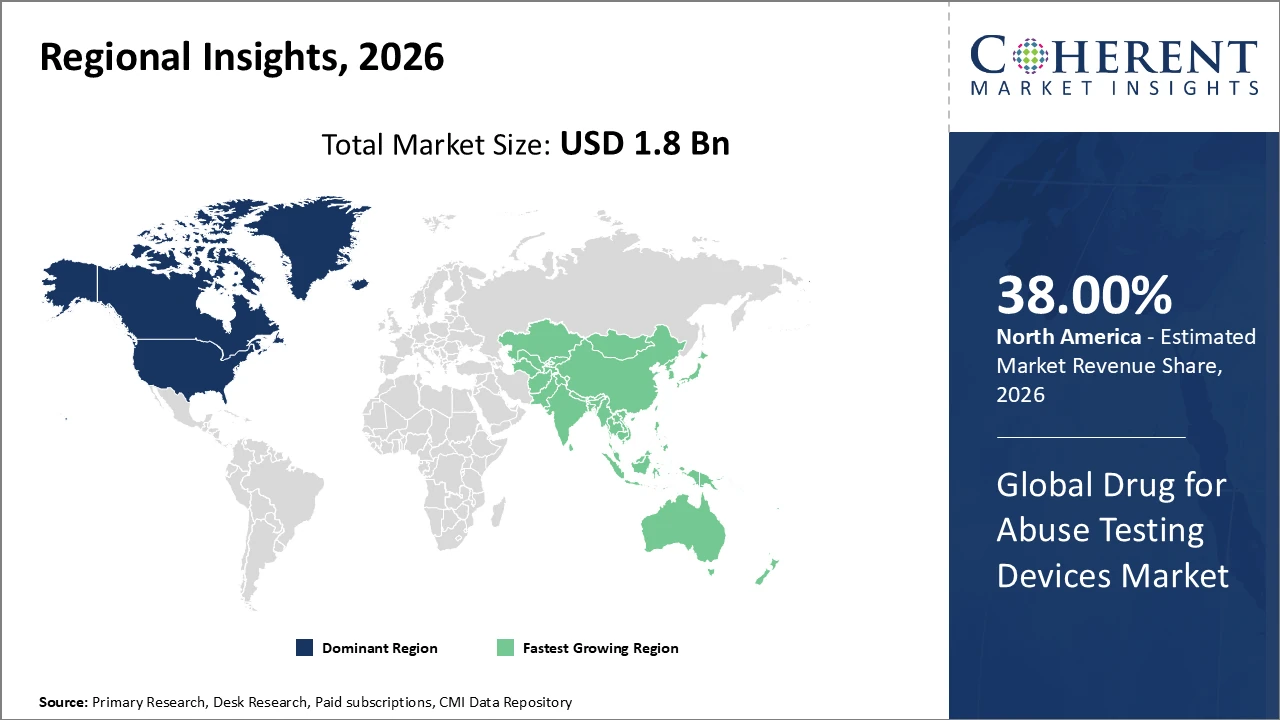
North America Drug for Abuse Testing Devices Market Analysis and Trends
North America holds a dominant position in the Drug for Abuse Testing Devices market, accounting for around 38% of the global share. This leadership is supported by a well-established healthcare infrastructure, strict regulatory enforcement, and substantial government investment in substance abuse prevention programs. The region benefits from widespread adoption of drug testing in workplaces, clinical settings, and forensic laboratories. Key industry players, including Abbott Laboratories and Quest Diagnostics, strengthen market presence through advanced product offerings, technological innovation, and compliance-driven solutions. High awareness of drug abuse issues and robust implementation of mandatory screening policies further sustain North America’s leading role in the market.
Asia Pacific Drug for Abuse Testing Devices Market Analysis and Trends
The Asia Pacific region is the fastest-growing market for Drug for Abuse Testing Devices, with a CAGR approaching 10%, driven by expanding healthcare infrastructure, rising public awareness, and supportive government initiatives promoting drug testing programs. Key countries such as China and India are central to this growth, experiencing increasing market revenues as demand for rapid, accurate, and cost-effective testing solutions rises. Companies like Thermo Fisher Scientific are strengthening their regional presence through strategic expansions and product innovations tailored to emerging market requirements. This growth is further supported by rising workplace drug screening, forensic applications, and clinical monitoring across the region.
Drug for Abuse Testing Devices Market Outlook for Key Countries
USA Drug for Abuse Testing Devices Market Analysis and Trends
The U.S. Drug for Abuse Testing Devices market thrives on widespread adoption across forensic, workplace, and clinical settings. Strict regulations from agencies like the U.S. Department of Transportation (DOT) and the Substance Abuse and Mental Health Services Administration (SAMHSA) ensure consistent demand and steady revenue growth. Leading companies such as Siemens Healthineers and Abbott Laboratories maintain strong market positions, particularly through portable immunoassay devices used in roadside and occupational testing. Additionally, the increasing use of multiplex devices in forensic laboratories enhances testing efficiency and accuracy. These factors collectively reinforce the United States’ position as a technology-driven leader in drug abuse testing solutions.
Germany Drug for Abuse Testing Devices Market Analysis and Trends
Germany’s Drug for Abuse Testing Devices market is driven by stringent workplace safety regulations, growing forensic testing requirements, and rising awareness of substance abuse in healthcare settings. The country has a strong presence of established players, including Roche Diagnostics and Siemens Healthineers, offering immunoassay and confirmatory testing solutions. Workplace drug screening programs and clinical monitoring initiatives contribute significantly to market adoption. Emerging trends include the integration of digital reporting systems, automation in laboratories, and AI-assisted result interpretation to enhance accuracy and efficiency. Additionally, growing demand for non-invasive saliva and oral fluid tests reflects the shift toward convenient, rapid, and patient-friendly testing methods.
Analyst Opinion
Increasing demand for rapid point-of-care testing: In 2025, over 45% of drug testing procedures in clinical and workplace settings adopted rapid devices, reflecting a strong shift toward immediacy and ease of use.
Expanding application spectrum across multiple sectors: Usage in pain management, forensic laboratories, and rehabilitation centers is diversifying, with 2024 data showing a 20% year-on-year growth in forensic applications in North America.
Pricing dynamics influencing market penetration: Competitive pricing has increased accessibility, with average costs for portable devices dropping by about 12% between 2024 and 2026, boosting adoption, especially in Asia Pacific.
Regulatory policies and compliance driving market revenue: Stricter global regulations, including mandatory testing in transport and construction sectors, contributed to a 15% revenue increase in the U.S. in 2025.
- Current Industry Events of 2026
- Market Size Estimation
- Regional Breakdown
- Competitive Landscape
- Customer Intelligence
- Segmental Analysis
- Pricing Analysis
- Key Market Drivers, Challenges & Future Trends
- Customized Insights Section
Market Scope
| Report Coverage | Details | ||
|---|---|---|---|
| Base Year: | 2025 | Market Size in 2026: | USD 1.8 billion |
| Historical Data for: | 2020 To 2024 | Forecast Period: | 2026 To 2033 |
| Forecast Period 2026 to 2033 CAGR: | 8.5% | 2033 Value Projection: | USD 3.2 billion |
| Geographies covered: |
| ||
| Segments covered: |
| ||
| Companies covered: | Abbott Laboratories, LabCorp, Bio-Rad Laboratories, Quest Diagnostics, Alere Inc., Thermo Fisher Scientific, Siemens Healthineers, Randox Laboratories Ltd., Roche Diagnostics, Tecan Group Ltd. | ||
| Growth Drivers: |
| ||
Drug for Abuse Testing Devices Market Growth Factors
The global rise in substance abuse is driving growth in the Drug for Abuse Testing Devices market, as governments and organizations expand screening programs. In Europe, mandated workplace testing increased by 25% in 2025. Technological innovations, including biosensor integration and AI-based analytics, improved device sensitivity and specificity, leading to a 30% rise in next-generation device adoption in forensic applications in 2026. Safety-focused industries like transportation and construction further boost demand, with U.S. regulatory enforcement increasing revenue by 17% in 2024. Expanding healthcare infrastructure and awareness in emerging economies, particularly Asia Pacific, supports a 20% CAGR from 2024 to 2026.
Drug for Abuse Testing Devices Market Development
In June 2025, the Government of Punjab launched the Data Intelligence and Technical Support Unit (DITSU) under its Yudh Nasheyan Virudh campaign to combat drug abuse, in collaboration with the Ananya Birla Foundation, aiming to enhance data-driven and systemic responses to substance use issues.
Key Players
Leading Companies of the Market
Abbott Laboratories
LabCorp
Siemens Healthineers
Bi-Rad Laboratories
Thermo Fisher Scientific
Quest Diagnostics
Alere Inc.
Randox Laboratories Inc.
Roche Diagnostics
Tecan Group Ltd.
Several leading companies have strengthened their positions in the Drug for Abuse Testing Devices market through strategic product expansions and technological advancements. For example, Abbott Laboratories launched a portable immunoassay device in 2025, which contributed to a 6% increase in its market share in North America. Similarly, Siemens Healthineers incorporated AI-enhanced detection capabilities into their devices in 2026, improving test accuracy by 9% and enabling faster result turnaround in clinical settings. These initiatives highlight how innovation and portfolio diversification are driving competitive advantage and market growth in both established and emerging regions.
Drug for Abuse Testing Devices Market Future Outlook
The future of the Drug for Abuse Testing Devices market is expected to be driven by increasing demand for rapid, accurate, and non-invasive testing solutions across healthcare, workplace, and forensic applications. Technological advancements, including digital integration, wearable sensors, and multiplex testing, will enhance real-time monitoring and ease of use. Rising awareness of substance abuse, stricter regulatory requirements, and expanding workplace drug policies will further fuel market growth. Emerging markets are likely to see increased adoption due to growing healthcare infrastructure. Overall, the market is projected to shift toward more portable, high-sensitivity, and user-friendly devices, supporting proactive drug abuse detection and prevention strategies.
Drug for Abuse Testing Devices Market Historical Analysis
The Drug for Abuse Testing Devices market has experienced steady growth over the past decade, driven by rising awareness of substance abuse and stricter workplace and legal regulations. Historically, urine-based immunoassay test kits dominated the market due to their affordability and ease of use. Over time, advancements led to the development of saliva, hair, and blood testing devices, providing non-invasive alternatives and longer detection windows. Laboratory-based confirmatory analyzers also gained traction, offering higher accuracy for forensic and clinical applications. The market’s historical growth was influenced by increasing government initiatives, expanding addiction treatment programs, and the need for reliable drug monitoring in workplaces and healthcare settings.
Sources
Primary Research Interviews:
R&D managers, engineers, and product developers from companies manufacturing drug testing devices.
Technical specialists from laboratories and diagnostic centers using drug screening kits and analyzers.
Industry experts from firms providing digital reporting, point-of-care testing solutions, and advanced confirmatory analyzers.
Magazines:
Clinical Laboratory News – Updates on drug testing technology, market trends, and clinical adoption.
Laboratory Equipment – Innovations in diagnostic devices, rapid testing, and laboratory workflow improvements.
Medical Device and Diagnostic Industry (MD+DI) – Insights on new drug detection devices, regulatory updates, and market developments.
Journals:
Journal of Analytical Toxicology – Research on drug detection methods, assay performance, and new substances.
Forensic Science International – Studies on drug testing in legal and forensic applications.
Drug and Alcohol Dependence – Insights into substance abuse trends and testing technologies.
Newspapers:
The Wall Street Journal – Company strategies, mergers, and investments in drug testing device manufacturers.
Financial Times – Market developments, regulatory updates, and global demand for drug screening solutions.
Reuters – News on technological innovations, regulatory changes, and industry standards.
Bloomberg – Corporate financials and market trends in drug testing and diagnostics.
Associations:
Substance Abuse and Mental Health Services Administration (SAMHSA) – Guidelines, standards, and testing recommendations.
American Association for Clinical Chemistry (AACC) – Standards, research, and clinical practices in toxicology and drug testing.
World Health Organization (WHO) – Global guidelines, safety protocols, and public health data on substance abuse monitoring.
Get access to 250+ pages report
Every segment, forecast, competitor profile and data table behind the analysis above — available for instant download.
- ESOMAR Member
- ISO 9001:2015 Certified
- D-U-N-S Registered
- GDPR & CCPA Compliant
Missing comfort of reading report in your local language? Find your preferred language:
Transform your Strategy with Exclusive Trending Reports
Frequently Asked Questions
Dominant players include Abbott Laboratories, Thermo Fisher Scientific, Siemens Healthineers, and Roche Diagnostics, recognized for their innovative products and extensive distribution networks that enhance market share.
The market is expected to grow from USD 1.8 billion in 2026 to USD 3.2 billion by 2033, driven by increased adoption, technological advancements, and regulatory mandates.
Workplace testing remains the largest end user segment, supported by growing drug screening mandates in safety-sensitive industries such as transportation and construction.
Advancements in multiplex and mobile testing devices, along with AI-assisted analytics, will shape market trends, enabling faster, more reliable, and user-friendly testing solutions.
The market is highly competitive, emphasizing technological innovation and pricing strategies. Key challenges include ensuring data privacy and adapting to evolving regulatory requirements across regions.
Common strategies include product innovation, mergers and acquisitions, collaborations with healthcare institutions, and localized marketing campaigns to meet regional demands and regulatory compliance.