

Dosimeters Market Size and Forecast – 2026 to 2033
The Dosimeters Market is anticipated to grow at a CAGR of 7.1% with USD 13.1 Bn share in 2026 and is expected to reach USD 18.4 Bn in 2033. Stringent radiation safety regulations drive the dosimeters market, while expanding use in medical imaging and radiotherapy boosts demand.
Key Takeaways
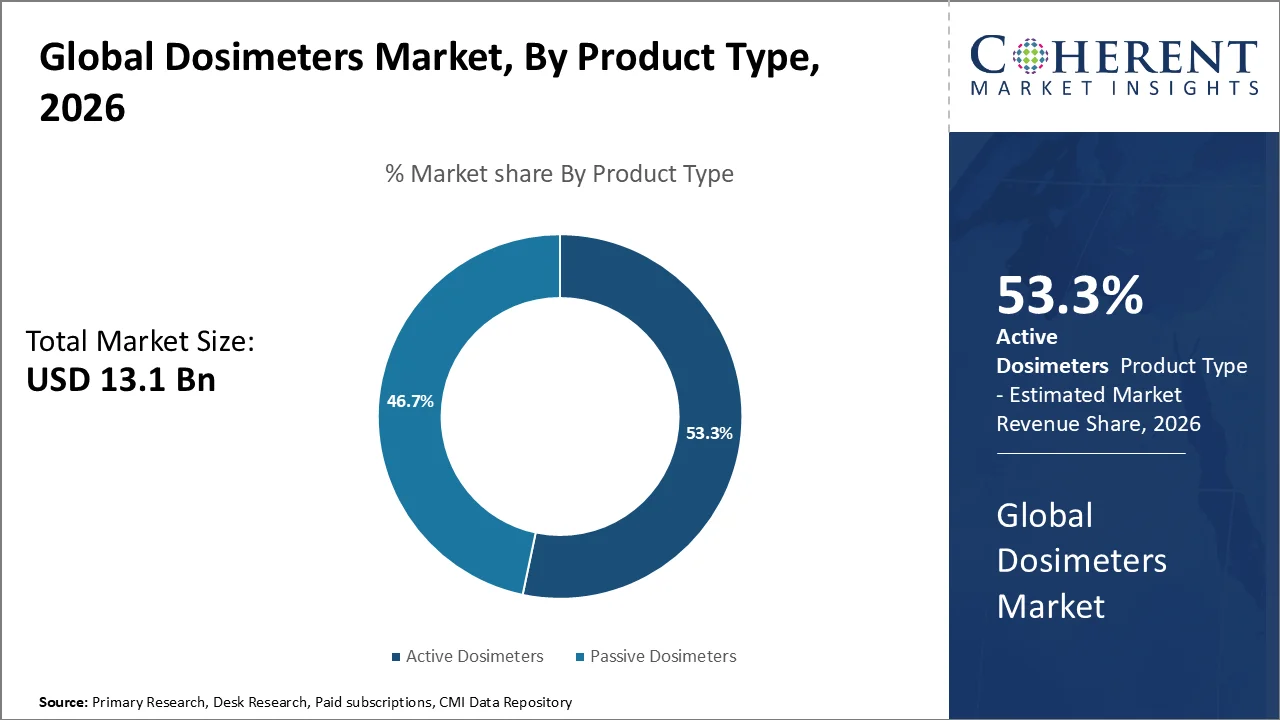
- Active Dosimeters are expected to hold the largest market share of 53.3% in 2026, driven by stringent radiation safety regulations and the growing need for real-time radiation monitoring in healthcare, nuclear power, and industrial applications. According to the International Atomic Energy Agency (IAEA), over 30 million radiation workers worldwide require occupational exposure monitoring.
- Bench-top Dosimeters are projected to account for 52.2% of the market in 2026, supported by the rising demand for radiation therapy quality assurance (QA). Globally, more than 50% of cancer patients receive radiation therapy during treatment, increasing the need for precise dosimetry systems to ensure treatment accuracy and patient safety.
- Hospitals are anticipated to capture 37.7% of the market in 2026, fueled by the increasing volume of diagnostic imaging procedures. The world performs an estimated 4 Bn diagnostic radiology examinations annually, including X-rays, CT scans, and fluoroscopy procedures, driving demand for radiation monitoring and dose management.
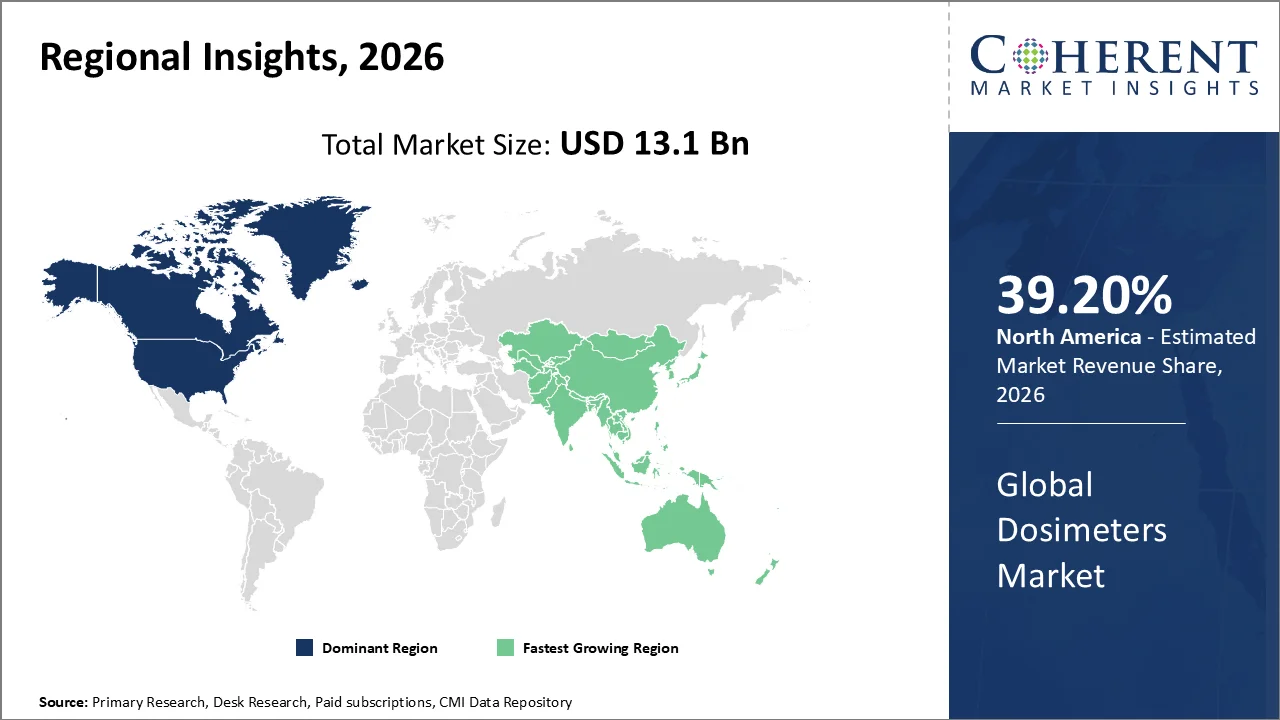
- North America is expected to dominate with a 39.20% market share in 2026, supported by strict radiation protection standards and strong regulatory oversight. The region conducts more than 95 million CT scans annually, with the United States maintaining one of the highest rates of medical imaging utilization globally, reinforcing demand for advanced dosimetry technologies.
Current Events and Their Impact on the Dosimeters Market
Current Event | Description and its Impact |
EU Euratom Safeguards Regulation (2025) |
|
Stricter Occupational Radiation Monitoring Requirements |
|
Segmental Insights
- Current Industry Events of 2026
- Market Size Estimation
- Regional Breakdown
- Competitive Landscape
- Customer Intelligence
- Segmental Analysis
- Pricing Analysis
- Key Market Drivers, Challenges & Future Trends
- Customized Insights Section
Why is Active Dosimeters Acquiring the Largest Market Share?
Active Dosimeters are expected to hold the largest market share of 53.3% in 2026. The segment's growth is driven by the increasing need for real-time radiation exposure monitoring and stringent workplace safety regulations across healthcare, nuclear, defense, and industrial sectors. Active dosimeters are gaining preference over passive alternatives due to their ability to provide immediate dose readings and alarm notifications. According to the United Nations Scientific Committee on the Effects of Atomic Radiation (UNSCEAR), medical exposure accounts for the largest source of man-made radiation exposure globally, increasing the need for continuous monitoring of healthcare personnel. Furthermore, the World Nuclear Association reports that more than 60 nuclear reactors are currently under construction worldwide, creating additional demand for occupational radiation monitoring devices. The integration of Bluetooth connectivity, automated dose recording, and centralized radiation management systems is further supporting the adoption of active dosimeters across end-user industries.
Bench-top Dosimeters expected to hold largest market share
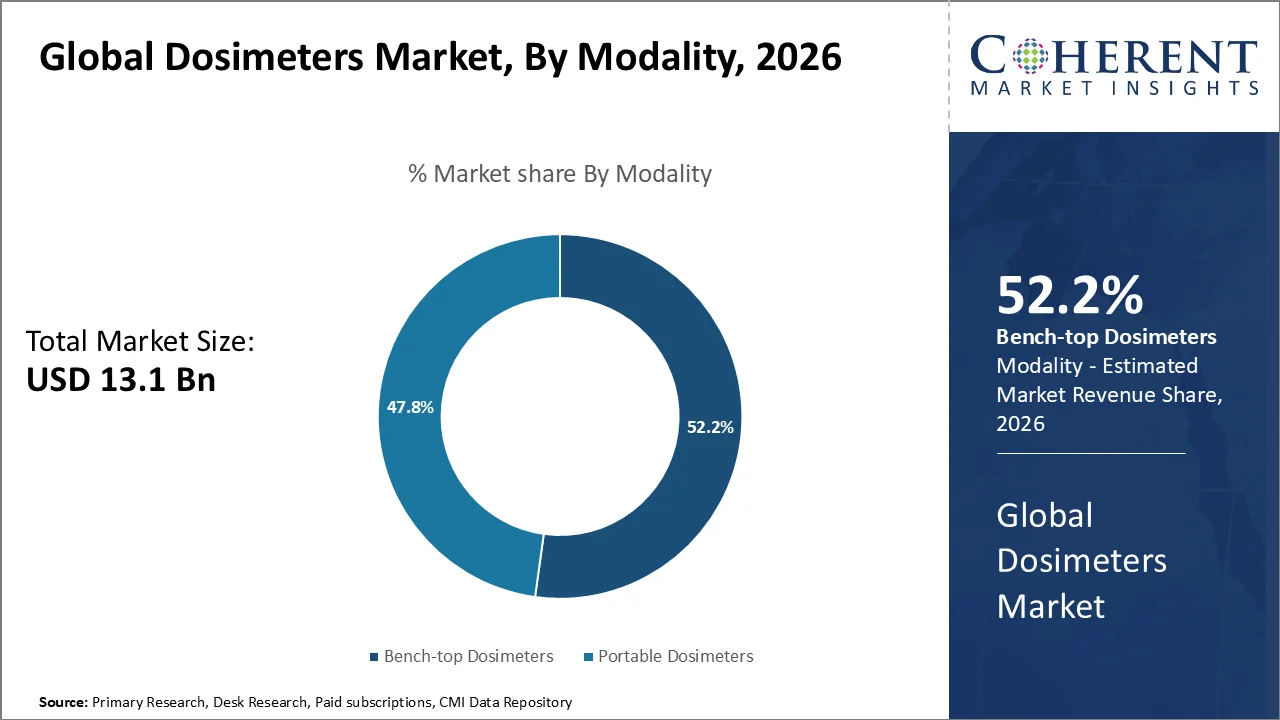
Bench-top Dosimeters are expected to hold the largest market share of 52.2% in 2026, driven by the growing demand for precise radiation measurement and quality assurance across healthcare, nuclear, and research applications. Radiotherapy departments increasingly rely on these systems for dose verification and equipment calibration to ensure treatment accuracy and patient safety. The segment is also benefiting from the expansion of diagnostic and research laboratories, with the number of PET and SPECT nuclear medicine procedures exceeding 40 million annually worldwide, requiring rigorous dosimetry and calibration protocols. In addition, the International Organization for Standardization (ISO) and national regulatory bodies mandate periodic calibration of radiation measurement instruments, supporting the adoption of bench-top dosimeters in accredited laboratories and healthcare facilities. Growing investments in nuclear facility modernization and radioactive waste management projects further strengthen demand, while advancements in automated calibration, digital detectors, and integrated data management systems continue to enhance operational efficiency and measurement reliability.
Which End User segment dominates the market?
Hospitals acquired the prominent market share of 37.7% in 2026. Rising use of radiation-based medical procedures strengthens the hospital segment in the dosimeters market as healthcare facilities depend on accurate monitoring systems to maintain safety. Hospitals increasingly deploy dosimeters to manage growing demand for diagnostic imaging, including X-rays, CT scans, and fluoroscopy, as well as expanding radiotherapy and nuclear medicine services. Regulatory authorities and accreditation bodies enforce strict radiation safety and continuous exposure tracking for staff and patients. Heightened awareness of occupational risks and improved digital dosimetry technologies also encourage broader adoption across hospital settings.
Dosimeters Market Trends
- Expanding use of radiation-based diagnostic and therapeutic procedures in hospitals is increasing demand for continuous exposure tracking and driving dosimetry adoption across clinical settings. The Organisation for Economic Co-operation and Development (OECD) reports that several developed countries perform more than 150 CT examinations per 1,000 population annually, reflecting the growing utilization of radiation-emitting medical equipment and the need for personnel dose monitoring.
- Growing nuclear energy production and decommissioning activities are increasing the need for precise radiation measurement and strict exposure control during operations and maintenance. According to the World Nuclear Association, more than 440 commercial nuclear reactors are operating worldwide, supplying approximately 9% of global electricity generation, while numerous aging facilities are undergoing decommissioning projects that require extensive radiation monitoring and worker protection programs.
Regional Insights
North America dominates owing to strong focus on occupational health and worker safety
North America is expected to acquire the dominant share of 39.20% in 2026. Strict regulatory frameworks governing radiation safety drive the dosimeters market in North America as regulatory agencies enforce continuous monitoring across medical, nuclear, and industrial sectors. Healthcare providers widely adopt advanced diagnostic imaging and radiotherapy, increasing the need for accurate exposure tracking. Established nuclear energy infrastructure and defense applications further strengthen dosimeter usage across the region. Organizations prioritize occupational health and safety, which accelerates the deployment of dosimetry systems. Rapid adoption of electronic and IoT-enabled dosimeters improves monitoring efficiency, accuracy, and real-time reporting capabilities. For instance, Mirion Dosimetry Services, a Mirion Medical company, has launched its new Instadose®VUE wireless dosimeter for commercial use. This next-generation wearable radiation monitoring device (X-ray badge) allows users to track their individual radiation exposure more quickly, accurately, and reliably, while giving them greater control over their data.
Asia Pacific Dosimeters Market Trends
The Asia Pacific dosimeters market grows as healthcare, nuclear power, and industrial sectors increasingly prioritize radiation safety. Expanding use of nuclear medicine and oncology drives demand for precise exposure monitoring. Countries such as India, China, and Japan develop more nuclear energy projects, further boosting adoption. In January 2026, construction of Unit 1 at Phase I of the Xuwei Nuclear Power Project in Jiangsu, China, advanced with the pouring of first concrete for the nuclear island. The facility will generate electricity and industrial heat through the integration of a high-temperature gas-cooled reactor and two Hualong One pressurized water reactors. Governments enforce stricter occupational safety regulations, while industries like radiography, mining, and oil and gas expand operations. Rising awareness of radiation risks and improvements in electronic dosimeter technology also actively support market growth across the region.
United States Dosimeters Market Trends
Stringent radiation safety regulations in the United States drive the dosimeters market as industries prioritize compliance and worker protection. Healthcare providers increasingly use radiation in diagnostic imaging and cancer treatment, which boosts the need for precise dose monitoring. Nuclear power facilities and industrial non-destructive testing further encourage dosimeter adoption. Defense and homeland security agencies also expand usage for radiation detection. Growing awareness of radiation exposure risks continues to push innovation and broader deployment of dosimetry technologies across the country. For instance, TeleDaaS, PLLC, a dosimetry-as-a-service provider, debuted at the Radiological Society of North America’s annual meeting, offering precision-based dosimetry analysis and treatment planning for CROs and pharmaceutical manufacturers.
Japan Dosimeters Market Trends
Japan’s dosimeters market grows due to a strong focus on radiation safety in nuclear energy, healthcare, and industrial sectors. In November 2025, Niigata Prefecture approved the partial restart of the 7,965-MWe Kashiwazaki-Kariwa Nuclear Power Plant, the world's largest nuclear facility by generating capacity. Nuclear facilities maintain continuous monitoring needs, driven by lessons from past incidents, which supports steady demand. Healthcare providers expand the use of radiation-based imaging and cancer treatments, increasing adoption. Government enforces strict occupational exposure rules, while advanced semiconductor and manufacturing industries rely on precise monitoring. Environmental radiation checks and disaster preparedness programs also strengthen market development.
Who are the Major Companies in Dosimeters Industry
Some of the major key players in Dosimeters are Thermo Fisher Scientific Inc., PRS Dosimetry, Mirion Technologies Inc., Landauer Inc., Polimaster Ltd., Radiation Detection Company Inc., Sierra Radiation Dosimetry Services Inc., Tracerco Limited, Unfors RaySafe AB, and PTW Frieburg GmbH.
Key News
- In June 2024, Thermo Fisher Scientific launched the Thermo Scientific NetDose Pro digital dosimeter, a compact, connected wearable device that monitors radiation exposure and helps organizations meet strict regulatory requirements across industries like healthcare.
Market Report Scope
Dosimeters Market Report Coverage
| Report Coverage | Details | ||
|---|---|---|---|
| Base Year: | 2025 | Market Size in 2026: | USD 13.1 Bn |
| Historical Data for: | 2020 To 2024 | Forecast Period: | 2026 To 2033 |
| Forecast Period 2026 to 2033 CAGR: | 7.1% | 2033 Value Projection: | USD 18.4 Bn |
| Geographies covered: |
| ||
| Segments covered: |
| ||
| Companies covered: | Thermo Fisher Scientific Inc., PRS Dosimetry, Mirion Technologies Inc., Landauer Inc., Polimaster Ltd., Radiation Detection Company Inc., Sierra Radiation Dosimetry Services Inc., Tracerco Limited, Unfors RaySafe AB, and PTW Frieburg GmbH. | ||
Analyst Opinion
- Dosimeters industry expanding due to radiation exposure has become an unavoidable operational reality across multiple high-risk sectors. In Japan alone, over 200 operational radiation-emitting medical facilities continuously depend on personal dosimetry for staff safety compliance, reflecting how embedded monitoring has become in routine healthcare workflows rather than being optional equipment.
- Nuclear oversight remains a critical driver, with all 33 operable nuclear reactors in Japan requiring continuous worker dose tracking under stringent safety protocols established after the Fukushima Daiichi incident. This has permanently elevated institutional reliance on real-time and cumulative radiation monitoring systems across plant operations, inspections, and maintenance activities.
- Medical radiation usage further reinforces demand. Japan performs over 6 million CT scans annually, one of the highest per-capita imaging rates globally, directly increasing occupational exposure risk for radiology professionals and driving mandatory dosimeter adoption in hospitals and diagnostic centers.
- Industrial applications also intensify usage, particularly in semiconductor fabrication and precision manufacturing, where even minimal radiation exposure control is essential for both worker safety and product integrity. In addition, nationwide environmental radiation surveillance programs—maintained across hundreds of monitoring stations—ensure continuous deployment of advanced dosimetry systems, making radiation tracking a structural necessity rather than a discretionary safety measure.
Speak to the analyst
Want personalized insights?
Take the findings above to one of our principal consultants, or have the report rebuilt around the segments, geographies and competitors you actually track.
Market Segmentation
- By Product Type (Revenue, USD Bn, 2021-2033)
- Active Dosimeters
- Passive Dosimeters
- By Modality (Revenue, USD Bn, 2021-2033)
- Portable Dosimeters
- Wearable
- Collar Level
- Chest Level
- Waist Level
- Wrist Level
- Finger Level (i.e. Ring Dosimeters))
- Non-wearable
- Wearable
- Bench-top Dosimeters
- Portable Dosimeters
- By End User (Revenue, USD Bn, 2021-2033)
- Hospitals
- Ambulatory Care Centers
- Research Institutes
- Healthcare Companies
- By Region (Revenue, USD Bn, 2021-2033)
- North America
- U.S.
- Canada
- Latin America
- Brazil
- Mexico
- Argentina
- Rest of Latin America
- Europe
- Germany
- U.K.
- France
- Italy
- Spain
- Russia
- Rest of Europe
- Asia Pacific
- China
- India
- Japan
- Australia
- South Korea
- ASEAN
- Rest of Asia Pacific
- Middle East
- GCC
- Israel
- Rest of Middle East
- Africa
- South Africa
- Central Africa
- North Africa
- North America
Sources
Primary Research interviews
- Radiation safety officers in hospitals and diagnostic imaging centers
- Nuclear power plant safety managers and health physics personnel
- Industrial radiography technicians and NDT (Non-Destructive Testing) professionals
- Government regulatory officials in radiation protection agencies
- Occupational health and safety managers in manufacturing and research labs
Databases
- PubMed (medical and radiation safety studies)
- IEEE Xplore (radiation detection technologies and instrumentation papers)
- ScienceDirect (engineering and materials research on dosimetry)
- SpringerLink (radiation physics and nuclear science publications)
- IAEA (International Atomic Energy Agency) databases and safety reports
- UNSCEAR (United Nations Scientific Committee on the Effects of Atomic Radiation) datasets
- National radiation protection authority databases (country-specific repositories)
Magazines
- Health Physics News
- Radiation Protection Today
- Nuclear Engineering International
- Medical Physics World
- Industrial Safety & Hygiene News
Journals
- Health Physics Journal
- Radiation Measurements Journal
- Journal of Radiological Protection
- Medical Physics
- IEEE Transactions on Nuclear Science
- Journal of Applied Clinical Medical Physics
Newspapers
- The Hindu (science and health coverage)
- The Indian Express (technology and healthcare reporting)
- The Times of India (health and industrial safety updates)
- Financial Express (industrial and healthcare sector news)
- The Economic Times (energy and healthcare industry developments)
Associations
- International Commission on Radiological Protection (ICRP)
- International Atomic Energy Agency (IAEA)
- Health Physics Society (HPS)
- World Health Organization (WHO) radiation and health programs
- National Council on Radiation Protection and Measurements (NCRP)
- Atomic Energy Regulatory Board (AERB), India
Public Domain sources
- Government radiation safety regulations and compliance documents
- WHO radiation health fact sheets and guidelines
- IAEA safety standards publications
- UNSCEAR reports on radiation exposure
- National nuclear energy policy documents
- Open-access academic papers on radiation dosimetry
Proprietary Elements
- CMI Data Analytics Tool
- Proprietary CMI Existing Repository of information for last 10 years
Get access to 250+ pages report
Every segment, forecast, competitor profile and data table behind the analysis above — available for instant download.
- ESOMAR Member
- ISO 9001:2015 Certified
- D-U-N-S Registered
- GDPR & CCPA Compliant
Missing comfort of reading report in your local language? Find your preferred language:
Transform your Strategy with Exclusive Trending Reports
Frequently Asked Questions
The global dosimeters market is estimated to surpass USD 18.4 Bn by 2033.
Major players operating in the global dosimeters market include Thermo Fisher Scientific Inc., PRS Dosimetry, Mirion Technologies Inc., Landauer Inc., Polimaster Ltd., Radiation Detection Company Inc., Sierra Radiation Dosimetry Services Inc., Tracerco Limited, Unfors RaySafe AB, and PTW Frieburg GmbH.
High cost of active electronic dosimeters is one of the major factors that is expected to hamper growth of the market over the forecast period.
Increasing adoption of radiation emitting diagnosis tools such as CT scans and MRI by hospitals, ambulatory care centers, and others is one of the major factors that is expected to propel growth of the market over the forecast period.
The global dosimeters market is estimated to exhibit a CAGR of 7.1% over the forecast period.
Among regions, North America held the dominant position in the global dosimeters market in 2017 and is expected to retain its dominance over the forecast period.