

Surgical Safety Glasses Market Size and Trends-(2026-2033)
The Surgical Safety Glasses Market is estimated to be valued at USD 143 Mn in 2026 and is expected to reach USD 263 Mn by 2033, growing at a compound annual growth rate (CAGR) of 9.1% from 2026 to 2033.
Key Takeaways
- Based on Product Type, the Anti‑fog Glasses segment is expected to lead the market with 39.60 % share in 2026, due to enhanced visibility during surgical procedures.
- Based on Distribution Channel, the Hospitals segment is expected to hold 53.40 % share of the market in 2026, driven by centralized procurement and strict safety compliance.
- Based on Region, North America is set to lead the market with 42.50 % share in 2026. While, Asia Pacific is anticipated to be the fastest growing region.
Market Overview
The surgical safety glasses market is witnessing growth due to several factors. The surgical procedures are increasing each year, thus creating a greater demand for protective eyewear among doctors and nurses. Hospitals and clinics recognize the importance of protecting medical staff from infectious materials for workplace safety. The government health agencies now require improved eye protection in operating rooms, making these glasses mandatory equipment.
Companies are bringing up improved products featuring fog-resistant lenses and comfortable designs that medical professionals prefer during long procedures. Technological improvements make glasses that are lighter and work better. Healthcare spending is rising in developing countries, leading to a larger customer base for manufacturers. The insurance companies are incentivizing hospitals that adhere to proper safety regulations. This approach increases the likelihood that these facilities will purchase high quality safety equipment. Factors such as the rise in surgical volumes, stricter regulations, increased safety awareness, and superior product innovation are propelling the market growth.
Current Events and Its Impacts on the Surgical Safety Glasses Market
Current Event | Description and the Impact |
Technological Innovations in Surgical Visualization
|
|
Regional Healthcare Policy Changes and Funding |
|
Economic Conditions and Market Demand Dynamics
|
|
Role Of Artificial Intelligence (AI) In Surgical Safety Glasses Market
Artificial intelligence (AI) is transforming the surgical safety glasses industry by adding smart features that make procedures easier and improve patient outcomes. These advanced glasses now integrate real-time data visualization, vital sign monitoring, and augmented reality overlays, which guide surgeons during complex procedures. AI algorithms process medical imaging in little time and display critical information directly in the surgeon's field of vision.
In April 2024, Vuzix Corporation launched the Vuzix Shield smart safety glasses for general availability, expanding beyond its earlier limited release to developers and researchers. Designed for industrial and frontline use, the AR wearable targets sectors such as healthcare, logistics, first response, and field service, offering AI features and voice support in 29 languages to improve workflow efficiency.
- Current Industry Events of 2026
- Market Size Estimation
- Regional Breakdown
- Competitive Landscape
- Customer Intelligence
- Segmental Analysis
- Pricing Analysis
- Key Market Drivers, Challenges & Future Trends
- Customized Insights Section
Segmental Insights
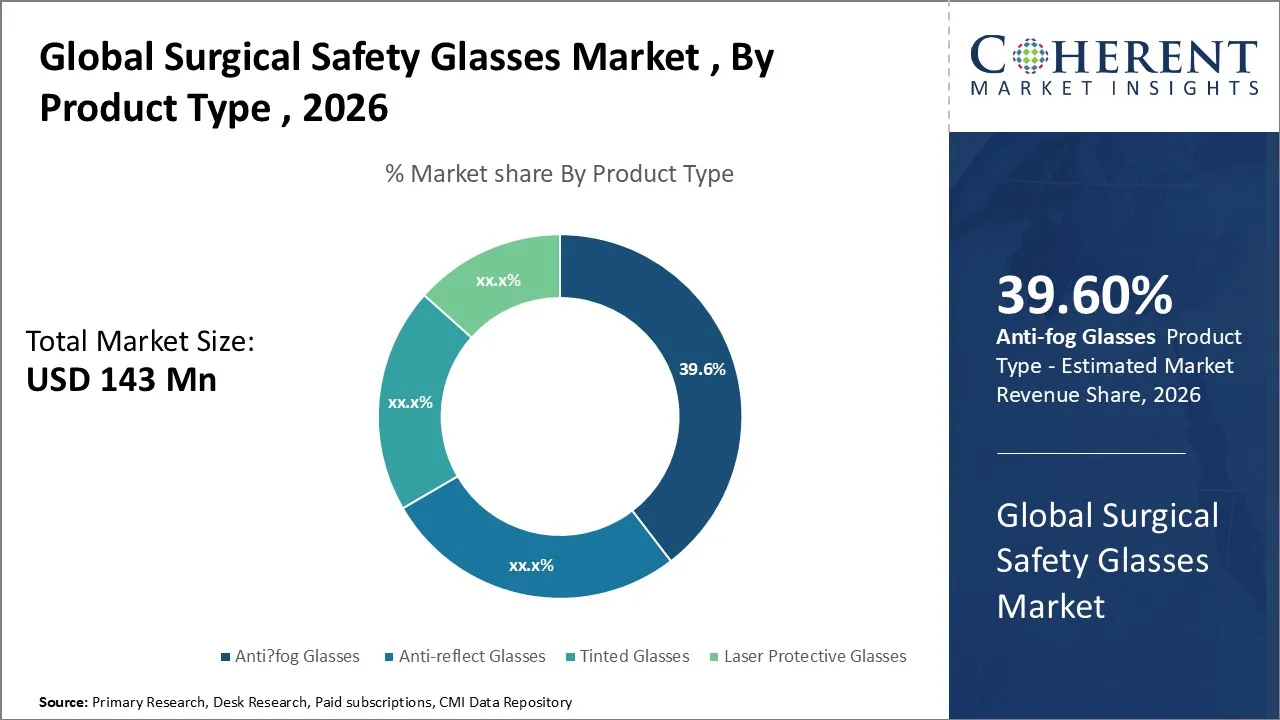
Surgical Safety Glasses Market Insights, By Product Type - Improved Visibility During Surgical Procedures Drives Preference for Anti ‑ fog Glasses
In terms of product type, the anti‑fog glasses segment contributes the highest share of 39.60% in 2026 of the market owing to its critical role in maintaining clear vision during procedures. Surgeons need uninterrupted visibility, which makes anti-fog technology essential in operating rooms. The segment is growing because these glasses prevent moisture buildup that happens from temperature changes and breathing. Hospitals choose anti-fog glasses since they reduce surgical delays and boost safety levels. Also, better coating technologies now provide long-lasting fog resistance, which drives greater usage among medical professionals.
Surgical Safety Glasses Market Insights, By Distribution Channel - Hospitals Leads with Strict Safety Compliance
In terms of distribution channel, the hospitals segment contributes the highest share of 53.40% in 2026 of the market owing to high volume usage and bulk buying power. Hospitals perform thousands of surgeries annually, which creates steady demand for quality protective eyewear across departments. This segment is growing because healthcare facilities are growing their surgical capabilities and upgrading safety equipment regularly. Hospitals also maintain strict quality standards and prefer direct buying relationships with manufacturers for better control. The rising surgical procedures globally, alongside better healthcare infrastructure investments, fuel greater hospital spending on safety equipment.
For instance, in August 2023, Oyster & Pearl Hospitals (ONP Hospitals) and Jehangir Speciality Hospital in Kothrud and Camp, Pune, introduced groundbreaking AI-driven advancements in the robotic joint replacement surgery. This pioneering technology, Robo3wiz Roboalign Hololens 2, integrates smart glasses with AI and AR to boost surgical accuracy, enhance patient results, and transform joint replacement procedures.
Regional Insights
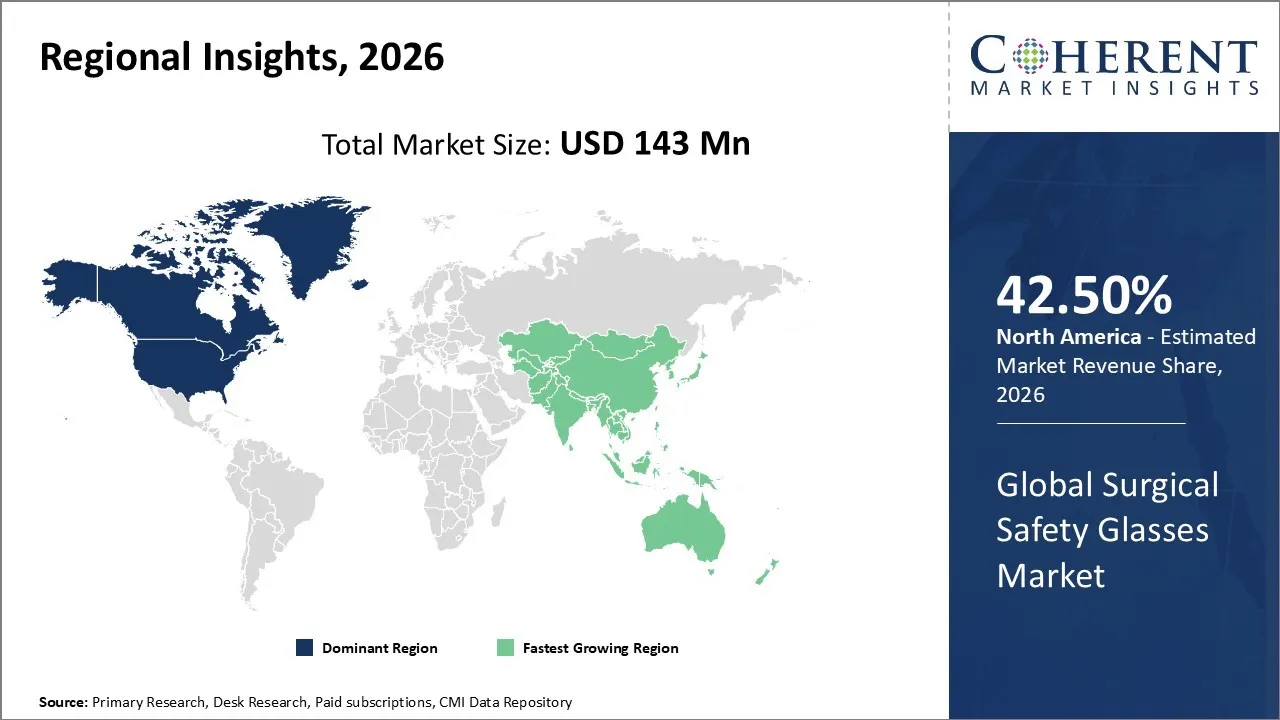
North America Surgical Safety Glasses Market Analysis & Trends
North America has remained the dominant region with 42.50% in 2026 of the global Surgical Safety Glasses Market over the past decade owing to its cutting-edge healthcare system and high number of surgical procedures. The region has numerous top-quality hospitals and medical centers that focus on using the best safety equipment for their staff. Countries like the US and Canada have strict workplace rules, which require healthcare workers to use safety glasses during surgeries.
The region is growing because healthcare spending keeps rising across North America. Many hospitals are investing more money in state-of-the-art surgical technologies and safety equipment to improve patient care and protect staff better. Also, the aging population needs more surgeries, which increases the demand for quality protective eyewear. The region boasts a presence of major manufacturers who keep introducing new and better products to the market.
The region’s focus on preventing hospital infections and improving surgical safety standards is also helping the market growth. Insurance coverage for medical procedures assists hospitals in upgrading their equipment regularly. This makes North America the most profitable and stable industry globally.
For instance, in August 2022, Univet Optical Technologies North America partnered with NDS to broaden access to Univet’s safety eyewear for healthcare professionals and patients across Canada and the US.
Asia Pacific Surgical Safety Glasses Market Analysis & Trends
Asia Pacific is experiencing rapid growth due to expanding healthcare infrastructure and rising surgical procedural volumes. The region has numerous hospitals and medical facilities that are upgrading their safety equipment to meet international standards. Countries like India, China, and Japan are implementing stricter workplace safety regulations, which require medical professionals to use protective eyewear during procedures.
The region is growing because healthcare investments keep increasing significantly across Asia-Pacific nations. Governments are spending more money on improving medical facilities and purchasing advanced safety equipment for healthcare workers. Also, the large and aging population needs more surgeries, which boosts demand for quality protective eyewear substantially.
The region’s emphasis on following global healthcare standards and minimizing infections propels the surgical safety glasses market to grow at a faster rate. The decreasing cost of manufacturing attracts global manufacturers to set up production facilities in this region. Asia Pacific remains the fastest-growing and most promising market for surgical safety glasses in the world.
Surgical Safety Glasses Market Outlook Country-Wise
The U.S. Surgical Safety Glasses Market Trends
The U.S. leads the market based on its advanced healthcare system and high number of surgeries performed. The country has the toughest safety standards in the working environment, which ensures the use of protective eyewear in all health facilities. Healthcare expenditure per capita remains high compared to other countries in the world, thereby allowing regular advancements in healthcare technology and upgrades of equipment.
Hospitals primarily focus on worker safety and infection control, thereby offering continuous demand for high-quality protective eyewear. Many major manufacturers are based in the U.S. and develop new healthcare safety technologies that are consistently introduced to the market. The increased number of surgeries among the boomer generation due to aging demands continuous growth in the demand for protective equipment.
China Surgical Safety Glasses Market Trends
China takes the leading position based on its large expansion of the medical sector and huge population. The country conducts millions of operations every year, leading to massive demand for safety glasses at hospitals. The government continues to invest heavily in medical improvement initiatives and countries countrywide. The increasing income of the middle class permits many people to acquire quality medical attention and operations. Also, the presence of huge manufacturers in the Chinese government’s efforts to adopt stringent medical safety regulations results in the massive adoption of safety gear at hospitals. Increased medical tourism and awareness of workplace safety also contribute to fueling market growth in the Chinese market.
Market Report Scope
Surgical Safety Glasses Market Report Coverage
| Report Coverage | Details | ||
|---|---|---|---|
| Base Year: | 2025 | Market Size in 2026: | USD 143 Mn |
| Historical Data for: | 2020 To 2024 | Forecast Period: | 2026 To 2033 |
| Forecast Period 2026 to 2033 CAGR: | 9.1% | 2033 Value Projection: | USD 263 Mn |
| Geographies covered: |
| ||
| Segments covered: |
| ||
| Companies covered: | BERNER International GmbH, Spectronics Corporation, NoIR Medical, Ikbolo, 3M, Carhartt, Mcr Safety, Uvex, Lincoln Electric, Miller, Pyramex Safety, Smith and Wesson, Wiley X, Kimberly Clark Professional, and Jackson Safety. | ||
| Growth Drivers: |
| ||
| Restraints & Challenges: |
| ||
Surgical Safety Glasses Market Drivers
Rise in surgical procedures
Rising surgical procedures performed worldwide act as the primary driver for the growth in the market. Hospitals and surgical centers around the world are performing millions more surgical procedures every year, thus generating a growing need for surgical safety glasses. The reason for this accelerated growth is the rapidly aging population in the world. There is a rising number of lifestyle-related health concerns, which impact the demand favorably. Higher incomes translate to more patients undergoing elective and cosmetic surgeries worldwide. There has been increased medical tourism activity, which translates to more patients seeking cheaper surgical options in other countries. These consequently drive the demand for surgical safety equipment worldwide.
There has been progress in the area of minimally invasive surgeries, making them safer for patients to undergo. With rising incomes, people are in a position to afford surgical procedures, both elective and cosmetic. As health problems related to lifestyle rise, so does the need for surgical procedures. Insurance coverage is also an area that has led to more patients being able to undergo the necessary surgical procedures. Patients are adopting the practice of traveling to foreign countries in search of less costly surgical solutions, thereby increasing the need for surgical safety products.
Surgical Safety Glasses Market Trends
Strict safety regulations
Strict healthcare safety regulations are opening vast market opportunities for the surgical safety glass market. Today, regulatory authorities across the world are enforcing the use of protective eyewear in operation theaters to protect healthcare professionals from bloodborne pathogens and harmful liquids.
The regulations influence innovation in products in several ways. The regulations ensure that products have certain specifications in impact resistance, optical clarity, and fluid protection that companies must adhere to. The regulations ensure the standard of quality in healthy lines for medical institutions. This ensures that surgical goggles are not an expense but a necessity in budgeting by medical institutions.
Similar safety measures are being followed in the emerging markets while upgrading the healthcare infrastructure. This consistency in regulations has widened the addressable market. The insurers demand documentation of the usage of protective tools during the procedure. This further leads to the establishment of consistent demand. The suppliers with compliance certifications of multiple international standards have a competitive edge in the sector.
Analyst Opinion (Expert Opinion)
- The surgical safety glasses market is demonstrating steady expansion, supported by increasing emphasis on occupational eye protection and stricter compliance with clinical safety protocols across healthcare facilities. Data from hospital procurement trends indicate a consistent rise in the adoption of protective eyewear among surgeons, nurses, and operating room staff, particularly in high-exposure surgical environments. Eye protection is increasingly being standardized as part of mandatory surgical attire in operating rooms and procedural suites.
- Product-level analysis shows strong demand for wraparound and full-coverage safety glasses, as these designs offer improved protection against fluid splashes, aerosols, and particulate matter. Anti-fog and anti-scratch lens technologies have become key purchasing criteria, with procurement data indicating higher repeat orders for products that maintain visual clarity during long surgical procedures. Departments such as general surgery, orthopedics, trauma care, and dental surgery account for a substantial share of product utilization due to higher procedural volumes and exposure risk.
- From a regional perspective, North America remains a leading contributor due to well-established occupational safety regulations and high procedural density in hospitals and ambulatory surgical centers. Europe follows closely, driven by standardized safety guidelines and modernization of surgical infrastructure. Asia Pacific is witnessing accelerated adoption as healthcare facilities expand and clinician safety awareness increases.
- End-user analysis highlights hospitals as the dominant demand centers, while ambulatory surgical centers contribute incremental growth. Overall, the market outlook remains positive, supported by procedural volume growth, product innovation, and sustained focus on surgical staff safety.
Speak to the analyst
Want personalized insights?
Take the findings above to one of our principal consultants, or have the report rebuilt around the segments, geographies and competitors you actually track.
Surgical Safety Glasses Industry News
- In November 2025, Snke, an expert in data-driven health tech, unveiled SnkeXR. This open platform augmented reality (AR) glasses solution caters to the medical grade standards for clinical and surgical use.
- In October 2025, University Hospitals of North Midlands NHS Trust (UHNM) surgeons were the first in the UK to utilize new virtual reality tech for spinal operations. They debuted the Magic Leap system at the Royal Stoke University Hospital, enabling them to view precise 3D images of a patient's spine during surgery through specialized virtual reality goggles.
- In May 2023, NuEyes, a leader in augmented reality smart glass technology, unveiled its next generation, the NuLoupes smart glasses. These glasses aim to transform the surgical and dental loupe market.
- In July 2022, Rods&Cones and Smith+Nephew, a medical technology business, partnered to provide consumers digital remote support and smart surgery eyewear. By supplying customers with smart surgery glasses, Smith+Nephew representatives can view procedures from the perspective of the surgeon, instrumental nurse, or any healthcare professional using them. This feature makes it possible to provide remote assistance before to, during, and following surgical procedures.
Market Segmentation
- Product Type Insights (Revenue, USD Mn, 2020 - 2033)
- Anti-fog Glasses
- Anti-reflect Glasses
- Tinted Glasses
- Laser Protective Glasses
- Distribution Channel Type Insights (Revenue, USD Mn, 2020 - 2033)
- Hospitals
- Retail Stores
- Online Channels
- Others
- Regional Insights (Revenue, USD Mn, 2020 - 2033)
- North America
- U.S.
- Canada
- Latin America
- Brazil
- Argentina
- Mexico
- Rest of Latin America
- Europe
- Germany
- U.K.
- France
- Italy
- Russia
- Rest of Europe
- Asia Pacific
- China
- India
- Japan
- Australia
- South Korea
- ASEAN
- Rest of Asia Pacific
- Middle East & Africa
- GCC Countries
- South Africa
- Rest of Middle East & Africa
- North America
- Key Players Insights
- BERNER International GmbH
- Spectronics Corporation
- NoIR Medical
- Ikbolo
- 3M
- Carhartt
- Mcr Safety
- Uvex
- Lincoln Electric
- Miller
- Pyramex Safety
- Smith and Wesson
- Wiley X
- Kimberly Clark Professional
- Jackson Safety
Sources
Primary Research Interviews
- Surgical Safety Glasses Manufacturers
- Medical Device & PPE Manufacturers
- Hospital Procurement & Supply Chain Managers
- Surgeons, Nurses & Operating Room Staff
- Infection Control & Occupational Safety Officers
- Healthcare Distribution & OEM Partners
- Others
Databases
- Bloomberg Terminal
- Thomson Reuters Eikon
- Others
Magazines
- Medical Device and Diagnostic Industry (MDDI)
- Healthcare Packaging Magazine
- Infection Control Today
- OR Manager
- Medical Product Outsourcing
- Others
Journals
- Journal of Hospital Infection
- American Journal of Infection Control
- Journal of Surgical Research
- BMJ Open
- The Lancet Digital Health
- Others
Newspapers
- Financial Times
- The Wall Street Journal
- Reuters
- Bloomberg News
- The Economic Times
- Others
Associations
- Association of periOperative Registered Nurses (AORN)
- World Health Organization (WHO)
- Occupational Safety and Health Administration (OSHA)
- International Safety Equipment Association (ISEA)
- Healthcare Infection Control Practices Advisory Committee (HICPAC)
- Others
Public Domain Sources
- U.S. Food and Drug Administration (FDA) – Medical Device Databases
- Centers for Disease Control and Prevention (CDC)
- World Health Organization (WHO) – Infection Prevention Guidelines
- European Commission – Medical Devices Regulation (MDR)
- National Institute for Occupational Safety and Health (NIOSH)
- Others
Proprietary Elements
- CMI Data Analytics Tool
- Proprietary CMI Existing Repository of Information for the Last 8 Years
*Definition: The surgical safety glasses market provides eye protection for doctors, nurses, and medical staff during surgeries and procedures. It provides specially called glasses that help hospitals and clinics keep their team safe and meet required health and safety rules. Companies utilize these markets to ensure compliance with occupational safety standards, protect medical staff from infectious materials, and maintain sterile operating conditions. These include face shields, goggles with anti-fog coatings, and laser eyewear.
Get access to 250+ pages report
Every segment, forecast, competitor profile and data table behind the analysis above — available for instant download.
- ESOMAR Member
- ISO 9001:2015 Certified
- D-U-N-S Registered
- GDPR & CCPA Compliant
Missing comfort of reading report in your local language? Find your preferred language:
Transform your Strategy with Exclusive Trending Reports
Frequently Asked Questions
The Surgical Safety Glasses Market is estimated to be valued at USD 143 Mn in 2026, and is expected to reach USD 263 Mn by 2033.
The CAGR of the Surgical Safety Glasses Market is projected to be 9.1% from 2026 to 2033.
Rise of surgical procedures and technological upgrades are the major factors driving the growth of the Surgical Safety Glasses Market.
Strict government regulations and a lack of a suitable reimbursement for glasses are the major factors hampering the growth of the Surgical Safety Glasses Market.
In terms of product type, the anti‑fog glasses segment is estimated to dominate the market revenue share in 2026.
BERNER International GmbH, Spectronics Corporation, NoIR Medical, Ikbolo, 3M, Carhartt, Mcr Safety, Uvex, Lincoln Electric, Miller, Pyramex Safety, Smith and Wesson, Wiley X, Kimberly Clark Professional, and Jackson Safety the major players.
North America is expected to lead the Surgical Safety Glasses Market in 2026.