

Electroceutical Devices Market Size and Forecast — 2024 - 2031
Electroceuticals is recently coined term for an old therapeutic modality, which broadly encompass all the bioelectric medicine. It includes any type of electrical stimulation, which affects and modify functions of the body and neural implants such as cochlear implants, retinal implants or spinal cord stimulators, cardiac pacemakers, and implantable defibrillators. Over a period of time, electroceutical expanded their applicability to include deep brain stimulation and the electrical stimulation of the vagus nerve. Electroceuticals are also called as bioelectronics, which encompass tiny electronic implants, which are capable to treat wide range of chronic diseases such as chronic pain, heart ailments, ophthalmic disease, neurological diseases, hearing disorders and gastrointestinal diseases.
Bioelectric medicine is an innovative approach to diagnose and treat injuries and diseases, as all major organs of the body are connected to the nerves, which allows the brain to monitor and regulate the functions of the organs. Bioelectric medicine refers to the usage of a device to modulate and read the electrical activity within the body’s nervous systems. Nerve blocking devices or nerve stimulating devices that are held against the skin or implanted on a nerve have the potential to regulate specific nerve activity, make specific changes in organ function, and also restore health without side effects of pharmaceutical agents. Bioelectric medicine technology is used to record, block, and stimulate neural signals, which can be used to the change the way diseases and injuries are treated. Biogenetic medicine are also used for the treatment of conditions such as cancer, paralysis, rheumatoid arthritis, and diabetes.
The global electroceutical devices market size was valued at US$ 16,141.8 Mn in 2017, and is expected to witness a CAGR of 6.8% over the forecast period (2018 – 2026).
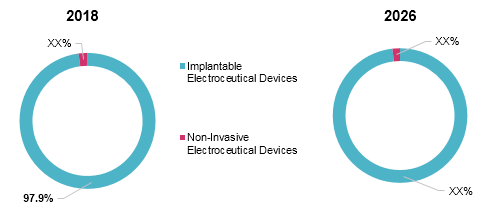
Global Electroceutical Devices Market Share, By Modality: 2018 & 2026
Source: Coherent Market Insights Analysis (2018)
- Current Industry Events of 2024
- Market Size Estimation
- Regional Breakdown
- Competitive Landscape
- Customer Intelligence
- Segmental Analysis
- Pricing Analysis
- Key Market Drivers, Challenges & Future Trends
- Customized Insights Section
Increasing Engagement of Key Players to Accelerate Drug Discovery and Development Process is expected to Aid in the Market Growth
Collaborations, advancements in technology, innovations in the field of bioelectric medicines such as non-invasive devices are the major factors driving growth of the bioelectric medicine market. For instance, in October 2016, the U.S. National Institutes of Health (NIH) announced US$ 20 million funding for the treatment of disease with electrical stimulation, which aims to improve maps of the peripheral nervous system—the body’s electrical wiring—and generate sophisticated systems that can hack into its codes. Moreover, the funding is part of a US$ 248 million, seven-year program, which the NIH Common Fund announced in 2014.
Furthermore, in 2016, GlaxoSmithKline Plc. (GSK) merged with Google’s parent company Alphabet to set up a new bioelectric company called Galvani Bioelectronics, which will benefit over 2 billion people suffering from chronic diseases. GSK invested around US$ 615 million for the development of Galvani Bioelectronics.
High Prevalence of Chronic Diseases among Global Population is Propelling Demand for Electroceutical Devices
Other factors boosting growth of the bioelectric medicine market include increasing number of diseases in geriatric population such as cardiac arrhythmias, Parkinson’s disease, Alzheimer’s disease, epilepsy, and depression, and rise in chronic diseases such as neurological and cardiac disorders. For instance, according to a study conducted by Journal of Family Medicine and Primary Care in 2017, four major chronic diseases including cancer, cardiovascular disease, diabetes, and chronic respiratory diseases were the major cause for 82% deaths in India. According to a study conducted by World Health Organization (WHO), in 2017, non-communicable diseases are expected to contribute to death of 52 million people by 2030 globally.
According to the Data published in Current Pharmaceutical Design Journal in 2017, ion channel and neurotransmitter modulators can act as electroceutical approaches to control the cancer. Furthermore, in March 2014, Cancer-Code Corporation (C3) announced issuance of patent which entitles: Method and System for Processing Cancer Cell Electrical Signals for Medical Therapy, which covers an innovative approach to eradicate cancer in humans and animals. Moreover, high prevalence of cancer and increasing awareness regarding early detection and treatment of cancer is further expected to drive growth of the global electroceutical devices market. For instance, in 2012, according to American Cancer Society data findings, North America accounted for high incidence rate of cancer in children as compared to any other region worldwide. Moreover, according to the same source, in 2012, North America accounted for 13.1% of total estimated cases of cancer worldwide.
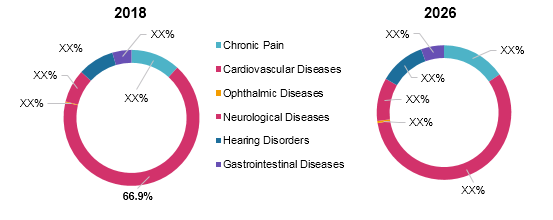
Global Electroceutical Devices Market Share, By Application: 2018 & 2026
Source: Coherent Market Insights Analysis (2018)
Furthermore, increasing incidence of diabetes mellitus worldwide is expected to drive growth of the market. For instance, according to the World Health Organization (WHO), 2016, an estimated 422 million adults are suffering from diabetes. The major spike in incidence of type 2 diabetes over the last decade (2006-2016) is mainly attributed to high prevalence of obesity.
Moreover, electrical stimulation and electroceutical treatment effectively restores injury, expediting normal healing and reducing chronic inflammation, biofilms, infection and associated symptoms, such as pain and high exudate. Electroceutical therapy for wound management uses a small, targeted, electrical current to create a physiological change that recompense the impaired biological functions in the wound, starting the healing process in the wound. Synapse electroceutical Ltd.: a medical technology company from U.K. offers AccelHeal: a small disposable class IIa portable medical device. Accel-Heal uses the patented Synapse Sequence programmed technology to promote healing in leg ulcers through the use of electroceutical energy.
Moreover, high prevalence of wound and ulcers among the global population is expected to augment growth of the electroceutical devices market. For instance, according to National Pressure Ulcer Advisory Panel, 2017 data findings, 2.5 million patients develop pressure ulcer annually, in U.S. Furthermore, pressure ulcer shows national incidence rate of 2.5% in hospitals.
Key players operating in electroceutical devices market include Medtronic plc, Abbott Laboratories, Cochlear Ltd. Sonova Holding AG, Advanced Bionics AG, Boston Scientific Corporation, electroCore, Inc., Biotronik, ReShape Lifesciences, Inc., and LivaNova, PLC.
Get access to 250+ pages report
Every segment, forecast, competitor profile and data table behind the analysis above — available for instant download.
- ESOMAR Member
- ISO 9001:2015 Certified
- D-U-N-S Registered
- GDPR & CCPA Compliant
Missing comfort of reading report in your local language? Find your preferred language:
Transform your Strategy with Exclusive Trending Reports
Frequently Asked Questions
The global electroceutical devices market is estimated to surpass US$ 28.9 Billion by 2026.
Major players operating in the global electroceutical devices market include Medtronic plc, Abbott Laboratories, Cochlear Ltd. Sonova Holding AG, Advanced Bionics AG, Boston Scientific Corporation, electroCore, Inc., Biotronik, ReShape Lifesciences, Inc., and LivaNova, PLC.
Among product type, implantable cardioverter defibrillators segment accounted for highest revenue share in market, owing to its wide application in various heart disease conditions.
High prevalence of chronic diseases among global population is one of the major factors that is expected to propel growth of the market over the forecast period.
The global electroceutical devices market is estimated to exhibit a CAGR of 6.8% over the forecast period.
Electroceuticals are also called as bioelectronics, which encompass tiny electronic implants that are capable to treat wide range of chronic diseases. High prevalence of chronic diseases across the globe is one of the major factors that is influencing adoption of electroceutical devices globally.