

Micro Injection Molding Medical Devices Market Size and Share Analysis – 2026 To 2033
The Micro Injection Molding Medical Devices Market size is anticipated to grow at a CAGR of 5.9%, with USD 2.09 Bn in 2026, and is expected to reach USD 3.12 Bn by 2033. The primary drivers are largely defined by the rising demand for miniaturized medical devices, increasing adoption of minimally invasive surgical procedures, growing use of high-precision polymer components in diagnostic and drug-delivery devices, and continued advancements in micro-scale manufacturing technologies. According to Intuitive Surgical, worldwide da Vinci and Ion procedures increased approximately 16% year-over-year in Q2 2026, while the installed base of da Vinci systems reached 11,710 systems, up 12% from 10,488 systems in Q2 2025.
Key Takeaways
- The Polyether Ether Ketone (PEEK) segment is expected to dominate the Micro Injection Molding Medical Devices Market with approximately 29.0% share in 2026. The segment’s growth is owing to PEEK’s high mechanical strength, biocompatibility, chemical resistance, sterilization compatibility, and increasing use in implantable and precision medical components. Victrex reported that approximately 15 million medical devices incorporating its PEEK-OPTIMA polymers have been implanted globally.
- The Clinical Diagnostic and Testing Devices segment is anticipated to lead the market with approximately 42.0% share in 2026. The segment’s growth is owing to the increasing adoption of point-of-care testing, miniaturized diagnostic cartridges, sample containers, microfluidic components, and high-volume disposable diagnostic devices requiring precise polymer molding. Abbott reported USD 8.94 billion in global Diagnostics sales in 2025, including USD 606 million from Point of Care diagnostics.
- North America is expected to acquire the prominent share of approximately 39.0% in 2026. The region’s growth is owing to its extensive medical-device manufacturing base, high adoption of minimally invasive technologies, established precision-molding capabilities, strong R&D investment, and rapid commercialization of advanced medical devices. According to AdvaMed, the U.S. medtech industry generates more than USD 250 billion in annual output, operates approximately 16,000 manufacturing facilities, and invests over USD 20 billion annually in R&D. Device marketing authorizations, highlighting the region’s strong medical-device innovation ecosystem.
Market Drivers
Rising Adoption of Minimally Invasive and Robotic Procedures is Driving Demand for Micro-Molded Medical Components
The Micro Injection Molding Medical Devices Market is gaining momentum owing to the increasing adoption of minimally invasive and robotic-assisted procedures. Such procedures require ever smaller and more complex catheters, endoscopic instruments, cannulas, connectors, sensors and surgical instruments, which are in great demand for high-precision molding technologies.
Intuitive Surgical said in 2026 that worldwide da Vinci and Ion procedures increased about 16% year-over-year, and its installed base of da Vinci systems increased 12% to 11,710 systems. Procedures performed exclusively with ion grew by approximately 36%, illustrating the continuing rise of minimally invasive technologies.
Growing Point-of-Care and Miniaturized Diagnostic Devices are Expanding Micro Injection Molding Applications
Another significant driver of the Micro Injection Molding Medical Devices Market is the rapid growth of point-of-care diagnostics, microfluidic cartridges, wearable diagnostic systems, and compact biosensors. These devices often include very small polymer components, fluidic channels, housings, connectors and sensor interfaces that demand high dimensional accuracy and repeatable high-volume manufacturing.
In February 2026, bioMérieux reported that its SPOTFIRE point-of-care molecular diagnostic platform generated EUR 168 million in 2025 sales, representing an 84% increase, while test volumes increased by more than 100%. The installed base of SPOTFIRE systems reached approximately 6,400 instruments at the end of 2025, up 110% compared with 2024.
Current Events and Their Impact
Current Event | Description and its Impact |
FDA Quality Management System Regulation (QMSR) Becomes Effective in the U.S. (2026) |
|
FDA Expands Unannounced Foreign Manufacturing Inspections (2025–2026) |
|
- Current Industry Events of 2026
- Market Size Estimation
- Regional Breakdown
- Competitive Landscape
- Customer Intelligence
- Segmental Analysis
- Pricing Analysis
- Key Market Drivers, Challenges & Future Trends
- Customized Insights Section
Segmental Insights
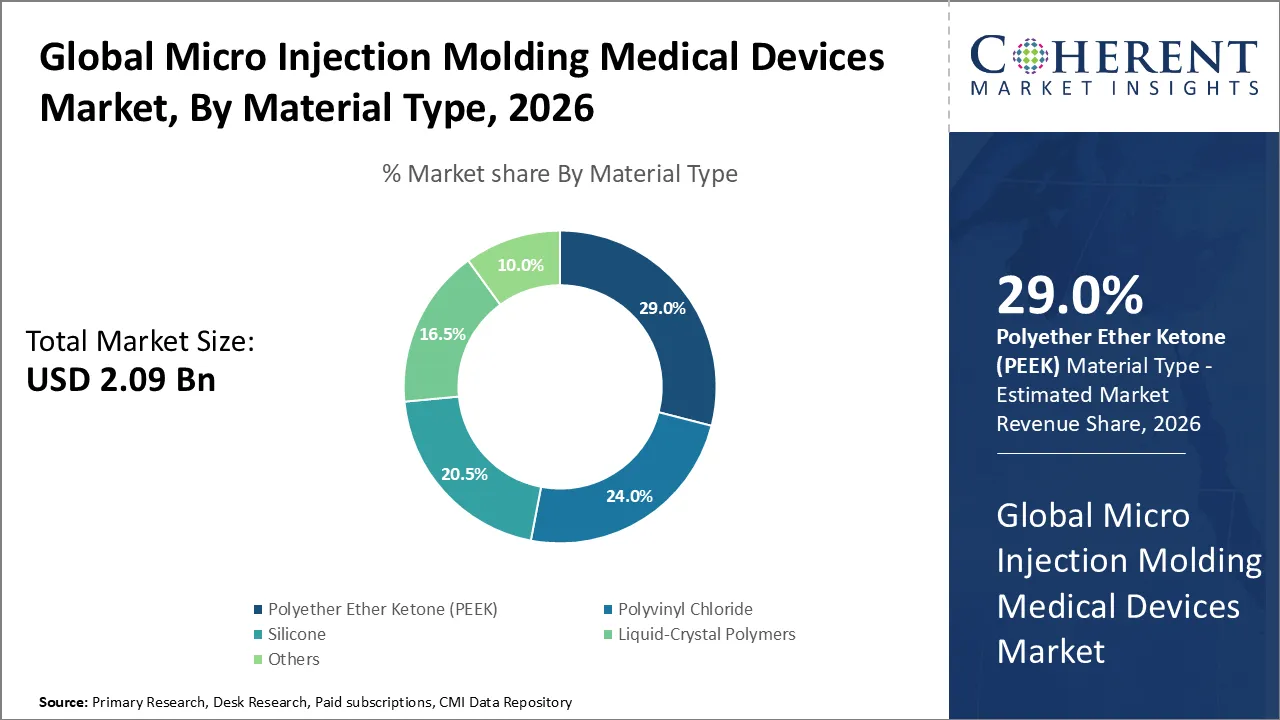
Why is Polyether Ether Ketone (PEEK) Acquiring the Largest Share?
On the basis of material type, the Polyether Ether Ketone (PEEK) segment is projected to account for the largest Micro Injection Molding Medical Devices Market share of approximately 29.0% in 2026. The segment’s growth is owing to PEEK’s combination of high mechanical strength, biocompatibility, chemical resistance, dimensional stability, sterilization compatibility, and suitability for precision processing. These characteristics support its use in implantable components, surgical instruments, dental devices, orthopedic products, and other medical components requiring tight dimensional tolerances.
In April 2024, the U.S. FDA granted 510(k) clearance to 3D Systems’ VSP PEEK Cranial Implant, a patient-specific cranial implant manufactured using material extrusion and implant-grade Evonik VESTAKEEP i4 3DF PEEK. The device is designed individually from patient CT data and is intended to fill cranial bone defects, demonstrating the growing regulatory acceptance of medical-grade PEEK in customized implant applications.
Clinical Diagnostic and Testing Devices Hold the Largest Market Share
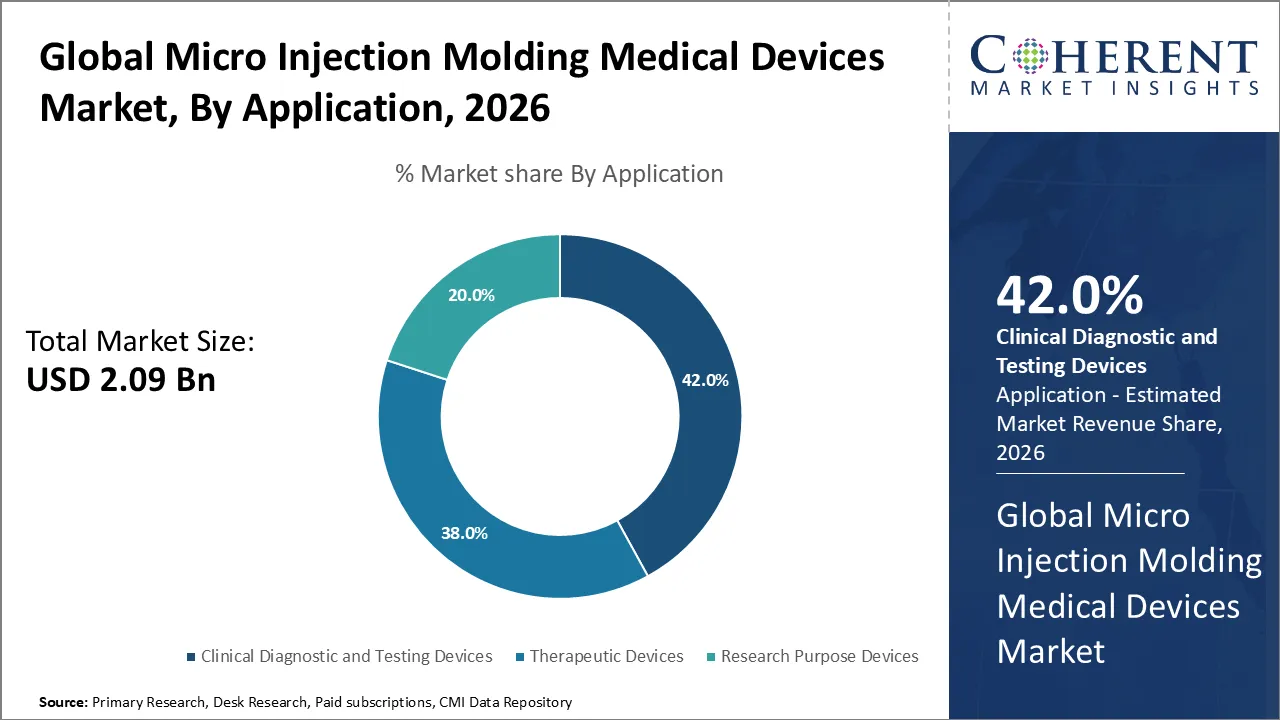
On the basis of application, the Clinical Diagnostic and Testing Devices segment is anticipated to lead the Micro Injection Molding Medical Devices Market with approximately 42.0% share in 2026. The segment’s growth is owing to increasing deployment of point-of-care testing devices, disposable diagnostic cartridges, sample containers, microfluidic systems, and compact molecular diagnostic platforms. Such products require highly repeatable molded components incorporating small fluid pathways, chambers, connectors, and complex geometries.
The scale of diagnostic consumables provides strong support for this application. In 2025, Danaher generated approximately USD 10.0 billion in revenue from its Diagnostics segment, of which 89% of segment revenue was recurring, mainly comprising consumables and services. This high proportion of recurring revenues demonstrates the large ongoing requirement for disposable diagnostic products used in hospitals, laboratories, physicians’ offices, and other testing settings.
In January 2026, Danaher reported roughly USD 500 million in Cepheid respiratory revenue for Q4 2025, and highlighted FDA clearance of the Xpert GI Panel, which detects 11 gastrointestinal pathogens from a single patient sample.
Micro Injection Molding Medical Devices Market Trends
- The growing miniaturization of medical devices is driving demand for sub-gram, micron-tolerance molded components for minimally invasive devices, diagnostics, drug delivery and patient-monitoring systems. In June 2026, Cordica Medical acquired RapidWerks’ micro-molding capabilities, including fully automated equipment that can manufacture parts weighing a fraction of a gram and expanding its abilities to the sub-gram, micron-tolerance range.
- The increasing adoption of automation, robotics, and in-line inspection is improving repeatability and reducing production variability in medical micro molding. Freudenberg Medical’s Baldwin Park Technical Center for Automation and Robotics operates 54 molding machines ranging from 5 to 350 tons and incorporates automated cavity separation, assembly, packaging, and in-line inspection within ISO Class 7 and 8 cleanrooms.
- The increasing focus on regionalized and nearshore medical-device manufacturing is reshaping micro-molding supply chains as OEMs seek greater production resilience, shorter lead times, and manufacturing closer to major healthcare markets. In April 2026, Quasar Medical opened its third manufacturing facility in Chonburi, Thailand, expanding capacity for interventional and minimally invasive medical devices.
Regional Insights
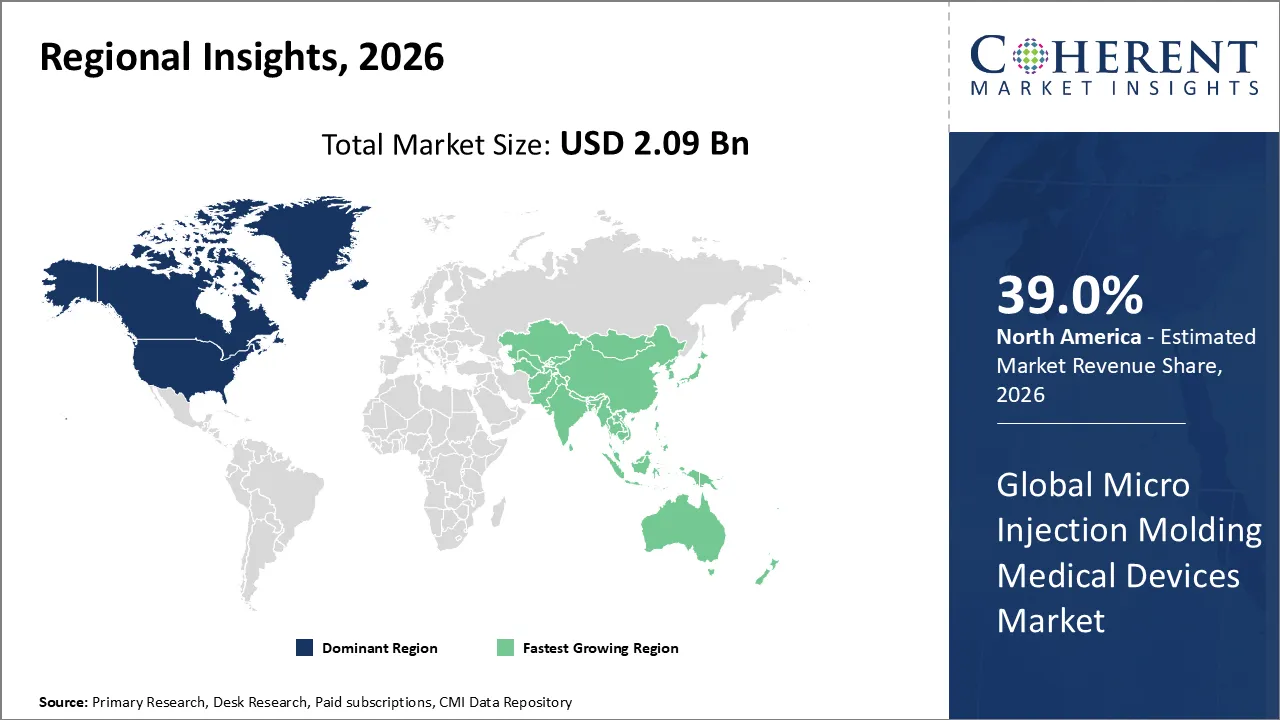
North America Dominates Owing to the Established Medical Device Manufacturing and Precision Molding Infrastructure
North America is expected to account for the prominent 39.0% share of the Micro Injection Molding Medical Devices Market in 2026. The region’s growth is owing to its large medical-device manufacturing base, extensive cleanroom molding infrastructure, high adoption of minimally invasive and diagnostic technologies, and strong capabilities in automated high-precision injection molding.
In January 2026, Rosti North America announced new ISO Class 8 cleanrooms at its Wisconsin and Utah facilities to expand production for regulated medical and life-sciences customers. The new Germantown, Wisconsin, cleanroom covers more than 3,000 square feet and incorporates a 300-ton injection-molding press with integrated automation, highlighting continued investment in high-precision medical molding capacity in the U.S.
The region also has substantial established production capacity. Phillips Medisize's Hudson, Wisconsin facility operates a 285,000-square-foot manufacturing footprint with 63,900 square feet of ISO Class 7 and 8 cleanrooms and supports production volumes of up to 300 million units annually for applications including point-of-care diagnostic consumables and injectable drug-delivery platforms.
Asia Pacific Micro Injection Molding Medical Devices Market Trends
Asia Pacific is expected to be the fastest-growing region over the forecast period. The region’s growth is owing to increasing localization of medical-device manufacturing, government incentives for high-precision device production, expansion of advanced manufacturing ecosystems, and rising production of diagnostic, implantable, surgical, and drug-delivery devices.
In July 2026, the Government of India reported that its Production Linked Incentive Scheme for Medical Devices, with an outlay of INR 3,420 crore, had approved 27 applications, including 14 MSMEs. Approved projects had generated INR 1,153.07 crore in actual investment and commenced domestic manufacturing of advanced products including heart valves, stents, MRI systems, CT systems, and other high-precision medical devices. Such manufacturing localization is expanding the addressable supplier base for precision-molded medical components.
Domestic MedTech Manufacturing Expansion and Precision Production Capabilities are Accelerating the Micro Injection Molding Medical Devices Market in the United States
The U.S. Micro Injection Molding Medical Devices Market is witnessing strong growth owing to the expansion of domestic medical-device manufacturing, increasing demand for highly miniaturized components, and greater adoption of integrated precision molding for cardiovascular, catheter, diagnostic, and drug-delivery applications. Medical-device OEMs are increasingly seeking suppliers capable of combining micro-scale molding, cleanroom production, automated assembly, and validated manufacturing within a single production platform.
In July 2026, EPTAM Precision Solutions announced the production launch and volume ramp of precision components and assemblies for a Class III cardiovascular device platform. The program integrates precision thermoplastic injection molding, laser processing, ultrasonic welding, and final packaging across EPTAM's U.S. manufacturing network.
Domestic injection-molding capacity is also expanding. In October 2025, PAJUNK completed a 30,000-square-foot expansion of its U.S. headquarters in Georgia, tripled its cleanroom capacity, and added injection-molding manufacturing capabilities to support increasing demand for regional anesthesia and procedural medical products.
China Micro Injection Molding Medical Devices Market Trends
China is expected to witness strong growth in the Micro Injection Molding Medical Devices Market over the forecast period. The growth is owing to the rapid expansion of the domestic medical-device industry, increasing localization of high-end devices, greater use of disposable interventional and diagnostic products, and government initiatives supporting advanced medical-device manufacturing and new materials.
China is simultaneously strengthening manufacturing-quality requirements. The National Medical Products Administration revised its Good Manufacturing Practice for Medical Devices, with the new GMP scheduled to take effect on November 1, 2026. The regulation incorporates updated lifecycle risk-management and quality-management requirements for medical-device manufacturers.
Large Medical Device Base and Expanding Precision Manufacturing Capabilities are Accelerating the Micro Injection Molding Medical Devices Market in the United States
The U.S. Micro Injection Molding Medical Devices Market is witnessing strong growth owing to the country's large medical-device industry, increasing development of miniaturized interventional and diagnostic devices, and established capabilities in precision polymer processing, cleanroom manufacturing, and automated assembly.
According to SelectUSA, the U.S. accounted for approximately 46% of global medical-device sales in 2024, while the country's medical-device industry cluster employs more than 285,000 people. This large downstream device-manufacturing ecosystem creates sustained requirements for precision-molded components used in catheters, surgical instruments, diagnostic systems, drug-delivery devices, and implantable products.
Domestic product-development infrastructure is also expanding. In November 2025, TE Connectivity expanded its PROPELUS medical-device prototype network with two new U.S. centers in Plymouth, Minnesota, and Wilsonville, Oregon. The facilities incorporate capabilities including rapid prototyping, material testing, polymer processing, and advanced engineering for products such as interventional catheters and surgical-robotics devices.
China Micro Injection Molding Medical Devices Market Trends
China is expected to witness strong growth in the Micro Injection Molding Medical Devices Market over the forecast period. The growth is owing to accelerating localization of medical-device production, development of high-end implantable and interventional products, expansion of domestic MedTech clusters, and government policies encouraging new materials and advanced manufacturing processes.
In January 2026, the Shanghai government released an Action Plan for the full-chain development of the high-end medical-device industry, targeting more than 500 newly approved Class III medical-device registration certificates for the Chinese mainland and more than 100 new products approved for overseas markets by 2027.
Who are the Major Companies in Micro Injection Molding Medical Devices Industry
Some of the major key players in Micro Injection Molding Medical Devices Market are Accu-Mold LLC, SMC Ltd., Makuta, Inc. (a part of Sansyu Group of companies), MTD Micro Molding, Micromolding Solution Inc., Kamek Precision Tools, American Precision Products, Sovrin Plastics, BMP Medical, Stamm AG, PEXCO.
Key News
- In September 2026, Accu-Mold LLC announced a USD 33.25 million expansion of its Ankeny, Iowa manufacturing operations. The company plans to add approximately 53,000 square feet of manufacturing space to increase production capacity, including additional space for a quality laboratory and tool-maintenance equipment.
- In June 2026, MTD Micro Molding announced new investments and operational advances in precision micro-medical manufacturing. During the first five months of 2026, the company produced approximately 4 million components across 45 production molds, including tiny orthopedic implants, thin-wall components for minimally invasive procedures, bioresorbable implants, and multi-step overmolded devices.
Market Report Scope
Micro Injection Molding Medical Devices Market Report Coverage
Report Coverage | Details | ||
Base Year: | 2025 | Market Size in 2026: | USD 2.09 Bn |
Historical Data for: | 2020 to 2024 | Forecast Period: | 2026 to 2033 |
CAGR: | 5.9% | 2033 Value Projection: | USD 3.12 Bn |
Geographies covered: |
| ||
Segments covered: |
| ||
Companies covered: | Accu-Mold LLC, SMC Ltd., Makuta, Inc. (a part of Sansyu Group of companies), MTD Micro Molding, Micromolding Solution Inc., Kamek Precision Tools, American Precision Products, Sovrin Plastics, BMP Medical, Stamm AG, PEXCO | ||
Growth Drivers: |
| ||
Restraints & Challenges: |
| ||
Analyst Opinion
- The Micro Injection Molding Medical Devices Market is increasingly benefiting from the miniaturization of next-generation medical devices and expansion of dedicated micro-molding capacity. In May 2026, Nissha Medical Technologies broke ground on a new 50,000-square-foot facility in Wisconsin dedicated to precision micro molding. The expansion is expected to more than double the company’s capacity across toolmaking, automation, development, and injection molding, highlighting growing commercial demand for miniature and high-precision medical components.
- The market is also moving to cleanroom-based, highly automated production as medical OEMs demand tighter contamination control, repeatability and regulatory compliance. TEX Plastics added a new ISO Class 7 injection-molding cleanroom in the U.K. in October 2025 and three more KraussMaffei machines – two 100-ton and one 200-ton systems.
- Regionalized manufacturing and integrated contract-production models will further strengthen the market opportunity, especially as medical-device companies look to shorter supply chains and scalable production near large healthcare markets. In June 2025, Sanner Group commenced manufacturing at its new 60,500-square-foot facility in Greensboro, North Carolina, dedicated partly to injection-molded medical-device and pharmaceutical components. Across its global network, Sanner now operates approximately 28,500 square meters of production space and 11,000 square meters of ISO Class 7 and 8 cleanroom capacity, illustrating the increasing scale of specialized medical injection-molding infrastructure.
Speak to the analyst
Want personalized insights?
Take the findings above to one of our principal consultants, or have the report rebuilt around the segments, geographies and competitors you actually track.
Market Segmentation
- By Material Type (Revenue, USD Bn, 2021-2033)
- Polyether Ether Ketone (PEEK)
- Polyvinyl Chloride
- Liquid-Crystal Polymers
- Silicone
- Others
- By Application (Revenue, USD Bn, 2021-2033)
- Clinical Diagnostic and Testing Devices
- Sample Containers
- Rapid POC Testing Components
- Others
- Therapeutic Devices
- IV Set Components
- Bio-absorbable Products
- Surgical Components
- Others
- Research Purpose Devices
- Laboratory Disposables
- Others
- Clinical Diagnostic and Testing Devices
- Global Micro Injection Molding Medical Devices Market, By Region (Revenue, USD Bn, 2021-2033)
- North America
- U.S.
- Canada
- Latin America
- Brazil
- Mexico
- Argentina
- Rest of Latin America
- Europe
- Germany
- U.K.
- France
- Italy
- Spain
- Russia
- Rest of Europe
- Asia Pacific
- China
- India
- Japan
- Australia
- South Korea
- ASEAN
- Rest of Asia Pacific
- Middle East
- GCC
- Israel
- Rest of Middle East
- Africa
- South Africa
- Central Africa
- North Africa
- North America
- Key Players
- Accu-Mold LLC
- SMC Ltd.
- Makuta, Inc.
- MTD Micro Molding
- Micromolding Solution Inc.
- Kamek Precision Tools
- American Precision Products
- Sovrin Plastics
- BMP Medical
- Stamm AG
- PEXCO
Sources
Primary Research Interviews
- Medical micro injection molding manufacturers
- Medical device OEMs and contract manufacturers
- Precision mold and micro-tooling engineers
- Polymer and biomaterial specialists
- Medical device design and R&D professionals
- Quality assurance and regulatory affairs managers
- Procurement managers from diagnostic, surgical, and drug-delivery device companies
- Key opinion leaders (KOLs) in medical plastics and precision manufacturing
Databases
- U.S. Food and Drug Administration (FDA) Medical Device Databases
- European Commission – EUDAMED
- U.S. International Trade Commission (USITC)
- United Nations Comtrade Database
- World Bank
- Organisation for Economic Co-operation and Development (OECD)
- PubMed / National Library of Medicine
Magazines
- Medical Plastics News
- Medical Product Outsourcing
- Medical Design & Outsourcing
- Plastics Technology
- Mold Making Technology
- Medical Device and Diagnostic Industry (MD+DI)
Journals
- Journal of Micromanufacturing
- International Journal of Advanced Manufacturing Technology
- Journal of Manufacturing Processes
- Polymer Engineering & Science
- Journal of Materials Processing Technology
- Biomedical Materials
- Journal of Biomedical Materials Research
Newspapers
- Reuters
- The Wall Street Journal
- Financial Times
- The New York Times
- The Economic Times
Associations
- Society of Plastics Engineers (SPE)
- Advanced Medical Technology Association (AdvaMed)
- Medical Device Manufacturers Association (MDMA)
- MedTech Europe
- Plastics Industry Association (PLASTICS)
- Association for Manufacturing Technology (AMT)
- Society of Manufacturing Engineers (SME)
Public Domain Sources
- Company Annual Reports and Investor Presentations
- U.S. FDA 510(k), PMA, and De Novo Medical Device Databases
- European Commission Medical Device Regulation and EUDAMED Publications
- Government Medical Device Manufacturing and Trade Statistics
- Company Product Catalogs, Technical Datasheets, and Manufacturing Capability Documents
- Patent Databases such as WIPO, USPTO, and Google Patents
- University and Research Institution Publications on Micro Molding and Medical Polymers
- Regulatory Standards and Quality System Publications, including ISO 13485 and medical-device manufacturing guidelines
Proprietary Elements
- CMI Data Analytics Tool
- Proprietary CMI Existing Repository of Information for the Last 10 Years
Get access to 250+ pages report
Every segment, forecast, competitor profile and data table behind the analysis above — available for instant download.
- ESOMAR Member
- ISO 9001:2015 Certified
- D-U-N-S Registered
- GDPR & CCPA Compliant
Missing comfort of reading report in your local language? Find your preferred language:
Transform your Strategy with Exclusive Trending Reports
Frequently Asked Questions
The Micro Injection Molding Medical Devices Market is expected to reach USD 3.12 Billion by 2033, up from USD 2.09 Billion in 2026.
Major players operating in the global Micro Injection Molding Medical Devices Market include Accu-Mold LLC, SMC Ltd., Makuta, Inc., MTD Micro Molding, Micromolding Solution Inc., Kamek Precision Tools, American Precision Products, Sovrin Plastics, BMP Medical, Stamm AG, and PEXCO.
The high initial investment cost and complex mold design and tooling requirements are among the key factors hampering growth of the market.
The increasing adoption of minimally invasive medical devices and rising demand for miniaturized diagnostic and drug-delivery components are the key factors driving market growth.
The Micro Injection Molding Medical Devices Market is anticipated to grow at a CAGR of 5.9% between 2026 and 2033.
Among regions, North America is expected to dominate the global Micro Injection Molding Medical Devices Market with approximately 39.0% share in 2026, supported by its established medical-device manufacturing base, extensive cleanroom infrastructure, and strong precision-molding capabilities.
Micro injection molding is a precision manufacturing process used to produce very small and highly complex polymer components for medical devices. It supports applications requiring micron-level dimensional accuracy, including catheters, diagnostic components, drug-delivery devices, implants, and minimally invasive surgical products.