

Saliva Collection Devices Market Insights - 2026 to 2033
The saliva collection devices market is estimated to be valued at USD 3,978.6 Mn in 2026 and is expected to reach USD 8,266.6 Mn in 2033, exhibiting a compound annual growth rate (CAGR) of 10.8% from 2026 to 2033.
Key Takeaways
- Based on Site of Collection, the Whole Saliva segment is expected to hold 67.4% share of the market in 2026.
- Based on Product Type, the Saliva Collection Kits segment is expected to lead the market with 52% share in 2026.
- Based on Application, the Diagnostic & Pathology segment is projected to account for 43.8% share in 2026
- Based on Region, North America is set to lead the saliva collection devices market with 42.7% share in 2026. While, Asia Pacific is anticipated to be the fastest growing region.
Market Overview
Invasive diagnostic tests as a replacement for less painful and expensive blood draws are gaining tremendous growth in the recent past. Saliva collection devices have enormous growth trend, which is driven by widespread awareness about the advantages of saliva as a diagnostic medium coupled with growing number of publications supporting new and varied applications for saliva as a diagnostic medium. Various new tools are now available for saliva collections, which will lead to boost demand for saliva collection and diagnostics in the research and clinical environments.
Current Events and Its Impacts on the Saliva Collection Devices Market
Current Event | Description and its Impact |
Artificial Intelligence Integration in Diagnostics |
|
Global Mental Health Crisis and Stress Biomarker Research |
|
How accurate is the disease detection?
- Oral cancer: Saliva-based tests show 90–95% sensitivity in early detection.
- Diabetes: Salivary glucose correlates strongly with blood glucose (correlation coefficient r>0.8).
- Current Industry Events of 2026
- Market Size Estimation
- Regional Breakdown
- Competitive Landscape
- Customer Intelligence
- Segmental Analysis
- Pricing Analysis
- Key Market Drivers, Challenges & Future Trends
- Customized Insights Section
Segmental Insights
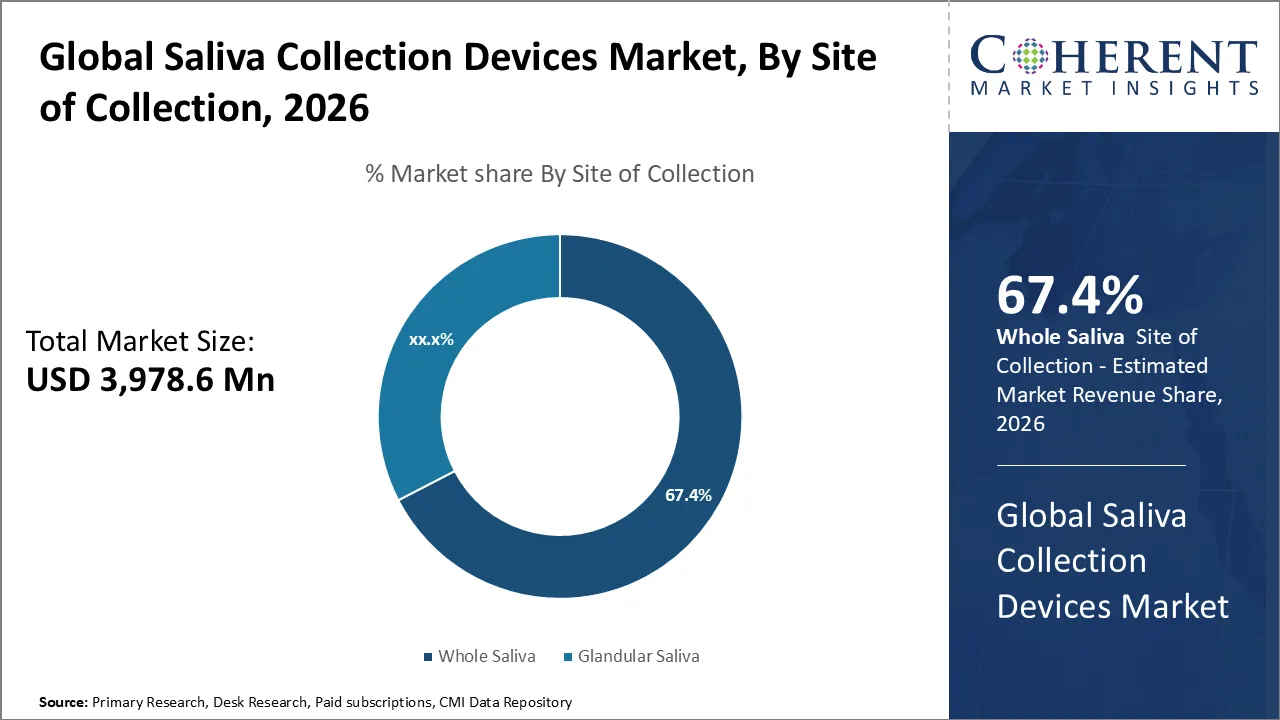
Saliva Collection Devices Market Insights, By Site of Collection: Whole Saliva due to ease, non‑invasiveness, and comprehensive biomarker coverage
In terms of site of collection, the whole saliva segment is expected to hold 67.4% share of the market in 2026. Since it is straightforward, non-invasive, and offers a thorough biomarker profile, whole saliva predominates. It is perfect for large-scale screenings, drug monitoring, and diagnostics because it collects secretions from all glands. The greatest market share is driven by its widespread adoption in clinical, forensic, and research settings due to its ease of collection.
For instance, the launch of Participant Sampling Packs by Salimetrics in 2026 shows the innovative potential of whole saliva collection. These kits make samples more reliable, make it easier for participants to collect samples, and speed up scientific discovery. They improve diagnostics, research, and biotech applications by making non-invasive saliva collection more consistent.
Saliva Collection Devices Market Insights, By Product Type: Saliva collection kits lead as standardized, reliable, and convenient tools ensuring sample integrity in testing
In terms of product type, the saliva collection kits segment is expected to lead the market with 52% share in 2026. Saliva collection kits are the best-selling products because they are easy to use, reliable, and have a standard design. They make sure that samples are safe, making them essential for diagnostics, genetic testing, and detecting infectious diseases. Their ease of use makes them suitable for both clinical and at-home testing, which drives demand in both the healthcare and biotech industries and keeps them in the lead.
For instance, in October 2025, the launch of the Accu-Tell Multi-Drug Midstream Pro Saliva by AccuBiotech shows the new saliva collection kits. The device is made to do oral fluid drug tests quickly, accurately, and reliably, and it makes sure that the samples are safe and efficient. Adopting it makes forensic, workplace, and clinical diagnostics stronger.
Saliva Collection Devices Market Insights, By Application: Diagnostic & Pathology Laboratories is driving demand through saliva‑based disease detection and routine diagnostics
In terms of application, the diagnostic & pathology segment is projected to account for 43.8% share in 2026, due to saliva testing is increasingly used to detect diseases, cancers, and infections. Non-invasive collection makes patients less uncomfortable and allows for more frequent monitoring. Standardized kits and whole saliva samples help labs, making them the largest consumers of saliva collection devices in 2026.
For instance, in June 2025, A study in the UK found that saliva tests are more accurate than PSA blood tests for figuring out the risk of prostate cancer. This discovery demonstrates the value that saliva can be for diagnosis, giving pathology labs a reliable, non-invasive option.
Regional Insights
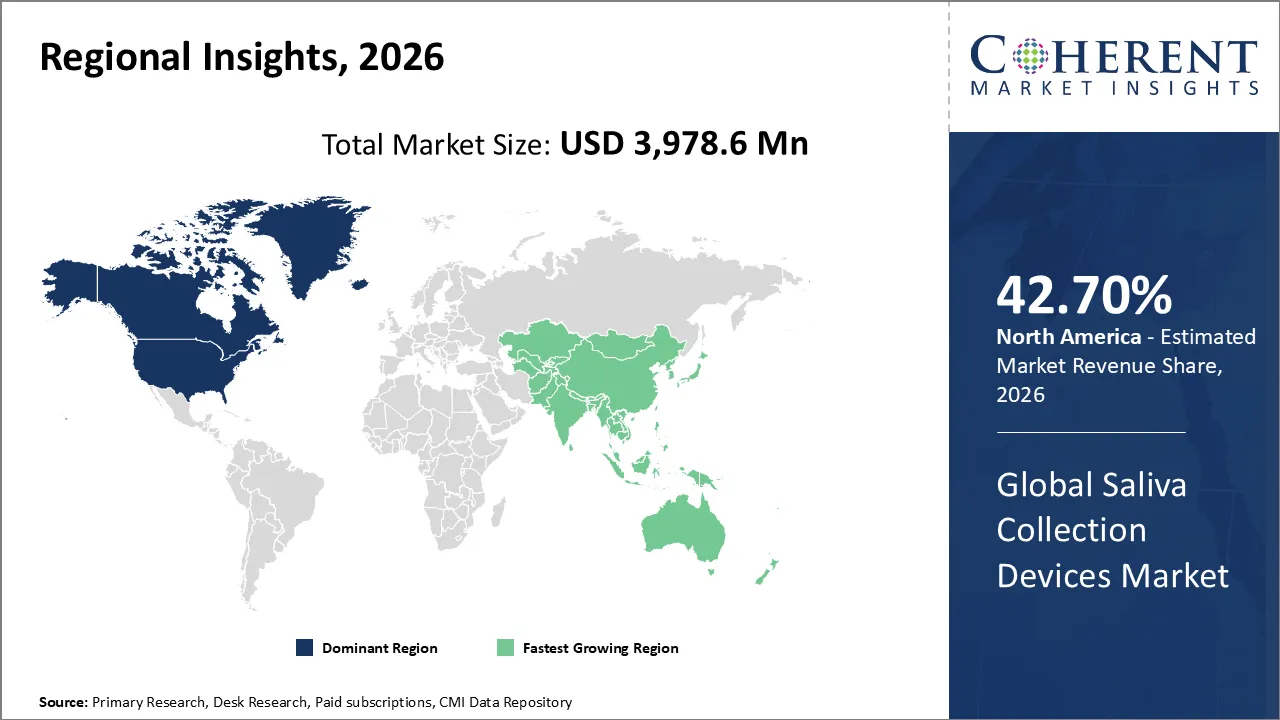
North America Saliva Collection Devices Market Analysis & Trends
North America is expected to lead the saliva collection devices market with 42.70% share in 2026, owing to its advanced diagnostic infrastructure, widespread use of non-invasive testing, and strong presence of biotech and pharmaceutical companies. Its strong market position is due to its growing use in infectious disease detection, oncology, and genetic research, as well as regulatory approvals and forensic uses.
For instance, in July 2025, The UCLA School of Dentistry and Dongwoon Anatech have teamed up to use EFIRM technology to improve saliva-based tests. The goal of the partnership is to make automated devices and cartridges that can find cancer and keep track of chronic diseases. This new idea makes saliva collection devices more useful in pathology, speeding up the use of these devices in non-invasive clinical settings around the world.
Asia Pacific Saliva Collection Devices Market Analysis & Trends
Asia Pacific is expected to exhibit the fastest growth, because healthcare infrastructure is growing, infectious and chronic diseases are increasing, and people are choosing non-invasive diagnostics. Government programs, increased funding going into biotech, and the need for affordable options are all driving adoption. This makes the region the fastest-growing market segment in the world.
For instance, in August 2025, Guttify launched India's first affordable saliva-based gut scan kit priced at ₹199, making non-invasive diagnostics accessible to the masses. The kit uses saliva samples to look for gut health markers, which encourages preventive care.
Saliva Collection Devices Market Outlook Country-Wise
The U.S. Saliva Collection Devices Market Trends
The saliva collection devices market in 2026 The US market is growing due to increasing use of non-invasive diagnostics, genetic testing, and infectious disease screening is still the most common method. The market is growing even faster across the country because more people want to test at home and get personalized medicine.
For instance, in October 2025, SimplyTest launched an oral HPV test in the US that uses saliva to detect strains that are linked to cancer early on. This new technology, which is non-invasive, accurate, and easy to use, makes North America even more of a leader in saliva collection devices. It adds to the tools used to diagnose cancer.
China Saliva Collection Devices Market Trends
The saliva collection devices market will be in use in 2026, due to the rising number of chronic diseases, the government's focus on expanding healthcare infrastructure, and the widespread use of genetic testing are all driving demand in China. More use in monitoring infectious diseases, along with consumers' preference for non-invasive tests, speeds up growth in clinical, research, and at-home settings.
Market Report Scope
Saliva Collection Devices Market Report Coverage
| Report Coverage | Details | ||
|---|---|---|---|
| Base Year: | 2025 | Market Size in 2026: | USD 3,978.6 Mn |
| Historical Data for: | 2020 To 2024 | Forecast Period: | 2026 To 2033 |
| Forecast Period 2026 to 2033 CAGR: | 10.8% | 2033 Value Projection: | USD 8,266.6 Mn |
| Geographies covered: |
| ||
| Segments covered: |
| ||
| Companies covered: | Quest Diagnostics, Neogen Corporation, AboGen, Inc., OraSure Technologies, Inc., Oasis Diagnostics Corporation, Alere, Porex Corporation., and Salimetrics, LLC. | ||
| Growth Drivers: |
| ||
| Restraints & Challenges: |
| ||
Saliva Collection Devices Market Driver
Rising Prevalence of Chronic & Infectious Diseases
The rise in chronic diseases like cancer, diabetes, and heart disease around the world, along with repeated outbreaks of infections, is driving the use of saliva-based tests. These devices are a great choice for regular monitoring and large-scale screening because they are non-invasive, affordable, and easy for patients to use. The effectiveness shown during COVID-19 testing made them even more useful, which increased confidence in their long-term use. In recognition of this, the market share for saliva collection devices keeps growing in both healthcare and research.
Shift Toward Minimally Invasive Diagnostics
Patients and clinicians increasingly prefer diagnostic methods that minimize discomfort, reduce risk, and improve compliance. Saliva collection avoids needles, making it especially suitable for children, elderly individuals, and those with needle phobia. Its ease of use also supports point-of-care testing and self diagnostics, aligning with the growing trend of decentralized healthcare. This convenience and accessibility are driving strong saliva collection devices market demand, as more providers and consumers recognize the benefits of painless, rapid, and reliable sample collection.
Saliva Collection Devices Market Opportunity
Rising Consumer Interest in Personalized Medicine
The global healthcare landscape is shifting toward personalized medicine, where treatments and preventive strategies are tailored to individual genetic profiles. Saliva collection kits play a crucial role in enabling this transformation by providing reliable DNA samples for analysis. Consumers increasingly seek ancestry insights, disease risk assessments, and pharmacogenomic testing, fueling demand for advanced saliva-based solutions. This trend aligns with the saliva collection devices market forecast, which projects strong expansion as personalized medicine becomes mainstream across clinical and consumer health sectors.
Analyst Opinion (Expert Opinion)
The market for saliva collection devices is expanding as non-invasive diagnostic sampling becomes more prevalent in healthcare, research, and forensic settings. The use of saliva as a main specimen for genetic, hormonal, and infectious disease testing is an important reason why it is so popular. Both direct-to-consumer and clinical laboratory use have helped make it so widely used. More than 85 million DNA and ancestry kits sold recently used saliva to collect samples. This shows the significance that saliva is for consumer-oriented testing. More than 400 clinical trials have used saliva samples, showing the significance they are becoming in drug research and biomarker analysis.
North America has the most users, processing more than 120 million saliva samples in healthcare and research settings. This is possible because of a large laboratory infrastructure and regulatory approvals. Europe comes next, with an increasing amount of use in diagnostics and forensics. Asia-Pacific is strengthening its position by expanding genetic testing and using more saliva samples in clinical studies.
Trends in product development show improvements in stabilizing samples and making designs that are easy to use. A large number of new devices have built-in buffers that keep biomolecules stable for longer periods of time and lower the rate of sample rejection. The use of self-collection kits has grown significantly, which has made them more popular with users and opened up more remote testing possibilities. The saliva collection devices market is changing because of new technologies, more clinical trials, and more uses in diagnostics, personalized medicine, and research. This is making it a key part of modern specimen collection solutions.
Speak to the analyst
Want personalized insights?
Take the findings above to one of our principal consultants, or have the report rebuilt around the segments, geographies and competitors you actually track.
Recent Developments
- In May 2025, Iran's first homegrown saliva collection kits for advanced DNA testing were made by an Iranian geneticist. This new idea makes less dependent on imports, boosts biotechnology research, and helps personalized medicine. The kits make it easier to do genetic testing, which is an enormous advance toward being able to take care of your own health and make progress in science.
Market Segmentation
- By Site of Collection
- Whole Saliva
- Glandular Saliva
- Parotid Saliva
- Submandibular/Sublingual Saliva
- Minor Glands
- By Product Type
- Saliva Collection Kits
- Saliva Collection Aids
- Oral Swab
- Fluid Specific Devices
- By Application
- Pharma and Biotech Industry
- Forensics
- Diagnostic and Pathology Laboratories
- Dentistry
- Research Institutes
- By Region
- North America
- U.S.
- Canada
- Latin America
- Brazil
- Argentina
- Mexico
- Rest of Latin America
- Europe
- Germany
- U.K.
- Spain
- France
- Italy
- Russia
- Rest of Europe
- Asia Pacific
- China
- India
- Japan
- Australia
- South Korea
- ASEAN
- Rest of Asia Pacific
- Middle East & Africa
- GCC Countries
- Israel
- Rest of Middle East & Africa
- North America
- Saliva Collection Devices Market- Competitive Landscape
- Quest Diagnostics
- Neogen Corporation
- AboGen, Inc.
- OraSure Technologies, Inc.
- Oasis Diagnostics Corporation
- Alere, Porex Corporation.
- Salimetrics, LLC.
Sources
Primary Research Interviews
- Saliva Collection Device Manufacturers
- Diagnostic Kit & IVD Manufacturers
- Clinical Laboratory Managers
- Hospital & Diagnostic Center Procurement Heads
- Molecular Diagnostics & Genomics Experts
- Biobanking & Sample Handling Specialists
- Others
Databases
- Bloomberg Terminal
- PitchBook
- Factiva
- Others
Magazines
- Clinical Diagnostics Magazine
- Medical Device and Diagnostic Industry (MD+DI)
- Laboratory Equipment Magazine
- BioSpectrum
- Others
Journals
- Journal of Clinical Microbiology
- Clinical Chemistry
- Journal of Molecular Diagnostics
- BMC Infectious Diseases
- Journal of Medical Devices
- Others
Newspapers
- The Wall Street Journal
- Financial Times
- Reuters
- Bloomberg News
- Others
Associations
- American Association for Clinical Chemistry (AACC)
- Clinical & Laboratory Standards Institute (CLSI)
- International Society for Biological and Environmental Repositories (ISBER)
- European Diagnostic Manufacturers Association (EDMA)
- Others
Public Domain Sources
- U.S. Food and Drug Administration (FDA)
- Centers for Disease Control and Prevention (CDC)
- National Institutes of Health (NIH)
- World Health Organization (WHO)
- European Medicines Agency (EMA)
- Others
Proprietary Elements
- CMI Data Analytics Tool
- Proprietary CMI Existing Repository of Information for the Last 8 Years
Get access to 250+ pages report
Every segment, forecast, competitor profile and data table behind the analysis above — available for instant download.
- ESOMAR Member
- ISO 9001:2015 Certified
- D-U-N-S Registered
- GDPR & CCPA Compliant
Missing comfort of reading report in your local language? Find your preferred language:
Transform your Strategy with Exclusive Trending Reports
Frequently Asked Questions
The saliva collection devices market is estimated to be valued at USD 3,978.6 Mn in 2026, and is expected to reach USD 8,266.6 Mn by 2033.
Major players operating in the global saliva collection devices market include Quest Diagnostics, Neogen Corporation, AboGen, Inc., OraSure Technologies, Inc., Oasis Diagnostics Corporation, Alere, Porex Corporation., and Salimetrics, LLC.
Regulatory Challenges is expected to hamper growth of the market over the forecast period.
Rising prevalence of chronic & infectious diseases and shift toward minimally invasive diagnostics are expected to propel growth of the market over the forecast period.
The global saliva collection devices market is estimated to exhibit a CAGR of 10.8% over the forecast period.
Among regions, North America is expected to hold dominant position in the global saliva collection devices market over the forecast period.