

Interventional Pulmonology Market Size and Share Analysis - Growth Trends and Forecast (2026 - 2033)
The global interventional pulmonology market size is forecast to grow from USD 4,686.6 Mn in 2026 to USD 6,954.3 Mn by 2033, registering a CAGR of 5.8% during the forecast period (2026-2033). This growth is attributable to rising prevalence of chronic respiratory diseases, increasing adoption of minimally invasive pulmonary procedures, and continuous advancements in bronchoscopic technologies. COPD and asthma make up most chronic respiratory disease (CRD) cases, with COPD accounting for 80% of CRD-related deaths. Globally, COPD cases are projected to increase by 23% between 2020 and 2050, with the largest rise expected among women and in low- and middle-income countries.
Key Takeaways from the Interventional Pulmonology Market Report
- Bronchoscopes are expected to lead the market with a share of 39% in 2026 because they are the core devices used in nearly every interventional pulmonology procedure, including diagnosis, biopsy, navigation, stent placement, and therapeutic interventions. For example, a 2024 study conducted at the Department of Pulmonary Diseases, Akdeniz University found that 3,877 bronchoscopic procedures were performed over a five-year period, showing the rising clinical use of bronchoscope-based interventions.
- Lung cancer is anticipated to account for the largest market share of 40% in 2026 due to increasing lung cancer screening, biopsy procedures, navigation bronchoscopy, EBUS, and minimally invasive diagnosis. For instance, the American Cancer Society estimates that about 229,410 new lung cancer cases will be diagnosed in the U.S. in 2026, creating strong demand for interventional pulmonology procedures.
- North America is projected to dominate the global interventional pulmonology industry with a share of 38% in 2026, owing to rising adoption of advanced bronchoscopy technologies, favorable reimbursement, and strong presence of leading medical device manufacturers. For example, a 2025 U.S. study reported 170 robotic bronchoscopy procedures at a single center, showing rising clinical adoption of advanced bronchoscopic technologies.
- Asia Pacific is poised to emerge as the fastest growing market for interventional pulmonology during the forecast period, registering a CAGR of 8.1%, thanks to rising burden of respiratory diseases, growing health awareness, and increasing adoption of minimally invasive pulmonary procedures. The region accounted for 63.1% of newly diagnosed lung cancer cases worldwide in 2022, driving demand for bronchoscopy and minimally invasive pulmonary interventions.
Interventional Pulmonology Market Overview
The global interventional pulmonology market is projected to register steady growth during the forecast period. This is primarily due to rising burden of respiratory diseases such as lung cancer, chronic obstructive pulmonary disease (COPD), and asthma. Similarly, growing preference for minimally invasive diagnostic and therapeutic procedures is supporting market expansion.
Rising adoption of advanced bronchoscopic technologies, endobronchial ultrasound (EBUS), navigational bronchoscopy, and robotic-assisted bronchoscopy is improving diagnostic accuracy and treatment outcomes. These technological advancements are expected to fuel growth of the interventional pulmonology market over the forecast period.
Interventional pulmonology uses minimally invasive, non-surgical procedures to diagnose and treat lung cancer, thoracic malignancies, tracheal disorders, and other diseases of the respiratory system. It primarily relies on endoscopic techniques, which involve inserting specialized instruments into the airways to visualize internal structures, obtain tissue samples, and perform therapeutic interventions. Interventional pulmonology is also used to relieve symptoms associated with respiratory diseases, such as shortness of breath, persistent cough, and chest pain.
Rising demand for early and accurate lung cancer diagnosis is expected to boost interventional pulmonology market growth during the assessment period. Lung cancer cases are rising across the world, pushing demand for precise diagnostic tools such as bronchoscopy, EBUS, and biopsy-guided procedures for early detection and staging.
Increasing adoption of disposable and single-use devices is also supporting market growth. Disposable bronchoscopes and tools are gaining traction due to infection control concerns and their tendency to reduce cross-contamination risks in hospitals and ICUs.
Segmental Insights
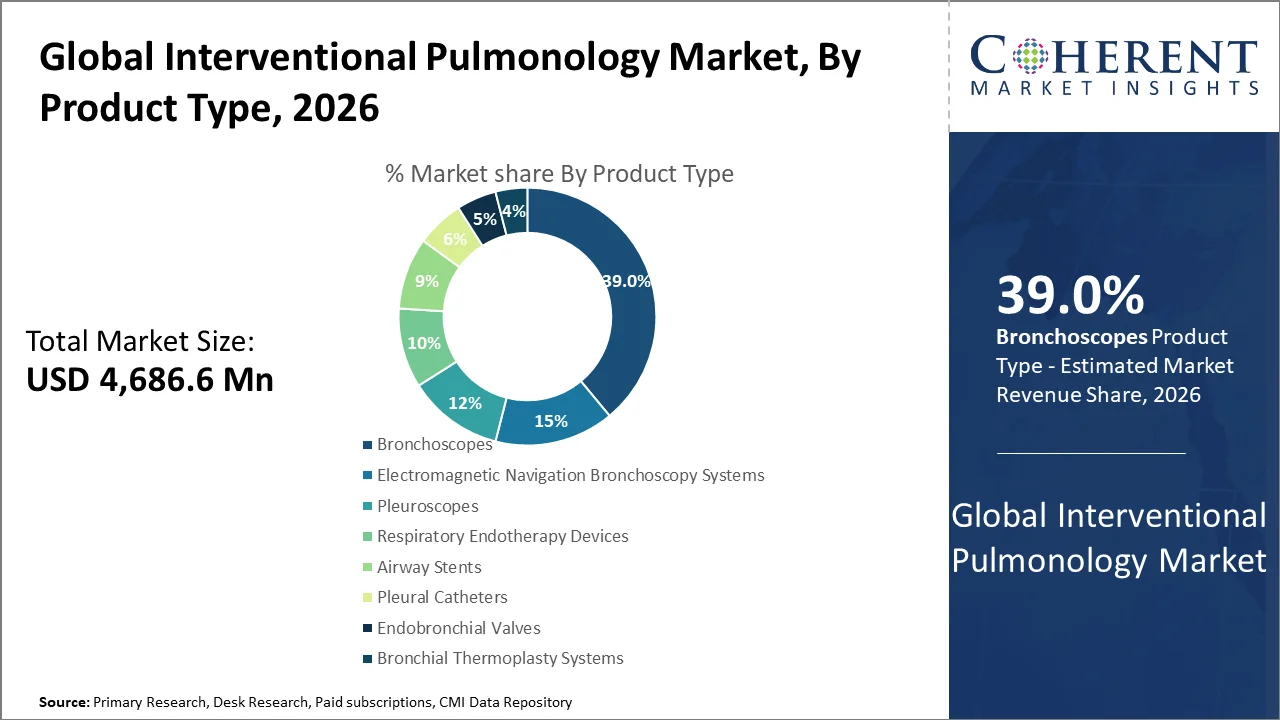
Which Product Type Dominates the Interventional Pulmonology Market?
Bronchoscopes to Capture Nearly Two-Fifths of the Market in 2026
According to Coherent Market Insights’ latest interventional pulmonology market analysis, bronchoscopes are set to dominate the market, accounting for a 39% revenue share in 2026. This dominance is attributable to their indispensable role in the diagnosis and treatment of respiratory diseases like lung cancer, chronic obstructive pulmonary disease (COPD), and airway obstructions.
Bronchoscopes are increasingly being used for the early and accurate diagnosis of pulmonary disorders. For instance, 2,098 flexible bronchoscopy procedures were performed at the Department of Pulmonary Medicine, PGIMER, Chandigarh, India, during 2024–2025, highlighting the widespread clinical use of bronchoscopes in diagnosing and managing respiratory diseases.
Growing preference for minimally invasive pulmonary procedures and continuous advancements in flexible, robotic-assisted, and endobronchial ultrasound (EBUS)-guided bronchoscopy technologies are also boosting segment growth. Similarly, increasing adoption of therapeutic bronchoscopy procedures and expanding investments in advanced respiratory care infrastructure are also expected to reinforce the leadership of the bronchoscope segment throughout the forecast period.
- Current Industry Events of 2026
- Market Size Estimation
- Regional Breakdown
- Competitive Landscape
- Customer Intelligence
- Segmental Analysis
- Pricing Analysis
- Key Market Drivers, Challenges & Future Trends
- Customized Insights Section
Which Indication Holds the Largest Share of the Global Interventional Pulmonology Market?
Lung Cancer Holds the Largest Share Due to Its High Global Disease Burden
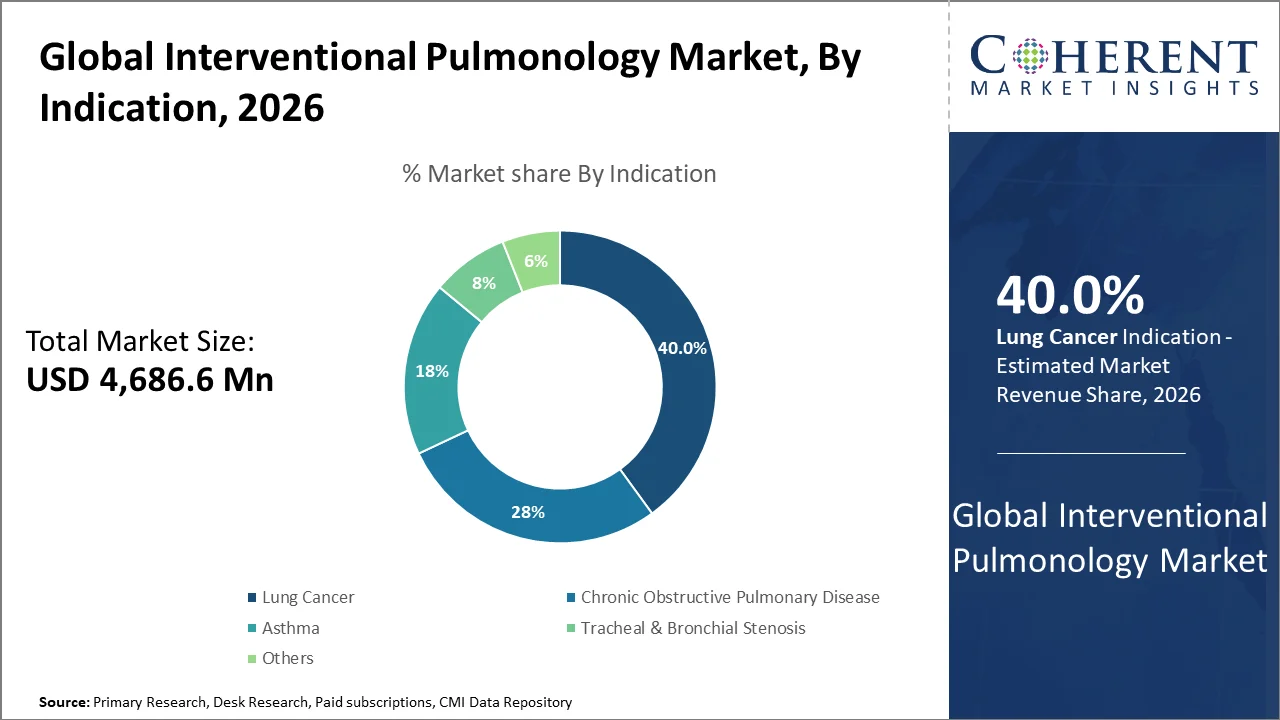
By indication, lung cancer is projected to account for 40% of the global interventional pulmonology market in 2026. This dominance is mostly due to high global incidence and mortality of lung cancer, which drive the need for early diagnosis, accurate staging, and minimally invasive therapeutic interventions.
A 2025 study published in the Journal of the National Cancer Center projects that the global burden of lung cancer will increase from 2.48 million new cases in 2022 to 4.62 million new cases by 2050. This rising disease burden is expected to increase demand for interventional pulmonology procedures as well as boost sales of interventional pulmonology products like bronchoscopes, pleuroscopes, airway stents, endobronchial valves, and bronchial thermoplasty systems.
Interventional pulmonology procedures, including bronchoscopy, endobronchial ultrasound (EBUS), navigational bronchoscopy, and airway stenting, play a vital role in diagnosing peripheral lung nodules, obtaining tissue biopsies, and assessing mediastinal lymph nodes. They are also widely used to relieve central airway obstruction and manage malignant pleural diseases. Rising adoption of advanced bronchoscopic technologies and expanding lung cancer screening programs are also expected to boost target segment during the forecast period.
Interventional Pulmonology Market Growth Drivers
Rising Burden of Respiratory Diseases
Increasing prevalence of respiratory diseases is providing a strong impetus for the growth of the interventional pulmonology market. There is a spike in cases of lung cancer, COPD, asthma, and other chronic respiratory diseases globally. For instance, according to the World Health Organization (WHO), global chronic obstructive pulmonary disease (COPD) cases will likely increase by about 23% through 2050. This rising burden of respiratory disorders is expected to fuel demand for diagnostic and therapeutic procedures like bronchoscopy and biopsy during the forecast period.
Interventional Pulmonology Market Opportunities
Rapid Technological Advancements in Interventional Pulmonology
Innovation in medical devices is expected to create lucrative growth opportunities for the interventional pulmonology market during the assessment period. Robotic bronchoscopy, endobronchial ultrasound (EBUS), electromagnetic navigation bronchoscopy (ENB), and AI-enabled imaging and diagnostic tools are revolutionizing the field of interventional pulmonology. These advancements improve accuracy, safety, and clinical outcomes, thereby encouraging wider adoption.
Interventional Pulmonology Market Trends
Shift Towards Minimally Invasive Procedures
Rising adoption of minimally invasive procedures is a key growth-shaping trend in the interventional pulmonology market. Doctors and patients in the contemporary world increasingly prefer minimally invasive techniques over open surgery due to shorter hospital stays, lower complications, and faster recovery. This shift is expanding adoption of interventional pulmonology technologies, thereby boosting overall market growth during the forthcoming period.
Current Events and Their Impact
Current Event | Description and its Impact |
WHO Continues to Strengthen Global Tuberculosis (TB) Treatment Guidelines |
|
Updated Bronchoscopy Guidelines for Lung Cancer Diagnosis (AABIP/IASLC, 2025) |
|
Regional Insights
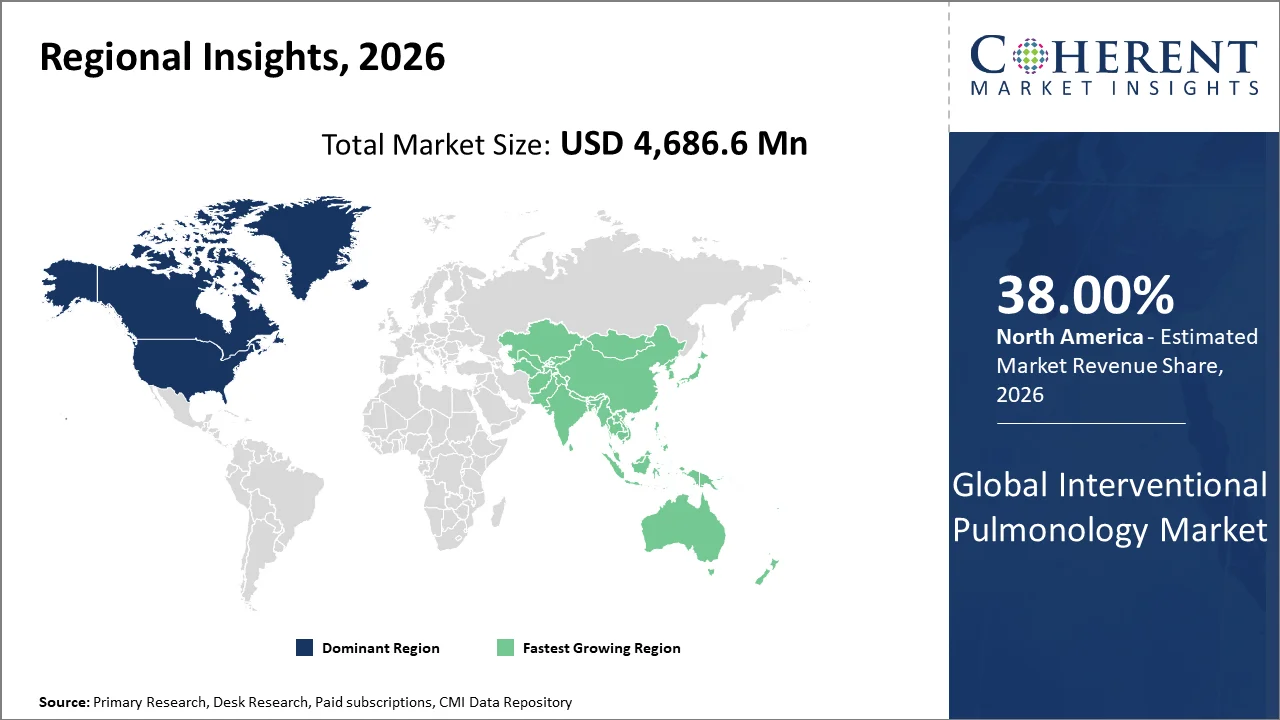
North America Dominates the Global Interventional Pulmonology Market
North America is expected to account for a prominent market share of 38% in the global interventional pulmonology market in 2026. This is attributable to rising adoption of advanced respiratory care technologies, high screening rates for lung diseases, and a well-developed healthcare system. Increasing use of minimally invasive bronchoscopic techniques and rising demand for early lung cancer detection and COPD management are also supporting market expansion in the region.
Rising prevalence of chronic respiratory diseases is acting as a catalyst triggering growth of North America interventional pulmonology market. According to the CDC, around 16 million adults in the United States are diagnosed with COPD, a leading cause of long-term respiratory complications requiring interventional procedures.
Similarly, 228,058 new lung cancers were reported in the United States in 2023, and 128,663 people in the U.S. died from lung cancer in 2024. This rising disease burden is expected to fuel demand for interventional pulmonology solutions in the region during the assessment period.
Asia Pacific Remains at the Epicenter of Interventional Pulmonology Market Growth
Asia Pacific is anticipated to emerge as a highly lucrative market for interventional pulmonology product manufacturers during the forecast period, registering a CAGR of 8.1%. This is mostly due to high burden of respiratory diseases, rapid urbanization, and growing access to advanced diagnostic and therapeutic bronchoscopy procedures. Rising prevalence of tuberculosis (TB) and air pollution–related lung disorders, which are increasing the need for minimally invasive lung interventions, is also supporting market expansion.
According to the WHO Global Tuberculosis Report 2024, India accounts for about one-quarter of global TB cases, making it the highest-burden country worldwide. This large patient pool is directly increasing demand for interventional pulmonology procedures such as bronchoscopy for diagnosis and airway management.
Interventional Pulmonology Market Outlook – Country-wise
U.S. Interventional Pulmonology Market Trends
The United States is expected to remain a key market for interventional pulmonology technologies and procedures during the forecast period. This is attributable to increaisng incidence of chronic respiratory diseases, advanced healthcare infrastructure, and rapid adoption of minimally invasive bronchoscopic technologies. Similarly, strong presence of leading medical devices companies and advancements in interventional pulmonology devices are supporting market expansion in the nation.
According to the making it one of the most common chronic diseases in the country. This high respiratory disease burden is expected to support the growth of the interventional pulmonology market in the United States during the projection period.
China Interventional Pulmonology Market Forecast
The interventional pulmonology market in China is projected to witness strong growth, owing to a high burden of respiratory infections, increasing lung cancer cases, and expanding access to advanced hospital infrastructure. Rapid urbanization and environmental exposure, particularly air pollution in major cities, are also increasing demand for interventional lung procedures and minimally invasive diagnostics.
Who are the Major Companies in the Interventional Pulmonology Market?
Some of the major players in interventional pulmonology market are Boston Scientific Corporation, Olympus Corporation, FUJIFILM Corporation, Becton, Dickinson and Company, Smiths Group plc., Cook Medical, Vygon, PENTAX Medical, Clarus Medical LLC, HUGER Medical Instrument Co., Ltd., Richard Wolf Corporation, Karl Storz, Taewoong Medical Co., Ltd., and ELLA – CS, s.r.o.
Key Strategies Adopted by Industry Players
Top manufacturers of interventional pulmonary devices are adopting various organic and inorganic strategies to boost their sales as well as gain a competitive edge over the industry. These include new product launches and approvals, investments in R&D, mergers, acquisitions, distribution agreements, partnerships, collaborations, and joint ventures.
- In May 2026, Fujifilm launched the EB-710US. It is a balloon-less endobronchial ultrasound (EBUS) bronchoscope used for lung and airway examination.
- In October 2025, Boston Scientific announced a definitive agreement to acquire Nalu Medical, Inc. The acquisition is intended to expand Boston Scientific’s portfolio in neuromodulation and minimally invasive pain management solutions.
- In April 2025, KARL STORZ introduced the Slimline C-MAC S in 2025 for airway management. It is a single-use video laryngoscope designed to support safe and effective intubation.
- In November 2024, GE HealthCare announced new imaging improvements for its OEC 3D C-arm. These updates are designed to support more precise care in interventional pulmonology procedures.
Market Report Scope
Interventional Pulmonology Market Report Coverage
| Report Coverage | Details | ||
|---|---|---|---|
| Base Year: | 2025 | Market Size in 2026: | USD 4,686.6 Mn |
| Historical Data for: | 2020 To 2024 | Forecast Period: | 2026 To 2033 |
| Forecast Period 2026 to 2033 CAGR: | 5.8% | 2033 Value Projection: | USD 6,954.3 Mn |
| Geographies covered: |
| ||
| Segments covered: |
| ||
| Companies covered: | Boston Scientific Corporation, Olympus Corporation, FUJIFILM Corporation, Becton, Dickinson and Company, Smiths Group plc., Cook Medical, Vygon, PENTAX Medical, Clarus Medical LLC, HUGER Medical Instrument Co., Ltd., Richard Wolf Corporation, Karl Storz, Taewoong Medical Co., Ltd., and ELLA – CS, s.r.o. | ||
| Growth Drivers: |
| ||
| Restraints & Challenges: |
| ||
Analyst Opinion (Expert Opinion)
- Rising respiratory disease burden is major growth driver for interventional pulmonology markey. Tuberculosis alone remains a major global issue, with an estimated 10.8 million people falling ill with TB in 2023 (WHO). This large patient pool increases demand for bronchoscopy and advanced diagnostic lung procedures.
- Growing chronic lung diseases are increasing procedure volumes. Diseases like COPD and asthma are rising due to pollution, smoking, and aging populations. This is expanding the need for interventional pulmonology procedures such as airway stenting and biopsy.
- Shift toward minimally invasive lung diagnostics is set to boost market growth during the forthcoming period. Techniques like navigational bronchoscopy and robotic-assisted bronchoscopy are improving accuracy in early lung cancer detection, leading to faster clinical uptake in hospitals.
Speak to the analyst
Want personalized insights?
Take the findings above to one of our principal consultants, or have the report rebuilt around the segments, geographies and competitors you actually track.
Market Segmentation
- By Product Type Insights ( Revenue, USD Mn, 2021 - 2033)
- Bronchoscopes
- Electromagnetic Navigation Bronchoscopy Systems
- Pleuroscopes
- Respiratory Endotherapy Devices
- Airway Stents
- Pleural Catheters
- Endobronchial Valves
- Bronchial Thermoplasty Systems
- By Indication Insights ( Revenue, USD Mn, 2021 - 2033)
- Asthma
- Chronic Obstructive Pulmonary Disease
- Lung Cancer
- Tracheal & Bronchial Stenosis
- Others
- By End User Insights ( Revenue, USD Mn, 2021 - 2033)
- Hospitals
- Ambulatory Surgical Centers
- Diagnostic Centers
- Specialty Clinics
- By Region Insights ( Revenue, USD Mn, 2021 - 2033)
- North America
- U.S.
- Canada
- Latin America
- Brazil
- Argentina
- Mexico
- Rest of Latin America
- Europe
- Germany
- U.K.
- Spain
- France
- Italy
- Russia
- Rest of Europe
- Asia Pacific
- China
- India
- Japan
- Australia
- South Korea
- ASEAN
- Rest of Asia Pacific
- Middle East
- GCC
- Israel
- Rest of Middle East
- Africa
- North Africa
- Central Africa
- South Africa
- North America
- Key Players in the Interventional Pulmonology Market
- Boston Scientific Corporation
- Olympus Corporation
- FUJIFILM Corporation
- Becton, Dickinson and Company
- Smiths Group plc.
- Cook Medical
- Vygon
- PENTAX Medical
- Clarus Medical LLC
- HUGER Medical Instrument Co., Ltd.
- Richard Wolf Corporation
- Karl Storz
- Taewoong Medical Co., Ltd.
- ELLA – CS, s.r.o.
Sources
Primary Research interviews
- Interviews with pulmonologists, interventional pulmonology specialists, respiratory therapists, hospital procurement managers, and ICU clinicians across key healthcare institutions.
Databases
- PubMed, ClinicalTrials.gov
- NIH (National Institutes of Health) databases
- WHO Global Health Observatory
- FDA device database
- European Medicines Agency (EMA) database
Magazines
- Nature Medicine
- Scientific American
- The Lancet Respiratory Medicine feature articles
- News Medical
- Medscape Pulmonology updates
Journals
- Chest (American College of Chest Physicians Journal)
- American Journal of Respiratory and Critical Care Medicine
- European Respiratory Journal
- Respiratory Medicine, Thorax
Newspapers
- The New York Times (Health section)
- The Guardian (Science & Health)
- The Washington Post (Health)
- Financial Times (Healthcare coverage)
Associations
- American Thoracic Society (ATS)
- European Respiratory Society (ERS)
- British Thoracic Society (BTS)
- World Health Organization (WHO)
- Global Initiative for Chronic Obstructive Lung Disease (GOLD)
Public Domain sources
- World Health Organization (WHO) reports
- CDC publications
- National health ministry reports
- Open-access medical research papers
- Government healthcare statistics portals
- NIH RePORTER
Proprietary Elements
- CMI Data Analytics Tool, Proprietary CMI Existing Repository of information for last 10 years
Get access to 250+ pages report
Every segment, forecast, competitor profile and data table behind the analysis above — available for instant download.
- ESOMAR Member
- ISO 9001:2015 Certified
- D-U-N-S Registered
- GDPR & CCPA Compliant
Missing comfort of reading report in your local language? Find your preferred language:
Transform your Strategy with Exclusive Trending Reports
Frequently Asked Questions
The global Interventional Pulmonology Market size is estimated to reach USD 4,686.6 Mn in 2026.
The global Interventional Pulmonology Market value is expected to reach USD 6,954.3 Mn by 2033.
The global Interventional Pulmonology Market is poised to exhibit a CAGR of 5.8% from 2026 to 2033.
Major growth factors include increasing prevalence of chronic obstructive pulmonary disease and asthma, new product launches and approvals, and advancements in interventional pulmonology devices.
Bronchoscopes are set to lead the market with a revenue share of 39% in 2026.
Some major companies in the Interventional Pulmonology Market include Boston Scientific Corporation, Olympus Corporation, FUJIFILM Corporation, Becton, Dickinson and Company, Smiths Group plc., Cook Medical, Vygon, PENTAX Medical, Clarus Medical LLC, HUGER Medical Instrument Co., Ltd., Richard Wolf Corporation, Karl Storz, Taewoong Medical Co., Ltd, and ELLA – CS, s.r.o.
North America, with a 38% share in 2026, is set to lead the market during the forecast period.