

Autoclave Equipment Market Size and Forecast — 2026 - 2033
The Global Autoclave Equipment Market size is estimated to be valued at USD 1.84 billion in 2026 and is expected to reach USD 3.15 billion by 2033, exhibiting a compound annual growth rate (CAGR) of 8.1% from 2026 to 2033.
Overview
Autoclave equipment consists of high-pressure, high-temperature vessels used for sterilization, curing, and composite manufacturing across various industries. Products are typically categorized into vertical, horizontal, and benchtop autoclaves, each designed for specific operational scales and applications. Vertical autoclaves are commonly used in laboratories and medical facilities, while horizontal and large-scale autoclaves serve aerospace, automotive, and industrial composite production. Key features include precise temperature and pressure control, programmable cycles, and safety mechanisms to ensure consistent performance. Advancements in automated and energy-efficient systems are enhancing productivity and reliability, making autoclave equipment essential for healthcare, manufacturing, and research applications worldwide.
Key Takeaways
The Horizontal Autoclaves segment dominates the market with a 38% share, driven by its versatility and scalability, contributing significantly to industry revenue.
The Pharmaceutical application segment is the fastest growing, fueled by increasing drug production complexity and stringent sterilization requirements.
Hospitals remain the largest end-user, accounting for over 45% of the market, supported by global hospital expansions and healthcare infrastructure development.
North America holds the dominant regional market share of 36%, due to advanced healthcare infrastructure and strong regulatory frameworks.
Asia Pacific is the fastest-growing region, with a CAGR of approximately 9.2% from 2024, supported by rapid industrialization and government investments in life sciences.
Europe shows steady growth, particularly in Germany and France, with rising adoption of advanced autoclave equipment.
Autoclave Equipment Market Segmentation Analysis
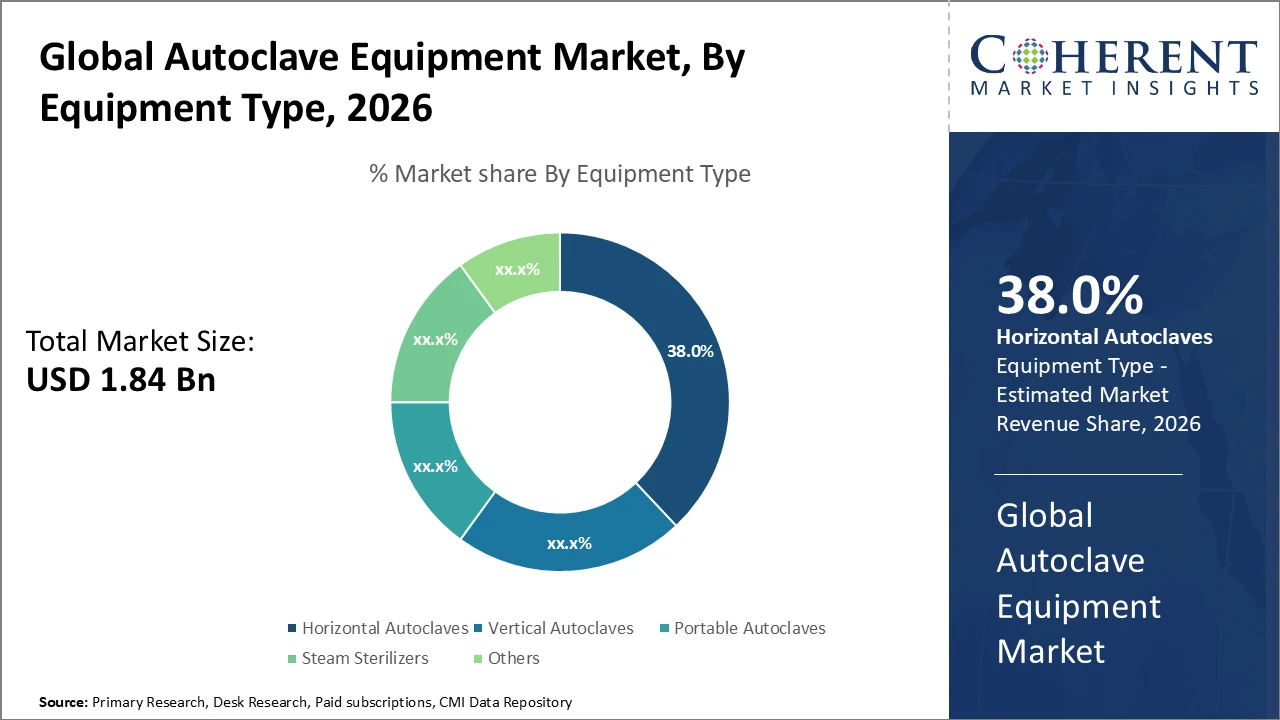
Autoclave Equipment Market Insights, By Equipment Type
Horizontal Autoclaves dominate the market with a 38% share, favored for their larger chamber capacity, uniform steam circulation, and adaptability across diverse applications, making them ideal for hospitals and pharmaceutical manufacturing. The fastest-growing subsegment is Portable Autoclaves, which are increasingly adopted in outpatient clinics and field hospitals due to their compact design and mobility, enabling rapid sterilization in constrained environments. Vertical Autoclaves continue to serve traditional laboratories, offering space-efficient sterilization solutions. Steam Sterilizers cater to specialized applications requiring high precision, though with limited market penetration. The “Others” category includes hybrid systems that integrate advanced sterilization technologies for niche industrial and medical uses.
Autoclave Equipment Market Insights, By Application
Pharmaceutical applications represent the fastest-growing segment in the autoclave equipment market, driven by strict sterilization requirements for injectable drugs, vaccines, and complex biologics. These autoclaves often feature advanced capabilities, including precise temperature control and validation protocols, resulting in higher pricing and revenue generation. The medical and healthcare sector remains the dominant end-user, with hospitals and clinics extensively using autoclaves for surgical instrument sterilization and infection control. Food processing applications are steadily increasing due to stringent safety regulations for canned and packaged goods. Biotechnology laboratories rely on specialized autoclaving for reagents and cultures, while other niche uses include agriculture and veterinary medicine.
Autoclave Equipment Market Insights, By End-User
Hospitals dominate the autoclave equipment market with over 45% share, driven by ongoing infrastructure expansion and increased global awareness of infection control. The fastest-growing end-user segment is pharmaceutical companies, investing in high-capacity autoclaves for large-scale drug production and strict compliance with GMP standards. Research laboratories continue to show steady growth, relying on adaptable small- to medium-sized autoclaves for experimental and diagnostic purposes. Food manufacturers are gradually increasing autoclave adoption to meet international food safety regulations, supporting incremental market growth. The “Others” category includes veterinary clinics and academic institutions, which require sterilization equipment but contribute modestly to overall market revenue.
Autoclave Equipment Market Trends
Integration of artificial intelligence and IoT in autoclave equipment enables predictive maintenance and process optimization, improving operational uptime by around 15% in 2025.
Environmental sustainability trends are driving the development of energy-efficient autoclaves, with European regulators promoting low-emission sterilization technologies.
Hybrid sterilization systems combining steam and vaporized hydrogen peroxide are gaining traction, particularly in pharmaceutical applications for heat-sensitive instrument sterilization.
Advanced autoclave technologies are increasingly adopted in Asia, with Japan and South Korea recording a combined 28% growth in hybrid equipment usage during 2024–2025.
Market demand is shifting toward smart, energy-efficient, and multifunctional autoclaves that enhance productivity and regulatory compliance.
Autoclave Equipment Market Insights, By Geography
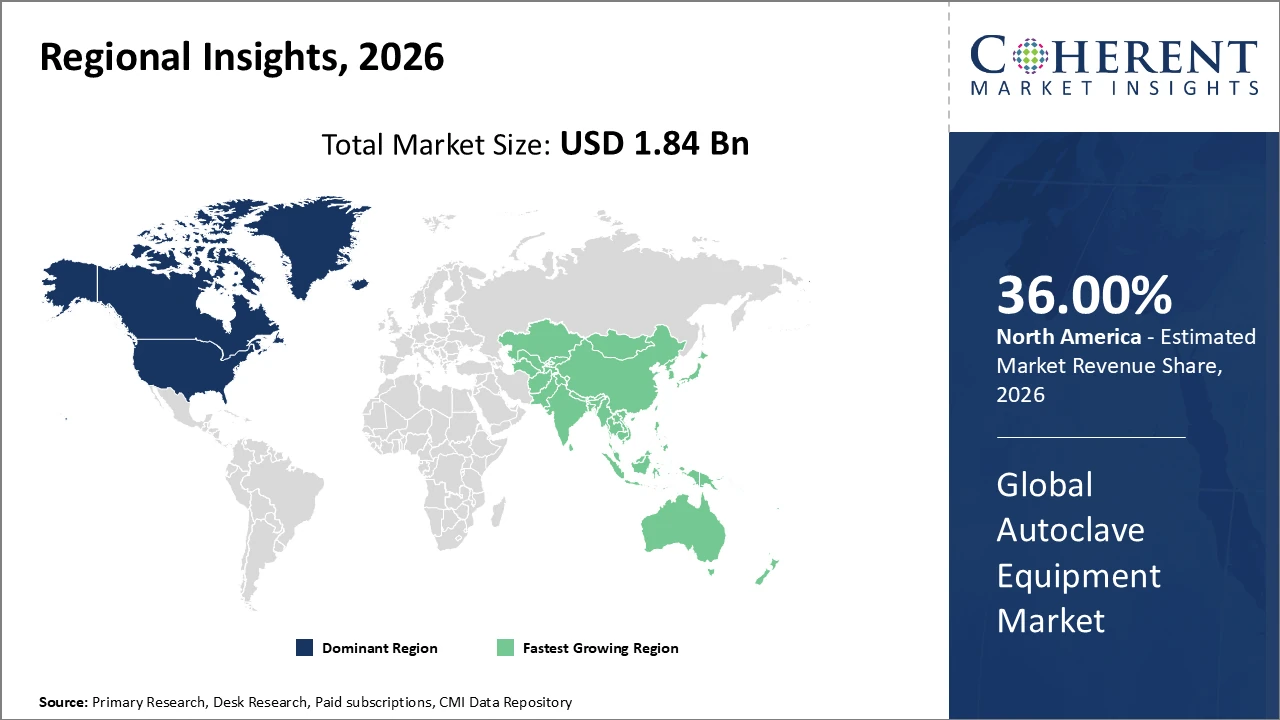
North America Autoclave Equipment Market Analysis and Trends
In North America, the autoclave equipment market is dominated by strong healthcare infrastructure, strict regulatory frameworks, and early adoption of advanced sterilization technologies. The United States accounted for 27% of regional market revenue in 2025, driven by ongoing hospital expansions and growing investments in pharmaceutical manufacturing facilities. Leading companies such as STERIS plc and Getinge Group have strengthened their presence through capacity expansions and technology upgrades, supporting the adoption of smart autoclaves. High demand for infection control, compliance with sterilization standards, and advanced medical device requirements continue to sustain market growth.
Asia Pacific Autoclave Equipment Market Analysis and Trends
Asia Pacific is the fastest-growing autoclave equipment market, registering a CAGR of over 9.2% from 2024 onwards. Growth is driven by rapidly expanding healthcare infrastructure, government initiatives promoting medical equipment manufacturing, and the rise of pharmaceutical hubs in China, India, and South Korea. Both local manufacturers and multinational companies are capitalizing on increasing demand for cost-effective and high-performance autoclave solutions. Market revenues are rising in tandem with this adoption, supported by technological upgrades and regulatory compliance. Key countries in the region have experienced import surges exceeding 20%, reflecting strong investment in advanced sterilization systems across healthcare and pharmaceutical sectors.
Autoclave Equipment Market Outlook for Key Countries
USA Autoclave Equipment Market Analysis and Trends
The USA’s autoclave equipment market is a major driver in North America, supported by stringent FDA sterilization standards and significant investments in healthcare infrastructure. Leading companies such as Getinge Group and STERIS plc dominate the market, focusing on innovation through smart, IoT-enabled autoclaves. In 2025, the U.S. contributed 36% of North America’s market revenue, driven by adoption in hospitals and pharmaceutical facilities. Growth in outpatient surgical procedures and biosciences is boosting demand for rapid-cycle autoclaving with precise control systems, enhancing efficiency, compliance, and overall sterilization reliability.
Germany Autoclave Equipment Market Analysis and Trends
Germany’s autoclave equipment market is characterized by steady growth, driven by advanced healthcare infrastructure, a strong pharmaceutical sector, and high adoption of precision sterilization technologies. Hospitals and research laboratories are key end-users, relying on both horizontal and vertical autoclaves for surgical instruments, lab reagents, and biopharmaceutical production. Sustainability trends are promoting energy-efficient and low-emission autoclaves, while hybrid sterilization systems combining steam and vaporized hydrogen peroxide are gaining traction for heat-sensitive applications. Leading players are investing in capacity expansions, automation, and IoT-enabled smart systems. Germany’s regulatory compliance and focus on quality assurance further reinforce market stability and adoption of cutting-edge autoclave technologies.
Analyst Opinion
Enhanced production capacity and technological advancements have driven market growth, with manufacturers increasing output to meet rising pharmaceutical sterilization demand. In 2025, automated autoclave equipment achieved a 24% increase in market penetration in North American healthcare facilities, supported by a 15% reduction in cycle times through improved steam distribution technologies.
Rising demand from healthcare and pharmaceutical sectors is evident, with autoclave imports in emerging Asia Pacific markets increasing 22% annually, fueled by expanding hospital infrastructure and pharmaceutical manufacturing. Multiple sterilization protocols have also contributed to pricing stability amid growing end-user needs.
Shifts toward customized and portable autoclaves show strong growth, with nano-scale units for dental and outpatient surgical centers experiencing a 35% CAGR in Europe between 2024 and 2026, reflecting demand for compact, mobile sterilization solutions.
Expanding applications in food safety and biotechnology are influencing market dynamics, with sterilization of canned foods and biotech reagents driving growth. The food processing industry in Latin America contributed to an 18% increase in autoclave revenue in 2024 due to strict government safety regulations.
- Current Industry Events of 2026
- Market Size Estimation
- Regional Breakdown
- Competitive Landscape
- Customer Intelligence
- Segmental Analysis
- Pricing Analysis
- Key Market Drivers, Challenges & Future Trends
- Customized Insights Section
Market Scope
| Report Coverage | Details | ||
|---|---|---|---|
| Base Year: | 2025 | Market Size in 2026: | USD 1.84 billion |
| Historical Data for: | 2020 To 2024 | Forecast Period: | 2026 To 2033 |
| Forecast Period 2026 to 2033 CAGR: | 8.1% | 2033 Value Projection: | USD 3.15 billion |
| Geographies covered: |
| ||
| Segments covered: |
| ||
| Companies covered: | Getinge Group, STERIS plc, MMM Group, Tuttnauer, Scican Limited, Astell Scientific Ltd., Priorclave Ltd., Federal Equipment Company, Belimed AG, Hirayama Manufacturing Corp. | ||
| Growth Drivers: |
| ||
Autoclave Equipment Market Growth Factors
Key factors driving the autoclave equipment market include rising global healthcare expenditure, particularly in oncology and surgical fields where stringent sterilization is critical, alongside regulatory requirements such as FDA and WHO guidelines that mandate equipment upgrades. Growing awareness of infection control protocols in emerging economies and increasing complexity in pharmaceutical manufacturing further boost demand for high-performance autoclaves. For example, U.S. healthcare spending rose by 6.2% in 2025, correlating with a 9% increase in autoclave installations. Similarly, Asia Pacific’s pharmaceutical output grew by over 11% in 2024, significantly expanding regional market revenue for autoclave equipment.
Autoclave Equipment Market Development
In July 2025, Shinva launched its LAS-M Series Vertical Autoclave, fully developed and manufactured in-house.
Key Players
Leading Companies of the Market
Getinge Group
STERIS plc
MMM Group
Tuttnaeur
Priorclave Ltd.
Astell Scientific Ltd.
Belimed AG
Scican Limited
Federal Equipment Company
Hirayama Manufacturing Corp.
Competitive strategies in the autoclave equipment market have increasingly emphasized digital integration, automation, and strategic acquisitions. In 2025, Getinge Group launched IoT-enabled autoclaves, enhancing real-time monitoring and predictive maintenance, which led to a 12% increase in customer retention. Meanwhile, STERIS plc expanded its presence in Asia Pacific by acquiring smaller regional manufacturers, boosting market share by 18% within a year and leveraging local regulatory compliance expertise. Additionally, Tuttnauer’s investments in environmentally friendly autoclave product lines drove a 20% revenue increase in Europe in 2024, highlighting the impact of sustainability-focused innovation.
Autoclave Equipment Market Future Outlook
The autoclave equipment market is poised for robust growth, driven by rising healthcare expenditure, expanding pharmaceutical manufacturing, and increasing adoption of advanced sterilization technologies. Emerging trends include IoT-enabled and AI-integrated autoclaves, offering predictive maintenance, process optimization, and reduced cycle times. Demand for energy-efficient and environmentally friendly equipment is expected to grow, especially in Europe and North America, while Asia Pacific will continue to lead regional growth due to rapid industrialization and expanding healthcare infrastructure. Hybrid sterilization systems and portable autoclaves are gaining traction across hospitals, laboratories, and pharmaceutical facilities. Overall, innovation, regulatory compliance, and sustainability will shape market expansion globally.
Autoclave Equipment Market Historical Analysis
The autoclave equipment market has experienced steady growth over the past decade, driven primarily by rising healthcare infrastructure, pharmaceutical manufacturing, and laboratory expansion. Early adoption was led by North America and Europe, where hospitals, research laboratories, and pharmaceutical companies demanded reliable sterilization for surgical instruments, reagents, and biopharmaceutical products. Horizontal and vertical autoclaves dominated initial sales due to their versatility and efficiency, while portable units gradually gained traction in specialized clinics. Technological advancements, including automation and improved steam distribution, enhanced performance and cycle times. Historical trends also highlight a growing emphasis on regulatory compliance, infection control, and the gradual shift toward energy-efficient and hybrid sterilization systems.
Sources
Primary Research Interviews:
Hospitals, clinics, and surgical centers
Pharmaceutical manufacturing facilities and laboratories
Research laboratories and academic institutions
Medical device and sterilization equipment consultants
Magazines:
Chemical & Engineering News
Coatings World
Medical Device & Diagnostic Industry (MD+DI)
HealthTech Magazine – Sterilization & Medical Equipment
Journals:
Journal of Hospital Infection
Infection Control & Hospital Epidemiology
Journal of Applied Polymer Science (for autoclaves in pharmaceuticals)
Progress in Organic Coatings
Industrial & Engineering Chemistry Research
Newspapers:
The Wall Street Journal – Healthcare & Medical Equipment
Financial Times – Medical Technology & Sterilization
Reuters – Healthcare & Industrial Equipment
Bloomberg – Medical and Industrial Equipment
Nikkei Asia – Healthcare and Manufacturing Equipment
Associations:
American Society for Healthcare Engineering (ASHE)
International Association for Sterilization Technology (IAST)
European Committee for Standardization – Sterilization Equipment Division
Association for the Advancement of Medical Instrumentation (AAMI)
Get access to 250+ pages report
Every segment, forecast, competitor profile and data table behind the analysis above — available for instant download.
- ESOMAR Member
- ISO 9001:2015 Certified
- D-U-N-S Registered
- GDPR & CCPA Compliant
Missing comfort of reading report in your local language? Find your preferred language:
Transform your Strategy with Exclusive Trending Reports
Frequently Asked Questions
Leading companies include Getinge Group, STERIS plc, Belimed AG, MMM Group, and Tuttnauer, among others, dominating various regional segments.
The market is projected to grow from USD 1.84 billion in 2026 to USD 3.15 billion by 2033, reflecting a CAGR of 8.1%.
Hospitals acquire the dominant share due to increasing drug manufacturing complexities and strict sterilization requirements.
Market trends indicate rising adoption of IoT-enabled smart autoclaves, hybrid sterilization technologies, and a shift toward environmentally sustainable and energy-efficient practices.
The competitive landscape is marked by strategic acquisitions, expansion into emerging markets, product automation innovations, and challenges including high capital expenditure and regulatory compliance.
Companies focus on digital integration, regional partnerships, product customization, and sustainable technology adoption to maintain market share and drive growth.