

Steam Autoclave Market Size and Forecast — 2026 - 2033
The Global Steam Autoclave Market size is estimated to be valued at USD 1.2 billion in 2026 and is expected to reach USD 2.1 billion by 2033, exhibiting a compound annual growth rate (CAGR) of 7.6% from 2026 to 2033.
Overview
The steam autoclave market is driven by the growing demand for effective sterilization across healthcare, pharmaceutical, and laboratory settings. Increasing hospital-acquired infection rates have heightened the need for reliable sterilization equipment to ensure patient safety. Expansion of surgical procedures and healthcare infrastructure, especially in developing regions, further boosts demand. Regulatory standards mandating strict sterilization practices also support market growth. In addition, rising pharmaceutical and biotechnology research activities require advanced autoclaves for contamination control. Technological advancements, such as automated and energy-efficient systems, are improving efficiency and adoption. Growing awareness of hygiene and infection control continues to be a key market driver globally.
Key Takeaways
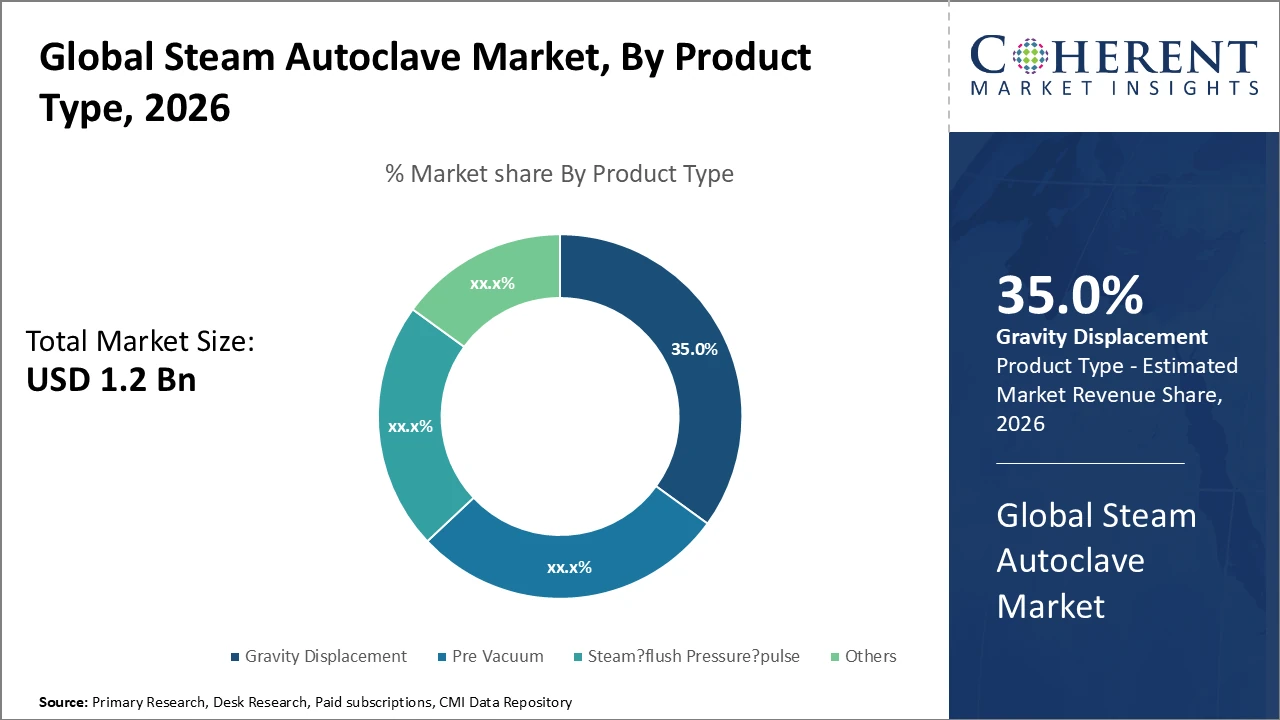
The Gravity Displacement segment dominates the Steam Autoclave Market with a 35% share, driven by its reliability, simplicity, and cost-effectiveness. Pre-Vacuum autoclaves are the fastest-growing segment due to superior sterilization efficiency for complex and porous instruments.
Hospitals and clinics account for the largest end-user share at 42%, supported by rising surgical procedures and strict infection control protocols worldwide.
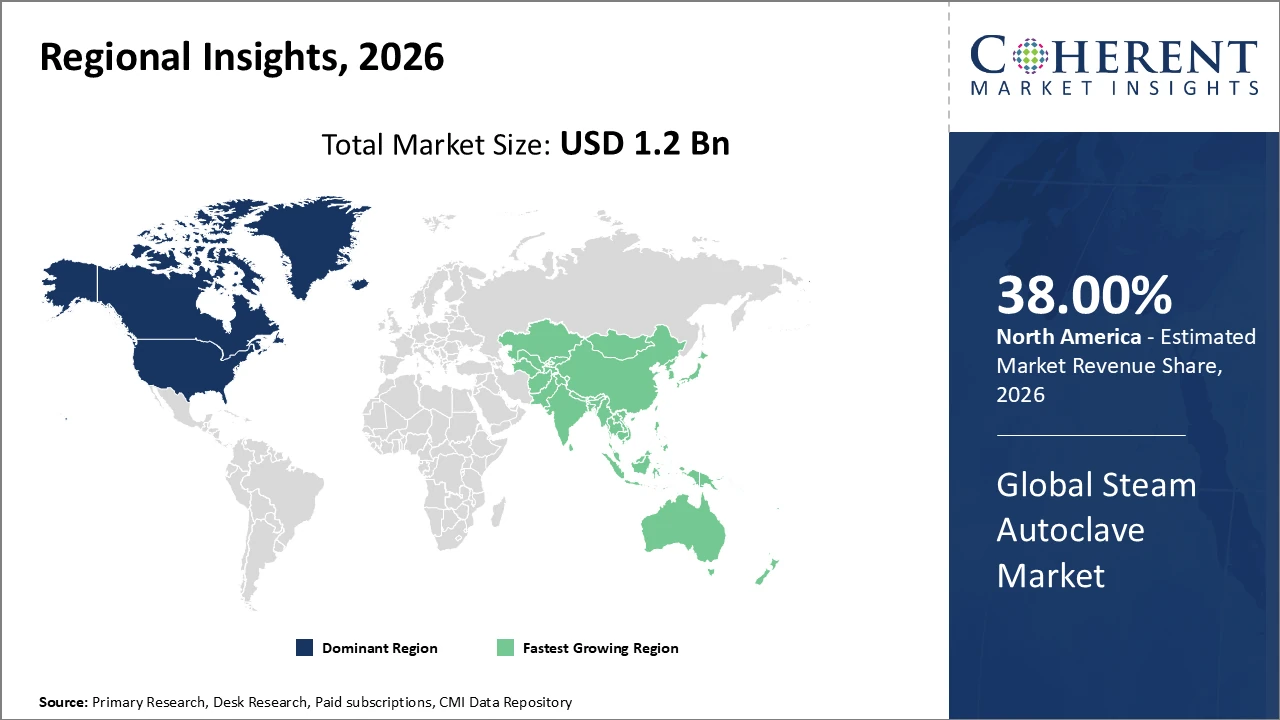
North America leads the global market due to advanced healthcare infrastructure and stringent regulatory standards for sterilization practices.
Asia Pacific is the fastest-growing region, fueled by expanding pharmaceutical manufacturing, increasing healthcare investments, and rising demand for sterilization equipment.
Europe’s market growth is supported by a strong focus on environmentally sustainable and energy-efficient sterilization solutions.
Steam Autoclave Market Segmentation Analysis
Steam Autoclave Market Insights, By Product Type
Gravity Displacement leads the market with a 35% share, favored for its simplicity, reliability, and cost-efficiency, particularly in small to medium healthcare facilities. It is widely used for routine sterilization of surgical instruments and laboratory equipment. The Pre-Vacuum segment is the fastest-growing, offering enhanced sterilization for complex instruments and shorter cycle times, with advanced vacuum technology ensuring thorough air removal and steam penetration—crucial in large hospitals and pharmaceutical manufacturing. Steam-Flush Pressure-Pulse, though smaller in share, is gaining adoption for delicate materials and rapid cycles. The Others category serves niche applications in veterinary and specialized research settings.
Steam Autoclave Market Insights, By Capacity
Small Capacity autoclaves dominate the market due to their extensive use in clinics, small hospitals, and laboratories where moderate sterilization volumes are sufficient. Their affordability and lower operating costs make them accessible, particularly in emerging regions. The Medium Capacity segment is the fastest-growing, driven by midsize hospitals and pharmaceutical facilities needing larger batch sterilization without major space requirements. Large Capacity autoclaves cater to major manufacturing and research centers handling bulk sterilization but account for a smaller share due to limited high-volume buyers. The Others category includes customized autoclaves designed for specialized industrial, veterinary, and research applications.
Steam Autoclave Market Insights, By End User
Hospitals and clinics dominate the Steam Autoclave market with a 42% share due to rising surgical procedures, strict sterilization standards, and heightened infection control awareness, especially in developed regions. Continuous investments in modernizing sterilization infrastructure and adopting automated autoclaves further strengthen this segment. The pharmaceutical and biotechnology segment is the fastest growing, driven by stringent regulatory requirements for drug safety and the expansion of biosimilar and vaccine manufacturing facilities worldwide. The food processing industry uses autoclaves for sterilizing packaging and ingredients, supported by food safety regulations. Research and laboratories rely on customized sterilization cycles, driven by growing life sciences R&D activities.
Steam Autoclave Market Trends
Integration of AI-enabled sterilization cycles is enhancing process control and reliability, with predictive maintenance reducing downtime and improving efficiency. In 2025, U.S. hospital chains reported a 15% reduction in cycle time using these systems.
Customization of steam autoclaves is rising, particularly in biopharmaceutical manufacturing, to meet specific sterilization parameters required for new drug production and regulatory compliance.
Sustainable and energy-efficient autoclaves are increasingly adopted, with over 18% of new installations in Europe by 2024 focusing on reduced energy consumption and environmentally friendly operations.
Overall market trends emphasize automation, efficiency, and eco-conscious design.
Steam Autoclave Market Insights, By Geography
North America Steam Autoclave Market Analysis and Trends
North America maintains a dominant position in the Steam Autoclave market, holding around 38% of the global market share in 2026. This leadership is supported by well-established healthcare infrastructure, stringent sterilization standards enforced by regulatory authorities like the FDA, and high adoption of advanced autoclave technologies. Hospitals and large clinical centers continually upgrade sterilization systems to meet infection control protocols, while pharmaceutical and biotechnology facilities increasingly rely on automated and AI-enabled autoclaves for compliance and efficiency. Leading companies, including Getinge AB and Steris Corporation, drive market growth through innovation, service excellence, and strategic partnerships across the region.
Asia Pacific Steam Autoclave Market Analysis and Trends
Asia Pacific demonstrates the fastest growth in the Steam Autoclave market, with a CAGR surpassing 9%, driven by rapid expansion of pharmaceutical and biotechnology manufacturing hubs in China and India. Rising government healthcare expenditure, growing awareness of infection control protocols, and increasing hospital infrastructure development further fuel demand. The region also benefits from an expanding base of small and medium healthcare facilities adopting autoclaves for routine sterilization. Key players such as Tuttnauer and Yamato Scientific are actively investing in regional sales networks, service capabilities, and localized manufacturing to strengthen their presence and capture emerging market opportunities in both clinical and industrial segments.
Steam Autoclave Market Outlook for Key Countries
USA Steam Autoclave Market Analysis and Trends
The USA remains the largest single-country market in the Steam Autoclave industry, supported by a high concentration of hospitals, research institutes, and biotechnology firms requiring advanced sterilization systems. Strong infection control initiatives have driven investments exceeding USD 100 million in sterilization infrastructure upgrades in 2025. The market is highly innovation-driven, with leading companies such as Systec GmbH and Belimed AG expanding their footprint through AI-integrated autoclave solutions. These technologies have improved sterilization cycle efficiency by around 12% in clinical environments. Continuous demand for automation, compliance with strict regulatory standards, and technological advancements sustain the country’s leadership position in the global market.
Germany Steam Autoclave Market Analysis and Trends
Germany’s Steam Autoclave Market is characterized by advanced healthcare infrastructure, stringent sterilization regulations, and a strong emphasis on quality control in hospitals and laboratories. Hospitals & Clinics dominate demand, driven by high surgical volumes and strict infection prevention protocols. Pharmaceutical and biotechnology companies are the fastest-growing end users, fueled by vaccine production and biosimilar manufacturing. Technological adoption, including AI-enabled cycle optimization and energy-efficient autoclaves, is rising, enhancing operational efficiency. Local manufacturers, along with international players like Getinge AB and Tuttnauer, are investing in automation and customized solutions. The market benefits from stable government support, regulatory compliance, and strong R&D activity.
Analyst Opinion
Manufacturing capacity for steam autoclaves increased by approximately 12% in 2025, reflecting expansion strategies to meet rising demand from emerging economies. Premium segment autoclaves with enhanced automation and IoT connectivity experienced price growth of around 8% in 2024 due to strong adoption in private hospitals and biopharmaceutical industries.
Import volumes of advanced steam autoclaves grew nearly 15% year-over-year in 2026, with Asia Pacific showing significant uptake driven by increasing medical device sterilization needs. Demand has diversified across biotechnology labs and food safety testing units, requiring customized thermal cycle solutions.
Integration of digital sterilization monitoring and validation systems in healthcare facilities rose, with over 40% of new hospital installations in 2025 specifying digitally integrated autoclaves, boosting market revenue.
Customer preference for eco-friendly, energy-saving autoclaves gained traction in 2024, with energy-efficient units accounting for roughly 18% of total sales in developed markets.
- Current Industry Events of 2026
- Market Size Estimation
- Regional Breakdown
- Competitive Landscape
- Customer Intelligence
- Segmental Analysis
- Pricing Analysis
- Key Market Drivers, Challenges & Future Trends
- Customized Insights Section
Market Scope
| Report Coverage | Details | ||
|---|---|---|---|
| Base Year: | 2025 | Market Size in 2026: | USD 1.2 billion |
| Historical Data for: | 2020 To 2024 | Forecast Period: | 2026 To 2033 |
| Forecast Period 2026 to 2033 CAGR: | 7.6% | 2033 Value Projection: | USD 2.1 billion |
| Geographies covered: |
| ||
| Segments covered: |
| ||
| Companies covered: | Tuttnauer, Getinge AB. LLG Labware, MMM Group, Steris Corporation, Belimed AG, Federal Equipment Company, Priorclave Ltd., Systec GmbH, Astell Scientific | ||
| Growth Drivers: |
| ||
Steam Autoclave Market Growth Factors
Rising incidence of hospital-acquired infections (HAIs) is intensifying the need for stringent sterilization protocols, boosting adoption of advanced steam autoclaves. Regulatory requirements from authorities like the FDA and EMA are tightening, compelling healthcare providers and manufacturers to prioritize compliance, thereby driving market growth. Expanding pharmaceutical and biotechnology sectors, particularly in emerging economies, have increased demand for reliable sterilization equipment, supporting revenue growth. Technological innovations, including remote monitoring, automation, and IoT-enabled cycle validation, have enhanced operational efficiency, reduced human error, and improved turnaround times, further accelerating market adoption and revenue generation across hospitals, research facilities, and manufacturing units during 2024–2025.
Steam Autoclave Market Development
In August 2025, Advanced Sterilization Products (ASP) launched the BIOTRACE Instant Read Steam System, the fastest FDA-cleared steam biological indicator system in the U.S. Designed for sterile processing departments, it provides results in just seven seconds, reducing turnaround time, lowering errors, and improving workflow efficiency.
Key Players
Leading Companies of the Market
Tuttnauer
Getinge AB
LLG Labware
MMM Group
Steris Corporation
Belimed AG
Federal Equipment Company
Priorclave Ltd.
Systec GmbH
Astell Scientific
Several leading companies have implemented targeted growth strategies during 2024 and 2025, focusing on acquisitions, technological innovation, and market expansion. For example, Getinge AB invested heavily in R&D to launch IoT-enabled steam autoclaves, enhancing operational efficiency and increasing its North American market share by 5% in 2025. Simultaneously, Tuttnauer expanded its footprint in Asia Pacific by establishing localized manufacturing units, driving a 20% surge in regional revenue. Belimed AG diversified its product portfolio with eco-friendly autoclaves, attracting significant demand from environmentally conscious customers across Europe and reinforcing its position in the sustainable sterilization segment.
Steam Autoclave Market Future Outlook
The Steam Autoclave Market is poised for robust growth driven by rising hospital-acquired infection rates, expanding pharmaceutical and biotechnology sectors, and stricter regulatory sterilization standards globally. Adoption of smart and IoT-enabled autoclaves will enhance operational efficiency, predictive maintenance, and process validation. Emerging regions, particularly Asia Pacific, are expected to witness accelerated demand due to growing healthcare infrastructure and increased awareness of infection control. Additionally, sustainable and energy-efficient autoclaves are likely to gain traction amid environmental regulations. Continuous innovation, coupled with digital integration and regional manufacturing expansion, will underpin steady market growth through 2033, creating opportunities across clinical, industrial, and research applications.
Steam Autoclave Market Historical Analysis
The Steam Autoclave Market has experienced steady growth over the past decade, primarily driven by rising healthcare infrastructure investments and stringent sterilization regulations in developed regions. From 2015 to 2023, North America and Europe dominated due to advanced hospital networks and adoption of automated sterilization systems. Asia Pacific began emerging as a key growth region around 2018, fueled by expanding pharmaceutical manufacturing and increasing awareness of infection control. Technological advancements, including pre-vacuum and gravity displacement systems, improved sterilization efficiency and reliability. The historical trend also reflects a gradual shift toward digital monitoring, energy-efficient designs, and tailored solutions for specialized clinical and industrial applications.
Sources
Primary Research Interviews:
Engineers, R&D managers, and project leaders from companies manufacturing steam autoclaves and sterilization equipment.
Technical specialists from firms providing sterilization services for hospitals, laboratories, and pharmaceutical production.
Industry experts from companies supplying digital monitoring, IoT-enabled sterilization systems, and energy-efficient autoclave technologies.
Magazines:
Infection Control Today – Innovations in steam sterilization, hospital infection control, and compliance best practices.
Healthcare Purchasing News – Market trends, procurement strategies, and new autoclave technologies.
Medical Device and Diagnostic Industry (MD+DI) – Updates on sterilization equipment advancements and market developments.
Journals:
Journal of Hospital Infection – Research on sterilization efficacy, HAIs prevention, and autoclave usage standards.
Sterilization Science and Technology – Studies on steam autoclave performance, efficiency, and safety
International Journal of Pharmaceutical Technology – Insights on sterilization in pharmaceutical and biotech manufacturing.
Newspapers:
The Wall Street Journal – Company strategies, mergers, and investments in sterilization equipment manufacturers.
Financial Times – Market developments, regulatory updates, and global steam autoclave demand.
Reuters – News on technological advancements and sterilization standards.
Bloomberg – Corporate financial performance and global market insights in sterilization equipment.
Associations:
Association for the Advancement of Medical Instrumentation (AAMI) – Standards, guidelines, and data for sterilization equipment.
International Association for Healthcare Central Service Materiel Management (IAHCSMM) – Sterilization best practices, training, and compliance.
World Health Organization (WHO) – Guidelines, global standards, and safety protocols for medical device sterilization.
Get access to 250+ pages report
Every segment, forecast, competitor profile and data table behind the analysis above — available for instant download.
- ESOMAR Member
- ISO 9001:2015 Certified
- D-U-N-S Registered
- GDPR & CCPA Compliant
Missing comfort of reading report in your local language? Find your preferred language:
Transform your Strategy with Exclusive Trending Reports
Frequently Asked Questions
The dominant market players include Tuttnauer, Systec GmbH, Getinge AB, and Belimed AG, all exhibiting strong R&D capabilities and extensive regional footprints.
The market size is projected to expand from USD 1.2 billion in 2026 to USD 2.1 billion by 2033, driven by technological integration and rising industrial demand.
Hospitals & Clinics represent the largest growth opportunity with 42% market share, due to escalating infections and surgical procedures globally.
Evolution will be marked by increased adoption of AI-integrated autoclaves, modular designs, and energy-efficient models responding to emerging operational and environmental needs.
The competitive landscape is characterized by innovation-led strategies focusing on automation and sustainability, with challenges including pricing pressures and stringent regulatory compliances.
Strategies include geographical expansion through local manufacturing, product customization, strategic partnerships, and focused R&D investments.