

Gynecological Devices Market Size and Share Analysis - 2026 To 2033
The Gynecological Devices Market is expected to grow at a CAGR of 8.0%, reaching USD 16,406.7 Mn in 2026 and projected to reach USD 28,118.1 Mn by 2033. Growth drivers include increasing gynecological disorders, heightened awareness of women's health, a growing preference for minimally invasive procedures, improved access to healthcare, and steady technological advancements in diagnostic and surgical devices. Gynecological disorders are increasing worldwide and in India, where more than 70% of women are affected by conditions such as PCOS, PCOD, fibroids, and endometriosis.
Key Takeaways from the Gynecological Devices Market Report
- Surgery Devices is predicted to hold the largest share of the overall market at 58.4% by device type in 2026. This is due to the trend of more people opting for minimally invasive procedures, the increase in gynecological problems, and the preference for laparoscopic surgery.
- Hospitals are expected to hold the largest share of 57.6% in the gynecological devices market. This is due to more surgeries, better surgical instruments, and more access to health care. According to the World Health Organization, an additional 143 Mn surgical procedures are needed each year to save lives, further strengthening the importance of hospital-based care.
- North America is projected to continue as the largest regional market for gynecological devices, with an estimated 40% share of the global revenue in 2026, owing to advanced healthcare infrastructure, high adoption of minimally invasive gynecological procedures, favorable reimbursement systems, and strong women health awareness programs. The National Cancer Institute (NCI) projected 69,120 new cases of uterine cancer and 20,890 new cases of ovarian cancer in the United States in 2025.
Segmental Insights
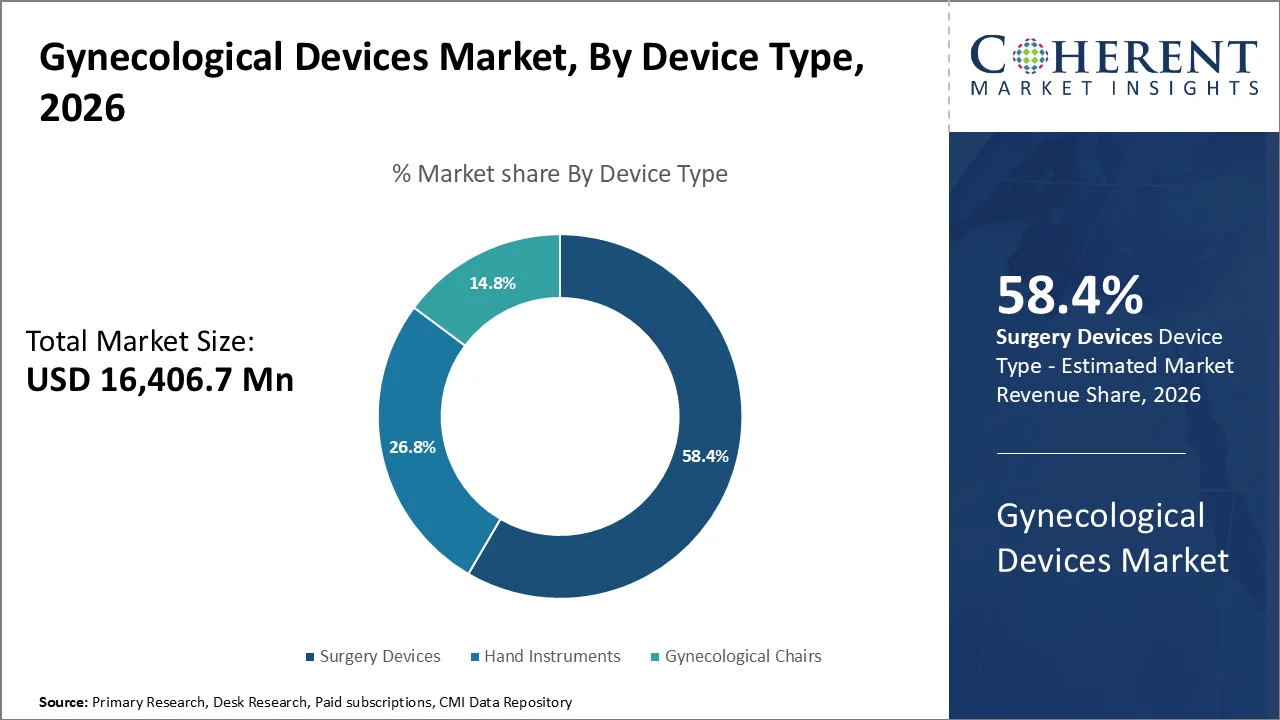
Why are Surgery Devices Acquiring the Largest Market Share?
Surgery devices are expected to account for the largest share of the gynecological devices market in 2026, at approximately 58.4% of total revenue. This dominance is driven by the increasing number of patients opting for minimally invasive gynecological procedures. It is also supported by the rising incidence of endometriosis, uterine fibroids, irregular bleeding, and gynecological malignancies. Endometriosis affects about 10% of women of reproductive age worldwide, representing approximately 190 million individuals.
Technological advancements in laparoscopic imaging systems, hysteroscopes, fluid management systems, and radiofrequency ablation devices are further increasing the adoption of surgical gynecological devices in hospitals and ambulatory surgical centers.
In September 2025, Olympus Corporation continued expanding its minimally invasive surgical portfolio through advanced endoscopy and visualization technologies, supporting the growing demand for gynecological laparoscopic and hysteroscopic procedures worldwide.
- Current Industry Events of 2026
- Market Size Estimation
- Regional Breakdown
- Competitive Landscape
- Customer Intelligence
- Segmental Analysis
- Pricing Analysis
- Key Market Drivers, Challenges & Future Trends
- Customized Insights Section
Which End User Segment Dominates the Market?
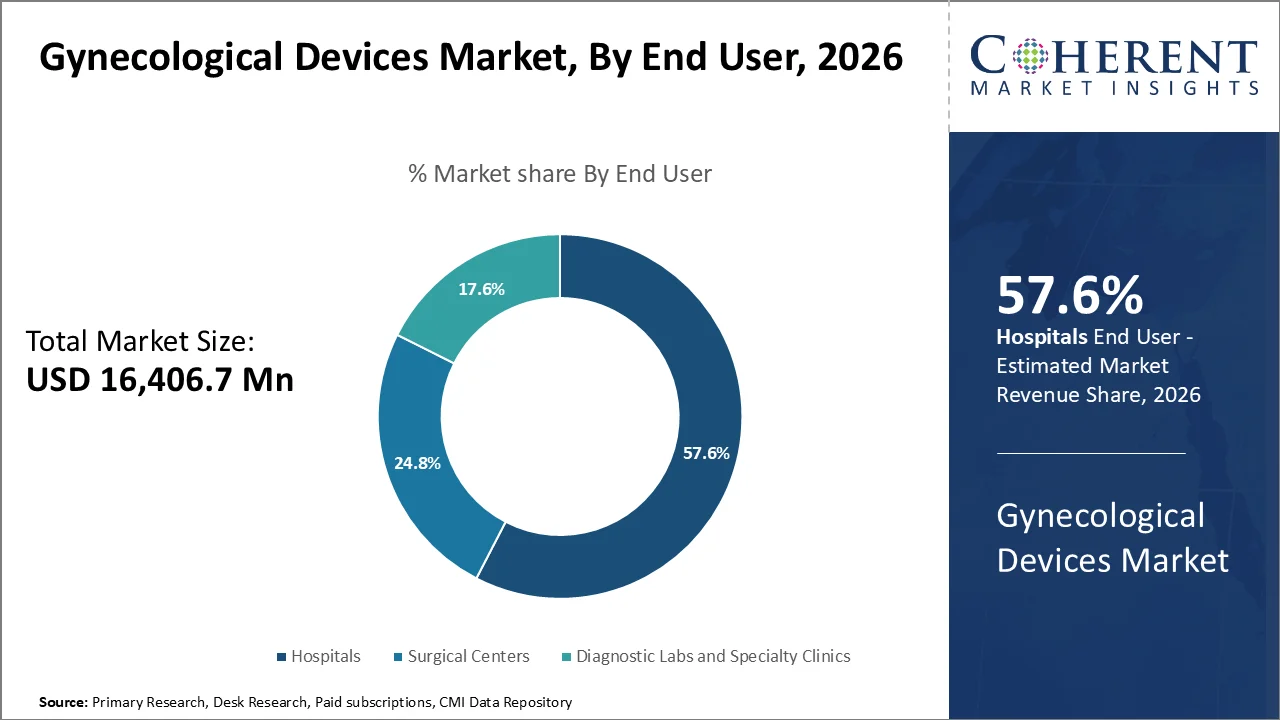
Hospitals are expected to dominate in 2026, accounting for approximately 57.6% of the market share. This is due to the availability of advanced equipment and specialized healthcare professionals. Most procedures, such as hysterectomies and gynecological cancer treatments, are still performed in hospital settings.
The hospital segment continues to remain the largest end user in the gynecological devices market, supported by expanding women’s health initiatives and increased investments in gynecology services globally.
In April 2026, Aster DM Healthcare invested INR 96 crore to expand its Women & Children facility at Aster Whitefield Hospital, Bengaluru. The expansion added 159 beds, increasing the hospital's capacity from 380 to 539 beds.
Rising Burden of Gynecological Disorders is Driving Growth in the Gynecological Devices Market
The increasing burden of gynecological disorders is driving demand for gynecological devices. Diseases such as endometriosis, fibroids, irregular bleeding, cervical cancer, and infertility require early diagnosis and treatment. As awareness of women’s health issues increases and access to care improves, procedure volumes in hospitals and specialty clinics are rising.
Through their contraceptive programmes, the UNFPA said 18 million unwanted pregnancies, 7.5 million unsafe abortions and 39,000 maternal deaths were averted in 2024. The use of these services and equipment is increasing worldwide as greater attention is paid to family planning.
Expanding Access to Family Planning and Reproductive Healthcare Accelerates Market Growth
Government agencies and international organizations are increasing investments in reproductive health programs, making it easier to access contraception, prenatal care, and gynecological services. This expansion presents significant opportunities for manufacturers of contraceptive devices and related tools. These products are increasingly used across both developed and developing regions as emphasis grows on preventing unintended pregnancies and improving maternal health.
According to UNFPA, in 2024, 259 million women and girls globally who did not want to become pregnant were not using modern contraception. This highlights the need for greater access to reproductive health care and contraception choices.
Current Events and Their Impact on the Gynecological Devices Market
Current Event | Description and its Impact |
WHO Cervical Cancer Elimination Initiative Accelerates Screening Programs Globally (2025–2026) |
|
Growing Global Investment in Family Planning and Reproductive Health Services (2025–2026) |
|
Gynecological Devices Market Trends
- Increasing adoption of minimally invasive gynecological procedures such as laparoscopy and hysteroscopy is improving patient outcomes, reducing hospital stays, and driving demand for advanced surgical devices.
- Rising gynecological disorder rates boost market growth. The WHO reports that around 190 million women and girls have endometriosis, about 10% of reproductive-aged women, supporting this trend.
- Cervical cancer screening programs are getting more attention, boosting demand for diagnostic devices. The WHO aims for 70% coverage for women aged 35 and 45 in their push to eliminate cervical cancer.
- The increasing rate of gynecologic cancers is pushing up demand for diagnostic and surgical devices too. The NCI estimates that there will be 69,120 new uterine cancer cases and 20,890 new ovarian cancer cases in the U.S. in 2025.
Regional Insights
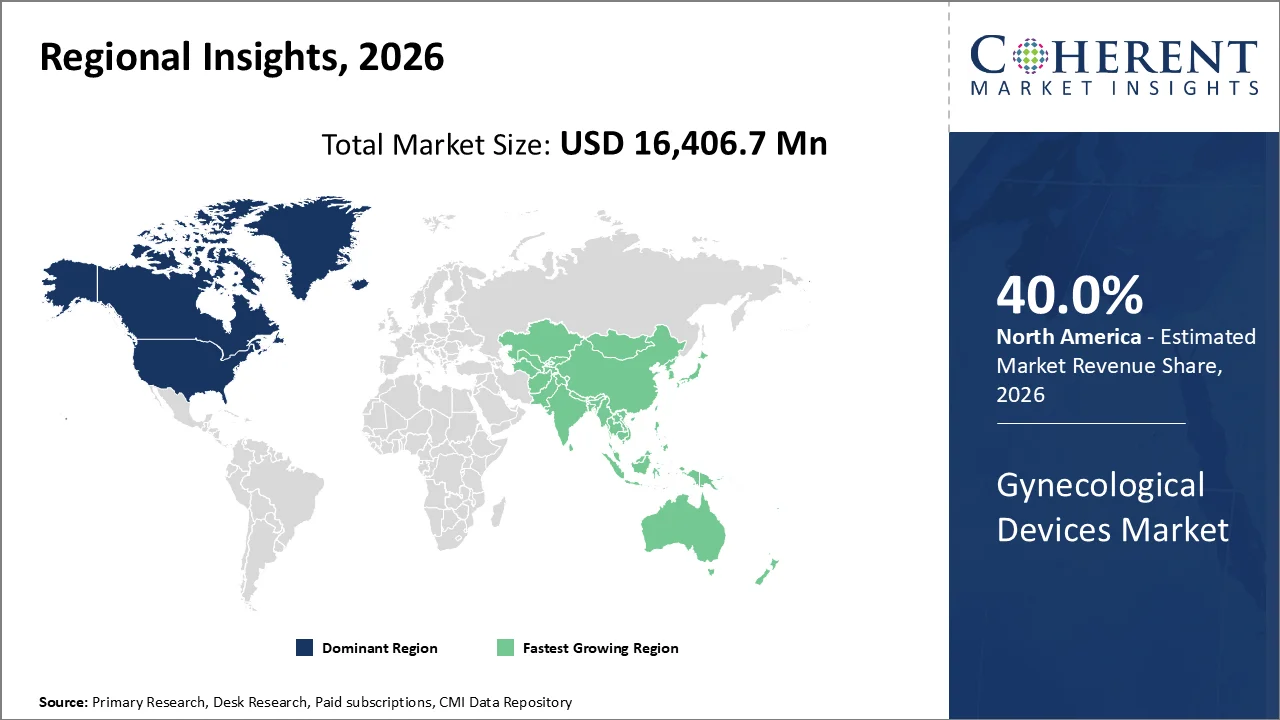
North America Dominates the Gynecological Devices Market Owing to Advanced Women's Healthcare Infrastructure
North America is expected to contribute 40% share of the gynecological devices market in 2026. This is due to the good health care, the extensive use of minimally invasive procedures, and the supporting insurance systems. There is also a high level of awareness of women’s health issues. The region is well prepared for cervical cancer screening, routinely uses laparoscopic and hysteroscopic techniques and invests heavily in women’s health care.
Innovation continues to drive market growth, with leading medical device companies expanding their minimally invasive gynecological portfolios through advanced laparoscopic and hysteroscopic systems.
In December 2025, Femasys Inc. announced that the U.S. Food and Drug Administration (FDA) granted 510(k) clearance for its next-generation FemVue Controlled device, designed to evaluate fallopian tube patency during fertility assessments.
Asia Pacific Gynecological Devices Market Trends
Asia Pacific is forecast to be the fastest growing region during the forecast period 2026 to 2033 for expansion of the market with a CAGR of 9.0 to 9.5%. This surge is attributed to the development of healthcare infrastructures, more awareness about women’s health, enhanced access to reproductive care, and a large population with gynecologic problems.
Governments in nations such as China, India, Japan and South Korea are increasing spending on women’s health, including cervical cancer screening and hospital upgrades. Hospitals are increasingly adopting advanced minimally invasive techniques like minimally invasive gyn operations and advanced endoscopic technologies to improve patient outcomes.
In September 2025, Samsung Medison unveiled enhanced women's healthcare ultrasound solutions at ISUOG 2025, including upgrades to its HERA platform focused on fertility, obstetrics, gynecology, and menopause-related diagnostics.
Growing Burden of Gynecological Disorders is Accelerating the Gynecological Devices Market Demand in the United States
The U.S. gynecological devices market is rising significantly. The rise is due to more gynecological disorders, more minimally invasive operations, more cancer screening, and significant healthcare expenditure. Moreover, the country boasts best hospital settings, supportive insurance policies and simple accessibility to latest technologies in the area.
Innovation remains a key market growth driver. In December 2025, Femasys Inc. announced U.S. FDA clearance for its next-generation FemVue Controlled diagnostic device, designed to evaluate fallopian tube patency during infertility assessments. The approval highlights the growing adoption of advanced gynecological diagnostic technologies in U.S. hospitals and fertility clinics.
Japan Gynecological Devices Market Trends
The Japan gynecological devices market is expected to grow steadily due to an aging population, increasing gynecological conditions, and a strong focus on women’s healthcare. Japan’s aging demographic is driving sustained demand for screening, surgical procedures, and reproductive health services. Japan has the world's oldest population, with people aged 65 and older comprising nearly 30% of its total population.
Who are the Major Companies in Gynecological Devices Industry
Some of the major key players in Gynecological Devices are Ethicon, Inc., Hologic, Inc., MedGyn Product Inc., Stryker Corporation, Cooper Surgical, Inc., Karl Storz GmbH& Co. KG, Boston Scientific Corporation, Richard Wolf GmbH, Medtronic, and Olympus Corporation.
Key News
- In January 2025, Hologic completed the acquisition of Gynesonics, Inc., adding the Sonata System, an incisionless ultrasound-guided radiofrequency ablation platform used for treatment of uterine fibroids and heavy menstrual bleeding.
- In March 2025, Olympus launched its first AI-powered surgical planning platform through a partnership with Ziosoft.
- In December 2025, CooperSurgical announced a direct sales expansion for its Labor & Delivery portfolio, including maternal and women's health devices across key European markets, strengthening access to obstetrics and gynecology technologies.
Market Report Scope
Gynecological Devices Market Report Coverage
| Report Coverage | Details | ||
|---|---|---|---|
| Base Year: | 2025 | Market Size in 2025: | USD 16,406.7 Mn |
| Historical Data for: | 2020 To 2024 | Forecast Period: | 2026 To 2033 |
| Forecast Period 2026 to 2033 CAGR: | 8.0% | 2032 Value Projection: | USD 28,118.1 Mn |
| Geographies covered: |
| ||
| Segments covered: |
| ||
| Companies covered: |
| ||
| Restraints & Challenges: |
| ||
Analyst Opinion
- Gynecological devices are supported by a large and growing clinical need rather than short-term healthcare trends.
- Cervical cancer prevention efforts will continue to increase in the years ahead. WHO’s Cervical Cancer Elimination Initiative targets for 70% global screening coverage. This should help increase the usage of colposcopes, biopsy instruments, hysteroscopes and related equipment.
- The industry is innovating in technology. Technologies such as AI-assisted imaging, high-definition endoscopic systems, robotic-assisted gynecological surgery, enhanced hysteroscopy platforms, and next-generation endometrial ablation technologies are enhancing diagnostic accuracy and operative results.
- Asia Pacific is likely to provide the best growth opportunities over the coming decade. This is because to improved healthcare, more women’s health initiatives, more spending on health care and a big population that needs reproductive and gynaecological care.
- Global demand for gynecological devices is growing due to rising awareness of women’s health, more participation in screening, growing access to reproductive care, and continued development of minimally invasive technology.
Speak to the analyst
Want personalized insights?
Take the findings above to one of our principal consultants, or have the report rebuilt around the segments, geographies and competitors you actually track.
Market Segmentation
- By Device Type (Revenue, USD Mn, 2021-2033)
- Surgery Devices
- Gynecological Endoscopy Devices
- Hysteroscope
- Colposcope
- Resectoscope
- Laparoscope
- Endoscopic Imaging Systems
- Endometrial Ablation Devices
- Hydrothermal Ablation Devices
- Radiofrequency Ablation Devices
- Balloon Ablation Devices
- Others (Cryotherapy, Microwave, Laser)
- Fluid Management Systems
- Female Sterilization / Contraceptive Devices
- Permanent Contraceptive Devices
- Temporary Contraceptive Devices
- Intrauterine Devices (IUDs)
- Intravaginal Rings
- Subdermal Contraceptive Implants
- Gynecological Endoscopy Devices
- Hand Instruments
- Vaginal Speculum
- Disposable Vaginal Speculum
- Reusable Vaginal Speculum
- Tenaculum
- Curettes
- Trocars
- Biopsy Forceps
- Others
- Vaginal Speculum
- Gynecological Chairs
- Fixed-Height Chairs
- Adjustable-Height Chairs
- Surgery Devices
- By End User (Revenue, USD Mn, 2021-2033)
- Hospitals
- Surgical Centers
- Diagnostics Lab and Specialty Clinics
- By Region (Revenue, USD Mn, 2021-2033)
- North America
- U.S.
- Canada
- Latin America
- Brazil
- Mexico
- Argentina
- Rest of Latin America
- Europe
- Germany
- U.K.
- France
- Italy
- Spain
- Russia
- Rest of Europe
- Asia Pacific
- China
- India
- Japan
- Australia
- South Korea
- ASEAN
- Rest of Asia Pacific
- Middle East
- GCC
- Israel
- Rest of Middle East
- North America
Sources
Primary Research Interviews
- Gynecologists and Obstetricians
- Minimally Invasive Gynecologic Surgeons
- Reproductive Health Specialists
- Hospital Administrators
- Ambulatory Surgical Center (ASC) Managers
- Medical Device Distributors
- Key Opinion Leaders (KOLs) in Women's Health and Gynecology
Databases
- World Health Organization (WHO)
- Centers for Disease Control and Prevention (CDC)
- National Institutes of Health (NIH)
- Organisation for Economic Co-operation and Development (OECD)
- United Nations Population Fund
- National Cancer Institute
Magazines
- Contemporary OB/GYN
- OBG Management
- Women's Healthcare
Journals
- American Journal of Obstetrics and Gynecology
- BJOG: An International Journal of Obstetrics & Gynaecology
- Journal of Minimally Invasive Gynecology
- Obstetrics & Gynecology
- International Journal of Gynecology & Obstetrics
Newspapers
- The New York Times
- The Wall Street Journal
- The Guardian
- USA Today
Associations
- American College of Obstetricians and Gynecologists
- International Federation of Gynecology and Obstetrics
- American Association of Gynecologic Laparoscopists
- European Society of Gynaecological Endoscopy
- Society of Gynecologic Oncology
Public Domain Sources
- Company Annual Reports and Investor Presentations
- Government Health Ministry Publications
- Clinical Trial Registries such as ClinicalTrials.gov
- Regulatory Agency Publications (FDA, EMA, PMDA)
- Hospital and Healthcare System Reports
Proprietary Elements
- CMI Data Analytics Tool
- Proprietary CMI Existing Repository of Information for the Last 10 Years
- Proprietary Market Modeling and Forecasting Framework
- Expert Interview Repository and Industry Benchmark Database
Get access to 250+ pages report
Every segment, forecast, competitor profile and data table behind the analysis above — available for instant download.
- ESOMAR Member
- ISO 9001:2015 Certified
- D-U-N-S Registered
- GDPR & CCPA Compliant
Missing comfort of reading report in your local language? Find your preferred language:
Transform your Strategy with Exclusive Trending Reports
Frequently Asked Questions
The Gynecological Devices Market is expected to reach USD 28,118.1 Mn by 2033.
Major players operating in the global gynecological devices market include Ethicon, Inc., Hologic, Inc., MedGyn Products, Inc., Stryker Corporation, CooperSurgical, Inc., Karl Storz GmbH & Co. KG, Boston Scientific Corporation, Richard Wolf GmbH, Medtronic plc, and Olympus Corporation.
High costs associated with advanced gynecological surgical and diagnostic devices, along with limited access to women's healthcare services in low- and middle-income countries, are major factors restraining market growth.
The increasing prevalence of gynecological disorders, growing adoption of minimally invasive gynecological surgeries and endoscopic procedures, expanding cervical cancer screening programs, rising awareness of women's health, and increasing access to reproductive healthcare services are driving market growth.
The Gynecological Devices Market is anticipated to grow at a CAGR of 8.0% between 2026 and 2033.
Among regions, North America is expected to account for the largest share of the global gynecological devices market during the forecast period, holding approximately 40% of market revenue in 2026.
Gynecological devices are used for the diagnosis, treatment, monitoring, and management of female reproductive health conditions. These devices support procedures such as cervical cancer screening, endometrial ablation, laparoscopy, hysteroscopy, contraception, fertility assessment, and treatment of disorders including endometriosis, uterine fibroids, and gynecologic cancers.