

Medical Camera Market Size and Forecast
Medical Camera Market Size and Forecast – 2025 – 2032
The Global Medical Camera Market size is estimated to be valued at USD 2.1 billion in 2025 and is expected to reach USD 4.3 billion by 2032, exhibiting a compound annual growth rate (CAGR) of 10.4% from 2025 to 2032.
Overview
Medical cameras are precision imaging devices designed for real-time visualization during diagnostic, surgical, and endoscopic procedures. These systems capture high-resolution still and video images to assist clinicians in performing minimally invasive surgeries and pathology assessments. Historically, medical cameras evolved from analog microscopy attachments to advanced digital imaging platforms integrated with sensors such as CCD and CMOS. Current systems include 3D, fluorescence, and infrared imaging capabilities for enhanced tissue differentiation and clinical accuracy. Compact, wireless, and AI-integrated cameras are gaining prominence, enabling improved documentation, telemedicine applications, and automated image analysis for better clinical outcomes.
Key Takeaways
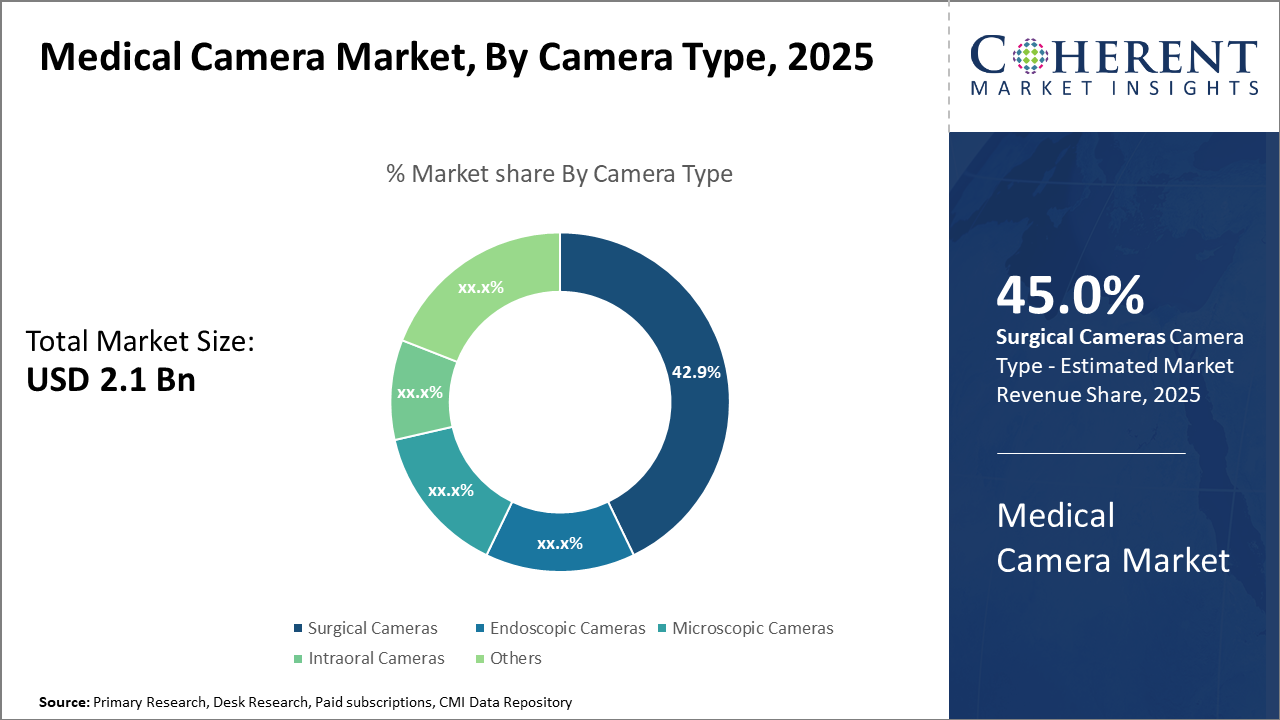
In the camera type segment, surgical cameras dominate with a market share of 45%, driven by their widespread application in minimally invasive surgeries requiring high-definition visualization.
Wireless cameras, within the technology segment, are the fastest-growing due to increasing demand for mobility and ease of use in clinical settings.
The diagnostic imaging application segment presents strong prospects, fueled by chronic disease diagnosis and treatment monitoring needs.
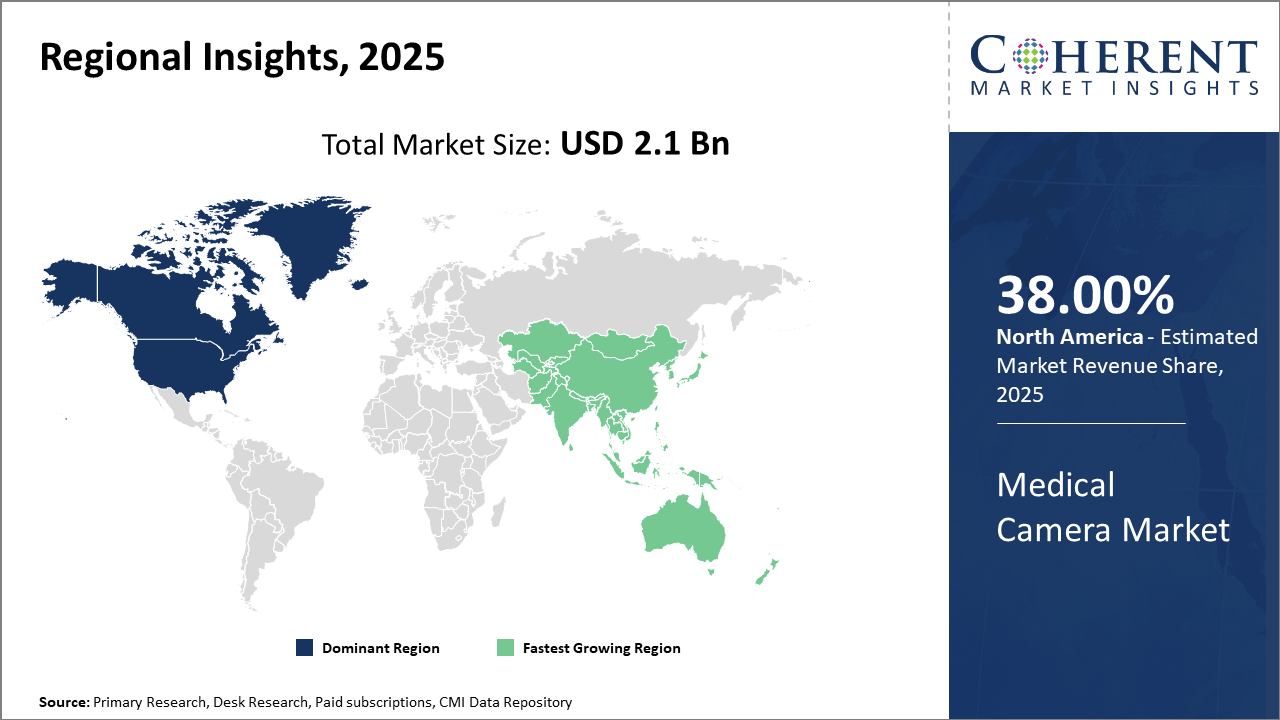
Regionally, North America holds the dominant position, accounting for over 38% of the industry share, supported by advanced healthcare infrastructure and high adoption of cutting-edge technologies.
Meanwhile, the Asia Pacific is the fastest-growing region with a CAGR of approximately 12%, attributed to expanding healthcare access, rising surgical volumes, and supportive governmental policies in countries like China and India.
Europe remains a critical market with steady growth driven by regulatory frameworks emphasizing product safety and efficacy.
Medical Camera Market Segmentation Analysis
Medical Camera Market Insights, By Camera Type
Surgical cameras dominate the market share owing to their critical role in minimally invasive and robotic-assisted surgeries. Their enhanced resolution and integration capabilities with surgical systems underpin their leadership in market revenue generation. Endoscopic cameras constitute the fastest-growing subsegment due to increasing adoption in gastroenterology and urology diagnostics, supported by innovations in flexible imaging technologies.
Medical Camera Market Insights, By Application
Minimally invasive surgery leads both market size and growth, driven by an increasing volume of laparoscopic, arthroscopic, and robotic surgeries globally. Enhanced surgical outcomes facilitated by superior imaging drive ongoing replacement and upgrades of camera systems. Diagnostic imaging is the second largest segment, benefiting from growing chronic disease burdens requiring accurate monitoring. Dental imaging enjoys rapid adoption of intraoral cameras powered by patient preference for cosmetic procedures, marking it as a fast-growth subsegment. Veterinary imaging remains niche but expands gradually with technological diffusion.
Medical Camera Market Insights, By Technology
Wired cameras currently hold the dominant market share as the established standard in surgical suites, prized for reliability and image stability. However, wireless cameras represent the fastest-growing technology, driven by demand for portability and integration with mobile platforms, particularly in outpatient and emergency settings. 3D imaging cameras support complex surgical applications by providing depth perception, with steady but specialized growth. The 4K resolution segment is rapidly expanding due to its ability to deliver ultra-high definition images crucial for diagnostics and surgeries, while Others include multi-spectral and specialized wavelength cameras for research and niche applications.
Medical Camera Market Trends
The evolving market increasingly embraces AI-driven imaging applications that streamline diagnostics and surgical workflows.
For example, integration of AI-based algorithms has improved anomaly detection accuracy by up to 15% in clinical trials conducted in 2024.
Wireless camera systems are gaining traction, with enhanced portability enabling their use in outpatient and emergency care settings, especially in regions with infrastructure challenges.
Additionally, a growing focus on environmental sustainability has motivated manufacturers to innovate with power-efficient sensors and recyclable materials, aligning with healthcare systems' green initiatives.
Medical Camera Market Insights, By Geography
North America Medical Camera Market Analysis and Trends
In North America, the dominance in the Medical Camera market stems from a mature healthcare infrastructure, high adoption rate of emerging surgical technologies, and significant investments in R&D. This region accounts for approximately 38% of the industry share. Prominent companies like Olympus Corporation and Medtronic plc have contributed significantly to market dynamics by continually launching advanced imaging solutions tailored for the U.S. and Canadian markets. Supportive regulatory frameworks and rising awareness of minimally invasive procedures further entrench the region’s leadership.
Asia Pacific Medical Camera Market Analysis and Trends
Meanwhile, the Asia Pacific exhibits the fastest growth with an estimated CAGR of 12%, driven largely by expanding healthcare services access, increasing government expenditure, and rising surgical procedure volumes in countries such as China and India. Domestic companies in China have expanded production capacity by over 20% in 2024, enabling cost-effective product availability. Furthermore, increasing demand for portable medical camera devices to serve rural and remote hospitals bolsters regional growth potential.
Medical Camera Market Outlook for Key Countries
USA Medical Camera Market Analysis and Trends
The USA remains the single largest contributor to the medical camera market revenue due to its extensive healthcare infrastructure and significant investments in advanced imaging equipment. Increasing demand for robotic-assisted surgeries and minimally invasive surgeries, propelled by institutions such as the Mayo Clinic and Cleveland Clinic, has led to a 14% rise in medical camera deployments in 2024. Additionally, government funding for innovation through agencies like the NIH supports R&D efforts, enabling market players to introduce state-of-the-art 4K and 3D imaging products that enhance surgical outcomes and diagnostic workflows.
India Medical Camera Market Analysis and Trends
India’s market is growing rapidly, fueled by rising healthcare expenditure, expanding private hospital networks, and government initiatives to upgrade medical infrastructure under schemes like Ayushman Bharat. The number of laparoscopic procedures increased by nearly 18% in 2024, driving demand for high-definition imaging solutions. Domestic manufacturers have scaled operations to deliver affordable yet sophisticated products, while international companies actively collaborate with local distributors to broaden market reach. This dynamic ecosystem creates opportunities for faster adoption of emerging technologies, including wireless and AI-driven cameras.
Analyst Opinion
The robustness of production capacity in semiconductor sensors is vital for the medical camera market size. In 2024, the global production of CMOS image sensors, integral to medical cameras, saw a 12% increase year-over-year, enabling higher resolution and better image quality. This capacity enhancement directly affects market share by allowing manufacturers to offer more advanced and cost-competitive solutions.
Demand-side indicators reveal growing uptake in the Asia Pacific’s healthcare sector, with countries like India and China reporting a 15% annual rise in surgical procedures requiring high-definition imaging since early 2024. This surge drives market revenue and highlights shifting market dynamics where increasing healthcare expenditure correlates with demand for advanced imaging tools.
Pricing dynamics demonstrate a slight downward trend for basic medical cameras, influenced by growing competition and manufacturability improvements. For instance, between 2023 and 2024, average prices of laparoscopic camera systems decreased by approximately 8%, facilitating broader adoption in emerging economies and reinforcing market growth strategies focused on affordability.
Nano-segmentation insights show niche applications in dental endoscopy and veterinary imaging sectors, contributing to incremental market share gains. Instruments optimized for smaller form factors grew by 18% in shipments in 2024, underscoring micro-indicator relevance in diversifying market scope and enhancing business growth opportunities.
- Current Industry Events
- Market Size Estimation
- Regional Breakdown
- Competitive Landscape
- Customer Intelligence
- Segmental Analysis
- Pricing Analysis
- Key Market Drivers, Challenges & Future Trends
- Customized Insights Section
Market Scope
| Report Coverage | Details | ||
|---|---|---|---|
| Base Year: | 2025 | Market Size in 2025: | USD 2.1 billion |
| Historical Data for: | 2020 To 2024 | Forecast Period: | 2025 To 2032 |
| Forecast Period 2025 to 2032 CAGR: | 10.4% | 2032 Value Projection: | USD 4.3 billion |
| Geographies covered: |
| ||
| Segments covered: |
| ||
| Companies covered: | Sony Corporation, Canon Inc., Nikon Corporation, Arthrex, Inc., Fujifilm Holdings Corporation, Olympus Corporation, Panasonic Corporation, Stryker Corporation, Karl Storz SE & Co. KG, Medtronic plc, Shenzhen Mindray Bio-Medical Electronics Co., Ltd. | ||
| Growth Drivers: |
| ||
Medical Camera Market Growth Factors
The deployment of telemedicine solutions, enhancing demand for wireless and high-resolution medical cameras supporting remote diagnostics. In 2024, telemedicine usage increased by nearly 25% in developed countries, driving new opportunities for market revenue. Rapid technological advancements, especially in 3D and 4K imaging capabilities, have improved surgical accuracy, fostering greater adoption of robotic-assisted surgeries. For example, robotic system-assisted surgeries grew by 17% globally in 2024. Furthermore, increasing investments in healthcare infrastructure, especially in Asia Pacific and North America, are expanding the market scope. Governmental initiatives promoting the modernization of health facilities have resulted in over USD 2 billion in capital investments dedicated to imaging equipment upgrades in 2024. Apart from this, the rising chronic disease prevalence requiring minimally invasive procedures amplifies demand for superior imaging solutions, contributing significantly to the market growth.
Medical Camera Market Development
In September 2024, Stryker introduced its 1788 Advanced Imaging Platform in India, aimed at enhancing surgical visualization across multiple specialties. The platform offers ultra-high-definition 4K imagery, a dramatically wider colour gamut (62.5× more visible colours), high dynamic range imaging, tone mode for even lighting, and advanced fluorescence modes such as CSF (Color Segmented Fluorescence) for perfusion and lymph-node mapping. It supports current and future imaging agents (e.g., CYTALUX®) and is designed for urology, thoracic, neurology, ENT, and other high-precision fields.
In November 2024, AVer launched its MD720UIS medical-grade all-in-one PTZ (pan-tilt-zoom) camera, designed for healthcare environments and telemedicine use. Key features include edge-AI capabilities (such as fall and bed-egress detection, face/eye tracking), 20× 4K optical zoom, PoE++ connectivity (single cable for power + data), privacy mode with mosaic effect, and integration with multiple healthcare apps.
Key Players
Leading Companies of the Market
Sony Corporation
Canon Inc.
Nikon Corporation
Arthrex, Inc.
Fujifilm Holdings Corporation
Olympus Corporation
Panasonic Corporation
Stryker Corporation
Karl Storz SE & Co. KG
Medtronic plc
Shenzhen Mindray Bio-Medical Electronics Co., Ltd.
Several leading market companies have implemented robust growth strategies, enhancing their competitive positioning. For instance, Sony Corporation successfully introduced a new line of 4K endoscopic cameras in 2024, resulting in a 10% revenue increase in the imaging segment. Similarly, Olympus Corporation expanded its penetration by forming strategic partnerships with leading hospitals across Europe, boosting market share by 8% in the same year. Karl Storz’s acquisition of niche medical camera technology firms in 2023 has accelerated innovation and diversified its product portfolio, enhancing business growth and market forecast confidence.
Medical Camera Market Future Outlook
Future advancements in the medical camera market will be defined by artificial intelligence, 3D imaging, and augmented reality integration. Cameras will increasingly incorporate AI-based image recognition and automatic calibration for enhanced diagnostic accuracy. The shift toward wireless, wearable, and capsule cameras will facilitate remote monitoring and minimally invasive diagnostics. As hospitals digitize workflows, demand for connected imaging systems integrated into surgical robotics and cloud-based storage will grow rapidly. The market will also benefit from the rising adoption of fluorescence and hyperspectral imaging for precision oncology and microvascular visualization.
Medical Camera Market Historical Analysis
The medical camera market has evolved dramatically since the early 20th century, beginning with analog microscope cameras used for pathology documentation. The introduction of digital imaging in the 1990s revolutionized surgical visualization and clinical diagnostics. Miniaturization and sensor innovation enabled the transition from bulky optical setups to compact, high-resolution endoscopic and surgical cameras. Integration with fiber optics and CMOS technology improved clarity and real-time imaging in minimally invasive procedures. The growing emphasis on image-guided surgery and telemedicine applications further broadened usage across clinical environments.
Sources
Primary Research Interviews:
Biomedical Engineers
Surgeons
Hospital Procurement Specialists
Imaging System Designers
Databases:
FDA Medical Device Database
WHO Health Technology Reports
NIH
GlobalData Medical Imaging Reports
Magazines:
Medical Device + Diagnostic Industry
Imaging Technology News
Nature Biomedical Engineering
Diagnostic Imaging Magazine
Journals:
Journal of Biomedical Optics
Surgical Innovation
IEEE Transactions on Medical Imaging
Journal of Endoscopic Surgery
Newspapers:
The Guardian (Health)
The Wall Street Journal (Medical)
The Hindu (Science)
The Times (Health)
Associations:
Radiological Society of North America (RSNA)
American College of Surgeons (ACS)
World Health Organization (WHO)
IEEE Engineering in Medicine and Biology Society
Get access to 250+ pages report
Every segment, forecast, competitor profile and data table behind the analysis above — available for instant download.
- ESOMAR Member
- ISO 9001:2015 Certified
- D-U-N-S Registered
- GDPR & CCPA Compliant
Missing comfort of reading report in your local language? Find your preferred language:
Transform your Strategy with Exclusive Trending Reports
Frequently Asked Questions
Leading players include Sony Corporation, Olympus Corporation, Canon Inc., Karl Storz SE & Co., and Fujifilm Holdings Corporation, each commanding significant market share through innovative product launches and strategic expansions.
The market size is projected to grow from USD 2.1 billion in 2025 to USD 4.3 billion by 2032, reflecting a CAGR of 10.4%, driven by increasing adoption in surgical and diagnostic applications.
Minimally invasive surgery and diagnostic imaging remain the largest contributors, propelled by expanding procedure volumes and technological enhancements that increase imaging precision.
The market trend will increasingly favor AI integration, wireless technologies, and sustainability initiatives, with enhanced image resolution driving diagnostic and procedural accuracy.
Competition is intensified by rapid technological advancements and pricing pressures. Key challenges relate to regulatory compliance and balancing innovation with cost-effectiveness.