

Dental Colorimeter Market Size and Forecast – 2026 to 2033
The Dental Colorimeter Market is anticipated to grow at a CAGR of 6.8% with USD 1.5 Bn in 2026 and is expected to reach USD 2.8 Bn in 2033. Rising demand for precise shade matching in restorative and cosmetic dentistry drives the Dental Colorimeter Market. The Global Cosmetic Dentistry industry size is estimated to surpass USD 17.02 billion by 2033.
Key Takeaways
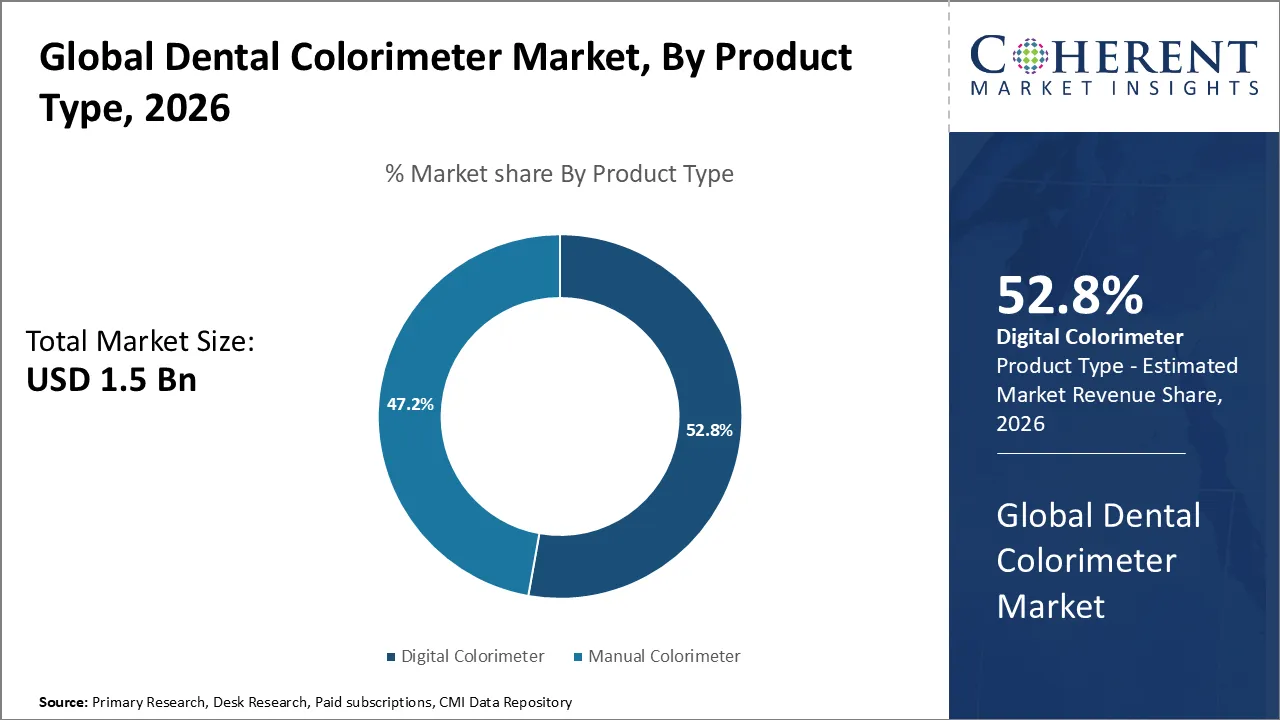
- Digital Colorimeter hold the largest market share of 52.8% in 2026 owing to the growing demand for aesthetic dentistry. 17% of Americans, nearly one in five have undergone a cosmetic dentistry procedure. Adults under 45 are also more likely than older adults to have received orthodontic treatment.
- Hospitals expected to hold largest market share of 42.8% in 2026 owing to its expansion of hospital-based dental departments. India has more than 35,886 dental clinics and specialized hospital-based dental facilities combined.
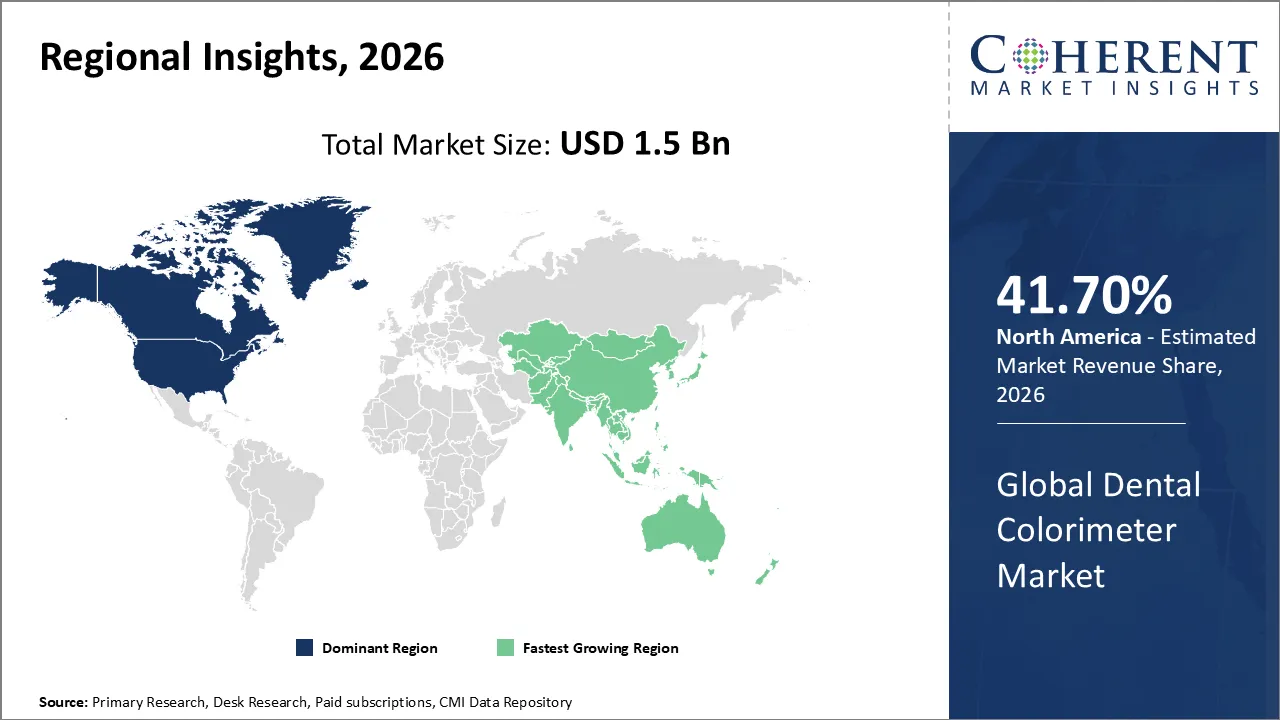
- By Region, North America is expected to acquire the dominant share of 41.7% in 2026 owing to the strong adoption of digital dentistry. More than half (53%) of respondents strongly agreed that digitalisation is essential to the future of dentistry.
Current Events and Their Impact on the Dental Colorimeter Market
Current Event | Description and its Impact |
FDA Quality Management System Regulation (QMSR) became effective in the U.S. on February 2, 2026 |
|
CDSCO's evolving regulation of medical-device software and AI is increasing relevance for connected dental colorimeters |
|
Segmental Insights
- Current Industry Events of 2026
- Market Size Estimation
- Regional Breakdown
- Competitive Landscape
- Customer Intelligence
- Segmental Analysis
- Pricing Analysis
- Key Market Drivers, Challenges & Future Trends
- Customized Insights Section
Why is Digital Colorimeter Acquiring the Largest Market Share?
Digital Colorimeter holds the largest market share of 52.8% in 2026. The digital colorimeter segment in the Dental Colorimeter Market benefits from rising demand for accurate and consistent tooth-shade matching in restorative and cosmetic dentistry. Dental professionals increasingly adopt digital workflows, including CAD/CAM systems and intraoral scanners, which support color measurement technologies. Patients also expect natural-looking restorations, encouraging dentists and laboratories to improve shade accuracy. The expansion of dental laboratories further supports adoption, while advanced sensors, portable designs, wireless connectivity, and integrated software enhance the functionality and usability of digital colorimeters.
Which End User segment dominates the market?
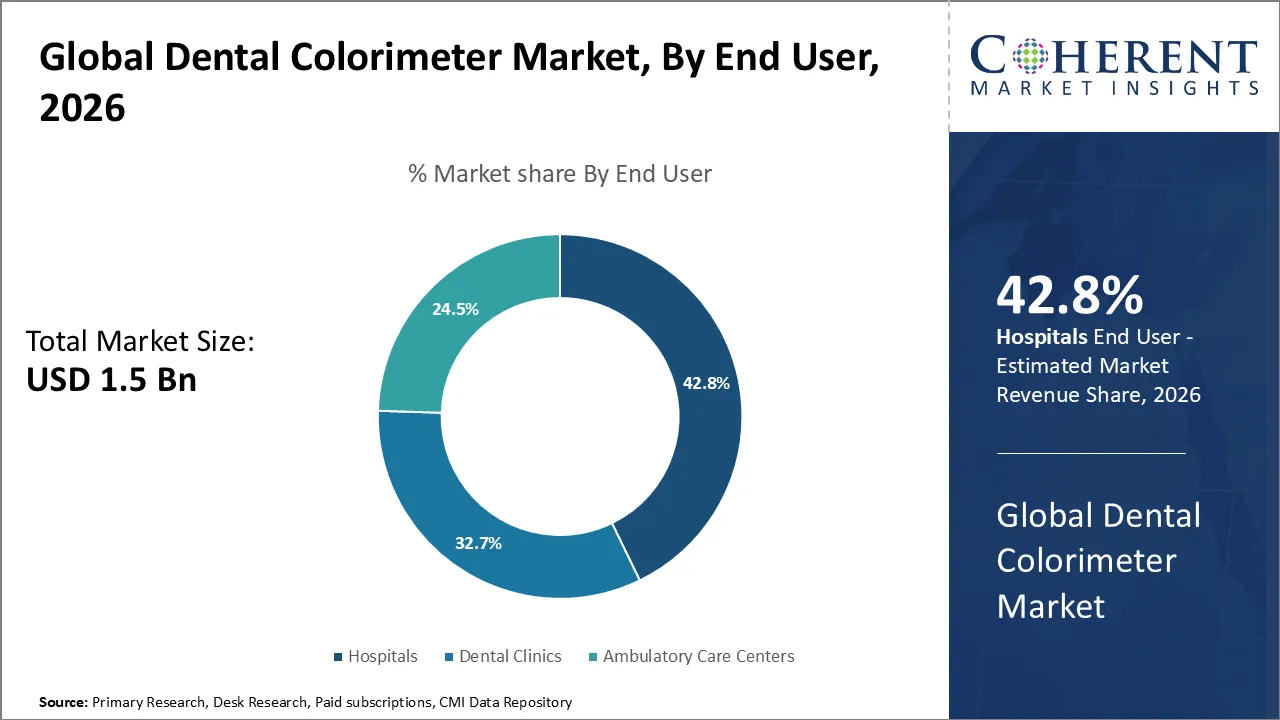
Hospitals expected to hold largest market share of 42.8% in 2026. Hospitals boost demand for dental colorimeters as they expand restorative and cosmetic dental procedures that require precise tooth-shade matching. Value 2 was the most prevalent existing tooth shade, accounting for 52.5% of cases, while Value 0 was the least prevalent. Value 2 was also the most preferred tooth shade, reported by 58.33% of participants. Dental departments adopt digital technologies to improve treatment accuracy and patient outcomes. Hospitals also integrate CAD/CAM systems, digital imaging, and intraoral scanners into dental workflows, increasing the need for advanced color-measurement tools. Rising patient expectations for natural-looking restorations further encourage healthcare providers to use objective shade-matching technologies. Dental colorimeters help hospitals standardize shade selection, improve laboratory coordination, and minimize errors during restoration fabrication and fitting.
Dental Colorimeter Market Trends
- Increasing adoption of digital dentistry and intraoral scanning. An ADA report citing the National Association of Dental Laboratories' 2023 survey found that 58% of dental laboratories reported an increase in the number of clients using intraoral impression systems, compared with 53% in 2022. The same survey found that 62% of laboratories used digital communication networks to communicate with clients using CAD/CAM, and 35% of impressions were digital.
- Expansion of CAD/CAM-based dental restoration workflows. The FDA classifies optical impression systems used for CAD/CAM of dental restorations as Class II medical devices under 21 CFR §872.3661. These systems use cameras, scanners or equivalent sensors together with computer processing and software to support the design and manufacture of dental restorations. The established regulatory framework for digital dental scanning and CAD/CAM supports continued integration of optical measurement technologies into restorative dentistry, creating opportunities for colorimeters to connect with digital restoration workflows.
- Growing use of AI and digital diagnostic technologies in dental practices. According to the ADA Health Policy Institute's 2026 national survey, 43.3% of responding U.S. dentists reported using AI for at least one task, while 22.8% reported using AI for imaging and diagnostics. Another 25.4% said they planned to use AI for imaging and diagnostics. This demonstrates increasing acceptance of AI-supported dental workflows. For dental colorimeters, the trend supports development of automated shade analysis, image-based shade assessment and software-assisted interpretation, although AI adoption does not by itself establish demand for a particular colorimeter.
Regional Insights
North America dominates owing to increasing focus on treatment efficiency
North America is expected to acquire the dominant share of 41.70% in 2026. North America’s Dental Colorimeter Market grows as dental professionals adopt digital dentistry, advanced equipment, and cosmetic and restorative procedures. Dental clinics and laboratories increasingly implement CAD/CAM systems, intraoral scanners, and digital workflows, driving demand for precise digital shade measurement. Patients also seek highly aesthetic restorations, encouraging providers to adopt accurate color-matching technologies. In addition, expanding dental laboratory services, continuous technological innovation in colorimeters, and greater emphasis on treatment precision and workflow efficiency strengthen market development across the region. HunterLab, a global innovator in color measurement technology, has launched the Agera L2 Spectrophotometer/Colorimeter, a reference-grade solution designed to provide visually aligned color measurements.
Asia Pacific Dental Colorimeter Market Trends
The Asia Pacific dental colorimeter market grows as consumers increasingly seek cosmetic and restorative dental treatments and become more aware of dental aesthetics. Dental clinics and laboratories across China, India, Japan, and Southeast Asia are adopting advanced colorimeters to achieve accurate tooth-shade matching. Dental professionals also integrate colorimeters into CAD/CAM and digital dentistry workflows to improve treatment precision. Expanding dental tourism, stronger healthcare infrastructure, rising disposable incomes, and the growing need for consistent shade selection further support market growth across the region.
United States Dental Colorimeter Market Trends
In the United States, growing demand for aesthetic and restorative dentistry drives the dental colorimeter market, as patients increasingly seek natural-looking restorations. Dentists and laboratories use colorimeters to achieve more accurate and consistent tooth-shade matching, strengthening digital collaboration. The adoption of CAD/CAM systems, intraoral scanners, and integrated digital laboratory workflows further supports market growth. Rising cosmetic dental procedures, advances in digital shade-analysis technology, and the need for faster and more efficient chairside procedures also encourage dental professionals to adopt colorimeter solutions. X-Rite, Inc. has enhanced its ShadeVision System, a shade-matching device that consistently measures the hue, value, and chroma of teeth. These product improvements help the system better address users’ requirements and support more consistent dental shade assessment.
Japan Dental Colorimeter Market Trends
Japan’s aging population drives demand for restorative and cosmetic dental treatments, increasing the need for accurate shade matching in crowns, veneers, and prosthetic restorations. Japan has more than 100,000 people aged 100 years or older, nearly 88% of whom are women. Dental clinics and laboratories are adopting digital dentistry and advanced diagnostic technologies to achieve more consistent color assessments. Growing awareness of oral aesthetics and preventive care, along with patients’ expectations for natural-looking restorations, further strengthens demand. Japan’s well-developed healthcare infrastructure and strong focus on technological innovation also encourage dental professionals to adopt precision equipment such as dental colorimeters.
Who are the Major Companies in Dental Colorimeter Industry
Some of the major key players in Dental Colorimeter are MHT Optic Research Ag., ZFX, VITA Zahnfabrik H. Rauter GmbH & Co KG., and Dentamerica.
Market Report Scope
Dental Colorimeter Market Report Coverage
Report Coverage | Details | ||
Base Year: | 2025 | Market Size in 2026: | USD 1.5 Bn |
Historical Data for: | 2020 to 2024 | Forecast Period: | 2026 to 2033 |
Forecast Period 2026 to 2033 CAGR: | 6.8% | 2033 Value Projection: | USD 2.8 Bn |
Geographies covered: |
| ||
Segments covered: |
| ||
Companies covered: | MHT Optic Research Ag., ZFX, VITA Zahnfabrik H. Rauter GmbH & Co KG., and Dentamerica. | ||
Analyst Opinion
- Japan’s shift toward digital and non-metal prosthodontics is, in our view, the strongest structural driver for dental colorimeter adoption. Japan’s Ministry of Health, Labour and Welfare reports that non-metal CAD/CAM crowns account for approximately 60% of premolar crown claims and around 30% of molar crown claims, with both shares increasing. As digitally fabricated restorations expand, laboratories and dental clinics have a stronger need to standardize shade selection and reduce subjective visual matching. We expect colorimeters to increasingly function as a quality-control tool within digitally integrated restorative workflows rather than as a standalone diagnostic device.
- The growing sophistication of Japan’s CAD/CAM workflow makes objective color measurement increasingly difficult to ignore. Current Japanese reimbursement rules explicitly recognize CAD/CAM crowns, inlays, and bridges, while qualifying CAD/CAM bridge treatment requires appropriate prosthodontic expertise and either in-house CAD/CAM capability or coordination with a dental laboratory equipped with the technology. In our assessment, this ecosystem creates a clear opportunity for colorimeters because shade data can complement digital design and laboratory communication, particularly where clinicians seek repeatable restoration outcomes across multiple production stages.
- The next phase of demand will come from workflow integration, not simply from dentists replacing visual shade guides. Japan’s dental sector is already incorporating optical impressions, CAD/CAM production, technician collaboration, and digital denture workflows; the Japan Dental Association’s 2026 journal, for example, describes workflows combining 3D scanning, CAD-based design, milling, and 3D printing. This makes color measurement a logical missing layer in an increasingly digitized restorative chain. Vendors that connect shade capture with digital laboratory workflows should therefore have a stronger commercial proposition than devices positioned only as standalone colorimeters.
- Japan represents a quality-driven rather than volume-driven opportunity for dental colorimeters. The country’s increasing use of CAD/CAM restorations means the commercial value of accurate shade communication rises with workflow complexity. We therefore expect adoption to concentrate first among technologically advanced dental laboratories, prosthodontic practices, and clinics handling higher volumes of esthetic restorations, where reducing remakes and improving shade consistency can directly justify equipment investment. This makes workflow compatibility, measurement reproducibility, and integration with digital dentistry more important purchasing criteria than basic color measurement alone.
Speak to the analyst
Want personalized insights?
Take the findings above to one of our principal consultants, or have the report rebuilt around the segments, geographies and competitors you actually track.
Market Segmentation
- By Product Type (Revenue, USD Bn, 2021-2033)
- Digital Colorimeter
- Manual Colorimeter
- By End User (Revenue, USD Bn, 2021-2033)
- Hospitals
- Dental Clinics
- Ambulatory Care Centers
- By Region (Revenue, USD Bn, 2021-2033)
- North America
- U.S.
- Canada
- Latin America
- Brazil
- Mexico
- Argentina
- Rest of Latin America
- Europe
- Germany
- U.K.
- France
- Italy
- Spain
- Russia
- Rest of Europe
- Asia Pacific
- China
- India
- Japan
- Australia
- South Korea
- ASEAN
- Rest of Asia Pacific
- Middle East
- GCC
- Israel
- Rest of Middle East
- Africa
- South Africa
- Central Africa
- North Africa
- North America
Sources
Primary Research interviews
- Prosthodontists and restorative dentists
- Dental laboratory technicians and laboratory managers
- Dental equipment distributors and suppliers
- CAD/CAM dental technology specialists
- Dental colorimeter and shade-analysis technology experts
- Hospital dental department professionals
- Dental clinic owners and practice managers
Databases
- PubMed / MEDLINE
- Scopus
- Web of Science
- Cochrane Library
- Google Scholar
- ClinicalTrials.gov
- U.S. National Library of Medicine databases
Magazines
- Dental Products Report
- DentistryIQ
- Dental Tribune
- Inside Dental Technology
- Dentistry Today
- Dental Economics
- British Dental Journal – News and industry coverage
Journals
- Journal of Prosthetic Dentistry
- Journal of Dentistry
- Journal of Prosthodontics
- Journal of Esthetic and Restorative Dentistry
- International Dental Journal
- Journal of Indian Prosthodontic Society
- Journal of Dental Research
- Dental Materials
- Journal of Pharmacy and Bioallied Sciences
Newspapers
- The New York Times
- The Wall Street Journal
- The Guardian
- The Japan Times
- Nikkei Asia
- Financial Times
- The Economic Times
- The Hindu
Associations
- American Dental Association (ADA)
- American College of Prosthodontists (ACP)
- International Association for Dental Research (IADR)
- FDI World Dental Federation
- Japan Dental Association (JDA)
- British Dental Association (BDA)
- Canadian Dental Association (CDA)
- Indian Dental Association (IDA)
- European Association for Dental Technology (EADT)
Public Domain sources
- U.S. Food and Drug Administration (FDA)
- U.S. National Institutes of Health (NIH)
- U.S. National Library of Medicine (NLM)
- Centers for Disease Control and Prevention (CDC)
- World Health Organization (WHO)
- Japan Ministry of Health, Labour and Welfare (MHLW)
- Japan Dental Association publications
- European Commission regulatory publications
- European Medicines Agency (EMA), where applicable
- Government statistical offices and national health databases
- National health expenditure and healthcare utilization databases
- Open-access peer-reviewed dental research
- PubMed Central (PMC)
Proprietary Elements
- CMI Data Analytics Tool
- Proprietary CMI Existing Repository of information for last 10 years
Get access to 250+ pages report
Every segment, forecast, competitor profile and data table behind the analysis above — available for instant download.
- ESOMAR Member
- ISO 9001:2015 Certified
- D-U-N-S Registered
- GDPR & CCPA Compliant
Missing comfort of reading report in your local language? Find your preferred language:
Transform your Strategy with Exclusive Trending Reports
Frequently Asked Questions
The Dental Colorimeter Market is anticipated to grow at a CAGR of 6.8% with USD 1.5 Bn in 2026 and is expected to reach USD 2.8 Bn in 2033.
A dental colorimeter is a digital device that measures and records tooth color objectively.
The market is primarily driven by increasing adoption of digital dentistry, growing demand for aesthetic and restorative procedures, and the need for consistent and objective tooth-shade matching.
Digital colorimeters represent the leading product segment in the provided market assessment.
Digital colorimeters provide objective measurements rather than relying exclusively on visual assessment.
Hospitals are identified as the leading end-user segment in the provided assessment, supported by the expansion of hospital-based dental departments and increasing integration of digital technologies, and intraoral scanning.