

Blood Irradiator Market Size and Forecast – 2026 to 2033
The Blood Irradiator Market is anticipated to grow at a CAGR of 5.4% with USD 60.3 Mn share in 2026 and is expected to reach USD 88.5 Mn in 2033. The growing need for safe blood transfusions drives demand for blood irradiators. Increasing blood disorders, rising transplant procedures, and expanding healthcare infrastructure encourage hospitals and blood banks to adopt blood irradiation systems. Approximately 900,000 people in the U.S. develop blood clots each year, resulting in around 100,000 deaths annually.
Key Takeaways
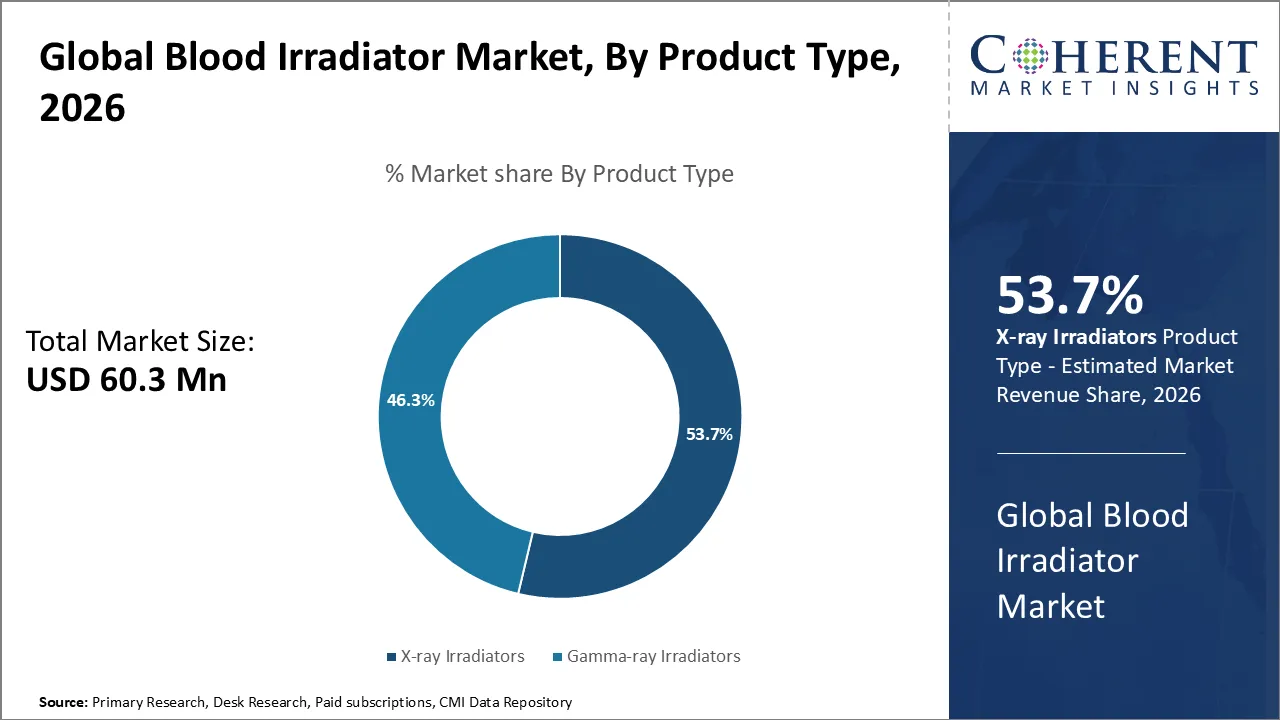
- X-ray Irradiators hold the largest market share of 53.7% in 2026 owing to the growing demand for blood transfusions. Global blood transfusion services collect approximately 120 Mn blood donations annually, with voluntary donors contributing more than 85% of the total supply.
- Hospitals expected to hold largest market share of 42.2% in 2026 owing to its rising cancer and hematological disease burden. Approximately 1.31 Mn new cases of hematological malignancies were reported globally, resulting in around 700,205 deaths.
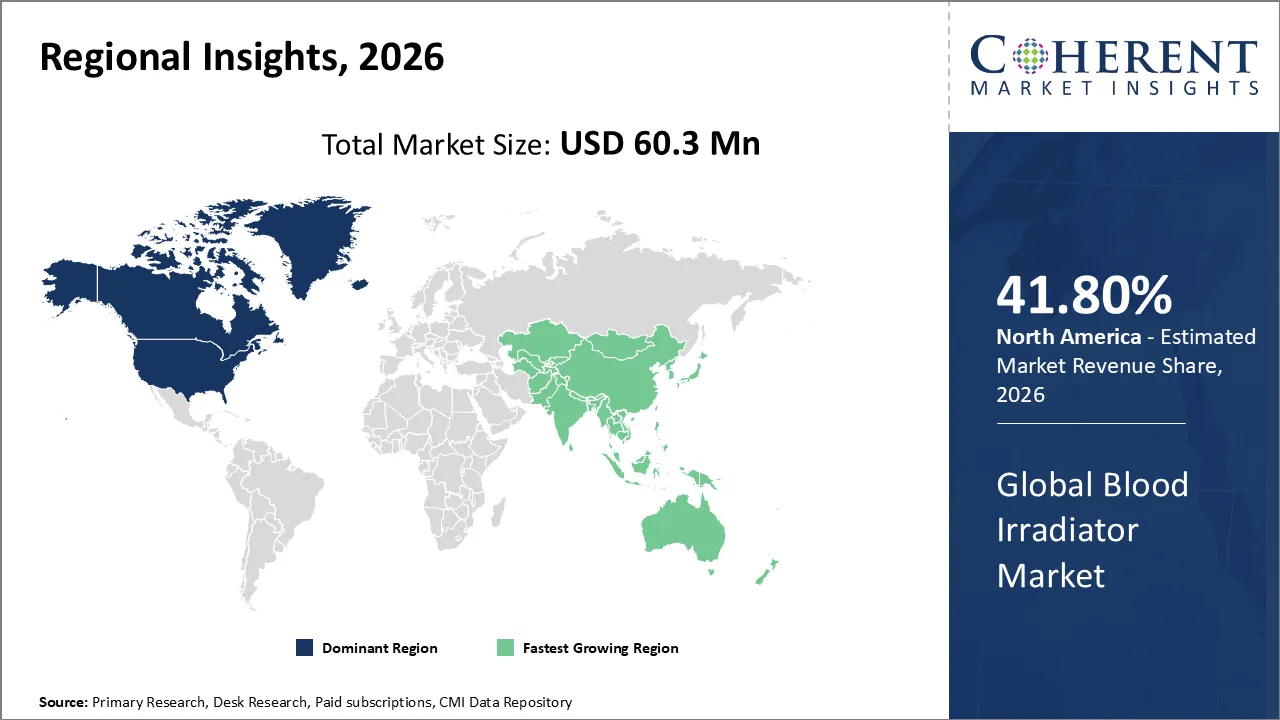
- North America is expected to acquire the dominant share of 41.8% in 2026 owing to the strong adoption of advanced medical technologies.
Current Events and Their Impact on the Blood Irradiator Market
Current Event | Description and its Impact |
U.S. FDA Proposes Formal Classification of Blood Irradiators – March 2026 |
|
FDA Proposed Dosimetry Requirements for TA-GVHD Blood Irradiators – 2026 |
|
Segmental Insights
- Current Industry Events of 2026
- Market Size Estimation
- Regional Breakdown
- Competitive Landscape
- Customer Intelligence
- Segmental Analysis
- Pricing Analysis
- Key Market Drivers, Challenges & Future Trends
- Customized Insights Section
Why is X-ray Irradiators Acquiring the Largest Market Share?
X-ray Irradiators hold the largest market share of 53.7% in 2026. X-ray irradiators are gaining traction in the blood irradiator market as healthcare providers seek safer and more efficient blood-component processing. These systems eliminate the need for radioactive sources, reducing the challenges associated with source handling, storage, transportation, and disposal. Rising blood transfusion volumes, increasing cancer and hematological disorders, expanding transplantation procedures, and greater emphasis on preventing transfusion-associated graft-versus-host disease are driving adoption. Manufacturers are also advancing dose control, automation, and monitoring technologies, while hospitals and blood centers increasingly adopt flexible, on-demand irradiation solutions. For instance, KUBTEC, a global leader in X-ray imaging and irradiation technology, launched its XCELL TomoRad system at this year’s annual meeting of the American Association for Cancer Research (AACR), introducing a new category of image-guided radiotherapy (IGRT) systems.
Which End User segment dominates the market?
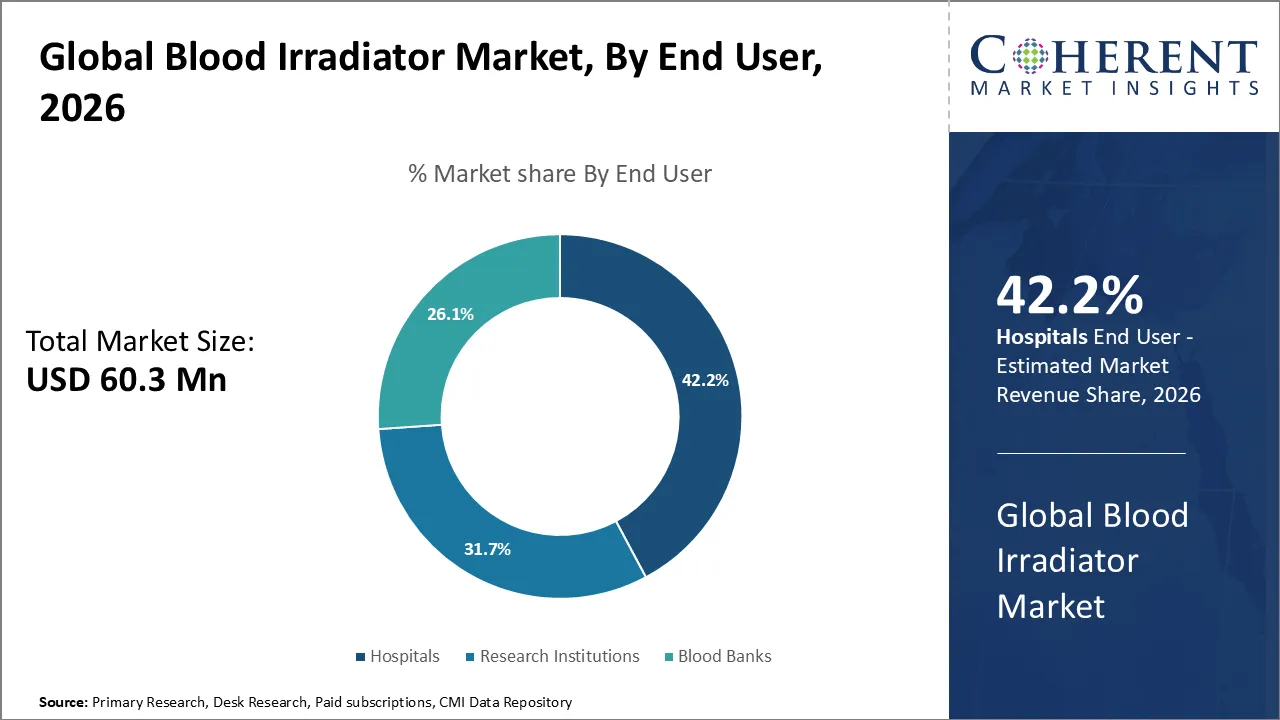
Hospitals expected to hold largest market share of 42.2% in 2026. Hospitals are increasing their use of blood irradiators as they conduct more transfusions, cancer treatments, transplant procedures, and complex surgeries. The rising number of immunocompromised patients also drives hospitals to use irradiated blood components to help prevent transfusion-associated graft-versus-host disease. Hospitals emphasize transfusion safety, effective blood management, and quick access to treated blood products. They are also expanding oncology and hematology services, upgrading healthcare infrastructure, and adopting on-site irradiation technologies, which further strengthens demand for blood irradiators.
Blood Irradiator Market Trends
- Growing adoption of X-ray blood irradiators: AERB confirms that both radioisotope-based systems using Co-60/Cs-137 and X-ray blood irradiation chambers are used in hospitals and blood banks. Radioisotope systems can contain sources with activity in the tens to hundreds of TBq, requiring controls for procurement, source replenishment, radiological surveillance, decommissioning and disposal. This regulatory and operational burden supports interest in X-ray-based systems that do not require radioactive-source management.
- Increasing demand for TA-GVHD prevention: AABB reports that TA-GVHD occurs in fewer than 1 per million transfusions but has a fatality rate above 90%. Cellular blood components are therefore irradiated for patients at particular risk, including selected immunocompromised patients and recipients undergoing hematopoietic stem-cell transplantation. This high clinical consequence supports continued demand for reliable blood-irradiation systems.
- Separate regulatory pathway for blood irradiation intended to prevent metastasis: The FDA's March 2026 proposal would classify blood irradiators intended to irradiate intraoperatively salvaged blood from cancer patients to prevent metastasis as Class III devices requiring premarket approval (PMA). FDA cited insufficient information to establish that general and special controls would provide reasonable assurance of safety and effectiveness for this intended use. This creates a substantially higher regulatory and clinical-evidence requirement for companies pursuing this application.
- Expansion of the global blood supply supports irradiation demand: WHO reported 120.4 million blood donations globally and noted that global blood collections increased by nearly 19% between 2013 and 2023. More than 85% of the estimated 120 million donations in 2023 came from voluntary unpaid donors. A larger and more structured blood supply increases the need for component processing and safety infrastructure, including irradiation capacity for blood components requiring TA-GVHD prevention.
Regional Insights
North America dominates owing to regulatory and quality-assurance focus
North America is expected to acquire the dominant share of 41.8% in 2026. Healthcare providers in North America are fueling the blood irradiator market by maintaining advanced healthcare infrastructure, managing high transfusion volumes, and prioritizing transfusion safety. Hospitals and blood centers use irradiation systems to support oncology, hematology, transplantation, and complex surgical procedures. Medical professionals increasingly emphasize the prevention of transfusion-associated graft-versus-host disease, driving demand for irradiated blood components. Hospitals also increasingly adopt X-ray irradiators because these systems provide on-demand operation and eliminate the need to handle, store, or manage radioactive sources.
Asia Pacific Blood Irradiator Market Trends
The Asia Pacific blood irradiator market is expanding as healthcare infrastructure improves, demand for safer blood transfusions increases, and investments in blood banks and specialized hospitals grow. Hospitals are performing more oncology, hematology, transplantation, and complex surgical procedures, which increases the need for irradiated blood components. Governments are upgrading transfusion services and strengthening blood safety regulations across China, India, Japan, and Southeast Asia. Healthcare providers are also adopting advanced X-ray irradiation technologies to address transfusion-related risks, improve blood safety, and modernize their facilities. The Indian Pharmacopoeia Commission (IPC) is launching sensitisation programmes and webinars to train blood-centre officials and strengthen compliance with national and international blood safety standards.
United States Blood Irradiator Market Trends
The United States blood irradiator market grows as healthcare providers prioritize transfusion safety and prevent transfusion-associated graft-versus-host disease (TA-GVHD), especially among immunocompromised and transplant patients. The FDA strengthens standardized irradiation practices through its oversight of blood products and medical devices. Healthcare facilities increasingly adopt advanced X-ray-based irradiators and seek safer alternatives to radioactive sources. Blood banks and transfusion centers also modernize their infrastructure, while greater clinical awareness, strict quality standards, and technological advancements continue to drive market demand. North Dakota has become the 14th U.S. state or territory to eliminate high-risk cesium-137 stockpiles after the U.S. Department of Energy removed all such material from the state.
Japan Blood Irradiator Market Trends
Japan’s blood irradiator market grows as healthcare providers prioritize transfusion safety and prevent transfusion-associated graft-versus-host disease (TA-GVHD). Japanese guidelines encourage healthcare facilities to irradiate blood components containing lymphocytes, and the Japanese Red Cross operates established irradiation procedures across its blood services. An aging population continues to drive transfusion demand, while hospitals modernize their facilities and strengthen blood-product safety systems. Approximately 29% of Japan’s population is aged 65 years or older, making it one of the world’s oldest populations. Healthcare organizations also invest in advanced irradiation equipment and infrastructure, supporting market development.
Who are the Major Companies in Blood Irradiator Industry
Some of the major key players in Blood Irradiator are Rad Source Technologies, Sukosol Group, Typenex Medical, Gamma-Service Medical GmbH, Cegelec NDT-PES, and Best Theratronics, Ltd.
Key News
- In June 2026, Birat Medical College in Biratnagar launched Nepal’s first irradiated blood service, providing specially prepared blood for cancer and transplant patients.
Market Report Scope
Blood Irradiator Market Report Coverage
Report Coverage | Details | ||
Base Year: | 2025 | Market Size in 2026: | USD 60.3 Mn |
Historical Data for: | 2020 to 2024 | Forecast Period: | 2026 to 2033 |
Forecast Period 2026 to 2033 CAGR: | 5.4% | 2033 Value Projection: | USD 88.5 Mn |
Geographies covered: |
| ||
Segments covered: |
| ||
Companies covered: | Rad Source Technologies, Sukosol Group, Typenex Medical, Gamma-Service Medical GmbH, Cegelec NDT-PES, and Best Theratronics, Ltd. | ||
Analyst Opinion
- Japan’s blood irradiator market is fundamentally supported by an entrenched transfusion-safety framework rather than discretionary technology adoption. The Japanese Red Cross has supplied irradiated blood products since 1998, and it currently irradiates whole blood, red blood cells, and platelet products to prevent transfusion-associated GVHD. Importantly, Japan reports no confirmed cases of transfusion-associated GVHD since the introduction of irradiated blood products, reinforcing our view that irradiation has become an established safety requirement rather than an emerging clinical option.
- The scale of Japan’s blood-product infrastructure provides a strong operational base for irradiator demand. As of March 2025, the Japanese Red Cross reported 4.99 million blood donors and supplied 17.37 million units of blood products, including 6.57 million red-cell units and 8.66 million platelet units. Because irradiation forms part of the manufacturing process for these cellular components, we view Japan’s large-volume centralized blood-supply system as a structural driver for irradiation equipment utilization and replacement demand.
- Japan’s market is also distinctive because irradiation is integrated directly into the blood-component workflow. The Japanese Red Cross uses dedicated X-ray irradiation equipment and applies a prescribed dose range of at least 15 Gy and no more than 50 Gy to cellular blood products. This standardized processing approach, combined with nationwide blood-product manufacturing and rapid hospital supply, strongly favors dependable, purpose-built irradiation systems over fragmented or occasional hospital-level adoption.
Speak to the analyst
Want personalized insights?
Take the findings above to one of our principal consultants, or have the report rebuilt around the segments, geographies and competitors you actually track.
Market Segmentation
- By Product Type (Revenue, USD Mn, 2021-2033)
- X-ray Irradiators
- Gamma-ray Irradiators
- By End User (Revenue, USD Mn, 2021-2033)
- Hospitals
- Research Institutions
- Blood Banks
- By Region (Revenue, USD Mn, 2021-2033)
- North America
- U.S.
- Canada
- Latin America
- Brazil
- Mexico
- Argentina
- Rest of Latin America
- Europe
- Germany
- U.K.
- France
- Italy
- Spain
- Russia
- Rest of Europe
- Asia Pacific
- China
- India
- Japan
- Australia
- South Korea
- ASEAN
- Rest of Asia Pacific
- Middle East
- GCC
- Israel
- Rest of Middle East
- Africa
- South Africa
- Central Africa
- North Africa
- North America
Sources
Primary Research interviews
- Blood bank directors and transfusion medicine specialists
- Hospital transfusion service managers
- Hematologists and clinical laboratory specialists
- Radiation oncologists and medical physicists
- Biomedical engineers and radiation-safety officers
- Procurement and medical-device purchasing managers
- Blood component processing and laboratory personnel
- Distributors and service providers of blood irradiation equipment
- Representatives from public and private blood centers
- Hospital administrators and healthcare facility managers
Databases
- PubMed / MEDLINE
- Scopus
- Web of Science
- Embase
- Cochrane Library
- ClinicalTrials.gov
- WHO Global Health Observatory
- World Bank Health Data
- OECD Health Statistics
- National health and hospital statistics databases
- National blood-service and blood-bank databases
- U.S. FDA medical-device databases
- U.S. Nuclear Regulatory Commission (NRC) public information and regulatory databases
- International Atomic Energy Agency (IAEA) databases and publications
Magazines
- Transfusion News
- AABB News
- ISBT Transfusion Today
- The ASCO Post
- Medical Device and Diagnostic Industry (MD+DI)
- Healthcare Purchasing News
- Hospital + Healthcare Management
- Biomedical Engineering publications and trade magazines
Journals
- Blood
- Transfusion
- Vox Sanguinis
- British Journal of Haematology
- Transfusion Medicine
- Transfusion Medicine Reviews
- Journal of Clinical Apheresis
- Journal of Blood Medicine
- International Journal of Radiation Biology
- Radiotherapy and Oncology
- Journal of Applied Clinical Medical Physics
- Journal of Medical Devices
- Journal of Clinical Pathology
- The Lancet Haematology
- Journal of the American Medical Association (JAMA)
- New England Journal of Medicine (NEJM)
Newspapers
- The New York Times
- The Wall Street Journal
- Financial Times
- The Guardian
- The Times of India
- The Hindu
- The Economic Times
- Business Standard
- Reuters
- Associated Press
- Bloomberg
Associations
- Association for the Advancement of Blood & Biotherapies (AABB)
- International Society of Blood Transfusion (ISBT)
- British Society for Haematology (BSH)
- International Society of Blood Transfusion organizations and regional affiliates
- International Atomic Energy Agency (IAEA)
- American Society of Hematology (ASH)
- American Society for Radiation Oncology (ASTRO)
- European Society for Blood and Marrow Transplantation (EBMT)
- European Hematology Association (EHA)
- International Society for Cellular Therapy (ISCT)
- National blood-service organizations
- National and regional transfusion medicine societies
Public Domain sources
- U.S. Food and Drug Administration (FDA) — medical-device clearances, regulatory documents, and blood-product information
- U.S. Nuclear Regulatory Commission (NRC) — radiation safety and regulatory information
- Centers for Disease Control and Prevention (CDC) — transfusion-related and healthcare data
- National Institutes of Health (NIH) / National Library of Medicine
- PubMed and PubMed Central
- World Health Organization (WHO) — blood safety and healthcare statistics
- International Atomic Energy Agency (IAEA) — blood irradiation, radiation safety, and technical publications
- U.S. Census Bureau — demographic and healthcare-relevant population statistics
- Eurostat — healthcare and demographic statistics
- World Bank — healthcare expenditure, population, and macroeconomic indicators
- OECD — healthcare system and hospital statistics
- Government health ministries and national blood authorities
- National statistical offices
- Hospital and blood-center annual reports
- Public procurement/tender databases
- Clinical trial registries
- FDA MAUDE and other publicly available medical-device safety databases
- ISO/ASTM standards and publicly available technical information
Proprietary Elements
- CMI Data Analytics Tool
- Proprietary CMI Existing Repository of information for last 10 years
Get access to 250+ pages report
Every segment, forecast, competitor profile and data table behind the analysis above — available for instant download.
- ESOMAR Member
- ISO 9001:2015 Certified
- D-U-N-S Registered
- GDPR & CCPA Compliant
Missing comfort of reading report in your local language? Find your preferred language:
Transform your Strategy with Exclusive Trending Reports
Frequently Asked Questions
The market is primarily driven by increasing emphasis on transfusion safety, rising demand for irradiated blood components, and the modernization of blood banks and hospital transfusion services.
X-ray irradiators are projected to represent the largest product segment.
X-ray systems allow facilities to irradiate blood components without managing radioactive sources.
Hospitals represent the leading end-user segment because they perform large volumes of transfusions and provide oncology, and complex surgical services.
Stem-cell and other transplantation procedures involve patients who may require irradiated cellular blood components to reduce the risk of transfusion-associated graft-versus-host disease.