

Dental Caries Detectors Market Size and Forecast — 2026-2033
The Global Dental Caries Detectors Market size is estimated to be valued at USD 344.3 million in 2026 and is expected to reach USD 641.6 million by 2033, exhibiting a compound annual growth rate (CAGR) of 9.3% from 2026 to 2033.
Overview
Dental caries detectors are diagnostic tools designed to identify early-stage tooth decay with high accuracy and minimal invasiveness. The market encompasses devices based on laser fluorescence, transillumination, fiber-optic, and digital imaging technologies. These tools help dentists detect lesions invisible to the naked eye, enabling preventive treatment before structural damage occurs. Modern devices integrate digital data capture and AI-based image interpretation to enhance clinical decision-making. Compact, handheld detectors are widely adopted in clinics for real-time diagnosis. As patient demand for preventive and minimally invasive dentistry grows, manufacturers are focusing on ergonomic designs, wireless connectivity, and multi-diagnostic capabilities.
Key Takeaways
Market segment-wise, fluorescence-based technology leads the market with a commanding 46% industry share, driven by superior detection capabilities and clinical preference.
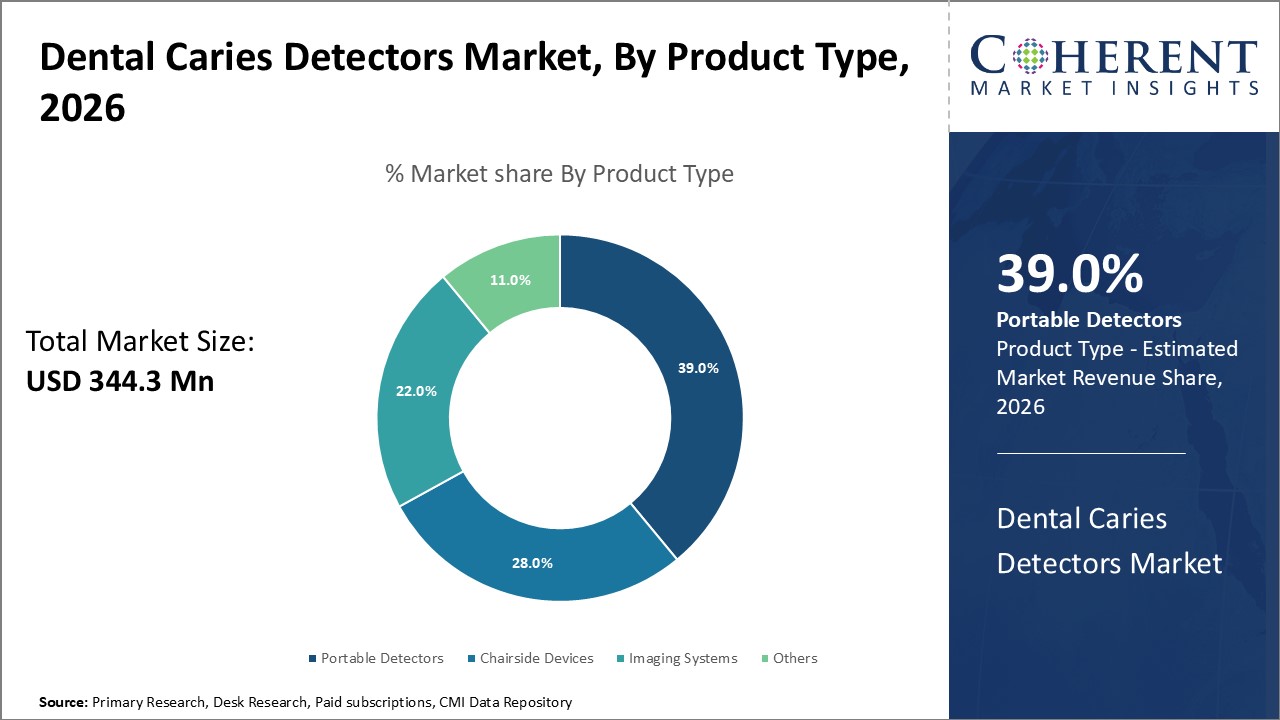
Portable detectors dominate product types, holding 39% market share due to demand for mobility and ease of use. Regarding end-user segments, dental hospitals represent over half of the market revenue, leveraging scale and frequent use to bolster business growth.
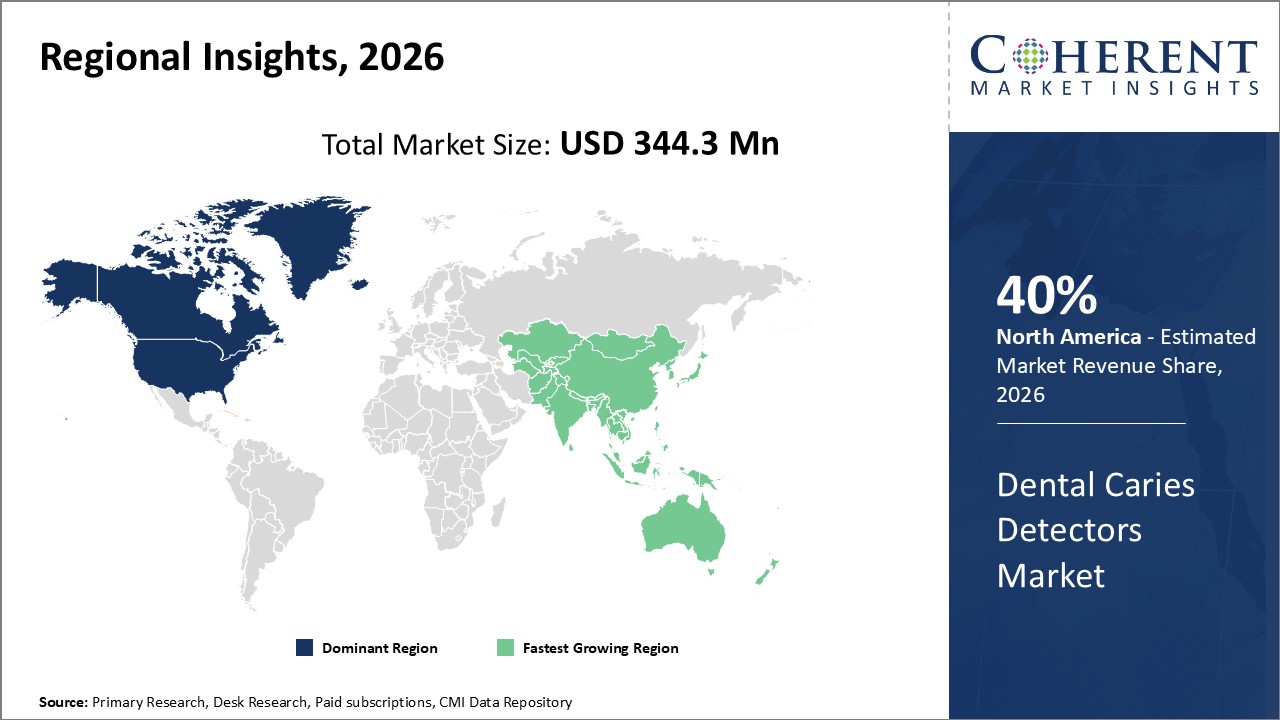
Regionally, North America holds a dominant industry share close to 40%, propelled by advanced healthcare infrastructure and substantial dental care expenditure.
Asia Pacific is the fastest-growing region with an impressive CAGR exceeding 11%, supported by expanding dental service networks and increasing oral health awareness programs.
Dental Caries Detectors Market Segmentation Analysis
Dental Caries Detectors Market Insights, By Technology
Fluorescence-based technology dominates the market share, accounting for 45%, due to its high sensitivity, real-time results, and ability to detect early-stage lesions. This segment benefits from increasing adoption in advanced dental setups and integration with imaging software, which enhances diagnostic accuracy. Laser-based detectors are the fastest-growing subsegment, propelled by continuous innovations that improve lesion detection without radiation exposure, expanding their application in pediatric dentistry and minimally invasive procedures.
Dental Caries Detectors Market Insights, By Product Type
Portable detectors dominate the market with a 39% share driven by their ease of use, mobility, and growing demand in community dental programs and rural healthcare setups. Their design caters to on-the-go screening, fostering increased penetration in emerging markets and dental camps. Chairside devices provide clinicians with immediate feedback during examinations, making them indispensable in clinical dental hospitals. Imaging systems serve specialized institutions offering advanced diagnostics combining caries detection with overall oral imaging but carry higher costs, limiting their market share.
Dental Caries Detectors Market Insights, By End-User
Dental hospitals command a 52% market share, the highest among end users, due to high patient volumes and preference for advanced dental equipment that ensures efficient treatment workflows. Dental clinics are the fastest-growing end-user subsegment, reflecting expanding private dental care in urban and semi-urban geographies. Their growth is driven by the adoption of cost-effective and portable detectors that improve patient throughput. Diagnostic centers, while smaller in scale, are increasingly integrating detection technologies for comprehensive oral health screening.
Dental Caries Detectors Market Trends
Recent years have seen the Dental Caries Detectors Market align closely with technological advancements, including the integration of artificial intelligence for automated lesion detection and portable fluorescence devices tailored for remote dentistry.
For example, in 2026, an uptick in AI-powered detectors reduced diagnostic errors by approximately 21% in leading clinics in the U.S.
Additionally, the convergence of optical and electrical conductance technologies presents multi-modal systems that improve diagnostic yield, capturing broader market interest globally.
Dental Caries Detectors Market Insights, By Geography
North America Dental Caries Detectors Market Analysis and Trends
In North America, dominance in the Dental Caries Detectors market stems largely from its mature healthcare infrastructure, high adoption of cutting-edge dental technologies, and significant healthcare spending. Major players such as Dentsply Sirona and KaVo Kerr have fortified their market share here through innovations and strategic partnerships. Additionally, government policies favoring preventive dental care have supported strong market revenue.
Asia Pacific Dental Caries Detectors Market Analysis and Trends
Meanwhile, the Asia Pacific exhibits the fastest growth with a CAGR exceeding 11%. Factors propelling this include expanding healthcare capacity, increasing dental insurance coverage, and rising consumer awareness. Countries like India and China contribute significantly, fueled by increasing disposable incomes and government oral health initiatives. Companies including VATECH and 3M have made notable inroads in this region by localizing their product offerings.
Dental Caries Detectors Market Outlook for Key Countries
USA Dental Caries Detectors Market Analysis and Trends
The USA maintains a lead position, accounting for nearly 30% of the global Dental Caries Detectors market revenue in 2026. Its sophisticated dental healthcare infrastructure and high consumer spending drive this trend. The focus on preventive dentistry has led to increased adoption of fluorescence and laser-based detectors in private and hospital dental clinics. Notable market players such as Straumann and Carestream Health are actively expanding their product portfolios and distribution networks through innovative go-to-market strategies and partnerships with dental service providers.
India Dental Caries Detectors Market Analysis and Trends
India’s market for dental caries detectors is witnessing accelerated growth supported by government-led oral care programs and rising middle-class affordability. The country’s healthcare expenditure on dental services grew by 19% in 2025, offering vast opportunities for portable and affordable detection devices in rural and semi-urban regions. Local and international players such as VATECH have capitalized on this growth by launching cost-effective, AI-enabled detectors catering to regional needs, further accelerating market share gains in the Asia Pacific region.
Analyst Opinion
The adoption of advanced fluorescence-based detection systems is a pivotal quantitative indicator driving market revenue. For instance, the introduction of fluorescence cameras improved diagnostic sensitivity by over 30% in clinical trials in 2025, as reported by multiple dental institutions, contributing to higher device uptake across North America and Europe.
The rising affordability and integration of portable caries detectors in emerging markets have altered market dynamics significantly. The increasing penetration in Asia Pacific, especially in India and China, where dental care accessibility expanded by 22% in 2026, evidences demand-driven growth that further enhances market share.
Pricing strategies conducive to budget hospitals and dental chains have boosted product adoption. In Western Europe, volume-based pricing models led to a 15% increment in institutional purchases during 2025, directly impacting overall market size and revenue streams.
Market supply chain resilience has been fortified by increasing local component manufacturing. For example, Taiwanese manufacturers contributed to a 13% reduction in lead times in 2026, supporting faster market expansion and stable availability of dental caries detectors.
- Current Industry Events of 2026
- Market Size Estimation
- Regional Breakdown
- Competitive Landscape
- Customer Intelligence
- Segmental Analysis
- Pricing Analysis
- Key Market Drivers, Challenges & Future Trends
- Customized Insights Section
Market Scope
| Report Coverage | Details | ||
|---|---|---|---|
| Base Year: | 2025 | Market Size in 2026: | USD 344.3 million |
| Historical Data for: | 2020 To 2024 | Forecast Period: | 2026 To 2033 |
| Forecast Period 2026 to 2033 CAGR: | 9.3% | 2033 Value Projection: | USD 641.6 million |
| Geographies covered: |
| ||
| Segments covered: |
| ||
| Companies covered: | Dentsply Sirona, KaVo Kerr, 3M Company, ACTEON Group, VATECH Co., Ltd., Straumann Group, Planmeca Oy, Carestream Health Inc., Danaher Corporation, Sirona Dental Systems GmbH. | ||
| Growth Drivers: |
| ||
Dental Caries Detectors Market Growth Factors
Several factors underpin the accelerating market growth observed in recent years. Increasing global oral health awareness campaigns supported by government initiatives have driven higher demand for precise caries detection tools, with countries like the U.S. investing approximately USD 112 million annually in such public health programs. Technological advancements, including AI integration in detectors, allow for more precise diagnosis, reducing patient chair time and enhancing business growth within dental practices.
Moreover, expanding dental infrastructure in emerging economies, coupled with increasing disposable incomes, is spurring market penetration, notably with India showing a 19% growth in dental health expenditure in 2025. Lastly, increasing accessibility to minimally invasive dental treatments intensifies demand for early and accurate caries detection, reinforcing market revenue expansion.
Dental Caries Detectors Market Development
In June 2023, Incisive Technologies launched its BlueCheck™ Caries Detection & Monitoring solution, aimed at improving preventive dental care by allowing clinicians to better identify early carious lesions. The device uses a biomolecule that binds to porous enamel and dentin surfaces and reveals blue staining of active caries, making them visible to the dental professional. BlueCheck is cleared by the U.S. Food & Drug Administration (510(k) # K222560) for use during routine examinations as an aid in caries visualization.
In January 2026, VideaHealth introduced Caries 3.0, its most advanced dental AI model to date, developed to improve the accuracy and consistency of caries detection. The platform features reduced false-positive rates (up to 66% reduction) and improved detection of incipient lesions, with the ability to deliver more consistent diagnostics across providers. It supports both bitewing and periapical radiographs and is designed for use in dental practices and dental support organizations.
Key Players
Leading Companies of the Market
Dentsply Sirona
KaVo Kerr
3M Company
ACTEON Group
VATECH Co., Ltd.
Straumann Group
Planmeca Oy
Carestream Health Inc.
Danaher Corporation
Sirona Dental Systems GmbH
Companies are increasingly focusing on strategic partnerships and acquisitions to expand their market presence. For instance, a recent collaboration between VATECH and regional distributors in the Asia Pacific led to a 10% uplift in sales in that territory in early 2026. Similarly, product innovation through R&D investments by Straumann has resulted in next-generation detectors, enhancing accuracy by 18%, which boosts adoption in premium dental clinics globally.
Dental Caries Detectors Market Future Outlook
In the coming years, digital innovation and artificial intelligence are expected to redefine caries detection. AI-assisted imaging, cloud-based diagnostics, and integrated chairside software will streamline detection, documentation, and patient education. Portable and cost-efficient caries detectors will expand access in community health and mobile dental units. Additionally, advancements in optics and miniaturization will allow for combined imaging and diagnostic tools that enhance workflow and enable early-stage intervention for preventive care.
Dental Caries Detectors Market Historical Analysis
The Dental Caries Detectors Market has evolved from traditional diagnostic techniques—such as radiography and visual inspection—to advanced devices using laser fluorescence, transillumination, and digital imaging. The introduction of fluorescence-based systems provided clinicians with objective detection of early demineralization, reducing unnecessary drilling and improving patient outcomes. Increasing awareness of preventive dentistry and the expansion of pediatric dental care programs further supported device adoption in dental clinics and academic institutions.
Sources
Primary Research Interviews:
Dentists
Dental Equipment Manufacturers
Dental Hygienists
Academic Researchers
Databases:
GlobalData Dental Equipment Reports
WHO Oral Health Statistics
ClinicalTrials.gov
Magazines:
Dental Products Report
Dentistry Today
Dental Economics
Oral Health Journal
Journals:
Journal of Dentistry
Caries Research
International Journal of Dental Hygiene
Journal of Clinical Dentistry
Associations:
American Dental Association (ADA)
FDI World Dental Federation
European Federation of Periodontology (EFP)
International Association for Dental Research (IADR)
Get access to 250+ pages report
Every segment, forecast, competitor profile and data table behind the analysis above — available for instant download.
- ESOMAR Member
- ISO 9001:2015 Certified
- D-U-N-S Registered
- GDPR & CCPA Compliant
Missing comfort of reading report in your local language? Find your preferred language:
Transform your Strategy with Exclusive Trending Reports
Frequently Asked Questions
The market is led by companies such as Dentsply Sirona, KaVo Kerr, 3M Company, and ACTEON Group, who command significant market share due to continuous innovation and expansive distribution channels.
The market is expected to grow from USD 344.3 million in 2026 to USD 641.6 million by 2033, reflecting a CAGR of 9.3%.
Dental hospitals hold the largest share, benefiting from higher patient inflows and faster adoption of advanced diagnostic technologies.
Emerging trends such as AI integration, device miniaturization, and multi-modal detection systems will redefine market dynamics and enhance diagnostic precision.
The competitive landscape is marked by innovation-driven differentiation and strategic collaborations, while challenges include cost constraints in emerging markets and technological standardization.
Strategies include regional partnerships, volume-based pricing, and R&D investments aimed at product innovation and market penetration.