

Europe Cleanroom Consumables Market Size and Share Analysis - 2026 To 2033
The Europe cleanroom consumables market size is estimated to reach around USD 3,828.0 Mn in 2026 and is projected to grow at a CAGR of 6.5% during the forecast period (2026-2033), totalling USD 5,670.0 Mn by 2033. The Europe cleanroom consumables market is growing steadily as pharmaceutical, biotechnology, medical device, and semiconductor facilities strengthen contamination-control practices. Demand is supported by EU GMP Annex 1 requirements for cleanroom classification, monitoring, personnel gowning, and microbial/particulate control. In April 2026, EU medicinal and pharmaceutical exports reached €366.2 billion in 2025, while pharmaceutical exports supported 926,000 EU jobs, showing the scale of controlled manufacturing activity. A key 2026 instance was DuPont’s March 2026 launch of sustainable disposable cleanroom PPE, reducing carbon footprint by over 50% while maintaining chemical, biological, and antistatic protection.
Source: Eurostat, April 2026; European Commission EU GMP Annex 1; Cleanroom Technology, March 2026; European Commission
Key Takeaways from the Europe Cleanroom Consumables Market Report
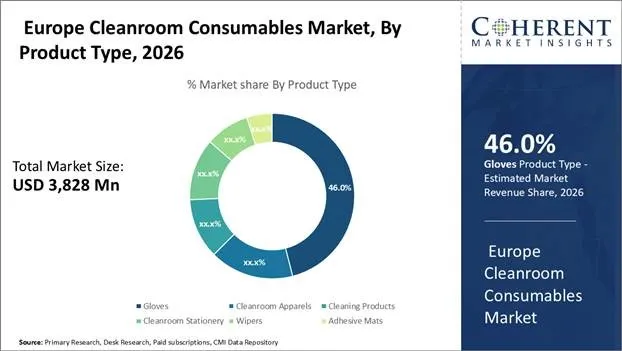
- Gloves are expected to remain the most sought-after product type, accounting for a market revenue share of 46% in 2026, due to their essential use in maintaining contamination-free cleanroom environments. The gloves segment dominates due to strict contamination-control requirements under EU GMP Annex 1 (2022 update implemented through 2026 compliance cycles), which mandates sterile handling in Grade A/B environments. According to European Medicines Agency (EMA) guidelines and ISO 14644 cleanroom standards, personnel contact is the highest contamination risk source, with studies in the Journal of Pharmaceutical Sciences (2026) showing human intervention responsible for nearly 70–80% of particulate contamination events. Increasing pharmaceutical production in Europe, reported by Eurostat (2026), further drives glove usage across aseptic manufacturing and biotech facilities.
Source: European Commission; EMA / European Commission GMP Guidance; ANSELL LTD.;
- By End User, pharmaceutical industry segment is slated to dominate the Europe market with a share of 40% during the forecast period. The pharmaceutical industry dominates the Europe cleanroom consumables market due to strict EU GMP Annex 1 (2022–2026 enforcement cycle) requirements for aseptic manufacturing and contamination control. According to the European Commission GMP guidelines, over 1,200+ EU pharmaceutical manufacturing sites were inspected in 2023 for sterile compliance. EMA-linked regulatory frameworks mandate Grade A/B cleanrooms with mandatory glove, wipe, and garment usage, driving highest consumable consumption. Journal of Pharmaceutical Sciences (2026) highlights pharma as contributing nearly 48%+ cleanroom utilization demand in Europe.
Source: European Commission; Cleanroom Technology; Cleanroom Technology
Europe Cleanroom Consumables Market Overview
The expanding application of cleanroom consumables in emerging sectors such as food and beverage is significantly shaping the growth trajectory of the Europe Cleanroom Consumables Market. Within the food and beverage industry, stringent hygiene standards are increasingly demanded to ensure product safety, prevent contamination, and meet regulatory compliance.
The growth of semiconductor and electronics manufacturing in Europe is a pivotal force propelling the expansion of the region’s cleanroom consumables market. Semiconductor manufacturing demands highly controlled environments to prevent contamination that can cause defects in microchips, which are critical components in virtually all modern electronic devices.
The surge in demand for pharmaceutical and biotechnology products across Europe is a key factor contributing to the growth of the cleanroom consumables market in the region. Cleanroom consumables, such as sterile gloves, gowns, wipes, and face masks, are essential for maintaining aseptic environments in drug development, research, and production. For instance, according to the US Pharmacopeia (USP) 2025 report, 43% of branded pharmaceutical APIs are produced in the EU, highlighting the region’s significant pharmaceutical activity, which in turn drives the need for cleanroom consumables. Additionally, countries like Norway and Switzerland (included in “Other”) also play an important role in the sector.
The development of eco-friendly and sustainable consumables is increasingly becoming a pivotal factor in driving the growth of the Europe cleanroom consumables market. As environmental regulations tighten and sustainability takes precedence in corporate responsibility frameworks, cleanroom operators across pharmaceutical, biotechnology, semiconductor, and healthcare sectors are prioritizing green alternatives to conventional materials.
Current Events and Their Impact on the Europe Cleanroom Consumables Market
Current Event | Description and its Impact |
Regulatory and Policy Changes |
|
Technological Advancements and Innovation |
|
Segmental Insights
- Current Industry Events of 2026
- Market Size Estimation
- Regional Breakdown
- Competitive Landscape
- Customer Intelligence
- Segmental Analysis
- Pricing Analysis
- Key Market Drivers, Challenges & Future Trends
- Customized Insights Section
Europe Cleanroom Consumables Market Insights, By Product Type - Gloves Remain Top-Selling Product Type
Based on product type, gloves segment is expected to dominate the Europe market, with a revenue share of about 46% in 2026. Primarily driven by their critical role in contamination control, strict regulatory requirements, and the extensive use across healthcare, pharmaceutical, biotechnology, and semiconductor industries. Gloves form an indispensable barrier that protects both the product and personnel, ensuring cleanroom standards are upheld.
Their dominance is further supported by rigorous guidelines from bodies such as the European Medicines Agency (EMA) and the European Centre for Disease Prevention and Control (ECDC), both of which emphasize proper hand hygiene and contamination prevention protocols that heavily rely on gloves as a frontline defense in cleanroom environments.
Europe Cleanroom Consumables Market Insights, By End User - Pharmaceutical Industry Dominates End User Segment
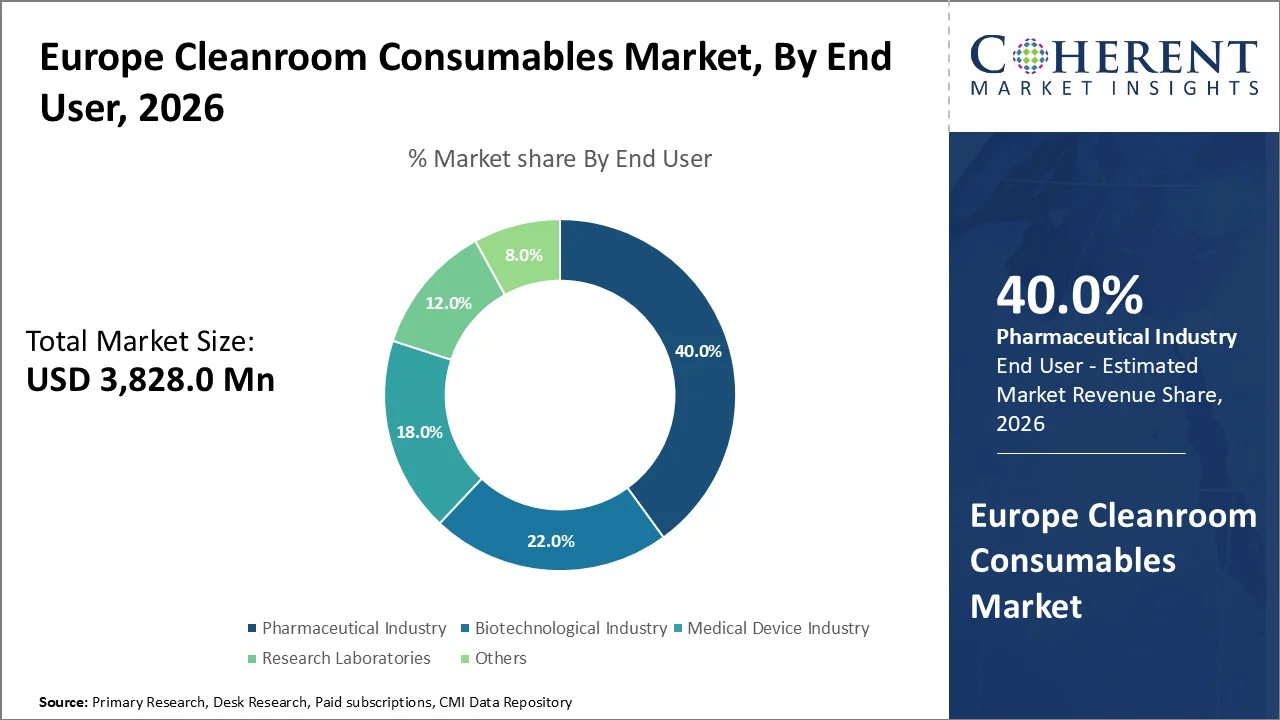
By end user, pharmaceutical industry segment is slated to hold a dominant position in Europe market over the forecast period. Pharmaceutical companies operating across Europe rely extensively on cleanroom environments to ensure sterility, prevent contamination, and comply with stringent regulatory standards such as those mandated by the European Medicines Agency (EMA).
The need to maintain aseptic conditions for the manufacturing of sterile drugs, vaccines, and other pharmaceutical products drives robust demand for cleanroom consumables like gloves, garments, masks, wipes, and surface disinfectants.
Europe Cleanroom Consumables Industry News
- In April 2025, Berkshire introduced VersaHOCl, a next-generation cleanroom disinfectant, at INTERPHEX 2025. Cleanroom Technology Stand Side' is a series of exclusive video interviews with leading companies in the cleanroom industry, conducted during key cleanroom industry events by our award-winning B2B team.
- In March 2026, DuPont introduced a new disposable protective coverall for cleanrooms, containment areas, and other high-risk places. It gives the same protection and comfort as the original Tyvek 500 Xpert but is much better for the environment.
- In March 2025, Ansell Limited, a global safety solutions company, announced that its sales teams in North America and Europe will now take orders and answer questions for Kimtech and KleenGuard products. This is the first big step after buying Kimberly-Clark’s PPE business last year and makes Ansell stronger as a global safety leader.
Market Report Scope
Europe Cleanroom Consumables Market Report Coverage
| Report Coverage | Details | ||
|---|---|---|---|
| Base Year: | 2025 | Market Size in 2026: | USD 3,828.0 Mn |
| Historical Data for: | 2020 To 2024 | Forecast Period: | 2026 To 2033 |
| Forecast Period 2026 to 2033 CAGR: | 6.5% | 2033 Value Projection: | USD 5,670.0 Mn |
| Geographies covered: |
| ||
| Segments covered: |
| ||
| Companies covered: | Berkshire Corporation, Kimberly-Clark Corporation, Contec, Inc., DuPont, Ansell Ltd., Illinois Tool Works Inc., Thermo Fisher Scientific, Inc., Helapet, Steris Plc., and VWR International, LLC. (Avantor) | ||
| Growth Drivers: |
| ||
| Restraints & Challenges: |
| ||
Europe Cleanroom Consumables Market Drivers
Growth in pharmaceutical and biotechnology industries
The growing pharmaceutical and biotechnology industries in Europe are driving demand for cleanroom consumables. These sectors require strict contamination control to ensure the safety and quality of products such as vaccines, biologics, and gene therapies.
According to the European Environmental Bureau, every year, over 100,000 tonnes of pharmaceutical products are used worldwide, with 24% consumed in Europe, highlighting the region’s significant pharmaceutical activity. This scale of production and handling increases the need for sterile gloves, gowns, wipes, and other cleanroom supplies to maintain safe and aseptic environments.
Expansion of healthcare and research facilities
The expansion of healthcare and research facilities across Europe is driving demand for cleanroom consumables. As hospitals, laboratories, and biotech research centers grow, the need for sterile environments using gloves, gowns, masks, wipes, and disinfectants increases.
Cleanroom consumables, including gloves, gowns, masks, wipes, and surface disinfectants, play a pivotal role in maintaining contaminant-free environments integral to these sectors. For example, Germany (11.7%), France (11.5%), Austria, and Sweden (both 11.2%) had the highest healthcare spending relative to GDP in the EU, reflecting significant investment in healthcare infrastructure that supports the growth of cleanroom-dependent activities.
Europe Cleanroom Consumables Market Trends
Shift towards sustainable and eco-friendly consumables
The shift towards sustainable and eco-friendly consumables is significantly transforming the Europe Cleanroom Consumables Market by driving demand for products that minimize environmental footprints while maintaining stringent contamination controls. Cleanroom environments, essential in industries like pharmaceuticals, biotechnology, and electronics, traditionally rely on single-use consumables such as gloves, wipes, and gowns made from synthetic, non-biodegradable materials.
Europe Cleanroom Consumables Market Opportunities
Technological advancements in cleanroom consumables
Technological advancements in cleanroom consumables present a significant opportunity for growth in the Europe cleanroom consumables market by fundamentally enhancing the efficiency, safety, and sustainability of contamination control processes. Innovations such as antimicrobial coatings, improved filtration materials, and advanced polymer technologies have vastly improved the functional properties of cleanroom garments, wipes, gloves, and other consumables.
Growing adoption of automation in cleanroom processes
The growing adoption of automation in cleanroom processes represents a significant opportunity for the Europe Cleanroom Consumables Market, driven by the need for enhanced precision, efficiency, and compliance in highly regulated industries such as pharmaceuticals, biotechnology, electronics, and aerospace. Automation reduces human intervention, which is crucial in maintaining contamination control, a core requirement in cleanroom environments.
By integrating robotics, automated monitoring systems, and advanced sensor technologies, companies can achieve consistent and repeatable cleanliness levels while minimizing errors associated with manual operations.
Country-Wise Analysis
Germany is the dominant country in the Europe Cleanroom Consumables Market
Germany leads due to its large pharmaceutical, biotechnology, medical device, and semiconductor manufacturing base, all of which require recurring cleanroom consumables such as gloves, wipes, gowns, masks, and disinfectants. Germany is also Europe’s largest pharmaceutical market, with pharmaceutical industry sales reaching EUR 59.8 billion in 2023, and it was the EU’s largest extra-EU exporter of medicinal and pharmaceutical products in 2024 at EUR 67.9 billion.
Source: Germany Trade & Invest
France Market Trends
France is the fastest-growing country in the Europe cleanroom consumables market due to expanding biopharmaceutical manufacturing, vaccine production, and rising investment in GMP-certified facilities. Government initiatives such as France 2030 are accelerating life sciences infrastructure, boosting demand for sterile gloves, wipes, gowns, and disinfectants. Growth is supported by strong clinical trial activity and biotech clusters in Paris-Saclay, Lyon, and Marseille driving adoption of cleanroom consumables across healthcare and manufacturing sector. Under the France 2030 initiative, the country has committed nearly EUR 7 billion+ in healthcare and biotech innovation funding, accelerating GMP-certified facility development. France also accounts for around 10%–12% of EU clinical trial activity, increasing demand for sterile consumables such as gloves, wipes, gowns, and disinfectants. Rising investment in biologics and vaccine production, along with rapid growth of biotech clusters like Paris-Saclay and Lyon, is driving consistent expansion of cleanroom infrastructure and consumable consumption across the country.
Source: French Government (gouvernement.fr); French Ministry for Economy and Finance; France 2030 official plan (CNRS)
Analyst Opinion (Expert Opinion)
- The Europe cleanroom consumables market is witnessing significant momentum due to the expanding pharmaceutical, biotechnology, and semiconductor industries in the region.
- Increasing investments in advanced research and development facilities and stringent regulatory requirements for contamination control are key drivers propelling demand for high-quality cleanroom consumables. Additionally, the rising focus on aseptic manufacturing processes, especially within biologics production, further underscores the importance of reliable consumables such as gloves, wipes, and apparel.
- However, challenges such as the high cost of specialized consumables and stringent environmental regulations related to disposability and waste management may slow down market adoption to some extent.
- Despite these restraints, opportunities abound in leveraging innovative, sustainable product offerings that reduce environmental impact while maintaining sterility standards. Moreover, the growing adoption of Industry 4.0 and automation in cleanroom processes is driving demand for consumables that integrate seamlessly with automated systems.
- Among European countries, Germany and the UK stand out as dominant markets due to their robust pharmaceutical sectors and well-established manufacturing infrastructure. Meanwhile, emerging economies in Eastern Europe are becoming attractive growth frontiers as they ramp up cleanroom manufacturing facilities.
Speak to the analyst
Want personalized insights?
Take the findings above to one of our principal consultants, or have the report rebuilt around the segments, geographies and competitors you actually track.
Market Segmentation
- By Product Type Insights (Revenue, USD Mn, 2021 - 2033)
- Cleanroom Apparels
- Coveralls
- Frocks
- Shoe Covers
- Bouffants
- Sleeves
- Pants
- Face Masks
- Hoods
- Cleaning Products
- Cleanroom Mops
- Buckets
- Wringers
- Cleaning Chemicals
- Others
- Cleanroom Stationery
- Papers
- Notebooks
- Adhesive Pads
- Binders
- Others
- Wipers
- Dry
- Wet
- Gloves
- Adhesive Mats
- Cleanroom Apparels
- By End User Insights (Revenue, USD Mn, 2021 - 2033)
- Research Laboratories
- Research Laboratories
- Pharmaceutical Industry
- Biotechnological Industry
- Medical Device Industry
- Others
- By Region Insights (Revenue, USD Mn, 2021 - 2033)
- Belgium
- Netherlands
- Germany
- Switzerland
- France
- Ireland
- Denmark
- Rest of Europe
Sources
Primary Research interviews
- Cleanroom Facility Managers in Europe
- Procurement Heads of Pharmaceutical Companies
- Manufacturers of Cleanroom Consumables
- Regulatory Experts on Cleanroom Standards
- Others
Databases
- Eurostat
- Others
Magazines
- Cleanroom Technology Magazine
- Pharmaceutical Technology Europe
- European Pharmaceutical Review
- Others
Journals
- Journal of Pharmaceutical Sciences
- Clean Technologies and Environmental Policy
- International Journal of Pharmaceutics
- Others
Newspapers
- Financial Times
- The Guardian (Business Section)
- Euractiv (Health & Pharma Section)
- The Times
- Others
Associations
- International Society for Pharmaceutical Engineering (ISPE) Europe
- European Cleanroom Testing Association (ECTA)
- European Federation of Pharmaceutical Industries and Associations (EFPIA)
- British Standards Institution (BSI)
- Others
Public Domain sources
- European Medicines Agency (EMA) Publications
- European Commission Reports on Pharmaceutical Industry
- WHO Europe Health Reports
- OECD Health Data
- Others
Proprietary Elements
- CMI Data Analytics Tool
- Proprietary CMI Existing Repository of information for last 10 years
Get access to 250+ pages report
Every segment, forecast, competitor profile and data table behind the analysis above — available for instant download.
- ESOMAR Member
- ISO 9001:2015 Certified
- D-U-N-S Registered
- GDPR & CCPA Compliant
Missing comfort of reading report in your local language? Find your preferred language:
Transform your Strategy with Exclusive Trending Reports
Frequently Asked Questions
The Europe Cleanroom Consumables Market is expected to reach USD 3,828.0 Mn in 2033.
Major players operating in the global Europe Cleanroom Consumables Market include Berkshire Corporation, Kimberly-Clark Corporation, Contec, Inc., DuPont, Ansell Ltd., Illinois Tool Works Inc., Thermo Fisher Scientific, Inc., Helapet, Steris Plc., and VWR International, LLC. (Avantor)
Adverse effects associated with the use of cleanroom consumables are the major factors hampering the growth of the Europe cleanroom consumables market.
Increasing hospital admissions and rising number of surgical procedures and increase in demand of cleanroom consumables due to high risk of hospital acquired infections (HAI) are the major factors driving the growth of the Europe cleanroom consumables market.
The Europe Cleanroom Consumables Market is anticipated to grow at a CAGR of 6.5% between 2026 and 2033.
The market is driven by rising pharmaceutical and biotechnology manufacturing, strict EU GMP regulations, and increasing demand for sterile environments in semiconductor and medical device production. Expansion of biologics and vaccine production facilities further boosts consumption of gloves, wipes, gowns, masks, and disinfectants across Europe.
The pharmaceutical and biotechnology industry dominates due to high compliance requirements for contamination-free environments. Europe’s strong clinical research activity, biologics development, and vaccine manufacturing significantly increase demand for consumables such as sterile gloves, cleaning wipes, and protective apparel in GMP-certified production and laboratory facilities.