

Medical Gloves Market Size and Forecast – 2026 to 2033
The Medical Gloves Market is anticipated to grow at a CAGR of 9.1% with USD 16.1 Bn share in 2026 and is expected to reach USD 33.4 Bn in 2033. Rising surgical procedures, expanding healthcare infrastructure, stricter infection-control standards, greater hygiene awareness, and growing demand for disposable protective equipment drive the Medical Gloves Market.
Key Takeaways
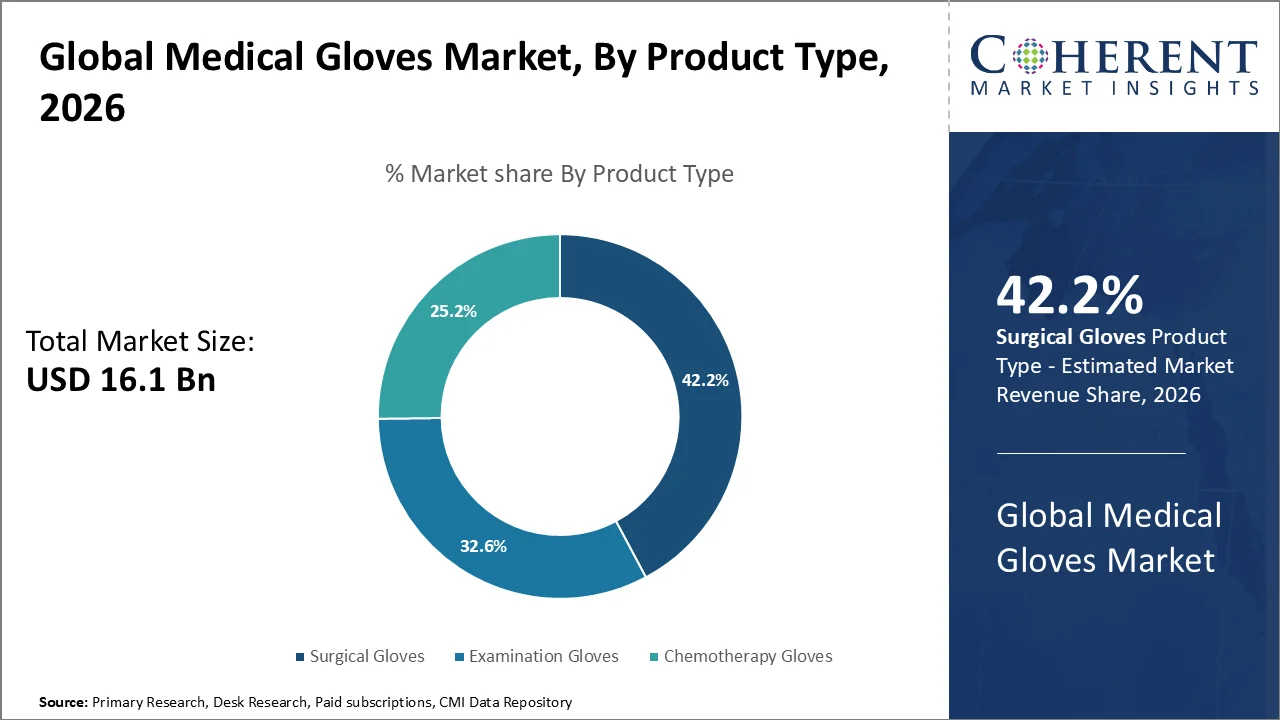
- Surgical Gloves hold the largest market share of 42.2% in 2026 owing to its rising number of surgical procedures. According to data published by the Aesthetic Society, approximately 1.9 million surgical procedures were performed in 2022, representing an increase compared with 2021.
- Latex expected to hold largest market share of 38.8% in 2026 owing to the excellent tactile sensitivity and dexterity. Latex gloves offer excellent elasticity, and a secure, comfortable fit that facilitates precise hand movements.
- Hospitals acquired the prominent market share of 41.1% in 2026 owing to its high patient volume and frequent healthcare procedures. As of early 2025, India recorded more than 91.9 million hospital admissions under the national AB-PMJAY scheme.
- North America is expected to acquire the dominant share of 43.8% in 2026 owing to its stringent infection-control standards. In 2023, 2.6% of hospitalized patients in U.S. acute care hospitals had at least one healthcare-associated infection (HAI), corresponding to an estimated 518,000 HAIs.
Current Events and Their Impact on the Medical Gloves Market
Current Event | Description and its Impact |
U.S. Tariff Increase on Chinese Medical Gloves |
|
U.S. FDA Quality Management System Regulation (QMSR) Takes Effect |
|
Segmental Insights
- Current Industry Events of 2026
- Market Size Estimation
- Regional Breakdown
- Competitive Landscape
- Customer Intelligence
- Segmental Analysis
- Pricing Analysis
- Key Market Drivers, Challenges & Future Trends
- Customized Insights Section
Why is Surgical Gloves Acquiring the Largest Market Share?
Surgical Gloves hold the largest market share of 42.2% in 2026. The Surgical Gloves segment is growing as healthcare providers perform more surgical procedures, strengthen infection-prevention practices, and expand healthcare infrastructure. Hospitals and ambulatory surgical centers are increasing their use of sterile, disposable gloves to prevent cross-contamination and protect patients and healthcare workers. The rising prevalence of chronic diseases is also driving demand for surgical interventions. Additionally, manufacturers are developing gloves with enhanced tactile sensitivity, puncture resistance, comfort, and latex-free properties, encouraging healthcare providers to adopt advanced products across various surgical specialties. Hourglass International launched a recycling program to divert disposable PPE from landfills across healthcare, cleanroom, and laboratory sectors. Founded in Colorado in 2005, the company initially manufactured and distributed specialty PPE, including HandPro gloves and Hourglass Controlled face masks.
Latex expected to hold largest market share
Latex expected to hold largest market share of 38.8% in 2026 owing to the established healthcare acceptance and familiarity. The Latex segment in the Medical Gloves Market is expanding as healthcare providers strengthen infection-control measures, increase spending, and demand dependable protective equipment. Latex gloves deliver excellent elasticity, tactile sensitivity, comfort, and a secure fit, making them well suited for examinations and precision procedures. Hospitals, clinics, and diagnostic facilities are also expanding their use of latex gloves. Meanwhile, manufacturers are introducing powder-free and low-protein formulations that reduce allergy concerns while maintaining performance, supporting continued adoption across healthcare settings. In April 2025, INTCO Medical launched its patented Syntex synthetic disposable latex gloves globally, aiming to improve glove quality, safety, and performance while overcoming the limitations of natural latex.
Which End User segment dominates the market?
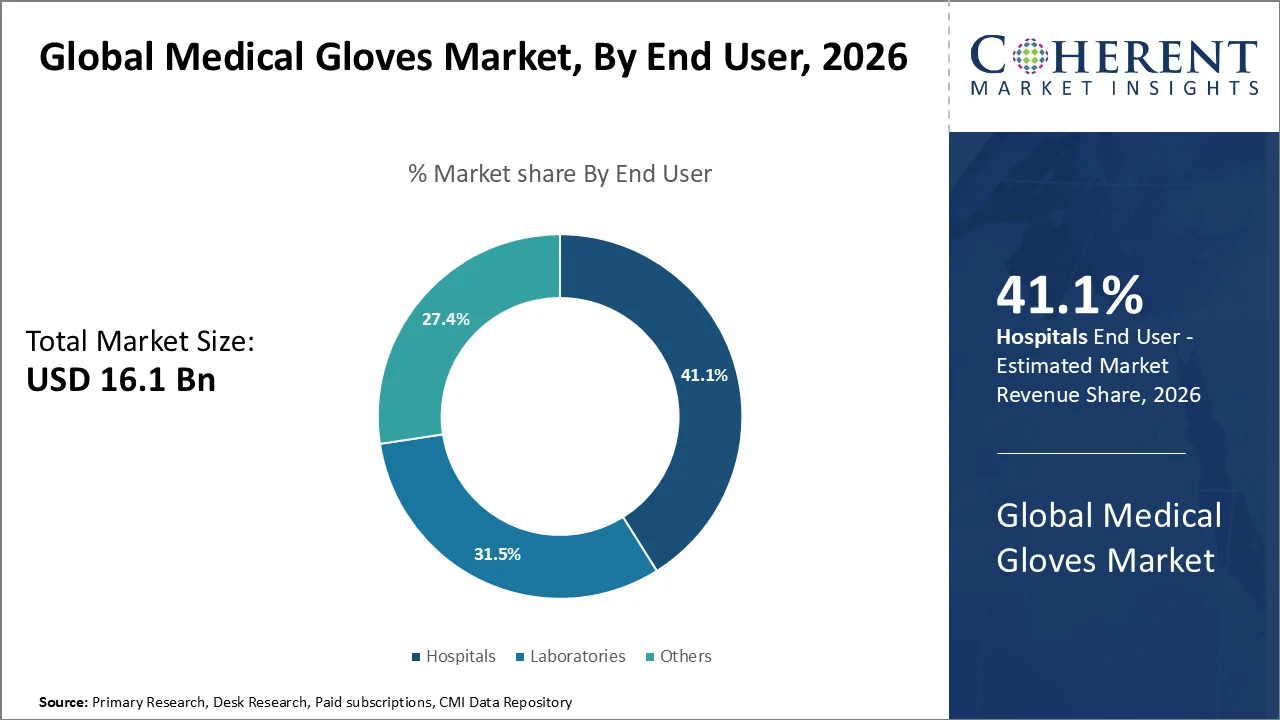
Hospitals acquired the prominent market share of 41.1% in 2026. The Hospitals segment in the Medical Gloves Market is growing as hospitals handle increasing patient volumes, surgical procedures, emergency cases, and diagnostic activities. Hospitals are strengthening infection-prevention measures and hygiene protocols, which drives their use of disposable gloves to prevent cross-contamination and protect patients and healthcare workers. Rising hospital admissions and expanding healthcare infrastructure further increase demand. Hospitals also replace gloves frequently in operating rooms, intensive care units, laboratories, and routine patient-care areas, maintaining steady consumption across healthcare facilities.
Medical Gloves Market Trends
- Rising use of nitrile and other synthetic gloves is supported by CDC guidance, which identifies latex, vinyl, and nitrile as commonly available materials for nonsterile disposable medical gloves. The CDC notes that glove selection depends on the task, chemical or chemotherapy exposure, latex sensitivity, sizing, and facility policies. It also reports that vinyl gloves have shown higher failure rates than latex or nitrile gloves under simulated and actual clinical conditions.
- Demand for specialized medical gloves is expanding beyond routine examination applications. FDA records show recent 510(k) clearances for powder-free nitrile examination gloves tested for use with chemotherapy drugs, fentanyl, and other selected drugs, demonstrating the availability of gloves designed for specialized hazardous-drug applications. For example, the FDA recorded a clearance in February 2025 for a powder-free nitrile examination glove tested for chemotherapy drugs, fentanyl citrate, and selected other drugs.
- Regulatory scrutiny of glove quality is strengthening product-performance requirements. The FDA states that medical gloves are regulated as Class I reserved medical devices and generally require 510(k) premarket notification. FDA review considers performance characteristics such as leak resistance, physical properties, and biocompatibility, encouraging manufacturers to maintain consistent quality and documented performance.
- Recent FDA clearances demonstrate continued product development in powder-free nitrile gloves. FDA records include multiple 510(k) decisions for specialized powder-free nitrile gloves, including products tested for chemotherapy-drug use and fentanyl exposure. For example, FDA records show decisions in 2022 and 2025 for such specialized nitrile examination gloves.
Regional Insights
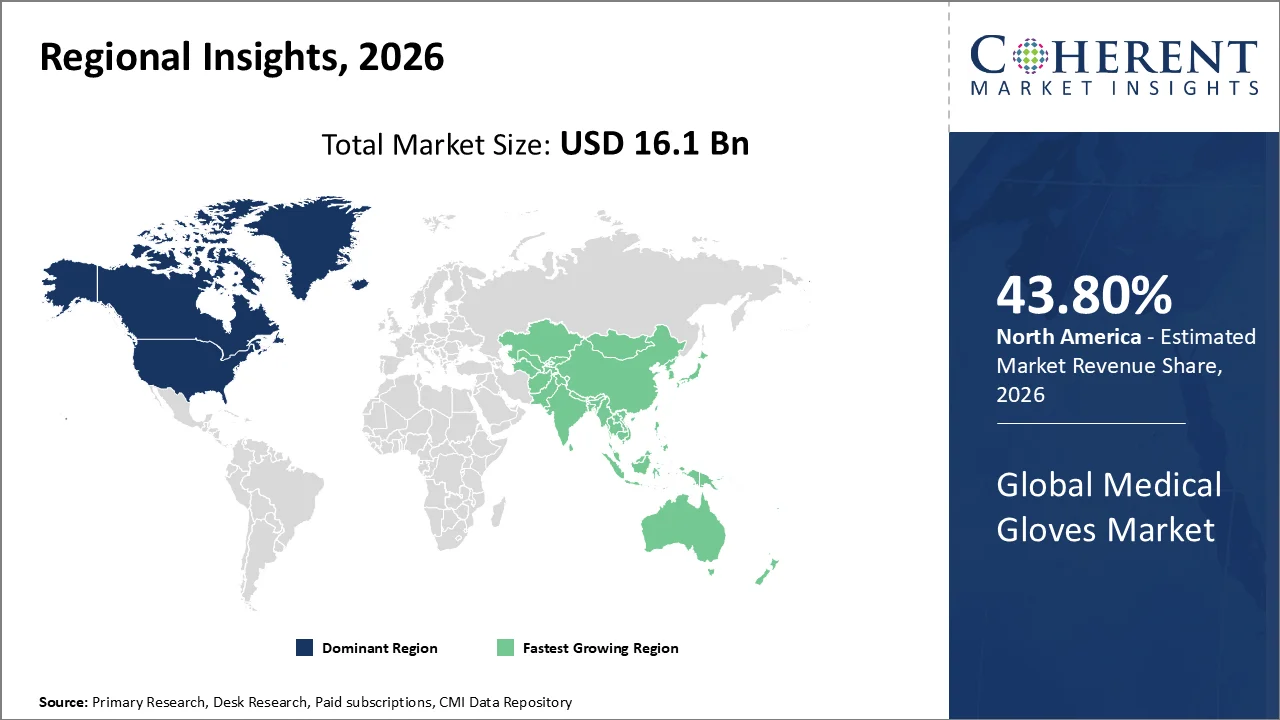
North America dominates owing to high awareness of healthcare-worker safety
North America is expected to acquire the dominant share of 43.80% in 2026. The North America Medical Gloves Market is expanding as healthcare providers implement strict infection-control standards, increase healthcare spending, and perform more surgical and outpatient procedures. Advanced hospital infrastructure and the rising prevalence of chronic diseases are driving demand for disposable gloves across healthcare facilities. Growing awareness of healthcare-associated infections also encourages medical professionals to use gloves consistently. Furthermore, healthcare providers increasingly prefer nitrile and powder-free gloves because they address latex-allergy concerns and offer improved durability, supporting adoption across hospitals, clinics, laboratories, and ambulatory surgical centers. In March 2026, Sol-Millennium Medical launched its U.S. B2B e-commerce platform, enabling healthcare providers to purchase safety-engineered medical devices directly while streamlining procurement and improving product availability.
Asia Pacific Medical Gloves Market Trends
Expanding healthcare infrastructure, growing hospital and diagnostic services, and stronger infection-prevention efforts are driving the Asia Pacific medical gloves market. Healthcare providers increasingly adopt gloves as hygiene awareness and occupational safety requirements grow across hospitals, clinics, laboratories, and home healthcare settings. Rising surgical volumes, aging populations, and medical tourism also boost demand. Consumers and healthcare facilities increasingly favor nitrile and powder-free gloves for their durability, chemical resistance, and lower allergy risk. Governments are investing in healthcare infrastructure and enforcing stricter quality standards, further supporting market growth. For instance, in May 2025, Hyderabad-based Wadi Surgicals launched accelerator-free nitrile gloves under its flagship Enliva brand, marking a major innovation in nitrile glove manufacturing.
United States Medical Gloves Market Trends
The United States medical gloves market is expanding as healthcare spending rises, patient visits increase, and healthcare providers place greater emphasis on infection prevention and control. Hospitals, clinics, laboratories, and dental facilities use gloves to protect workers and patients from blood, bodily fluids, and infectious microorganisms. Nitrile gloves are gaining popularity due to their durability, chemical resistance, and lower risk of latex-related allergies. Workplace safety regulations, growing hygiene awareness, demand for dependable medical PPE, and increased domestic manufacturing investments further strengthen market growth and supply-chain resilience. In April 2026, Hourglass International launched the Nusa200, a powder-free, latex-free nitrile examination glove manufactured in the U.S. for medical, dental, research, and laboratory applications.
Japan Medical Gloves Market Trends
Japan’s aging population drives the medical gloves market by increasing demand for healthcare services, surgeries, diagnostics, and long-term elderly care. Growing awareness of infection prevention and hygiene practices encourages hospitals, clinics, laboratories, and dental facilities to use gloves consistently. Strict medical safety regulations and quality standards also boost demand for certified protective gloves. Increased healthcare spending, the prevalence of chronic and infectious diseases, and rising demand for durable, powder-free, and latex-free nitrile gloves further support market growth.
Who are the Major Companies in Medical Gloves Industry
Some of the major key players in Medical Gloves are Paul Hartmann AG, Paul Hartmann AG, Hotpack Packaging Industries, LLC, Falcon, Deeko Bahrain, Deeko Bahrain, Salalah Medical Supplies Mfg. Co. LLC, United Medical Industries Co. Ltd., and NAFA (NAFA Enterprises, Ltd.)
Key News
- In March 2026, Caracal Products & Services launched a new line of advanced PPE gloves for healthcare professionals, expanding its portfolio of healthcare solutions and protective products.
Market Report Scope
Medical Gloves Market Report Coverage
| Report Coverage | Details | ||
|---|---|---|---|
| Base Year: | 2025 | Market Size in 2026: | USD 16.1 Bn |
| Historical Data for: | 2020 To 2024 | Forecast Period: | 2026 To 2033 |
| Forecast Period 2026 to 2033 CAGR: | 9.1% | 2033 Value Projection: | USD 33.4 Bn |
| Geographies covered: |
| ||
| Segments covered: |
| ||
| Companies covered: | Paul Hartmann AG, Hotpack Packaging Industries, LLC, Falcon, Deeko Bahrain, Salalah Medical Supplies Mfg. Co. LLC, United Medical Industries Co. Ltd., and NAFA (NAFA Enterprises, Ltd.) | ||
Analyst Opinion
- Infection prevention remains the strongest structural demand driver. From an analyst perspective, medical gloves are not a discretionary healthcare product; they are a basic infection-control consumable. The World Health Organization estimates that hundreds of millions of patients acquire healthcare-associated infections every year, reinforcing the need for barrier protection across hospitals, surgical centers, laboratories, and other care settings. This makes glove consumption closely tied to clinical activity rather than short-term consumer trends.
- Surgical and procedural volumes provide a dependable consumption base. More than 310 million major surgical procedures are performed globally each year, according to widely cited WHO estimates. Every procedure requiring sterile protection creates recurring glove demand, while hospitals also consume examination gloves for routine patient contact, diagnostics, wound care, and laboratory work. In our view, this recurring-use model makes medical gloves one of the more resilient consumables within the broader healthcare supply chain.
- Nitrile is strategically gaining ground over latex. The shift toward nitrile gloves reflects both performance requirements and concerns surrounding latex sensitivity. Nitrile offers strong puncture resistance and chemical protection while avoiding natural-rubber latex proteins. For example, nitrile accounted for roughly 60% of U.S. medical examination glove unit sales in recent years, illustrating how quickly procurement preferences can change when hospitals prioritize durability and allergy-risk reduction. We expect this material shift to remain a key competitive differentiator.
- The market is moving toward higher-value gloves rather than simply higher volumes. Hospitals increasingly evaluate gloves based on puncture resistance, tactile sensitivity, ergonomic fit, powder-free construction, and compliance with stringent safety standards. This is particularly important in surgical environments, where glove failure can have consequences far beyond product replacement.
Speak to the analyst
Want personalized insights?
Take the findings above to one of our principal consultants, or have the report rebuilt around the segments, geographies and competitors you actually track.
Market Segmentation
- By Product Type (Revenue, USD Bn, 2021-2033)
- Examination Gloves
- Surgical Gloves
- Chemotherapy Gloves
- By Raw Material (Revenue, USD Bn, 2021-2033)
- Latex
- Nitrile Rubber
- Vinyl Rubber
- Polyisoprene
- By End-User (Revenue, USD Bn, 2021-2033)
- Hospitals
- Laboratories
- Others (Medical Institutes, Clinics)
- By Region (Revenue, USD Bn, 2021-2033)
- North America
- U.S.
- Canada
- Latin America
- Brazil
- Mexico
- Argentina
- Rest of Latin America
- Europe
- Germany
- U.K.
- France
- Italy
- Spain
- Russia
- Rest of Europe
- Asia Pacific
- China
- India
- Japan
- Australia
- South Korea
- ASEAN
- Rest of Asia Pacific
- Middle East
- GCC
- Israel
- Rest of Middle East
- Africa
- South Africa
- Central Africa
- North Africa
- North America
Sources
Primary Research interviews
- Hospital procurement managers and infection-control specialists
- Surgeons, physicians, nurses, and clinical laboratory professionals
- Medical glove manufacturers, distributors, and importers
- Healthcare supply-chain and purchasing professionals
- Regulatory and quality-assurance professionals
- Medical device testing and certification experts
Databases
- U.S. Food and Drug Administration (FDA) medical device databases and 510(k) records
- CDC PPE-Info standards database
- U.S. Census Bureau trade databases
- UN Comtrade Database
- World Bank DataBank
- OECD Statistics
- WHO Global Health Observatory
- Eurostat
- National healthcare and customs databases
Magazines
- Medical Device Network
- Medical Product Outsourcing
- Healthcare Purchasing News
- Infection Control Today
- Medical Design & Outsourcing
- Hospital Management
Journals
- American Journal of Infection Control
- Journal of Hospital Infection
- Infection Control & Hospital Epidemiology
- Journal of Medical Devices
- BMJ
- The Lancet
- Journal of Occupational and Environmental Hygiene
Newspapers
- Reuters
- The Wall Street Journal
- Financial Times
- The New York Times
- The Economic Times
- The Hindu
- Nikkei Asia
Associations
- ASTM International — medical glove standards and testing specifications
- International Organization for Standardization (ISO) — glove standards and specifications
- Association for the Advancement of Medical Instrumentation (AAMI)
- Association for Professionals in Infection Control and Epidemiology (APIC)
- American Hospital Association (AHA)
- American Medical Association (AMA)
- American Nurses Association (ANA)
- International Federation of Infection Control (IFIC)
Public Domain sources
- U.S. Food and Drug Administration (FDA) medical glove guidance, regulatory records, and recognized consensus standards
- Centers for Disease Control and Prevention (CDC) infection-prevention guidelines and PPE information
- World Health Organization (WHO) publications and health statistics
- U.S. National Institutes of Health (NIH) and PubMed
- U.S. Census Bureau
- UN Comtrade
- World Bank
- OECD
- Eurostat
- National government health ministries and statistical agencies
Proprietary Elements
- CMI Data Analytics Tool
- Proprietary CMI Existing Repository of information for last 10 years
Get access to 250+ pages report
Every segment, forecast, competitor profile and data table behind the analysis above — available for instant download.
- ESOMAR Member
- ISO 9001:2015 Certified
- D-U-N-S Registered
- GDPR & CCPA Compliant
Missing comfort of reading report in your local language? Find your preferred language:
Transform your Strategy with Exclusive Trending Reports
Frequently Asked Questions
The Medical Gloves Market is anticipated to grow at a CAGR of 9.1% with USD 16.1 Bn share in 2026 and is expected to reach USD 33.4 Bn in 2033.
Medical gloves provide a protective barrier between healthcare workers, patients, and potentially infectious materials during examinations, surgeries, diagnostics, wound care, and laboratory procedures.
The major types include nitrile, latex, and vinyl gloves. Nitrile gloves are increasingly preferred for their puncture resistance, chemical protection, and latex-free composition.
Key demand drivers include rising healthcare and surgical procedures, infection-control requirements, growing awareness of hygiene, and increasing use of disposable protective equipment.
Nitrile gloves combine durability, flexibility, and resistance to punctures and chemicals while reducing concerns associated with latex allergies, making them suitable for a wide range of medical applications.
Hospitals, surgical centers, clinics, dental facilities, diagnostic laboratories, nursing facilities, and emergency-care settings are major users of medical gloves.