

Foam Dressing Market Size and Forecast — 2026-2033
The Global Foam Dressing Market size is estimated to be valued at USD 3.02 billion in 2026 and is expected to reach USD 5.18 billion by 2033, exhibiting a compound annual growth rate (CAGR) of 8.0% from 2026 to 2033.
Overview
Foam dressings are advanced wound care products designed to manage moderate to heavy exudating wounds by providing moisture balance and protection against contamination. These dressings are composed of absorbent polyurethane or silicone foam layers that cushion the wound while allowing gas exchange. Key product types include adhesive and non-adhesive variants, silver-impregnated antimicrobial foams, and multilayer composites for chronic wound management.
Foam dressings are widely used in treating pressure ulcers, diabetic foot ulcers, surgical wounds, and burns. Innovations such as smart dressings with moisture sensors, breathable film backings, and enhanced conformability are improving healing outcomes. Manufacturers focus on combining foam with bioactive agents or hydrocolloids to accelerate tissue repair and reduce infection risk, addressing growing demand in hospitals and home healthcare.
Key Takeaways
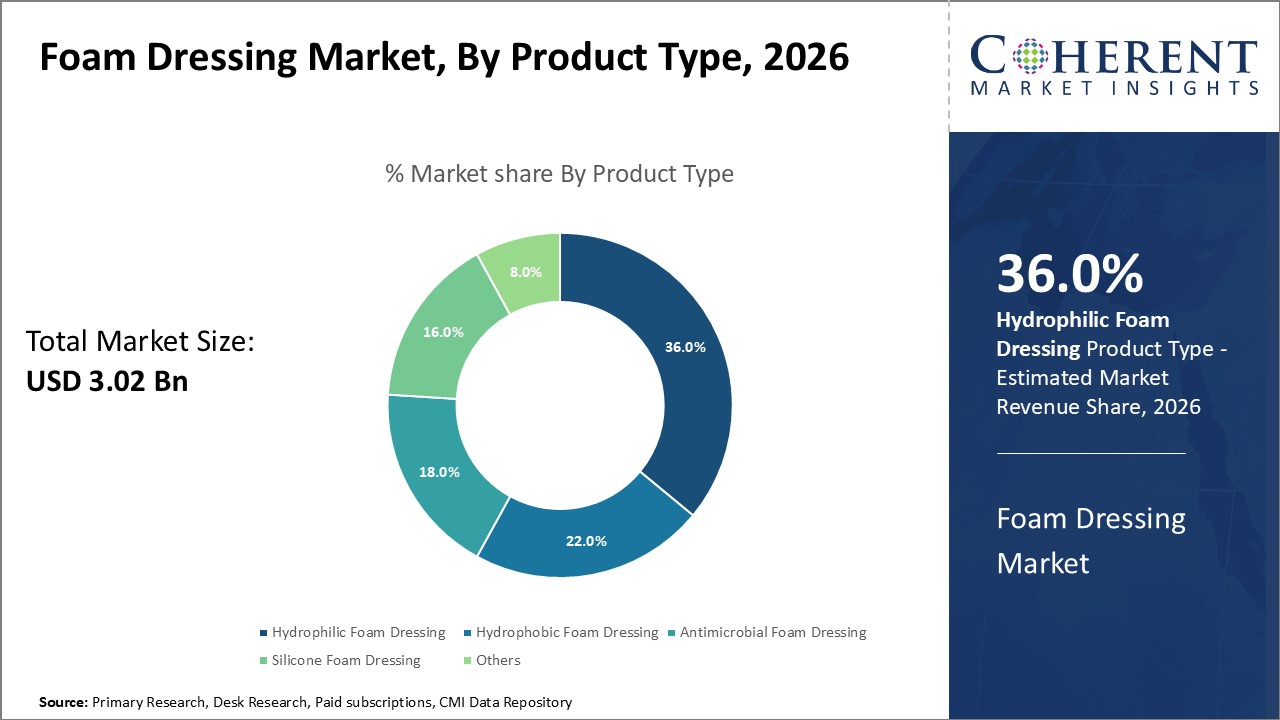
The hydrophilic foam dressing segment dominates the product type category, commanding over 36% market share due to superior absorption and patient comfort.
Chronic wounds represent the largest application segment, driven by an aging population and the global rise in lifestyle diseases requiring advanced foam dressing solutions.
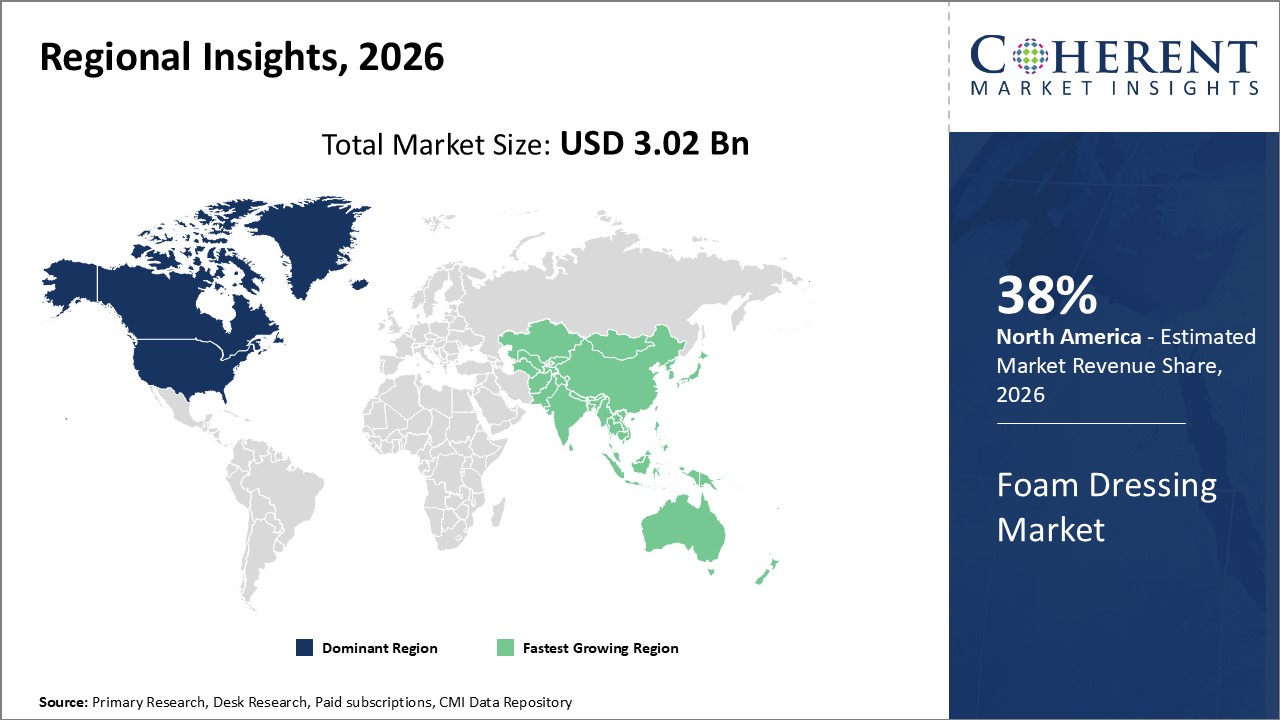
North America leads the regional market with a 38% industry share attributed to sustained healthcare spending and innovation adoption by market players.
Asia Pacific is the fastest-growing region, registering a CAGR above 9%, fueled by expanding healthcare infrastructure, rising chronic disease prevalence, and supportive policies promoting wound care accessibility.
Foam Dressing Market Segmentation Analysis
Foam Dressing Market Insights, By Product Type
Hydrophilic Foam Dressing dominates the market share. Hydrophilic foam dressings lead due to superior fluid absorption and patient comfort, making them the preferred choice for chronic and acute wound care. The fastest-growing subsegment is Antimicrobial Foam Dressing, which is gaining traction owing to increasing infection control concerns and rising hospital-acquired infection rates globally. Hydrophobic foam dressings provide moisture barrier properties beneficial in certain wound environments, while silicone foam dressings offer atraumatic removal, favored in sensitive skin applications.
Foam Dressing Market Insights, By Application
Chronic Wounds dominate the market share. Growing burdens of diabetes and pressure ulcers drive the expansion of foam dressing use in chronic wound management. The fastest-growing application is Burns, where advanced foam dressings support fluid management and infection prevention, critical to recovery. Acute wounds represent a stable demand segment sustained by surgical interventions and trauma cases. Surgical wounds are increasingly treated with bioengineered foam solutions promoting faster healing and reduced scarring. ‘Others’ cover less prevalent applications such as veterinary wound care and dermatology.
Foam Dressing Market Insights, By End-User
Hospitals dominate the market share due to institutional demand for advanced wound management solutions and higher purchasing capacities. The fastest growing subsegment is Home Care Settings, reflecting a shift toward outpatient wound care and patient self-management, fueled by remote monitoring technologies and cost-containment strategies. Clinics maintain steady demand by serving outpatient and minor wound care needs. Ambulatory Surgical Centers are expanding their wound care offerings, leveraging minimally invasive procedure growth. The ‘Others’ segment includes long-term care facilities and specialty care centers, contributing marginally to overall market revenue.
Foam Dressing Market Trends
The foam dressing market trend is increasingly characterized by technological convergence and sustainability initiatives.
The advent of sensor-integrated foam dressings signals a significant leap, with clinical trials in 2025 demonstrating up to 19% faster healing times for chronic wounds.
Furthermore, bioengineered foam dressings capable of releasing therapeutic agents are gaining momentum, reflecting a trend towards multifunctional product profiles.
Sustainability remains critical as regulatory bodies worldwide mandate eco-friendly certifications; this has resulted in a 21% sales growth in biodegradable foam dressings between 2023 and 2026.
Foam Dressing Market Insights, By Geography
North America Foam Dressing Market Analysis and Trends
In North America, the dominance in the foam dressing market is driven by high healthcare expenditure, advanced hospital infrastructure, and innovation from leading market companies. The region accounts for approximately 38% of the market share, supported by strategic product launches and supplier consolidation. U.S. players notably contribute to the rapid adoption of antimicrobial and sensor-enabled foam dressing technologies.
Asia Pacific Foam Dressing Market Analysis and Trends
Meanwhile, the Asia Pacific exhibits the fastest growth with an estimated CAGR exceeding 9%. This surge is attributed to expanding healthcare infrastructure, rising incidence of diabetes and chronic wounds, and favorable government policies aimed at improving medical care accessibility. Emerging market companies are capitalizing on cost-effective production and localized marketing strategies to capture this growth.
Foam Dressing Market Outlook for Key Countries
USA Foam Dressing Market Analysis and Trends
The USA’s foam dressing market continues to expand due to increasing chronic wound prevalence combined with significant healthcare spending exceeding USD 4 trillion annually. Manufacturers like Mölnlycke and Smith & Nephew have established strong footprints here, integrating innovative technologies such as antimicrobial and sensor-enabled foam dressings. Recent FDA approvals in 2025 for advanced foam products have accelerated adoption rates in clinical settings. Emphasis on personalized treatment protocols and reimbursement schemes further solidifies the country’s position as a market leader.
India Foam Dressing Market Analysis and Trends
India’s foam dressing market is rapidly emerging due to rising awareness of advanced wound care solutions among healthcare providers and patients. Government programs enhancing healthcare delivery and increased demand for cost-effective dressings have led to market revenue growth exceeding 11% year-over-year. Domestic and multinational companies are investing in localized manufacturing and distribution. Challenges such as regulatory complexities persist but are gradually being addressed through policy reforms aimed at streamlining medical device approvals.
Analyst Opinion
The increasing demand for advanced wound care products in aging populations is a major driver of the foam dressing market revenue. For instance, in 2025, over 16% of the population in developed countries was aged 65 and above, leading to a surge in chronic wound cases requiring sophisticated dressing solutions. This demand has resulted in an approximate 9% year-over-year revenue increase within foam dressing segments targeting such clinical applications.
Production advancements focusing on antimicrobial foam dressings have improved pricing structures and supply chain efficiencies. In 2026, mass manufacturing capabilities in Asia Pacific led to a 12% reduction in unit production costs. This cost competitiveness has expanded product accessibility across emerging economies, contributing to a 10% growth in foam dressing market share within these regions.
Import patterns reveal significant shifts induced by healthcare infrastructure modernization, especially in North America and Europe. For example, the U.S. increased foam dressing imports by 14% in 2025, driven by rising hospital expenditure on wound care products. Moreover, the diversification of use cases into sports medicine and veterinary sectors supports the demand-side indicators of the expanding foam dressing market scope.
Key microeconomic indicators highlight the rising preference for eco-friendly, biodegradable foam materials. Several manufacturers invested in sustainable product lines in 2025, recording a 21% uptick in sales within green foam dressing variants and fostering business growth strategies centered on environmental regulations compliance.
- Current Industry Events of 2026
- Market Size Estimation
- Regional Breakdown
- Competitive Landscape
- Customer Intelligence
- Segmental Analysis
- Pricing Analysis
- Key Market Drivers, Challenges & Future Trends
- Customized Insights Section
Market Scope
| Report Coverage | Details | ||
|---|---|---|---|
| Base Year: | 2025 | Market Size in 2026: | USD 3.02 billion |
| Historical Data for: | 2020 To 2024 | Forecast Period: | 2026 To 2033 |
| Forecast Period 2026 to 2033 CAGR: | 8.0% | 2033 Value Projection: | USD 5.18 billion |
| Geographies covered: |
| ||
| Segments covered: |
| ||
| Companies covered: | Mölnlycke Health Care, Smith & Nephew plc, 3M Company, ConvaTec Group Plc, Coloplast A/S, Derma Sciences, Inc., Paul Hartmann AG, Medline Industries, Inc., BSN Medical, Urgo Medical, Wilmington Healthcare. | ||
| Growth Drivers: |
| ||
Foam Dressing Market Growth Factors
Emerging chronic wound cases related to diabetes and obesity continue to propel the foam dressing market growth. Approximately 537 million adults were reported to have diabetes in 2025, fueling demand for efficient wound management solutions. Advancements in bioengineered foam materials, offering superior absorbency and infection control, have accelerated the adoption of foam dressings in healthcare facilities. Increased government funding towards healthcare infrastructure, particularly in the Asia Pacific, has expanded access to foam dressings, contributing to sizable market revenue growth. Additionally, rising patient awareness and preference for minimally invasive wound care are pushing market dynamics toward high-performance foam dressing solutions.
Foam Dressing Market Development
In January 2025, Coloplast Corporation launched Biatain® Silicone Fit, a new silicone-foam dressing designed for both pressure-injury prevention and wound management in the United States. The product incorporates the company’s 3D Fit technology, enabling the dressing to “fit to the body” (conform to body folds and creases during patient movement) and “fit to the wound” (closely match the depth and shape of wounds up to 2 cm), thereby reducing dead space where exudate can accumulate. The dressing is available in 12 sizes/shapes and is structured to simplify clinical workflows while improving patient comfort and outcomes.
In January 2023, Convatec Group PLC introduced ConvaFoam™, a family of advanced foam dressings designed ‘to simplify the choice’ for healthcare professionals managing wounds across different stages and types. ConvaFoam includes features such as enhanced silicone adhesion, improved exudate-absorption and fluid-handling performance, and up to 7-day wear time. It is indicated for use on a spectrum of wound types, enabling clinicians and caregivers to use a single dressing family for multiple indications.
Key Players
Leading Companies of the Market
Mölnlycke Health Care
Smith & Nephew plc
3M Company
ConvaTec Group Plc
Coloplast A/S
Derma Sciences, Inc.
Paul Hartmann AG
Medline Industries, Inc.
BSN Medical
Urgo Medical
Wilmington Healthcare
Several leading companies have adopted aggressive market growth strategies, including R&D investments and strategic partnerships. For example, Smith & Nephew enhanced its antimicrobial foam dressing portfolio via alliances in 2025, resulting in a 16% year-over-year market revenue growth. Likewise, Mölnlycke’s product diversification into bioengineered foam variants led to increased penetration within surgical wound segments, significantly boosting their industry share in North America.
Foam Dressing Market Future Outlook
In the coming years, the foam dressing market is expected to expand with the growing emphasis on chronic wound management and personalized care. Manufacturers are investing in smart dressing technologies that integrate biosensors to monitor moisture, temperature, and infection biomarkers in real time. Sustainable materials, biodegradable foams, and antimicrobial coatings derived from natural compounds are gaining prominence due to regulatory and environmental pressures.
The integration of telehealth platforms and AI-assisted wound imaging is expected to enhance product adoption in both clinical and home settings. With increasing healthcare expenditure in emerging economies and a rising geriatric population, the global market will continue to shift toward high-performance, cost-effective foam dressings designed for long-term comfort and clinical efficiency.
Foam Dressing Market Historical Analysis
Historically, the foam dressing market evolved from traditional wound dressings toward advanced, multifunctional materials that promote faster and more hygienic healing. In the 1990s and early 2000s, polyurethane-based foams became a standard for managing high-exudate wounds, replacing gauze and hydrocolloid dressings. The market grew significantly with the rising prevalence of chronic wounds linked to diabetes, obesity, and aging populations.
During the 2010s, silver-infused and silicone-coated foam dressings were introduced to improve antimicrobial protection and minimize trauma during dressing changes. The emergence of negative pressure wound therapy (NPWT) systems incorporating foam interfaces further advanced the segment.wound care solutions and drove innovation in breathable, self-adhesive, and extended-wear foams for remote patient management.
Sources
Primary Research Interviews:
Wound Care Specialists
Dermatologists
Clinical Nursing Supervisors
Hospital Procurement Managers
Databases:
WHO Wound Care Data
PubMed Clinical Trials
Magazines:
Wound Care Today
Medical Device Network
Hospital Management
Wounds International
Journals:
Journal of Wound Care
Advances in Skin & Wound Care
International Wound Journal
Ostomy Wound Management
Associations:
World Union of Wound Healing Societies (WUWHS)
European Wound Management Association (EWMA)
American Professional Wound Care Association (APWCA)
International Wound Infection Institute (IWII)
Get access to 250+ pages report
Every segment, forecast, competitor profile and data table behind the analysis above — available for instant download.
- ESOMAR Member
- ISO 9001:2015 Certified
- D-U-N-S Registered
- GDPR & CCPA Compliant
Missing comfort of reading report in your local language? Find your preferred language:
Transform your Strategy with Exclusive Trending Reports
Frequently Asked Questions
Several key market companies, such as Mölnlycke Health Care, Smith & Nephew plc, and 3M Company, dominate the foam dressing market by leveraging innovation, strategic partnerships, and expanding product portfolios.
The market size is expected to grow from USD 3.02 billion in 2026 to USD 5.18 billion by 2033, exhibiting significant growth driven by rising clinical demand and technological advances.
Hospitals and home care settings are the largest end-user segments, driven by increased patient awareness and the rising incidence of chronic wounds requiring specialized care.
Integration of smart technologies, personalized treatments, and sustainable materials will dominate the foam dressing market trends, leading to improved patient outcomes and expanded market scope.
The competitive landscape is highly fragmented, with market players focusing on innovation and cost-efficiency; challenges include managing regulatory compliance and navigating market restraints related to reimbursement policies.
Companies adopt strategies such as strategic partnerships, product innovation focusing on antimicrobial and bioengineered foams, and geographic expansion targeting emerging markets to drive business growth.