

Bandages Market Size and Forecast — 2026-2033
The Global Bandages Market size is estimated to be valued at USD 9.84 billion in 2026 and is expected to reach USD 14.6 billion by 2033, exhibiting a compound annual growth rate (CAGR) of 7.0% from 2026 to 2033.
Overview
Bandages cover a broad set of wound-care products designed to protect, compress, absorb, and facilitate healing across acute, chronic, and surgical wounds. Product types include simple adhesive dressings, gauze and conforming bandages, hydrocolloid and hydrogel dressings for moist wound management, foam and alginate dressings for moderate-to-heavy exudate, transparent film dressings for catheter/tube sites, antimicrobial dressings (silver, iodine, honey-impregnated), compression bandages for venous leg ulcers, and specialty silicone or silicone-adhesive dressings for fragile skin.
Key Takeaways
Adhesive bandages dominate the product type segment, holding 41% of the market share in revenue terms, owing to widespread usage in first aid and convenience features.
Hydrocolloid bandages are the fastest-growing subsegment, driven by their effectiveness in chronic wound care.
First aid usage remains the most significant category, benefiting from rising consumer awareness and emergency preparedness, while surgical wound care is rapidly expanding due to increasing surgical interventions globally.
North America leads the regional market share due to strong healthcare infrastructure and high adoption of advanced bandages, whereas Asia Pacific exhibits the highest CAGR, propelled by growing healthcare investments and large unmet medical needs in countries like India and China.
Bandages Market Segmentation Analysis
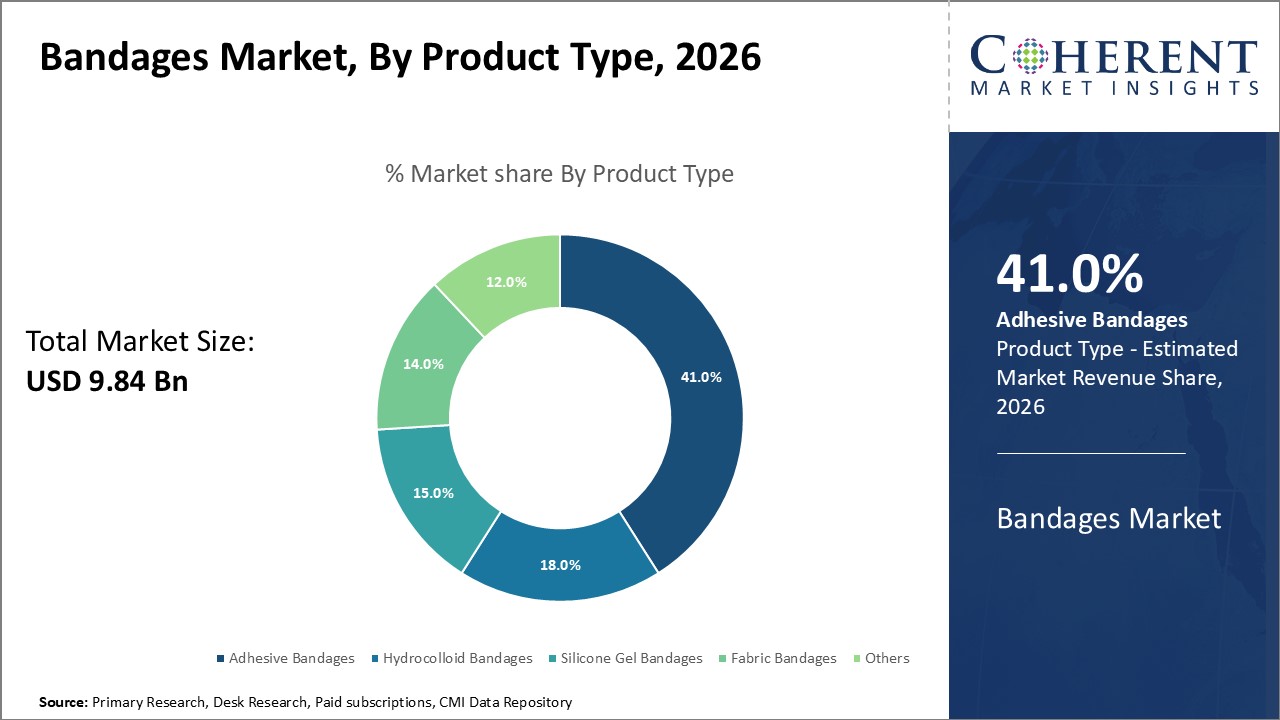
Bandages Market Insights, By Product Type
Adhesive Bandages dominate the market share. Adhesive bandages, known for their versatility and ease of application, continue to lead due to widespread use in first aid and minor wound dressing. Their broad applicability, coupled with innovations in hypoallergenic adhesives, fortifies their position in the industry. Hydrocolloid Bandages represent the fastest-growing subsegment, largely because of their superior performance in chronic and difficult-to-heal wounds. These bandages provide a moist healing environment, enhancing tissue regeneration, which has driven their adoption in clinical settings. Silicone Gel Bandages are favored for their scar management properties post-surgery, gaining traction in cosmetic and reconstructive surgery patients.
Bandages Market Insights, By Usage Type
First Aid usage leads the segment due to broad consumer awareness and easy accessibility of bandage products in households and public locations. The growing trend of emergency preparedness in schools and workplaces has also fueled this growth. Surgical Wound Care is the fastest-growing subsegment, reflecting the increased number of surgeries worldwide and the emphasis on infection prevention. Bandages designed for sterile post-operative wound healing command high usage in hospitals and clinics. Chronic Wound Care, primarily driven by diabetic and pressure ulcers, is growing steadily due to rising chronic disease prevalence and longer healing durations requiring efficient bandaging solutions.
Bandages Market Insights, By End-User
Hospitals maintain dominance owing to high volumes of surgical and acute wound care treatments, along with better reimbursement policies supporting advanced wound care products. This segment benefits from continuous technological upgrades and bulk purchasing patterns. Home Care emerges as the fastest-growing subsegment, led by increasing patient preference for at-home wound management and a rise in chronic wound cases requiring prolonged care outside clinical settings. Improved accessibility to over-the-counter bandages and telemedicine consultations further fuel this growth. Clinics play a supportive role, focusing on outpatient wound care with moderate growth rates.
Bandages Market Trends
Market trend analysis points toward heightened demand for multifunctional bandages incorporating biosensors and antimicrobial agents.
In 2025, the deployment of next-generation hydrocolloid and alginate bandages in post-surgical care grew by over 11%, underscoring the demand for innovative wound care solutions.
Additionally, the consumer shift toward sustainable and biodegradable bandages is expected to reshape product design and supply chain strategies.
The rise in telehealth infrastructure has also influenced the integration of digital wound monitoring technologies into bandage products, thereby supporting remote care and improving patient outcomes.
Bandages Market Insights, By Geography
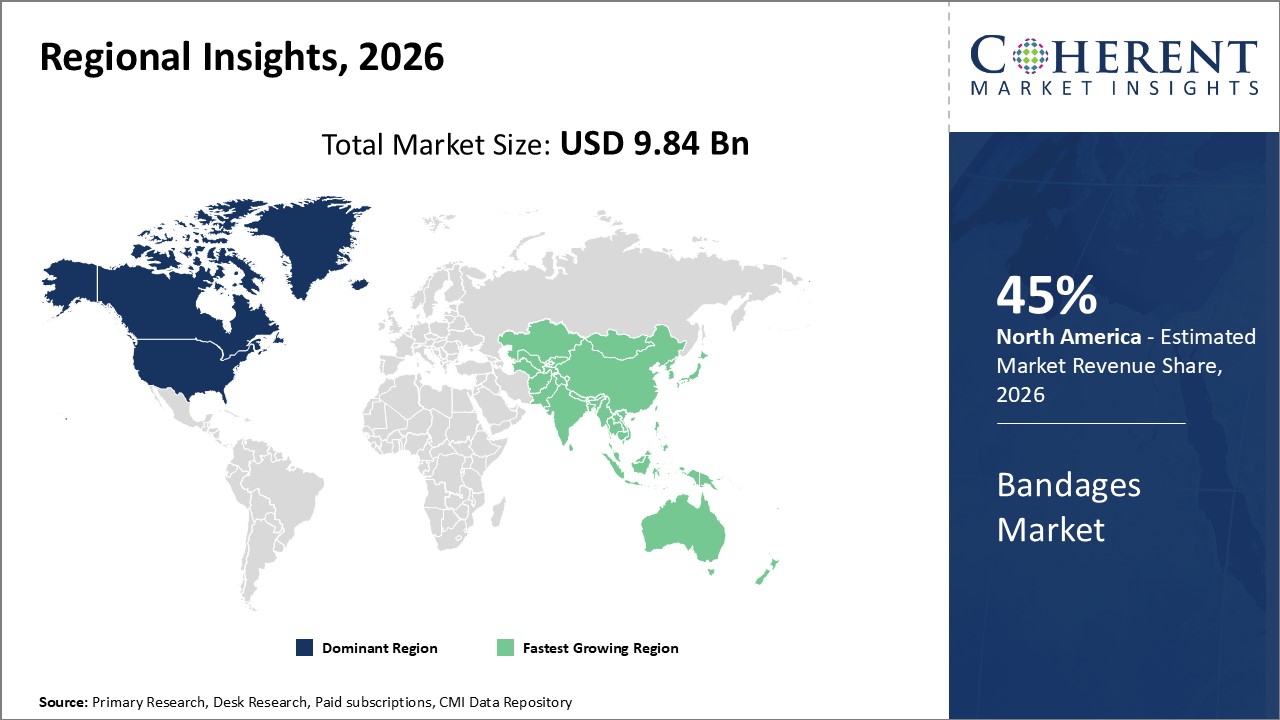
North America Bandages Market Analysis and Trends
In North America, the dominance in the Bandages market is primarily due to the region’s robust healthcare system, the presence of major market companies, and advanced R&D activities. The U.S. alone contributes over 45% of the market revenue, driven by the wide adoption of advanced wound care products and favorable regulatory policies encouraging innovation.
Asia Pacific Bandages Market Analysis and Trends
Meanwhile, the Asia Pacific region exhibits the fastest growth, with a CAGR exceeding 8%. This growth is attributable to increased healthcare investments, expanding hospital infrastructure, and the rising incidence of lifestyle diseases. Countries like India and China are critical contributors, supported by government initiatives to improve healthcare access, which is fueling the bandages market growth.
Bandages Market Outlook for Key Countries
USA Bandages Market Analysis and Trends
The U.S. bandages market remains a significant growth engine, supported by high patient awareness, advanced healthcare facilities, and widespread usage of smart bandages. The country's investment in healthcare innovation led to a 12% increase in sales of antimicrobial and hydrocolloid bandages in 2025 alone. Moreover, regulatory support from the FDA for novel wound care solutions encourages manufacturers to launch new products, catering to both hospital and home care sectors.
India Bandages Market Analysis and Trends
India's bandage market is rapidly evolving, driven by a large patient base suffering from diabetes and other chronic conditions. The expansion of public and private healthcare infrastructure has accelerated bandage consumption by over 15% annually. Additionally, increasing health insurance coverage and growing awareness about wound care practices position India as a lucrative market. Local manufacturers, alongside multinational companies, are expanding their production capacities here to meet surging demand, particularly focusing on cost-effective and eco-friendly bandaging solutions.
Analyst Opinion
Increasing demand for advanced wound care bandages is a foremost driver of market expansion. For instance, the rising adoption of hydrocolloid and silicone gel bandages has shown an annual increase of 13% in volume shipments globally in 2025, indicating shifting consumer preferences toward more effective and less invasive solutions.
Demand-side insights reveal that the Asia Pacific region's imports of medical-grade bandages increased by 15% in 2025, primarily driven by expanding healthcare infrastructure and rising government initiatives for accessible wound care in emerging economies like India and China.
Micro-indicators suggest that online retail channels contributed to over 35% of bandage market revenue in 2025 in North America, reflecting evolving consumer purchasing patterns and preference for convenient availability, which directly affects market revenue growth strategies.
- Current Industry Events of 2026
- Market Size Estimation
- Regional Breakdown
- Competitive Landscape
- Customer Intelligence
- Segmental Analysis
- Pricing Analysis
- Key Market Drivers, Challenges & Future Trends
- Customized Insights Section
Market Scope
| Report Coverage | Details | ||
|---|---|---|---|
| Base Year: | 2025 | Market Size in 2026: | USD 9.84 billion |
| Historical Data for: | 2020 To 2024 | Forecast Period: | 2026 To 2033 |
| Forecast Period 2026 to 2033 CAGR: | 7.0% | 2033 Value Projection: | USD 14.6 billion |
| Geographies covered: |
| ||
| Segments covered: |
| ||
| Companies covered: | 3M, Smith & Nephew, Johnson & Johnson, Beiersdorf AG, BSN medical, Convatec Group, Cardinal Health, Ansell Limited, Mölnlycke Health Care, HARTMANN Group, Nitto Denko Corporation. | ||
| Growth Drivers: |
| ||
Bandages Market Growth Factors
The increasing prevalence of chronic conditions such as diabetes that result in difficult-to-heal wounds significantly propels demand for advanced bandages. For instance, diabetic foot ulcers accounted for over 21% of chronic wound cases globally in 2025. Growth in surgical procedures worldwide enhances the need for sterile and reliable post-operative bandages. Additionally, rising consumer preference for eco-friendly and biodegradable bandages aligns with global sustainability trends, particularly in Europe and North America. Lastly, advancements in smart bandage technology integrating sensors for real-time monitoring of wound healing foster new opportunities, as highlighted by a 31% increase in smart bandage adoption in Europe during 2025.
Bandages Market Development
In October 2023, BITS Pilani, Hyderabad, developed a smart bandage capable of detecting and eliminating wound infections without antibiotics. The innovation features an integrated biosensing layer that identifies early markers of infection—such as pH changes and pathogen-related biochemical signals—and activates an on-demand antimicrobial response through nano-engineered materials. This technology significantly reduces reliance on traditional antibiotics, lowers the risk of antimicrobial resistance, and enhances precision in wound care. The smart bandage is designed for chronic wounds, traumatic injuries, surgical sites, and diabetic ulcers, offering a more responsive and patient-centric healing method that aligns with the growing demand for advanced, intelligent wound-management solutions.
In 2025, BAND-AID® Brand introduced its Waterproof Clear Adhesive Bandages, designed to provide 360-degree protection in wet and active environments. These bandages feature a fully sealed waterproof barrier that prevents water, dirt, and germs from reaching the wound while maintaining flexibility and comfort during daily movement. The transparent design ensures a discreet appearance, supporting consumer preference for functional yet aesthetically minimal wound dressings. This launch strengthens the brand’s position in the premium waterproof bandage segment and reflects increasing market demand for durable, lifestyle-oriented bandage solutions that combine robust protection with all-day adhesion.
Key Players
Leading Companies of the Market
3M
Smith & Nephew
Johnson & Johnson
Beiersdorf AG
BSN medical
Convatec Group
Cardinal Health
Ansell Limited
Mölnlycke Health Care
HARTMANN Group
Nitto Denko Corporation
Several leading companies have pursued strategic mergers and acquisitions to consolidate their market shares; for example, the acquisition of a smaller wound care startup by a key player in 2025 increased their R&D capabilities in antimicrobial bandages, which led to a 8% rise in market share in North America. Others have deepened their regional presence by expanding manufacturing facilities in the Asia Pacific, tapping into fast-growing demand in markets like India and China.
Bandages Market Future Outlook
The bandages market will be characterized by convergence of materials innovation, digital sensing, and evidence-driven reimbursement: smart dressings that monitor wound environment (moisture, pH, temperature, bacterial load) and transmit data to clinicians will move from pilot projects to limited commercial offerings as sensors and power solutions shrink and per-unit costs decline. Bioresponsive dressings that release antimicrobials or growth factors in response to specific biomarkers will reduce overtreatment and target therapy to clinically meaningful triggers, improving safety and cost-effectiveness. Sustainability considerations will drive biodegradable substrates and recyclable sterile packaging, responding to institutional pressure to reduce medical-waste footprints.
Bandages Market Historical Analysis
Bandages evolved from simple cloth wraps and gauze into engineered wound-care systems supporting moist healing and advanced therapeutic delivery. The 20th century saw the adoption of sterile adhesive dressings and gauze; later decades introduced hydrocolloids, hydrogels, alginates, foam dressings, and antimicrobial-impregnated variants. Advances focused on exudate management, reduced trauma removal layers, and adhesive technologies that protect fragile skin while maintaining barrier function. Integration with negative-pressure wound therapy and use in chronic wound protocols further diversified product portfolios.
Sources
Primary Research Interviews:
Wound-care nurses
Dermatologists
Sterile supply managers
Databases:
PubMed Wound Care literature
WHO Wound-care resources
ClinicalTrials.gov
ISO dressing standards database
Magazines:
Wound Care Today
Wounds International
HealthTech Magazine (MedTech)
Medical Design & Outsourcing
Journals:
Wound Repair and Regeneration
International Wound Journal
Journal of Wound Care
Advances in Wound Care
Newspapers:
The Guardian (Health)
Financial Times (Healthcare)
The New York Times (Science)
The Hindu (Medical)
Associations:
Wound Healing Society (WHS)
European Wound Management Association (EWMA)
Association for the Advancement of Wound Care (AAWC)
World Health Organization (WHO)
Get access to 250+ pages report
Every segment, forecast, competitor profile and data table behind the analysis above — available for instant download.
- ESOMAR Member
- ISO 9001:2015 Certified
- D-U-N-S Registered
- GDPR & CCPA Compliant
Missing comfort of reading report in your local language? Find your preferred language:
Transform your Strategy with Exclusive Trending Reports
Frequently Asked Questions
The bandages market is led by prominent companies such as 3M, Johnson & Johnson, and Smith & Nephew, known for their diversified product portfolios and extensive global presence. Other notable players include Beiersdorf AG and Paul Hartmann AG, focusing heavily on innovation in wound care.
The Bandages market size is projected to grow from USD 9.84 billion in 2026 to USD 14.6 billion by 2033, reflecting a CAGR of 7.0%, driven by rising demand for advanced wound management solutions and increasing healthcare expenditure worldwide.
First aid applications represent the largest and most mature segment, supported by increased public health awareness.
Trends indicate a shift toward smart and bioactive bandages that offer real-time healing status monitoring, antimicrobial properties, and eco-friendly materials. These innovations will redefine market dynamics and open new avenues for growth through technologically advanced products.
The competitive landscape is characterized by intense rivalry and continuous product innovation. Key challenges include raw material shortages and regulatory hurdles concerning bioengineered bandages, alongside cost pressures in developing markets impacting market revenue.
Leading companies often adopt strategies such as mergers/acquisitions to bolster R&D capabilities, geographical expansion through localized manufacturing, and partnerships with healthcare providers to enhance distribution and product adoption.