

Canada Insulin Delivery Devices Market Size and Share Analysis - Growth Trends and Forecast (2026 - 2033)
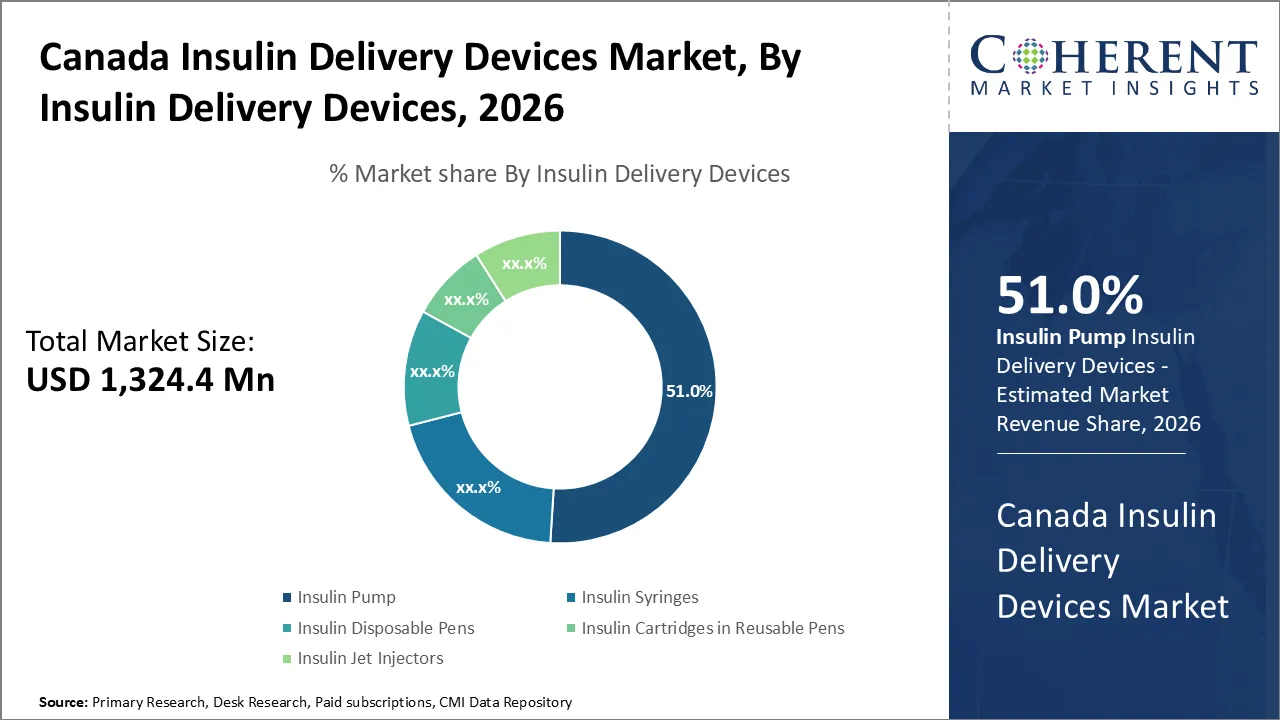
The Canada insulin delivery devices market size is estimated to reach around USD 1,324.4 Mn in 2026 and is projected to grow at a CAGR of 4.5% during the forecast period (2026-2033), totaling USD 1,627.7 Mn by 2033.
Key Takeaways from the Canada Insulin Delivery Devices Market Report
- Insulin pump is expected to remain the most sought-after insulin delivery devices, accounting for a market revenue share of 51% in 2026, because it offers continuous glucose monitoring, precise insulin dosing, and improved patient convenience, which makes it especially appealing for patients with type 1 diabetes and those requiring intensive insulin therapy.
- Increasing prevalence of diabetes in Canada is expected to drive growth of the Canada insulin delivery devices market during the forecast period.
Canada Insulin Delivery Devices Market Overview
Canada Insulin Delivery Devices market is projected to grow steadily during the forecast period. The increasing adoption of advanced insulin delivery technologies is significantly propelling the growth of the insulin delivery devices market in Canada. Over the past few years, technological innovations such as insulin pumps, continuous glucose monitoring (CGM)-integrated pumps, and smart insulin pens have gained widespread attention for their ability to improve glycemic control and enhance patients’ quality of life.
The expansion of home healthcare services coupled with the rapid adoption of telemedicine is significantly transforming the landscape of the Canada insulin delivery devices market. As more patients with diabetes seek convenience and continuous care outside conventional healthcare settings, there is an increasing reliance on advanced insulin delivery technologies that can be used safely and efficiently at home.
The rising prevalence of diabetes in Canada is a key driver of the country’s expanding insulin delivery devices market. Over the past decade, diabetes, particularly type 2 diabetes, has steadily increased due to factors such as an aging population, sedentary lifestyles, and rising obesity rates. For instance, according to the Public Health Agency of Canada (PHAC) 2025 report, the age-standardized prevalence of diabetes among both sexes reached 9.40% in 2023–2024, reflecting a noticeable upward trend from previous years. As more Canadians are diagnosed with diabetes, the demand for insulin and advanced delivery devices continues to grow, directly fueling market expansion.
The trend of collaborations between device manufacturers and pharmaceutical companies is significantly shaping the insulin delivery devices market in Canada, driving innovation and improving patient outcomes. These partnerships combine the technical expertise of device manufacturers with the pharmaceutical companies' deep understanding of drug therapies, leading to the development of advanced insulin delivery systems such as smart insulin pens, connected pumps, and integrated digital health solutions.
Current Events and Their Impact
Current Event | Description and its Impact |
Regulatory and Policy Changes |
|
Technological Advancements and Innovation |
|
Segmental Insights
- Current Industry Events of 2026
- Market Size Estimation
- Regional Breakdown
- Competitive Landscape
- Customer Intelligence
- Segmental Analysis
- Pricing Analysis
- Key Market Drivers, Challenges & Future Trends
- Customized Insights Section
Canada Insulin Delivery Devices Market Insights, By Insulin Delivery Devices - Insulin Pump Remain Top-Selling Insulin Delivery Devices
Based on insulin delivery devices, insulin pump segment is expected to dominate the Canada market, with a revenue share of about 51% in 2026. Owing to their advanced technology, ease of use, and the increasing adoption by both type 1 and insulin-dependent type 2 diabetes patients. Insulin Pumps offer continuous subcutaneous insulin infusion, closely mimicking the body’s natural insulin delivery, which significantly improves glycemic control and reduces the risk of long-term diabetes complications.
Supporting evidence can be found in guidelines published by Diabetes Canada, which endorses the use of insulin pump therapy for appropriate candidates, particularly highlighting their efficacy in improving quality of life and reducing hypoglycemic episodes. These medical recommendations have propelled healthcare providers to prioritize pump therapy, leading to heightened demand for these devices in clinical settings.
Canada Insulin Delivery Devices Industry News
- In April 2025, Insulet introduced the Omnipod 5 insulin pump in Canada, a new device that helps people with type 1 diabetes aged two and older manage their insulin automatically.
- In March 2026, Calgary startup NanoTess, which makes products for skin and wound care, has teamed up with embecta, a top maker of insulin injection devices, to sell NanoSALV Catalytic in over 14,000 pharmacies across Canada.
Market Report Scope
Canada Insulin Delivery Devices Market Report Coverage
| Report Coverage | Details | ||
|---|---|---|---|
| Base Year: | 2025 | Market Size in 2026: | USD 1,324.4 Mn |
| Historical Data for: | 2020 To 2024 | Forecast Period: | 2026 To 2033 |
| Forecast Period 2026 to 2033 CAGR: | 4.5% | 2033 Value Projection: | USD 1,627.7 Mn |
| Geographies covered: |
| ||
| Segments covered: |
| ||
| Companies covered: | Medtronic, Novo Nordisk, Eli Lilly, Sanofi, Ypsomed Holding AG, Tandem, Insulet Corporation, F. Hoffmann-La Roche Ltd., and Becton Dickinson and Company, among others. | ||
| Growth Drivers: |
| ||
| Restraints & Challenges: |
| ||
Market Dynamics
Canada Insulin Delivery Devices Market Drivers
Growing awareness about diabetes management
Growing awareness about diabetes management is playing a pivotal role in propelling the Canada insulin delivery devices market forward, as increasing education and outreach initiatives are transforming patient attitudes and healthcare provider practices. In recent years, there has been a significant emphasis on enhancing diabetes education programs and promoting self-management strategies among patients living with diabetes.
Globally, nearly one in nine adults (589 million people) now have diabetes, and about 252 million are not aware they have it, often being diagnosed only after complications appear. These global trends highlight the importance of diabetes education and self-management strategies, showing why initiatives in Canada to improve awareness are critical and helping to expand the market for insulin delivery devices.
Canada Insulin Delivery Devices Market Drivers
Supportive government initiatives and reimbursement policies
Supportive government initiatives and reimbursement programs play a key role in driving the growth of Canada’s insulin delivery devices market by improving accessibility and affordability for patients managing diabetes. By reducing financial barriers and promoting structured diabetes care, these programs help more patients adopt insulin delivery devices and manage their condition effectively.
For example, In January 2025, Diabetes Canada updated its clinical practice guideline (CPG) methods to use the GRADE approach, enhancing the rigor, transparency, and trustworthiness of guideline development. This methodological improvement aligns Diabetes Canada with national and international decision-making bodies and promotes consistent, evidence-informed practices for diabetes care. While not a direct reimbursement policy, this initiative helps healthcare providers make better-informed decisions, indirectly supporting the adoption of insulin delivery devices.
Canada Insulin Delivery Devices Market Trends
Rising focus on patient-centric and personalized diabetes care
The rising focus on patient-centric and personalized diabetes care is significantly influencing the Canada insulin delivery devices market by transforming the way insulin is administered and managed, ultimately improving patient outcomes and satisfaction. This shift is largely driven by advancements in technology and a deeper understanding of individual patient needs, moving away from one-size-fits-all approaches to more tailored treatment regimens.
Canada Insulin Delivery Devices Market Opportunities
Development of smart and connected insulin delivery devices
The development of smart and connected insulin delivery devices represents a significant opportunity in the Canadian insulin delivery devices market, driven by the increasing prevalence of diabetes and the growing emphasis on personalized, technology-driven healthcare solutions. In Canada, diabetes remains a substantial public health challenge, with approximately 4.2 million Canadians living with diabetes or prediabetes as of 2022, according to Diabetes Canada. This swelling patient base necessitates improved methods of insulin management, which smart and connected devices are uniquely positioned to provide.
Expansion of home healthcare services and telemedicine
The expansion of home healthcare services and telemedicine presents a significant opportunity for the insulin delivery devices market in Canada, due to the country’s increasing focus on patient-centered, accessible, and continuous care for chronic conditions such as diabetes. Canada’s healthcare system, particularly in rural and remote areas, faces challenges related to limited access to specialist care and frequent hospital visits.
Analyst Opinion (Expert Opinion)
- The Canada Insulin Delivery Devices Market is experiencing notable momentum, driven primarily by the increasing prevalence of diabetes across the country. Rising awareness about diabetes management and technological advancements in insulin delivery devices are key factors propelling market growth.
- The availability of user-friendly, minimally invasive delivery options such as insulin pens and pumps is encouraging adoption among patients seeking better glycemic control and convenience. Government initiatives aimed at improving diabetes care and reimbursement policies further support market expansion by increasing accessibility to advanced devices.
- However, challenges such as the high cost of insulin delivery systems and limited reimbursement in certain provinces may restrain market growth. Additionally, patient reluctance to switch from traditional methods and lack of awareness about newer devices can impede widespread adoption.
- Despite these hurdles, significant opportunities lie in the integration of digital health technologies with insulin delivery devices, offering real-time monitoring and personalized treatment adjustments that enhance patient outcomes.
- Regionally, urban centers in provinces like Ontario and British Columbia dominate due to higher patient populations and better healthcare infrastructure. At the same time, smaller but rapidly growing demand in remote and underserved regions is encouraging manufacturers to develop cost-effective and portable delivery solutions.
Speak to the analyst
Want personalized insights?
Take the findings above to one of our principal consultants, or have the report rebuilt around the segments, geographies and competitors you actually track.
Market Segmentation
- By Insulin Delivery Devices Insights ( Revenue, US$ Mn, 2020 - 2033)
- Insulin Pump
- Insulin Syringes
- Insulin Disposable Pens
- Insulin Cartridges in Reusable Pens
- Insulin Jet Injectors
- Key Players
- Medtronic
- Novo Nordisk
- Eli Lilly
- Sanofi
- Ypsomed Holding AG
- Tandem
- Insulet Corporation
- Hoffmann-La Roche Ltd.
- Becton Dickinson and Company
Sources
Primary Research interviews
- Key Opinion Leaders (KOLs) in Endocrinology
- Medical Device Manufacturers in Canada
- Healthcare Providers & Diabetes Clinics
- Regulatory Experts on Medical Devices
- Others
Databases
- GlobalData Healthcare
- IMS Health
- Frost & Sullivan
- Others
Magazines
- Diabetes Care & Technology Magazine
- Medical Device Network
- Canadian Medical Association Journal (CMAJ)
- Diabetes Canada Newsletter
- Others
Journals
- Journal of Diabetes Science and Technology
- Diabetes Therapy
- Canadian Journal of Diabetes
- Medical Devices: Evidence and Research
- Others
Newspapers
- The Globe and Mail (Health Section)
- Toronto Star (Health & Science)
- National Post (Health)
- CBC News (Health)
- Others
Associations
- Diabetes Canada
- Canadian Medical Association (CMA)
- Canadian Medical Device Technology Association (MEDEC)
- International Diabetes Federation - Canadian Branch, Others
Public Domain sources
- Health Canada - Medical Devices Database
- Canadian Agency for Drugs and Technologies in Health (CADTH)
- Statistics Canada (Health Data)
- Public Health Agency of Canada (PHAC)
- Others
Proprietary Elements
- CMI Data Analytics Tool
- Proprietary CMI Existing Repository of information for last 8 years
Get access to 250+ pages report
Every segment, forecast, competitor profile and data table behind the analysis above — available for instant download.
- ESOMAR Member
- ISO 9001:2015 Certified
- D-U-N-S Registered
- GDPR & CCPA Compliant
Missing comfort of reading report in your local language? Find your preferred language:
Transform your Strategy with Exclusive Trending Reports
Frequently Asked Questions
The Canada market is estimated to be valued at USD 1,324.4 Mn in 2026.
Canada Insulin Delivery Devices Market value is expected to surpass USD 1,627.7 Mn by 2033.
Canada market is poised to exhibit a CAGR of 4.5% from 2026 to 2033.
Increasing prevalence of diabetes and increasing demand for insulin delivery devices is fueling the growth of the market.
High cost of insulin delivery devices and stringent government regulations are the major factors restraining growth of the market.
Insulin Pump segment, with about 51% market share in 2026, dominates the market.
Medtronic, Novo Nordisk, Eli Lilly, Sanofi, Ypsomed Holding AG, Tandem, Insulet Corporation, F. Hoffmann-La Roche Ltd., and Becton Dickinson and Company, among others. are the major players.