

Insulin Delivery Devices Market Size and Share Analysis- 2026 To 2033
The Insulin Delivery Devices Market size is anticipated to grow at a CAGR of 6.8% with USD 19.8 Bn in 2026 and is expected to reach USD 31.2 Bn in 2033. The growth is owing to the rising prevalence of diabetes, increasing insulin-dependent patient pool, and growing preference for convenient self-administration across homecare and clinical settings. The cutting-edge innovations like smart insulin pens, tubeless patch pumps, CGM-integrated pumps, and automated insulin delivery systems are assisting in improving the dose accuracy, adherence, glycemic control, and patient comfort. For example, the IDF reported in 2024 that over 1 in 10 adults were living with diabetes globally, thereby highlighting the growing patient population propelling demand for devices.
Key Takeaways
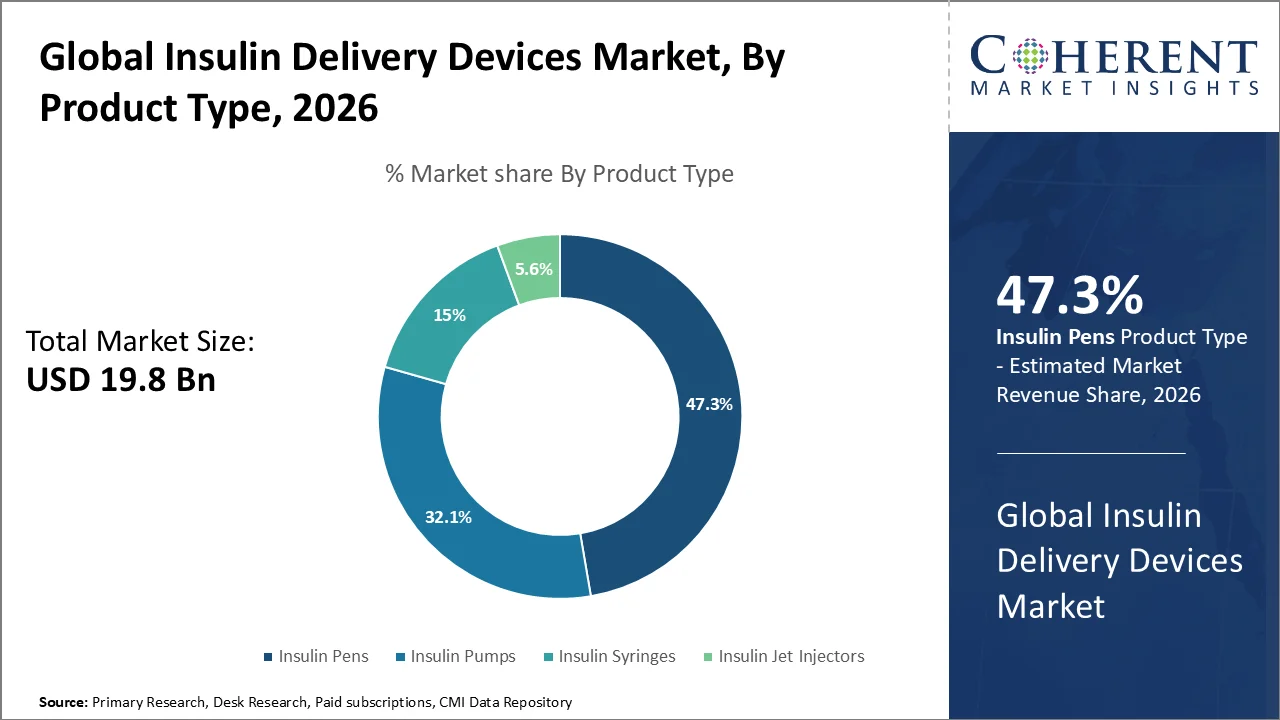
- Insulin pens segment is expected to account for the largest share of 47.3% in 2026. The segment’s growth is owing to the rising preference for convenient, accurate, and portable insulin administration, especially amongst the patients requiring daily self-injection. The growing diabetes prevalence is supporting the wider adoption. The CDC reported 40.1 million people with diabetes in the U.S. in 2023, thereby creating the strong demand for easy-to-use insulin delivery formats.
- The retail pharmacies segment is expected to hold 48.5% market share by 2026. The growth is attributable to the easier prescription refills, pharmacist-led product guidance, and wider access to insulin pens, pen needles, syringes, and related diabetes supplies. A nationwide pharmacy access study found that nearly 90% of Americans live within 5 miles of a community pharmacy, supporting frequent insulin-device purchases and refills.
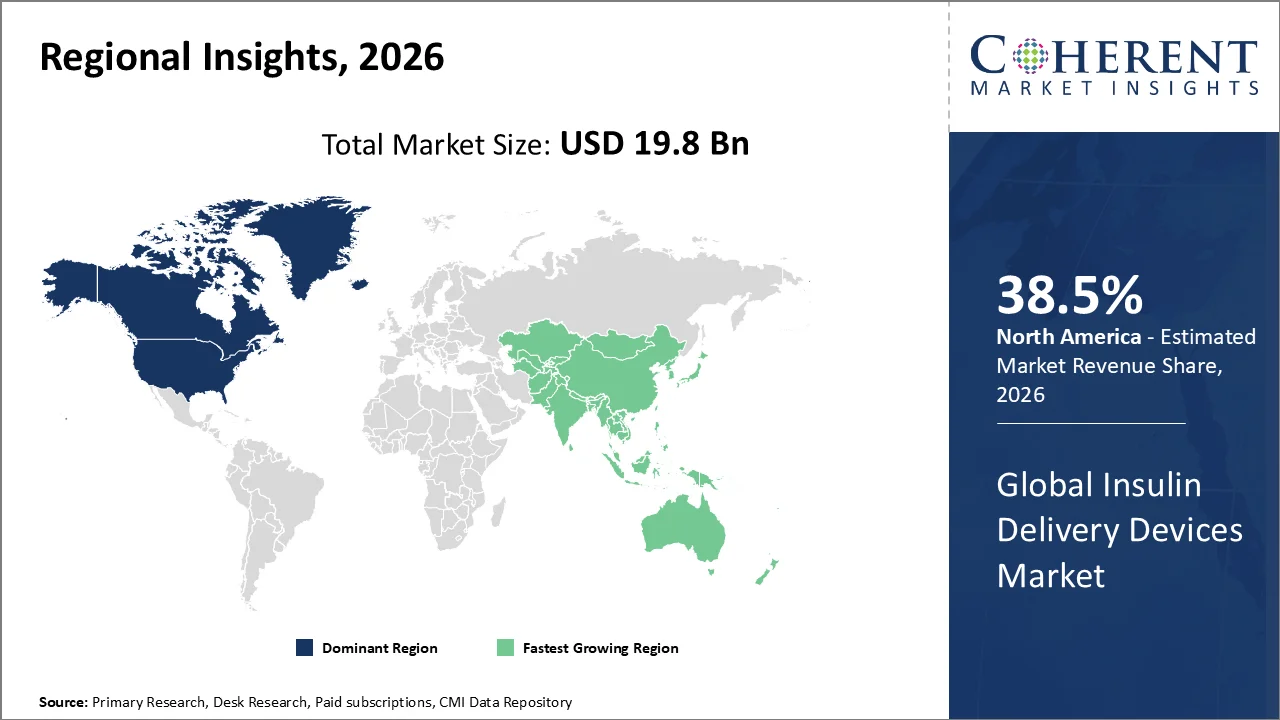
- North America is expected to acquire the dominant share of 38.5% in 2026. The region’s growth is owing to the high diabetes burden, strong reimbursement access, and rapid adoption of connected insulin pens, pumps, and automated insulin delivery systems. Medtronic reinforced its partnership with Abbott in April 2025 by filing FDA 510(k) applications for an interoperable insulin pump compatible with Abbott’s CGM platform.
Segmental Insights
Why is Insulin Pens Segment Acquiring the Highest Share in the Market?
By product type, insulin pens segment is projected to account for the largest Insulin Delivery Devices Market share of 47.3% in 2026. The segment’s growth is owing to the strong preference for devices that support convenient self-administration, portability, accurate dosing, and easier daily diabetes management.
Insulin pens are widely used by both basal and mealtime insulin users because they reduce dependence on conventional vial-and-syringe methods and allow discreet dosing outside hospitals and clinics. The demand is further supported by the rising insulin-treated diabetes population. The FDA reported in February 2025 that around 8.4 million Americans are dependent on insulin therapy like rapid-acting and long-acting insulin.
In June 2026, Ascensia Diabetes Care launched the CONTOURCOMFORT pen needles, thereby enhancing its CONTOUR portfolio with an aim to improve stability, comfort, as well as usability for daily insulin injections. The needles feature a 5-bevel tip and ergonomic design for a more confident and consistent injection experience.
- Current Industry Events of 2026
- Market Size Estimation
- Regional Breakdown
- Competitive Landscape
- Customer Intelligence
- Segmental Analysis
- Pricing Analysis
- Key Market Drivers, Challenges & Future Trends
- Customized Insights Section
Retail Pharmacies holds the Largest Market Share
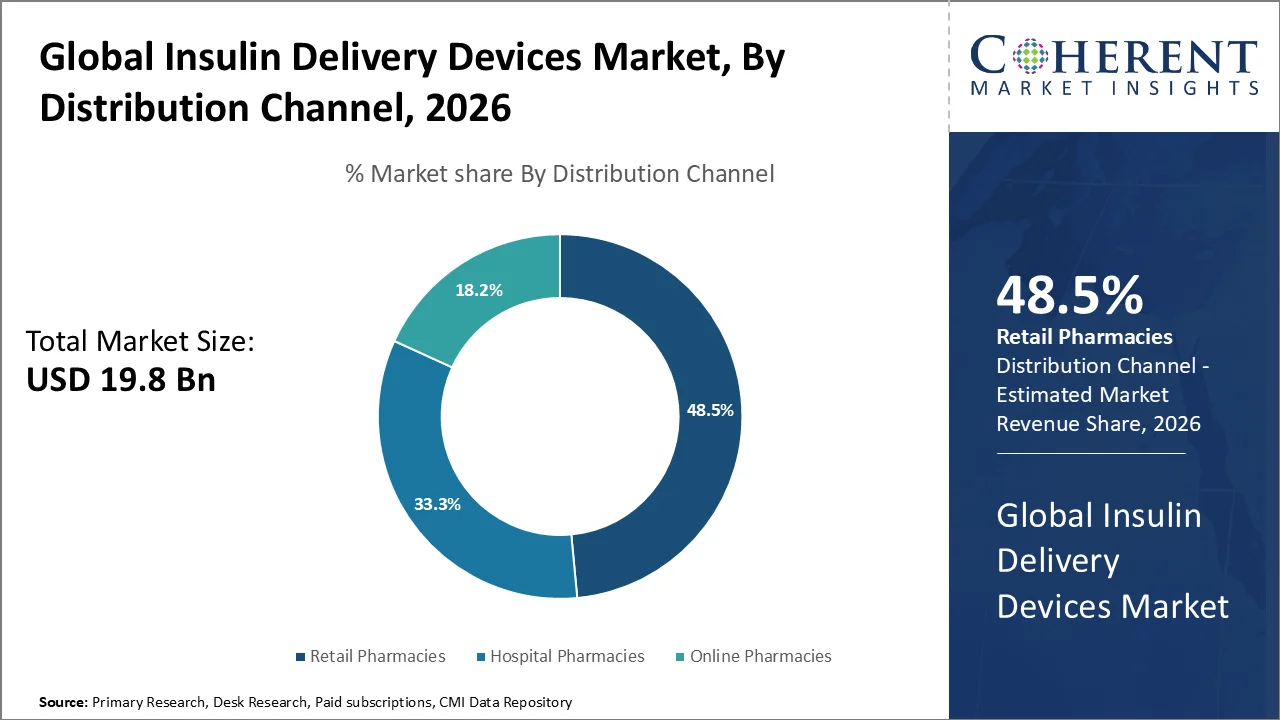
Based on distribution channel, the retail pharmacies segment is poised to dominate the market and accounts for a considerable 48.5% share in 2026. The segment’s growth is owing to the high frequency of recurring diabetes prescriptions, patient preference for convenient access to medications, and the critical role of community pharmacies in supplying insulin pens, pen needles, syringes, and other diabetes-related devices.
In England, the NHS Business Services Authority reported that nearly 77 million prescribed diabetes-treatment items were dispensed through community pharmacies in 2024/25. This marks a 9% year-on-year increase and highlights the sector’s essential role in chronic care management.
In August 2024, the U.S. FDA approved the Insulet SmartAdjust technology for adults with type 2 diabetes, thereby expanding the availability of automated insulin delivery systems beyond type 1 patients. This development reinforces retail pharmacies as the primary distribution channel for modern, patient-friendly insulin therapies.
Market Drivers
Rapid Shift Toward Automated and Connected Insulin Delivery Transforming the Insulin Delivery Devices Industry in the US
The U.S. insulin delivery devices market is undergoing a rapid transformation with a strong focus on automated as well as connected systems. The regulatory support from the U.S. Food and Drug Administration (FDA) continues to advance automated insulin delivery (AID) technologies, particularly through the promotion of artificial pancreas device systems, which provide safe as well as precise closed-loop insulin dosing.
The adoption trends indicate more than 10,000 participants are engaged in the ongoing real-world AID evaluation studies in March 2026. The controlled trials show automated systems improving glycemic time-in-range outcomes by more than 10% compared with traditional pump therapy, thereby highlighting both clinical as well as practical benefits of connected and automated insulin management in the U.S. market.
In March 2025, Tandem Diabetes Care, Inc. launched Control-IQ+, an automated insulin delivery system in the U.S. It is available for people with type 1 diabetes aged 2 years and older and adults with type 2 diabetes. The technology enhances personalization, flexibility, and glycemic control through the advanced hybrid closed-loop features.
Smart Insulin Pens and App-Based Dose Guidance: A Key Advancement in Insulin Delivery Devices Market
The smart insulin pens and app-based dose guidance is one of the major advancements in the Insulin Delivery Devices Market. They assist in improving insulin dosing accuracy, minimizing missed-dose risk, and enabling patients to self-manage diabetes more effectively outside clinical settings.
In the United States, approximately 8.3 million people require insulin therapy to maintain blood glucose levels, and global insulin demand is projected to increase by 20% by 2030, thereby reflecting a growing patient base which could benefit from connected devices.
The recent innovations are focused on seamless integration between smart pens and digital applications. In January 2026, Medtronic received the FDA clearance for the MiniMed Go Smart Multiple Daily Injection (MDI) system. It combines the InPen smart insulin pen with the Abbott’s Instinct sensor. The system delivers real-time personalized insights, dose calculations, and missed-dose alerts for individuals aged 7 years and older with type 1 or type 2 diabetes. This enhances adherence and glycemic management while supporting remote monitoring along with the telehealth interventions.
Current Events and Their Impact on the Insulin Delivery Devices Market
Current Event | Description and its Impact |
2026 CMS DMEPOS Competitive Bidding and Monthly Rental Model for Insulin Pumps |
|
FDA Cybersecurity Guidance and Omnipod 5 Recall Tighten Safety Oversight
|
|
Insulin Delivery Devices Market Trends
- The rising adoption of smart insulin pens and connected dose-tracking devices is improving the adherence, reducing missed doses, and supporting the app-based diabetes management.
- Automated insulin delivery systems integrating pumps, CGMs, and algorithms are expanding, thereby enabling real-time dose adjustment and lower hypoglycemia risk.
- The tubeless patch pumps and wearable infusion devices are gaining traction as patients seek discreet, flexible, and needle-sparing insulin administration.
- The growing diabetes burden is increasing the long-term demand for insulin pens, pumps, syringes, as well as infusion accessories. As of 2026, around 589 million adults aged 20–79 years are living with diabetes globally, projected to reach 853 million by 2050. In the U.S., the CDC reported 40.1 million people with diagnosed or undiagnosed diabetes in 2023.
- Supportive clinical guidelines, device approvals, and reimbursement policies are improving the access to cutting edge insulin delivery devices. In 2026, the ADA Standards identified automated insulin delivery as a preferred insulin delivery system. Also, Medicare Part B covers durable external insulin pumps and the insulin used with covered pumps.
Regional Insights
North America Market Leadership Driven by Rising Prevalence of Chronic Conditions and Massive Healthcare Investments
North America is set to account for the leading position in the Insulin Delivery Devices Market. The region occupies a substantial 38.5% share in 2026. The growth is mainly driven by the rising prevalence of chronic conditions, massive healthcare investments, and rapid technology adoption. According to the Centers for Disease Control and Prevention (CDC), nearly 38.4 million Americans have diabetes, while 97.6 million adults live with prediabetes. This massive patient pool has shifted preferences toward advanced administration.
In June 2026, Beta Bionics Inc. launched a public real-time dashboard for its iLet Bionic Pancreas. The platform provides insights on insulin delivery outcomes for patients with baseline HbA1c and at least two weeks of uploaded data.
Asia Pacific Insulin Delivery Devices Market Trends
The Asia Pacific region is poised to be as the fastest-growing region through 2026-2033. The region’s growth is owing to the rising diabetes prevalence, increasing healthcare infrastructure investments, and strong adoption of innovative delivery systems.
The Western Pacific region alone accounts for approximately 215 million adults with diabetes, representing 37% of global cases, highlighting sustained demand for advanced insulin administration technologies.
In May 2026, CareMedi launched CareLevo, the world’s first patch-type insulin pump designed for seven-day use, extending typical wear from 3–4 days. The development accelerates the company’s global market entry, supported by a Series B investment of 26 billion won.
Rising Diabetes Prevalence Accelerates Insulin Delivery Devices Adoption in United States
The United States Insulin Delivery Devices Market has seen robust growth. The growth is owing to the rising diabetes prevalence, technological advancements, and increased patient preference for improved glycemic control. A key driver is the growing number of diagnosed diabetics requiring efficient, less invasive delivery options.
According to the U.S. CDC National Diabetes Statistics Report 2026, an estimated 29.1 million adults in the U.S. live with diagnosed diabetes, thereby propelling the demand for pens, pumps, and automated systems.
In March 2026, the U.S. FDA approved Novo Nordisk’s Awiqli, the first once-weekly basal insulin for adults with type 2 diabetes. The therapy, reducing injections from seven to one per week, is expected to launch in the U.S. in the second half of 2026.
China Insulin Delivery Devices Market Trends
The Insulin Delivery Devices Market in China is influenced by the rising diabetes prevalence, technological innovation, and patient preference for convenient management solutions. According to the official health data, China accounts for approximately 22% of the global diabetes population among adults. This reflects a substantial chronic disease burden which propels the demand for cutting edge insulin delivery devices.
In March 2026, Medtrum unveiled the next-generation TouchCare Automated Insulin Delivery system at ATTD, featuring its APGO self-learning algorithm. The fully connected, tubeless patch pump system provides automated insulin adjustments and meal handling, available in 200U and 300U capacities for the personalized diabetes management.
Who are the Major Companies in Insulin Delivery Devices Industry
Some of the major key players in Insulin Delivery Devices industry are Novo Nordisk A/S, Becton, Dickinson and Company, Sanofi S.A., F. Hoffmann-La Roche, Ltd., Eli Lilly and Company, Medtronic, Plc, Ypsomed Holding AG, Animas Corporation, and Insulet Corporation.
Key News
- In May 2026, ViCentra launched its Kaleido smartphone-controlled hybrid closed-loop insulin delivery system in Europe. The system integrates the Kaleido patch pump with Diabeloop’s DBLG2 algorithm and the Dexcom G7 CGM for advanced insulin management.
- In February 2026, Insulet launched its Omnipod 5 Automated Insulin Delivery System in Saudi Arabia, Kuwait, Qatar, and the UAE. It provide tubeless insulin delivery integrated with the continuous glucose sensors.
- In February 2026, Senseonics and Sequel Med Tech launched a Type 1 diabetes system combining the Eversense 365 one-year implantable CGM with Sequel’s automated insulin delivery system. This integration offers an alternative to traditional 15-day wearable CGMs, enabling longer-term continuous glucose monitoring.
Market Report Scope
Insulin Delivery Devices Market Report Coverage
| Report Coverage | Details | ||
|---|---|---|---|
| Base Year: | 2025 | Market Size in 2026: | USD 19.8 Bn |
| Historical Data for: | 2020 To 2024 | Forecast Period: | 2026 To 2033 |
| Forecast Period 2026 to 2033 CAGR: | 6.8% | 2033 Value Projection: | USD 31.2 Bn |
| Geographies covered: |
| ||
| Segments covered: |
| ||
| Companies covered: | Novo Nordisk A/S, Becton, Dickinson and Company, Sanofi S.A., F. Hoffmann-La Roche, Ltd., Eli Lilly and Company, Medtronic, Plc, Ypsomed Holding AG, Animas Corporation, and Insulet Corporation. | ||
| Growth Drivers: |
| ||
| Restraints & Challenges: |
| ||
Analyst Opinion
- Insulin delivery devices are driven by a large and expanding diabetes treatment base. The International Diabetes Federation (IDF) reported in 2025 that approximately 578 million adults were living with diabetes globally, with the number expected to reach 783 million by 2045, creating sustained demand for pens, pumps, injectors, and connected insulin delivery systems.
- Insulin therapy is essential for type 1 diabetes and also important for several advanced type 2 diabetes patients. In the U.S., the CDC reported in January 2026 that 2.1 million people had diagnosed type 1 diabetes which includes 4,000 children and adolescents supporting the demand for recurring devices.
- Advanced insulin delivery is shifting from basic injections to smart and automated systems. ADA’s Standards of Care in Diabetes—2026 state that automated insulin delivery systems are preferred for people with type 1 diabetes and insulin-deficient diabetes, which is expected to strengthen adoption of insulin pumps, smart pens, and CGM-integrated delivery platforms.
Speak to the analyst
Want personalized insights?
Take the findings above to one of our principal consultants, or have the report rebuilt around the segments, geographies and competitors you actually track.
Market Segmentation
- By Product Type (Revenue, USD Bn, 2021-2033)
- Insulin Syringes
- Insulin Pumps
- Insulin Pens
- Insulin Jet Injectors
- By Distribution Channel (Revenue, USD Bn, 2021-2033)
- Hospital Pharmacies
- Retail Pharmacies
- Online Pharmacies
- By Region (Revenue, USD Bn, 2021-2033)
- North America
- U.S.
- Canada
- Latin America
- Brazil
- Mexico
- Argentina
- Rest of Latin America
- Europe
- Germany
- U.K.
- France
- Italy
- Spain
- Russia
- Rest of Europe
- Asia Pacific
- China
- India
- Japan
- Australia
- South Korea
- ASEAN
- Rest of Asia Pacific
- Middle East
- GCC
- Israel
- Rest of Middle East
- Africa
- South Africa
- Central Africa
- North Africa
- North America
Sources
Primary Research Interviews
- Endocrinologists & Diabetes Specialists
- Hospital & Clinic Administrators
- Diabetes Care Nurses / Educators
- Medical Device Distributors & Wholesalers
- Insulin Pump & Pen Manufacturers’ R&D Teams
- Diabetes Technology Consultants
- Patient Advocacy Groups & KOLs
Databases
- Bloomberg Terminal
- Thomson Reuters Eikon
- IQVIA / IMS Health
- National Health Statistics Databases
Magazines
- Medical Device and Diagnostic Industry (MD+DI)
- Diabetes Technology & Therapeutics Journal
- MedTech Insight
- Pharmaceutical Executive
- Endocrinology Today
Journals
- Diabetes Care (ADA)
- Journal of Diabetes Science and Technology
- International Journal of Endocrinology
- Current Diabetes Reports
- The Lancet Diabetes & Endocrinology
Newspapers
- Financial Times
- The Wall Street Journal
- Reuters
- Bloomberg News
- Healthcare News outlets
Associations
- American Diabetes Association (ADA)
- International Diabetes Federation (IDF)
- European Association for the Study of Diabetes (EASD)
- Juvenile Diabetes Research Foundation (JDRF)
- Association for the Advancement of Medical Instrumentation (AAMI)
Public Domain Sources
- U.S. Food & Drug Administration (FDA) – Device Approvals & Safety Notices
- Centers for Disease Control and Prevention (CDC) – Diabetes Statistics
- National Institutes of Health (NIH) – Clinical Trials & Reports
- World Health Organization (WHO) – Global Diabetes Reports
- European Medicines Agency (EMA) – Device Guidance
- Ministry of Health / National Health Services datasets
Proprietary Elements
- CMI Data Analytics Tool
- Proprietary CMI Repository (last 10 years)
Get access to 250+ pages report
Every segment, forecast, competitor profile and data table behind the analysis above — available for instant download.
- ESOMAR Member
- ISO 9001:2015 Certified
- D-U-N-S Registered
- GDPR & CCPA Compliant
Missing comfort of reading report in your local language? Find your preferred language:
Transform your Strategy with Exclusive Trending Reports
Frequently Asked Questions
The Insulin Delivery Devices Market is expected to reach USD 31.2 Bn in 2033.
Major players operating in the global Insulin Delivery Devices Market include Novo Nordisk A/S, Becton, Dickinson and Company, Sanofi S.A., F. Hoffmann-La Roche, Ltd., Eli Lilly and Company, Medtronic, Plc, Ypsomed Holding AG, Animas Corporation, and Insulet Corporation.
The high upfront and recurring costs of advanced devices, limited healthcare reimbursement in emerging economies, and data security concerns tied to connected digital health devices are the key factors hampering growth of the market.
The escalating worldwide prevalence of diabetes, rapid technological advancements in smart drug-delivery platforms, and favorable government initiatives for chronic disease management is boosting demand for insulin delivery devices.
The Insulin Delivery Devices Market is anticipated to grow at a CAGR of 6.8% between 2026 and 2033.
Among regions, North America is expected to account for a largest market share in the global Insulin Delivery Devices Market over the forecast period.
Insulin delivery devices are evolving with features such as Bluetooth-enabled smart pens, integration with continuous glucose monitoring systems in automated pumps, and single-use disposable devices that improve safety, ease of use, and patient compliance.