

North America Air Ambulance Service Market Size and Share Analysis - 2026 To 2033
The North America air ambulance service market size is expected to expand from USD 3.52 Bn in 2026 to reach USD 5.99 Bn by 2033, witnessing a compounded annual growth rate of 7.9%. The growth can be attributed to factors such as increasing demand for rapid emergency medical transport services, growing incidences of critical ailments, technological developments in air ambulances, and advancements in healthcare infrastructure.
Key Takeaways from the North America Air Ambulance Service Market Report
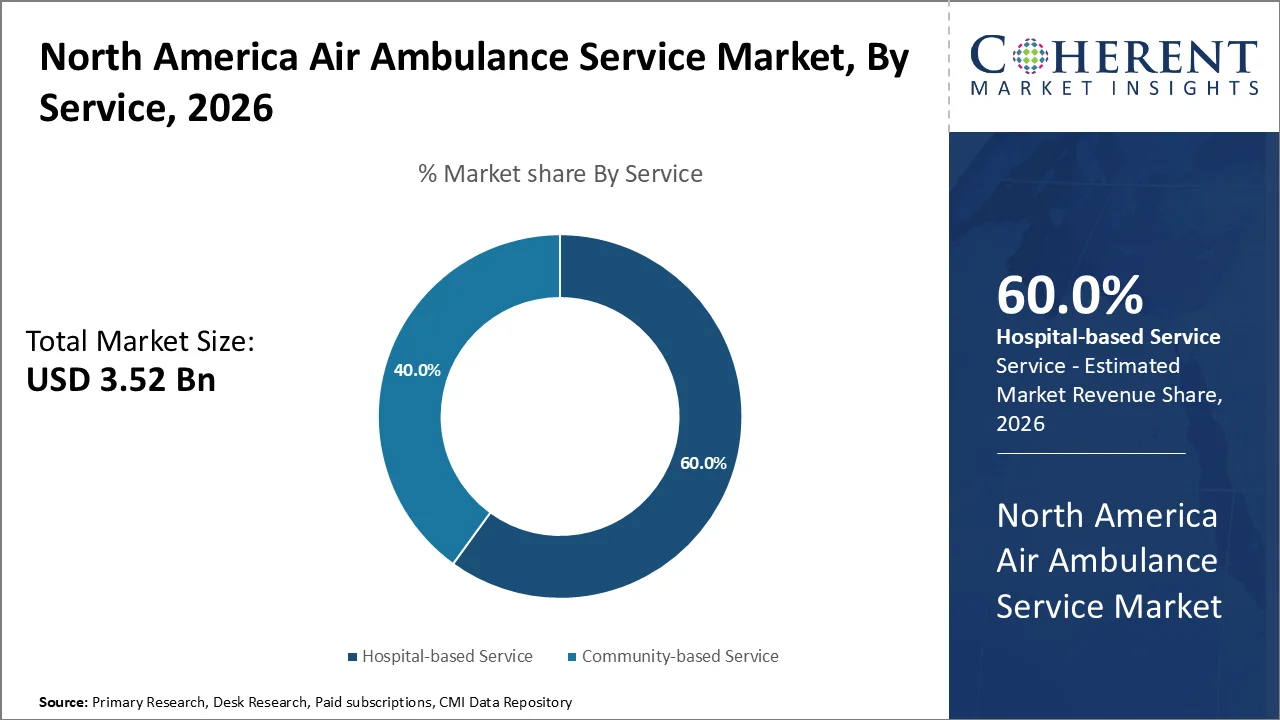
- Hospital-based services segment is projected to account for 60% of the market share in 2026, owing to the increasing presence of large hospitals owning air ambulances for the fast transportation of patients. As per data from the American Hospital Association (AHA), there are over 5,000 hospitals in the U.S. offering emergency and critical care facilities.
- Helicopters are predicted to hold the maximum market share of around 70% by 2026, attributed to their significant application in short-haul emergencies and transport services in urban areas that require speed and convenience. As per AAMS, more than 90% of the emergency air medical transports in the US are carried out using helicopters.
- Inter-facility transport is projected to occupy a 45% market share by 2026 due to the significant number of critical patients who require transfer between hospitals. In addition, according to NEMSIS, United States National EMS Information System, inter-facility transport makes up almost half of all air ambulance services.
Segmental Insights
Why are Hospital-Based Services Dominating the North America Air Ambulance Service Market?
Hospital-based air ambulance services are expected to hold a majority market share, at around 60% of the overall service volume, in 2026. This is due to the use of dedicated air ambulance fleets by leading hospitals to ensure fast patient transportation.
The growing number of critical cases like cardiac arrests, trauma, and strokes, as well as the urgent requirement for patient transfers between hospitals, has contributed to the greater need for air ambulances based within hospitals. Developments in medical technology on board, and trained staff for critical care, have also enhanced the effectiveness of these fleets.
In February 2025, Air Methods Corporation unveiled a new hospital-based air ambulance program at Vanderbilt University Medical Center in Nashville, Tennessee.
- Current Industry Events of 2026
- Market Size Estimation
- Regional Breakdown
- Competitive Landscape
- Customer Intelligence
- Segmental Analysis
- Pricing Analysis
- Key Market Drivers, Challenges & Future Trends
- Customized Insights Section
Which Aircraft Type Dominates the Market?
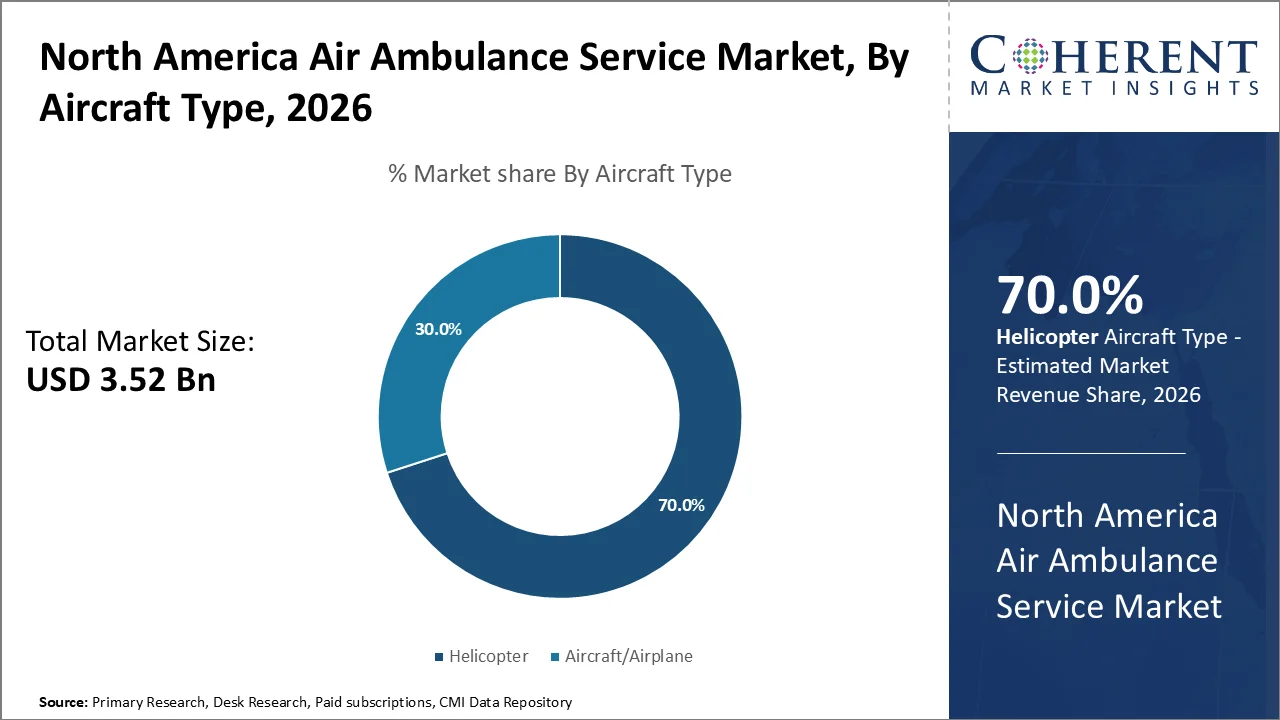
Helicopters are projected to account for the largest share of the air ambulance fleet in 2026, approximately 70% of total aircraft deployed. This is largely due to their suitability for short-distance emergency and urban transport, where speed and accessibility are critical.
Based on research conducted by the Association of Air Medical Services (AAMS), more than 90% of the total number of air medical transport services provided in the United States rely on helicopter usage.
The increased use of helicopters can be attributed to the improvement in navigational equipment, medical equipment, and telemedicine services, which have made it possible for paramedics and flight nurses to deliver advanced critical care during patient transport.
Which Application Segment Leads the Market?
Inter-facility transport is predicted to dominate the North America air ambulance service market, holding a market share of 45% in 2026. This dominance will be due to a large number of transfers of critically ill patients from one hospital to another, especially to specialized centers from small or rural hospitals.
The U.S. National EMS Information System (NEMSIS) reports that nearly half of all air ambulance missions are inter-facility transfers, underscoring their significance in improving patient outcomes and healthcare efficiency.
The rising complexity of healthcare delivery, the requirements of specialized critical care teams, and the development of regional trauma systems have all played their part in the increased use of air ambulances in North America.
Market Drivers
Rising Demand for Rapid Emergency Medical Transport is Transforming the North America Air Ambulance Service Industry
The rising occurrence of critical health disorders and the requirement for prompt medical transportation is boosting the demand for North American air ambulance services. Health organizations are increasingly providing air ambulances to provide patients with timely access to specialized medical treatment, especially in rural and remote locations.
According to the U.S. Department of Health and Human Services, over 60 million Americans live in rural areas, where access to Level I trauma centers is limited, creating a strong demand for air medical services.
Advanced Aircraft and Technology Innovations Enhance Patient Outcomes
Medical helicopters and airplanes are now fitted with sophisticated medical devices, telemedicine facilities, and better navigation equipment. This has enabled paramedics and flight nurses to provide emergency care services on flights.
According to the Association of Air Medical Services (AAMS), 90% of all American air medical services have critical care staff, leading to better survival chances for trauma and heart attack victims.
Current Events and Their Impact on the North America Air Ambulance Service Market
Current Event | Description and its Impact |
2026 Medicare Reimbursement and Air Medical Transport Policy Updates in the U.S. |
|
Trade Restrictions & Regulatory Tightening on Aircraft Imports and Medical Equipment |
|
North America Air Ambulance Service Market Trends
- Helicopters are still considered the top aircraft for short distances and urban use, representing about 70% of air ambulances in America.
- Technology enhances care quality and efficiency. Contemporary aircraft incorporate telemedicine, modern navigation systems, and ICU units, allowing paramedics and flight nurses to deliver quality care route.
- The expansion of rural healthcare accessibility programs is supporting market growth. Around 60 million people live in rural areas of the United States, and most of these locations are not close to Level I trauma centers.
- Enhancing insurance and payment options improves access. Air medical transportation is reimbursed by CMS within the Medicare and Medicaid programs, for both fixed-wing and rotary-wing modes of air ambulance service for critical-care patients.
North America Air Ambulance Service Market Outlook – Country-wise
The U.S. is expected to remain the dominant market in North America for air ambulance services in 2026, accounting for around 80% of the regional market. The demand is projected to be stimulated by the growing geriatric population that is more likely to suffer from chronic ailments, including cardiovascular conditions, requiring the use of air ambulances.
States with historically high usage of fixed-wing air ambulances, such as Alaska, Wyoming, and Montana, continue to use air medical transport due to long distances, which typically average over 400 miles. Increased numbers of hospital fleet operations, transfers between facilities, and improvements in technology in critical care transport further add to market demand.
In 2026, Canada will be expected to have a lower but rising share of the North American air ambulance market due to the requirement for movement over wide and far-reaching distances. This is because of the low density of populations in rural and northern Canada that require both rotary and fixed wing air ambulances.
Government initiatives for improving rural health care access along with sustained investments in the air ambulance infrastructure at hospitals will help improve service coverage and response times, especially in provinces such as British Columbia, Alberta, and Ontario.
Who are the Major Companies in North America Air Ambulance Service Industry
Some of the major key players in North America Air Ambulance Service are Alacura Medical Transportation Management LLC, Air Methods, Acadian Air Med, company, Aeromedevac, AirMed International, LLC, AirCARE1, Jet Rescue International, MedWay Air Ambulance, IAS Medical, US Air Ambulance, Air Medical Group Holdings (AMGH), Express Air Medical Transport, Air Ambulance Worldwide, AeroCare Medical Transport System, Inc., REVA, Inc., UNC Health Care, Aitheras Aviation Group, LLC, KIDZ Medical Service, Suncoast Air & Ground Medical Transport, Classic Air Medical, Sunrise Air Ambulance, Inc., Aero Jet Medical, Fox Flight Inc., WellCare Air Ambulance Services, Advanced Air Ambulance, Corp., American Air Ambulance, Lifeguard Ambulance Service LLC, Aviation West Charters, LLC and PHI Air Medical.
Industry News
- In February 2025, Air Methods launched a new critical care helicopter base at Vanderbilt University Medical Center to improve hospital-based emergency transport and inter-facility transfers.
- In January 2024, Acadian Air Med unveiled a new fixed-wing air ambulance service connecting rural hospitals in Louisiana and Texas to tertiary care centers, reducing patient transfer times for critical care cases.
Market Report Scope
North America Air Ambulance Service Market Report Coverage
| Report Coverage | Details | ||
|---|---|---|---|
| Base Year: | 2025 | Market Size in 2026: | USD 3.52 Bn |
| Historical Data for: | 2020 To 2024 | Forecast Period: | 2026 To 2033 |
| Forecast Period 2026 to 2033 CAGR: | 7.9% | 2033 Value Projection: | USD 5.99 Bn |
| Geographies covered: |
| ||
| Segments covered: |
| ||
| Companies covered: | Alacura Medical Transportation Management LLC, Air Methods, Acadian Air Med, company, Aeromedevac, AirMed International, LLC, AirCARE1, Jet Rescue International, MedWay Air Ambulance, IAS Medical, US Air Ambulance, Air Medical Group Holdings (AMGH), Express Air Medical Transport, Air Ambulance Worldwide, AeroCare Medical Transport System, Inc., REVA, Inc., UNC Health Care, Aitheras Aviation Group, LLC, KIDZ Medical Service, Suncoast Air & Ground Medical Transport, Classic Air Medical, Sunrise Air Ambulance, Inc., Aero Jet Medical, Fox Flight Inc., WellCare Air Ambulance Services, Advanced Air Ambulance, Corp., American Air Ambulance, Lifeguard Ambulance Service LLC, Aviation West Charters, LLC and PHI Air Medical | ||
| Growth Drivers: |
| ||
| Restraints & Challenges: |
| ||
Analyst Opinion
- North America air ambulance service is set to grow in the coming years due to the high rate of incidence of trauma, heart-related ailments, and neurological diseases, among other critical medical conditions. The industry analysts have pointed out that growth in the market is not cycle-dependent but driven by a need for timely medical attention.
- Inter-facility transport remains the backbone of the North America air ambulance ecosystem. The growing dependency of hospitals on air medical transport to move critically ill patients from community hospitals to tertiary centers improves the prospects for future growth in air ambulance services.
- Helicopters continue to dominate the market because of their operational flexibility and rapid response capabilities. Analysts note that rotary-wing aircraft are particularly effective in urban emergencies, accident response, and remote area access, where conventional ground transportation may be delayed by distance or traffic congestion.
- The United States remains the primary growth engine for the regional market owing to its advanced emergency medical service (EMS) infrastructure, strong hospital integration, and growing adoption of hospital-based air ambulance programs. Increasing healthcare spending and high awareness regarding emergency care further support market expansion.
- Technological advancements are significantly improving patient outcomes during transport. The presence of ICU-standard medical equipment on board, telemedicine capabilities, GPS navigation, and live patient monitoring enable flight teams to provide critical care services while traveling.
- Another important trend in the industry is the increased focus on fleet upgrades and hospital alliances, according to analysts. This involves increasing helicopter and aircraft fleets that incorporate advanced life support systems to enhance efficiency and decrease transportation time.
- Despite strong growth prospects, however, the industry is likely to be confronted with some difficulties concerning expensive operating costs, reimbursement problems, shortage of pilots, and stringent aviation laws for aircraft safety. Such conditions can affect the profitability and operations of small air ambulances.
Speak to the analyst
Want personalized insights?
Take the findings above to one of our principal consultants, or have the report rebuilt around the segments, geographies and competitors you actually track.
Market Segmentation
- By Service (Revenue, USD Bn, 2021-2033)
- Hospital-based Service
- Community-based Service
- By Aircraft Type (Revenue, USD Bn, 2021-2033)
- Helicopter
- Aircraft/Airplane
- Rotary Winged Aircraft
- Fixed Winged Aircraft
- By Application (Revenue, USD Bn, 2021-2033)
- Inter- Facility
- Rescue Helicopter
- Organ Transplant Logistics
- Overweight Patient Transport
- Infectious Disease
- Neonatal Transport
- Others (Pediatric Transport)
- By Region (Revenue, USD Bn, 2021-2033)
- U.S.
- Canada
Sources
Primary Research Interviews
- Interviews with air ambulance operators, hospital emergency department heads, EMS coordinators, aviation medical transport pilots, critical care flight nurses, and industry experts
Databases
- Government healthcare and emergency medical services databases (U.S. and Canada)
- National Emergency Medical Services Information System (NEMSIS)
- Centers for Medicare & Medicaid Services (CMS) reimbursement database
- Federal Aviation Administration (FAA) aviation operations database
- Health Canada emergency transport datasets
- Hospital and trauma registry databases
Magazines
- Air Medical Journal
- EMS World Magazine
- Aviation Week & Space Technology
- Healthcare Transport Magazine
- Emergency Medicine News
Journals
- Journal of Air Medical Transport
- Prehospital Emergency Care Journal
- Aviation, Space, and Environmental Medicine Journal
- Journal of Emergency Medical Services (JEMS)
- American Journal of Emergency Medicine
Newspapers
- The New York Times (healthcare and emergency services coverage)
- The Washington Post (health policy and EMS developments)
- Reuters Healthcare & Aviation News
- Bloomberg Health & Aviation Reports
- Canadian Broadcasting Corporation (CBC News – Health Section)
Associations
- Association of Air Medical Services (AAMS)
- National Association of Emergency Medical Technicians (NAEMT)
- American Hospital Association (AHA)
- International Association of Flight and Critical Care Paramedics (IAFCCP)
- Federal Aviation Administration (FAA – EMS programs)
Public Domain Sources
- U.S. Department of Health and Human Services (HHS) reports
- Health Resources and Services Administration (HRSA) rural health data
- National EMS Information System (NEMSIS) public datasets
- Government of Canada Health Emergency Services reports
- World Health Organization (WHO) emergency medical transport data
- Publicly available hospital and EMS annual reports
Proprietary Elements
- CMI Data Analytics Tool
- Proprietary CMI Air Medical Transport Repository (last 10 years of historical data)
Get access to 250+ pages report
Every segment, forecast, competitor profile and data table behind the analysis above — available for instant download.
- ESOMAR Member
- ISO 9001:2015 Certified
- D-U-N-S Registered
- GDPR & CCPA Compliant
Missing comfort of reading report in your local language? Find your preferred language:
Transform your Strategy with Exclusive Trending Reports
Frequently Asked Questions
The North America air ambulance service market is estimated to be valued at USD 3.52 Bn in 2026.
The market is expected to reach USD 5.99 Bn by 2033, driven by increasing demand for emergency medical transport and inter-facility transfers.
The market is poised to exhibit a CAGR of 7.9% from 2026 to 2033.
Major growth factors include rising emergency and trauma cases, increasing geriatric population, expansion of hospital-based air ambulance networks, and technological advancements in in-flight critical care systems.
The hospital-based service segment, with about 60% share in 2026, dominates the market due to strong integration of air ambulance fleets within hospital emergency systems.
The helicopter segment, with about 70% share in 2026, leads the market due to its ability to provide rapid response in urban and remote emergency situations.
The inter-facility transport segment, with about 45% share in 2026, dominates the market due to high demand for transferring critically ill patients between hospitals.