

Medical Gases and Equipment Market Analysis & Forecast: 2026-2033
Medical Gases and Equipment Market is estimated to be valued at USD 15.86 Bn in 2026 and is expected to reach USD 27.35 Bn in 2033, exhibiting a compound annual growth rate (CAGR) of 8.1% from 2026 to 2033.
Key Takeaways
- By Product Type, the Medical Gases are projected to dominate the global medical gases and equipment market with a substantial 57.2% share in 2026. This leading position is driven by the increasing demand for medical gases such as oxygen, nitrous oxide, and carbon dioxide across various healthcare applications.
- North America is expected to remain the dominant region in the global medical gases and equipment market, accounting for 42.3% of the market share in 2026. This regional dominance is attributed to the robust healthcare infrastructure, widespread adoption of technologically advanced equipment.
Market Overview
The global medical gases and equipment market is witnessing significant growth, fuelled by rising demand for respiratory care, increasing surgical procedures, and expanding healthcare infrastructure. Medical gases such as oxygen and nitrous oxide are essential for anaesthesia and life support. Equipment advancements ensure safe storage and delivery. Hospitals and clinics remain the key end users, supported by growing patient admissions.
Current Events and its Impact on the Medical Gases and Equipment Market
Current Event | Description and its impact |
Technology Commercialization and Product Launches |
|
Strategic Investments and Collaborations |
|
Technology Commercialization and Product Launches |
|
Pipeline Analysis – Medical Gases and Equipment Market
The medical gases and equipment market is witnessing robust pipeline developments, with leading manufacturers focusing on product innovation, automation, and miniaturization. Key players such as Linde, Air Liquide, and GCE Healthcare are actively developing next-generation gas delivery systems with integrated IoT capabilities for real-time monitoring and data analytics.
Several companies are in advanced stages of testing portable and wearable oxygen concentrators designed to improve patient mobility and long-term care at home. Innovations in on-site gas generation systems are also gaining traction, especially in low-resource settings, reducing dependency on traditional gas cylinders.
Additionally, regulatory-approved low-flow nitrous oxide systems and smart flowmeters with EMR compatibility are expected to hit the market by 2026, improving precision in anesthesia and respiratory therapy. These advancements reflect a shift towards personalized, efficient, and safer medical gas solutions, signalling strong market expansion and technological transformation in the near future.
- Current Industry Events of 2026
- Market Size Estimation
- Regional Breakdown
- Competitive Landscape
- Customer Intelligence
- Segmental Analysis
- Pricing Analysis
- Key Market Drivers, Challenges & Future Trends
- Customized Insights Section
Patent Landscape – Medical Gases and Equipment Market
The patent landscape of the medical gases and equipment market reflects a growing emphasis on innovation in gas delivery systems, safety mechanisms, and integrated monitoring technologies. Major players such as Linde plc, Air Liquide, Praxair, and Drägerwerk AG hold numerous patents focused on automated gas flow regulators, portable oxygen concentrators, and on-site gas generation units.
A significant number of recent filings centre around IoT-enabled systems that monitor gas purity, flow rates, and consumption in real-time, enhancing patient safety and operational efficiency. Intellectual property activity is also rising in child-safe valve designs, multi-gas mixing technology, and emergency gas resuscitation systems.
Additionally, innovations in miniaturized components for homecare and wearable applications are being actively patented, indicating a market shift toward decentralization and personalized care. The growing number of global patents, especially in the U.S., Europe, and Asia Pacific, underscores the competitive and technologically dynamic nature of the medical gases and equipment market.
Reimbursement Scenario – Medical Gases and Equipment Market
The reimbursement landscape critically shapes market access and adoption for medical gases and equipment. In North America, particularly the U.S., Medicare reimbursement covers portable oxygen concentrators under HCPCS codes E1390 and E1392, but caps rental payments at 36 months within a 60‑month period.
After 36 months, suppliers still must maintain equipment without additional reimbursement, limiting long-term revenue potential. Supplier participation in competitive bidding further influences pricing and margins, with shifts in reimbursement rates impacting adoption.
In Europe and select APAC countries, portable oxygen concentrators benefit from more favourable public reimbursement policies.
Germany’s public insurance reimburses devices via the Hilfsmittelverzeichnis registry code. Meanwhile, reimbursement variability persists across countries: e.g., Australia lacks ambulatory long-term therapy coverage, so patients often self-fund portable options.
Emerging markets like India and Uttar Pradesh (India) are expanding reimbursement for home respiratory equipment: UP’s government now reimburses oxygen concentrators up to ₹60,000 for state employees. Such policy shifts improve accessibility and drive demand in underserved regions.
Globally, manufacturers must navigate a complex mix of coding systems (HCPCS, ICD, CPT) and actively engage with payers to secure coverage and favourable payment rates. Understanding the reimbursement environment is essential for market viability and scale.
Prescribers’ Preference – Medical Gases and Equipment Market
Prescribers, including pulmonologists, anaesthesiologists, and emergency care physicians, show a strong preference for oxygen and nitrous oxide-based therapies due to their proven efficacy in treating respiratory distress, anaesthesia administration, and pain management.
Oxygen remains the most commonly prescribed gas, particularly for patients with chronic obstructive pulmonary disease (COPD), and asthma. Physicians increasingly favor portable oxygen concentrators and on-demand gas delivery systems for enhanced mobility and patient compliance in homecare settings.
Safety, accuracy, and ease of integration with existing monitoring systems are key factors influencing prescriber choice. Devices with smart flow regulation, digital monitoring, and alarm features are preferred in critical care environments. In surgical settings, anesthetists prioritize precise gas mixers and vaporizers that offer consistent concentration levels.
Additionally, growing awareness of infection control and operational efficiency has led to increased prescriber support for disposable gas accessories. Overall, prescribers value reliability, patient safety, and regulatory compliance in their equipment selections.
Medical Gases and Equipment Market Drivers
- Increasing supply of medical gases and equipment
The increasing supply of medical gases and equipment of regulatory authorities is expected to drive the global medical gases and equipment market over the forecast period. For instance, in April 2020, the U.S. Food and Drug Administration (FDA) issued a temporary policy to help increase the number of portable cryogenic oxygen and nitrogen containers.
In June 2025, The Times of India reported that the Haryana government approved ₹127 crore (approx. US $15 million) in infrastructure projects for the Sheetla Mata Devi Medical College and Hospital in Gurgaon. The funding includes oxygen generation plants, medical gas pipeline systems, and ventilator equipment—highlighting continued investment in onsite medical gas infrastructure to improve patient care capacity.
- Increasing adoption of growth strategies
Lucrative market expansion will result from the leading companies' core strategies including collaborations, investments, mergers, acquisitions, and technical innovations. For instance, in January 2022, NOVAIR, a leading manufacturer of on-site gas production systems, announced the acquisition of OGSI - Oxygen Generating Systems Intl., a U.S.-based manufacturer of industrial and medical oxygen generators. Through this acquisition OGSI and the U.S. market, gain access to a wide range of high-end solutions.
In June 2025, The Times of India shared that the Maharashtra health department has mandated mock drills on all operational pressure swing adsorption (PSA) oxygen plants across health facilities. This proactive measure aims to ensure readiness in oxygen delivery systems (including concentrators, cylinders, pipelines, and ventilators), in response to rising concerns over acute respiratory infections.
Global Medical Gases and Equipment Market: Key Trends
- Introduction of medical gases and equipment devices in the market:
The introduction of medical gases and equipment devices in the market is expected to drive the growth of the global medical gases and equipment market over the forecast period. For instance, in June 2021, GCE Healthcare, medical manufacturing company, launched Meditec high-pressure regulator, a brand-new innovative design blending extensive manufacturing expertise with professional medical knowledge.
Segmental Insights
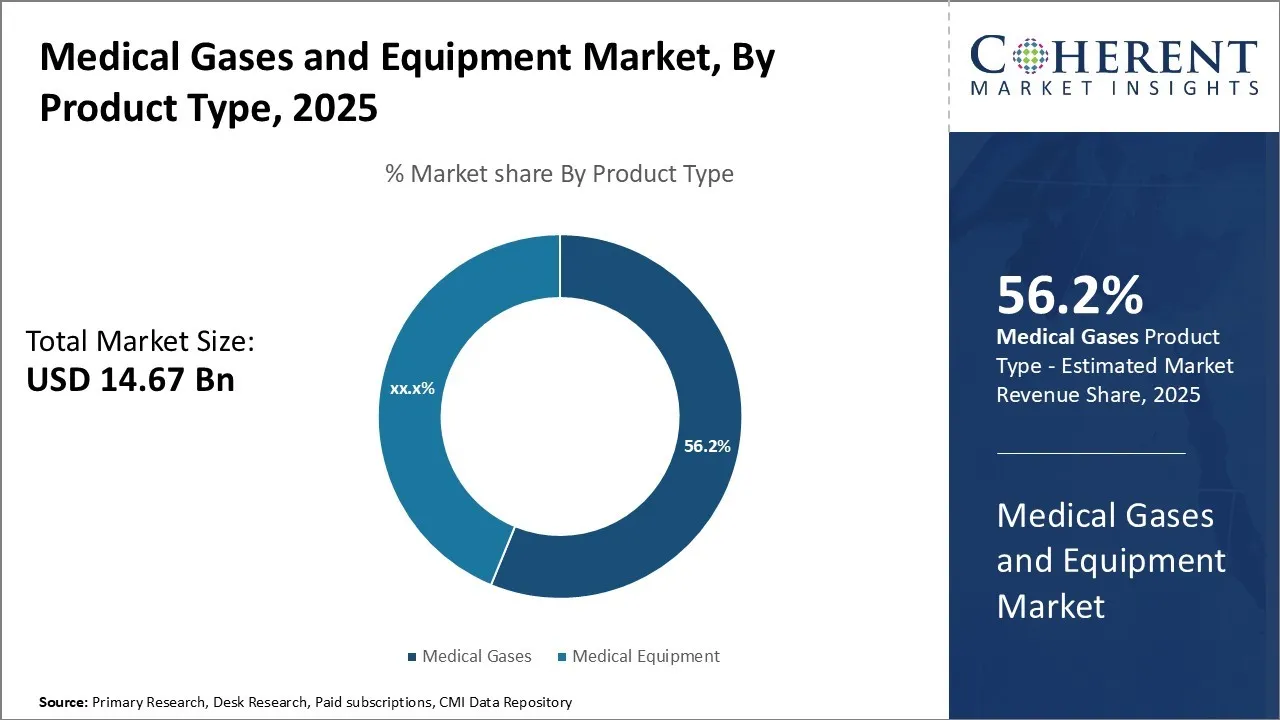
Global Medical Gases and Equipment Market Insights, By Product Type
Medical gases are projected to dominate the global medical gases and equipment market with a substantial 57.2% share in 2026. This leading position is driven by the rising demand for essential gases such as oxygen, nitrous oxide, and carbon dioxide across a range of healthcare applications, including respiratory therapy, anesthesia delivery, and emergency response.
The increasing prevalence of chronic respiratory disorders, the aging global population, and the growing volume of surgical procedures have significantly intensified the need for reliable and high-purity medical gases.
Moreover, technological advancements in gas delivery systems such as portable and mobile medical gases and equipment trolleys are improving accessibility and convenience in both clinical and homecare environments. These mobile solutions are especially critical in emergency care and operating rooms, where rapid and flexible access to medical gases is essential.
Combined with increased regulatory support for home-based care, these developments are contributing to consistent demand. Medical gases remain indispensable in acute care settings, ICUs, and homecare services, reinforcing their stronghold in the product type segment.
Global Medical Gases and Equipment Market - Cross Sectional Analysis
The market studies will be supported by the expansion of new product development, which is anticipated to fuel market expansion in Asia-Pacific region. For instance, in August 2020, Panasonic Corporation, an electronics company, developed an ultrasonic gas flow and concentration sensor for hydrogen that enables the real-time simultaneous measurement of the flow rate and concentration of hydrogen under a highly humid environment for the first time in the industry.
Global Medical Gases and Equipment Market – Regional Insights
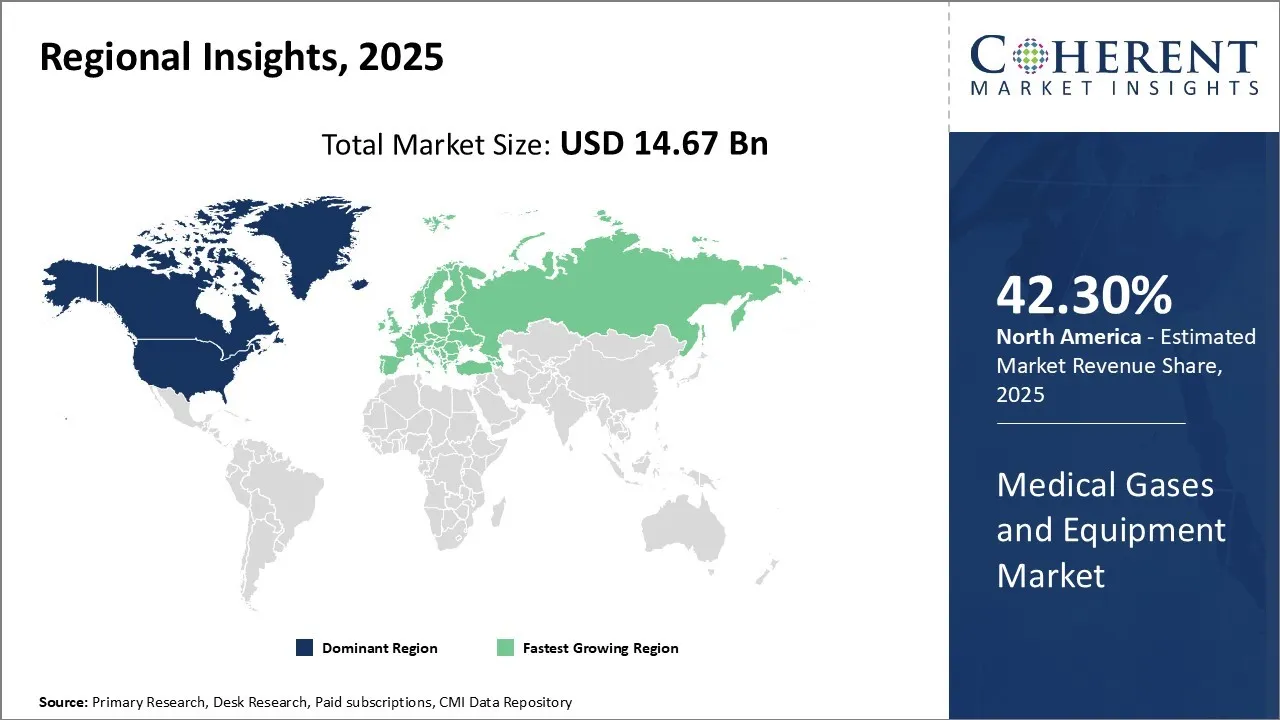
North America Medical Gases and Equipment Market Trends and Analysis
North America is expected to remain the dominant region in the global medical gases and equipment market, accounting for an estimated 42.30% market share in 2026. This regional dominance is underpinned by the robust healthcare infrastructure, high healthcare spending, and early adoption of advanced medical technologies.
The United States, in particular, hosts leading medical gas and equipment manufacturers such as Air Liquide Healthcare, Linde, and Praxair, who continue to innovate in gas delivery, storage, and monitoring systems.
Strict regulatory frameworks emphasizing patient safety, along with growing awareness of respiratory and critical care needs, further boost demand for medical gases across hospitals, surgical centres, and home healthcare settings. The rising incidence of chronic respiratory diseases, coupled with an aging population, is accelerating the use of oxygen therapy and other gas-based interventions.
Moreover, ongoing investments in smart gas monitoring systems and portable oxygen concentrators reflect the region's focus on efficient and patient-centric respiratory care. With a strong foundation in innovation, regulation, and clinical infrastructure, North America remains a vital hub for the growth of the medical gases and equipment market.
Medical Gases and Equipment Market Dominating Countries
United States and Canada
The United States is the undisputed leader in the global medical gases and equipment market, driven by its advanced healthcare infrastructure, substantial healthcare spending, and early adoption of cutting-edge medical technologies. The presence of key players such as Air Liquide Healthcare, Linde, and Praxair has positioned the U.S. as a centre of innovation in gas delivery, storage, and monitoring solutions.
High demand for oxygen therapy, anaesthesia delivery systems, and emergency medical gases especially in light of chronic respiratory illnesses and an aging population further solidifies its dominance.
Favourable regulatory frameworks and robust investment in portable oxygen concentrators and smart gas monitoring systems continue to drive growth and accessibility across both hospital and homecare settings. Additionally, the growing emphasis on climate-resistant medical gases and equipment ensures reliable performance under varying environmental conditions, which is increasingly critical during natural disasters, outdoor emergency deployments, and in regions with extreme weather patterns.
Canada complements the U.S. market with its publicly funded healthcare system that emphasizes universal access and preventive care. Increased investment in respiratory care services, especially in rural and remote communities, is fuelling the demand for medical gases and related equipment. Canada’s rising focus on telehealth, along with national initiatives to enhance in-home respiratory therapy, supports the growing role of medical gases in non-hospital environments.
The integration of climate-resistant solutions into medical gas infrastructure also enhances operational continuity and patient safety in Canada’s diverse climatic regions. Together, the U.S. and Canada represent the backbone of North America’s leadership in the global medical gases and equipment market, setting industry benchmarks in innovation, patient safety, and system integration.
Market Report Scope
Medical Gases and Equipment Market Report Coverage
| Report Coverage | Details | ||
|---|---|---|---|
| Base Year: | 2025 | Market Size in 2026: | USD 15.86 Bn |
| Historical Data for: | 2020 To 2024 | Forecast Period: | 2026 To 2033 |
| Forecast Period 2026 to 2033 CAGR: | 8.1% | 2033 Value Projection: | USD 27.35 Bn |
| Geographies covered: |
| ||
| Segments covered: |
| ||
| Companies covered: | Air Liquide S.A., Praxair, Inc. (The Linde Group), BeaconMedaes LLC, Air Products and Chemicals Inc., Medical Gas Solutions, Airgas Inc., and MATHESON Tri-Gas Inc. | ||
| Growth Drivers: |
| ||
| Restraints & Challenges: |
| ||
Analyst Viewpoint – Medical Gases and Equipment Market
The global medical gases and equipment market is poised for sustained growth, driven by the increasing burden of respiratory diseases, expanding surgical procedures, and a rising aging population. This decentralization trend is expected to unlock new revenue streams in homecare and ambulatory services.
Technological innovations such as IoT-enabled gas monitoring systems, on-site gas generation units, and precision flow meters are enhancing safety, efficiency, and compliance, making them highly attractive across hospital and long-term care settings. Analysts also highlight the role of favourable regulatory reforms and reimbursement policies, particularly in North America and parts of Europe, which continue to drive market penetration.
With increasing demand from both developed and emerging economies, the market is witnessing intensified competition and strategic consolidation. Long-term growth will depend on manufacturers’ ability to deliver cost-effective, patient-centric, and smart medical gas solutions.
Medical Gases and Equipment Market: Key Development
In June 2024, Messer Group GmbH announced the acquisition of Federal Helium System, including the Federal Helium Reserve, Cliffside Field. With the help of this acquisition both the organizations can ensure smooth operation of Helium System.
In June 2023, Nippon Gases announced the acquisition of most of the shares of Spanish medical equipment manufacturer Noxtec Development SL.
Market Segmentation
- Medical Gases and Equipment Market, By Product Type (Revenue, USD Bn, 2021 - 2033)
- Medical gases
- Pure Gases
- Gas Mixtures
- Medical equipment
- Manifolds
- Outlets
- Hose Assemblies and Valves
- Alarm Systems
- Cylinders and Accessories
- Flowmeters
- Regulators
- Medical Air Compressors
- Vacuum Systems
- Masks
- Medical gases
- Medical Gases and Equipment Market, By Region (Revenue, USD Bn, 2021 - 2033)
- North America
- U.S.
- Canada
- Latin America
- Brazil
- Argentina
- Mexico
- Rest of Latin America
- Europe
- Germany
- U.K.
- Spain
- France
- Italy
- Russia
- Rest of Europe
- Asia Pacific
- China
- India
- Japan
- Australia
- South Korea
- ASEAN
- Rest of Asia Pacific
- Middle East
- GCC Countries
- Israel
- Rest of Middle East
- Africa
- South Africa
- North Africa
- Central Africa
- North America
- Key Players Insights
- Air Liquide S.A
- Praxair, Inc.
- (The Linde Group)
- BeaconMedaes LLC
- Air Products and Chemicals Inc.
- Medical Gas Solutions
- Airgas Inc
- MATHESON Tri-Gas Inc.
Sources
The Stakeholders Consulted
- Respiratory therapists and ICU physicians
- Biomedical engineers and hospital equipment managers
- Manufacturers and suppliers of medical gases and equipment
- Home healthcare providers and oxygen therapy specialists
- Regulatory and compliance officers from healthcare institutions
- Government healthcare agencies and public health planners
- Distributors and procurement officers in hospitals and diagnostic centers
Databases Opened
- U.S. Food and Drug Administration (FDA) – Medical Device Database
- Centers for Medicare & Medicaid Services (CMS) – Durable Medical Equipment Utilization
- Ministry of Health and Family Welfare (India) – Health Infrastructure Statistics
- World Bank Open Data – Health System Indicators
Magazines & Trade Publications
- Medical Device and Diagnostic Industry (MD+DI)
- Medical Gas World
- HealthCare Business News
- DOTmed HealthCare Business Daily
- BioSpectrum – Medical Devices Section
Scientific and Industry Journals
- Journal of Clinical Monitoring and Computing
- Respiratory Care Journal
- Biomedical Engineering Online
- International Journal of Medical Engineering and Informatics
- Medical Gas Research
Newspapers & Media Outlets
- The Wall Street Journal – HealthTech & MedTech Section
- Bloomberg – Healthcare Devices & Innovations
- Reuters – Global Healthcare Market Trends
- The Economic Times – Health & Pharmaceuticals
- Business Standard – Medical Devices and Infrastructure
Associations and Regulatory Bodies
- U.S. Food and Drug Administration (FDA)
- European Medicines Agency (EMA)
- Medical Gas Association (UK)
- Compressed Gas Association (CGA)
- Indian Pharmacopoeia Commission (IPC)
- World Health Organization (WHO) – Medical Device Regulation and Guidance
Public Domain Sources
- U.S. Centers for Disease Control and Prevention (CDC) – Healthcare Facility Data
- European Commission – Health Technology and Safety Reports
- World Bank – Health Infrastructure Reports
- WHO – Essential Medical Devices and Oxygen Therapy Guidelines
- OECD Health Statistics Database
Proprietary Research Elements
- CMI Data Analytics Tool
- Proprietary CMI Repository of Market Data (covering past 8 years)
- CMI Expert Interviews and Transcripts (focused on respiratory care, medical gas supply, and healthcare equipment trends)
*Definition: Oxygen is a medical gas used for life support and during the treatment of diseases such as respiratory illnesses, carbon monoxide poisoning, and cardiovascular diseases. Liquid nitrogen is used in the treatment of cancer. In cryosurgery, the cold gas is used to remove tumors and skin lesions.
Get access to 250+ pages report
Every segment, forecast, competitor profile and data table behind the analysis above — available for instant download.
- ESOMAR Member
- ISO 9001:2015 Certified
- D-U-N-S Registered
- GDPR & CCPA Compliant
Missing comfort of reading report in your local language? Find your preferred language:
Transform your Strategy with Exclusive Trending Reports
Frequently Asked Questions
The Medical Gases and Equipment Market size is estimated to be valued at USD 15.86 Bn in 2026, and is expected to reach USD 27.35 Bn by 2033.
The CAGR of the global Market is projected to be 8.1% from 2026 to 2033.
Increasing supply of medical gases and equipment and increasing adoption of growth strategies is expected to drive the market growth.
Cylinders and accessories is the leading product type segment in the market.
Shortage of oxygen cylinders is expected to hinder the market over the forecast period.
The major players operating in the market are Air Liquide S.A., Praxair, Inc. (The Linde Group), BeaconMedaes LLC, Air Products and Chemicals Inc., Medical Gas Solutions, Airgas Inc., and MATHESON Tri-Gas Inc.
Medical air is a clean, dry, and controlled mixture of gases (mainly nitrogen and oxygen) used in healthcare, free from contaminants and moisture. Unlike ambient air, it's delivered through medical gas systems for respiratory therapy, anesthesia, and surgical tools.