

Oxygen Concentrators Market Analysis & Forecast: 2026-2033
Oxygen Concentrators Market size is estimated to be valued at USD 2.85 Bn in 2026 and is expected to reach USD 5.41 Bn in 2033, exhibiting a compound annual growth rate (CAGR) of 9.6% from 2026 to 2033.
Key Takeaways
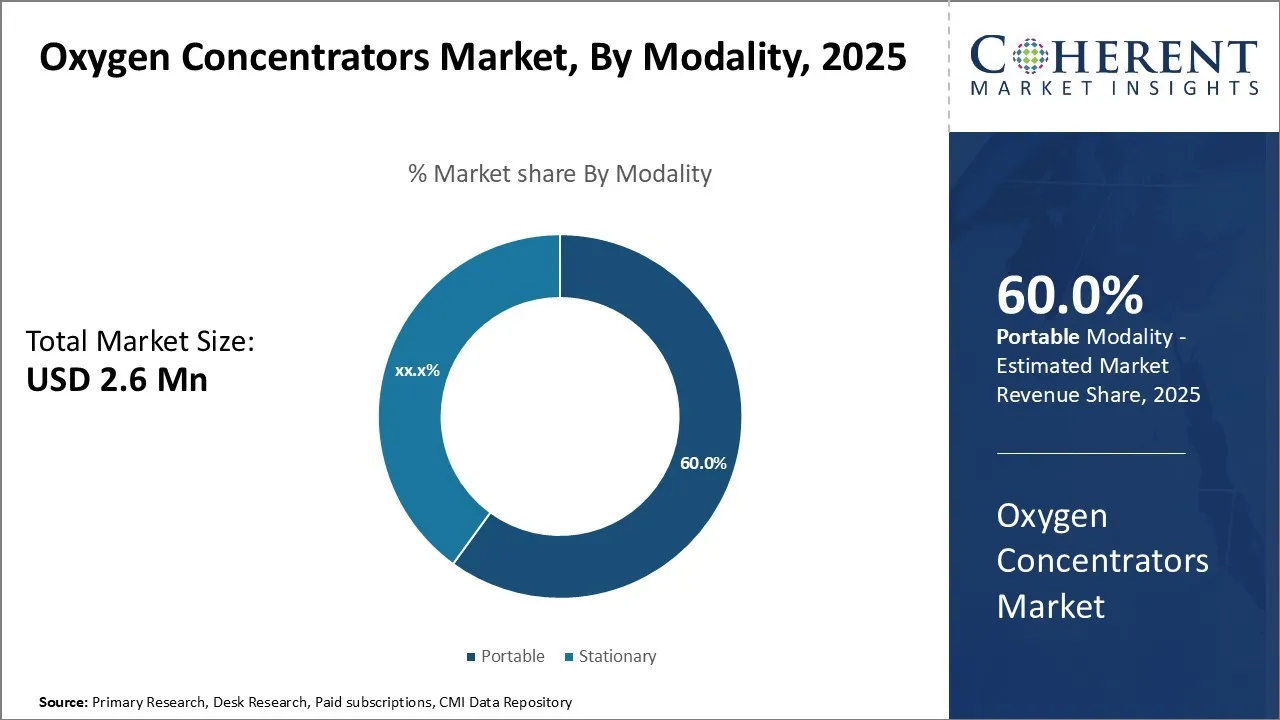
- By Modality, Portable oxygen concentrators are expected to dominate the market with 61% share in 2026, due to rising launches and favorability of mobile/at-home oxygen therapy solutions.
- By Region, North America is anticipated to account for approximately 33.5% of the market in 2026, supported by robust inorganic growth (e.g., acquisitions) and strong regulatory progress
Market Overview
Growth is driven by the rising prevalence of chronic respiratory diseases, increasing demand for portable and pulse-flow concentrators, and strong adoption in hospital and home-care settings. North America leads the market due to technological advances and strategic acquisitions, while Asia Pacific is the fastest-growing region. Key trends include smart, IoT-enabled devices and NGO-led innovations, though product recalls remain a notable challenge.
Current Events and Its Impact on the Oxygen Concentrators Market
Event | Description and Impact |
Aging Population Demographics and Respiratory Disease Surge (Macro-Level) |
|
Healthcare Digitalization and Technology Integration (Nano-Level) |
|
Global Supply Chain Semiconductor Shortages (Macro-Level) |
|
Oxygen Concentrators Market: Pipeline Analysis
The oxygen concentrators pipeline is expanding steadily, driven by advancements in portability, smart technology, and personalized therapy. In the near term (2025–2027), key players like Philips and Inogen are launching IoT-enabled portable models with remote monitoring, supporting the shift toward home-based care. AI-powered dosing systems are also entering advanced development stages, enabling real-time adjustment of oxygen flow based on patient vitals.
By 2028, membrane-based concentrators—noted for their lightweight and quiet performance—are expected to reach commercial readiness, alongside wearable designs like backpack units targeting mobile COPD users. Mid-stage projects are also exploring closed-loop oxygen delivery, integrating respiratory sensors to tailor therapy dynamically.
In preclinical development, companies are focusing on smart sensor-based platforms, combining SpO₂ tracking with machine learning to deliver adaptive care. Major trends include battery-efficient hardware, AI integration, and compact form factors for use beyond hospitals. Regulatory momentum—such as FDA clearances and CE fast-tracks—is accelerating innovation, positioning the market for a new generation of connected, intelligent oxygen systems.
- Current Industry Events of 2026
- Market Size Estimation
- Regional Breakdown
- Competitive Landscape
- Customer Intelligence
- Segmental Analysis
- Pricing Analysis
- Key Market Drivers, Challenges & Future Trends
- Customized Insights Section
Patent Landscape
The oxygen concentrators market value is supported by a dynamic and steadily expanding patent landscape, where over 70% of active patents are held by major industry leaders including Philips Respironics, Inogen, Invacare Corporation, CAIRE Inc., and Drive DeVilbiss Healthcare. Core areas of innovation include lightweight portable concentrator designs, pulse-dose and continuous-flow dual-mode systems, noise reduction mechanisms, and energy-efficient battery integration.
Recent patent filings emphasize advancements in IoT-enabled monitoring, AI-driven oxygen flow adjustment, and wearable concentrator configurations, highlighting the shift toward connected and personalized respiratory care therapy. Intellectual property around integrated sensor arrays and adaptive dosing algorithms is also gaining traction, reflecting industry focus on improving patient comfort and compliance.
Startups and research institutions are contributing with early-stage patents in membrane-based oxygen separation, solid-state concentrators, and multi-gas delivery systems, signalling future diversification in design platforms and clinical use cases.
The United States and China dominate global patent activity, followed by Japan and key European markets. This competitive patent environment supports ongoing innovation, strengthens market positions, and raises entry barriers for emerging players in the respiratory care sector.
Reimbursement Scenario
The global reimbursement landscape for oxygen concentrators is diverse and influenced by public health coverage, homecare policies, and device classification. In the U.S., reimbursement is structured through HCPCS codes (e.g., E1390 for stationary and E1392 for portable units), with Medicare Part B covering 80% of the approved cost for medically necessary use, subject to deductible. CMS applies a monthly capped rental model, typically reimbursing up to 36 months, followed by maintenance payments for continued use.
Private insurers like Cigna and Aetna follow similar models but may require prior authorization and documentation of arterial blood gas results or pulse oximetry. Reimbursement levels vary, often exceeding Medicare rates but with stricter utilization reviews.
In Europe, policies differ by country. The UK's NHS covers oxygen therapy under long-term condition support, with equipment provided through regional contracts. In Germany, reimbursement is regulated under statutory health insurance (GKV), based on therapeutic necessity certified by pulmonologists.
In Asia-Pacific, Japan covers oxygen therapy under the national insurance system with reimbursement tied to disease severity and oxygen flow rate. Australia funds oxygen concentrators under the State and Territory Programs, often with eligibility based on blood oxygen thresholds.
Prescribers’ Preference
Oxygen concentrators are a frontline therapy in managing chronic and acute respiratory conditions, with prescriber preferences shaped by disease severity, care setting, and patient mobility needs.
In chronic obstructive pulmonary disease (COPD), pulmonologists prefer portable oxygen concentrators (POCs) with pulse-dose delivery for ambulatory patients, enabling mobility and adherence to long-term oxygen therapy (LTOT). Oxygen concentrators for sports recovery typically involve stationary units with continuous flow, which help athletes enhance muscle repair and oxygenation during nighttime rest or after intense training sessions.
For interstitial lung disease (ILD) and pulmonary fibrosis, specialists prioritize high-flow units with reliable oxygen purity, often integrating backup battery systems to support uninterrupted therapy. Cardiologists managing congestive heart failure (CHF) in oxygen-dependent patients recommend concentrators with real-time oxygen saturation monitoring for personalized flow adjustment.
In pediatric care, clinicians opt for low-decibel, compact units that reduce noise sensitivity and support home-based therapy, especially in neonatal bronchopulmonary dysplasia cases. Emergency physicians prefer easily deployable, rapid-start concentrators in field triage and ambulance settings, especially where cylinder oxygen is unavailable.
Global Oxygen Concentrators Market– Drivers
- Increasing organic strategies such as regulatory authority milestone
Rising adoption of organic strategies, including key regulatory milestones, is expected to drive the latest oxygen concentrators market trends and fuel global growth throughout the forecast period. For instance, on January 10, 2023, Inogen, Inc., one of the medical technology companies offering innovative respiratory products for use in the homecare setting, announced that it had passed regulatory milestones in the U.S. and Europe to support its line of portable oxygen concentrator solutions.
Inogen acquired approval under the European Medical Device Regulation (EU MDR) from its notified authority, the British Standards Institution (BSI), in December 2022, allowing it to sell and market the Inogen One G4 and the improved Inogen One G5 portable oxygen concentrators in the EU.
- Increasing prevalence of chronic respiratory diseases
The increasing prevalence of chronic respiratory diseases is expected to increase the demand for oxygen concentrators, thereby driving the global oxygen concentrators market’s growth.
For instance, on April 25, 2023, the Institute of Health Metrics and Evaluation published data according to which the prevalence of chronic respiratory diseases in 2019 was 454.6 Billion cases globally. While the prevalence of chronic respiratory diseases has increased by 39.8% from 1990 to 2019. Hence, this is expected to fuel the oxygen concentrators markets growth over the forecast period.
Segmental Insights
Global Oxygen Concentrators Market Insights, By Modality
The market is segmented into portable and stationary. Within this, the portable segment is anticipated to drive significant oxygen concentrators market growth and maintain a dominant position globally throughout the forecast period, and this is attributed to the increasing launch of portable oxygen concentrators.
Global Oxygen Concentrators Market Insights, By Technology
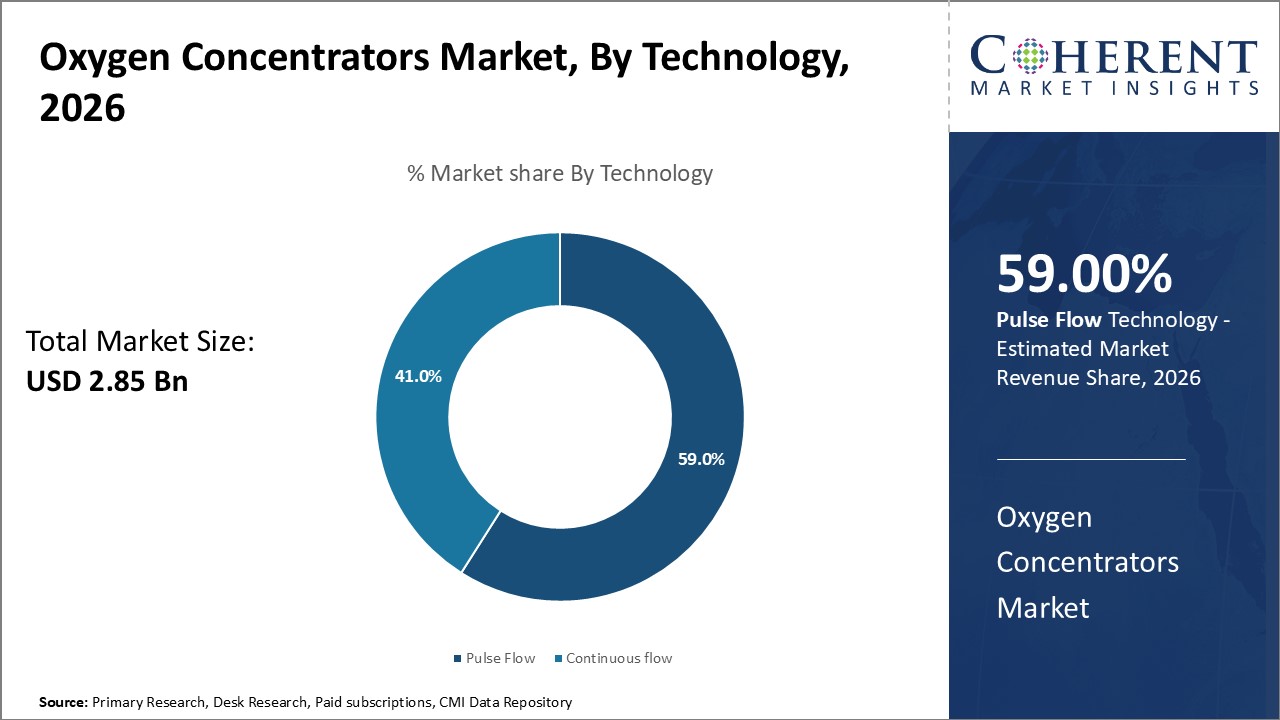
The market is segmented into pulse flow and continuous flow. Out of which, pulse flow is expected to dominate the market over the forecast period, and this is attributed to the introduction of pulse flow portable oxygen concentrators in the market.
Global Oxygen Concentrators Market Insights, By End User
The market is segmented into hospitals, home care, and ambulatory surgical centers. Out of which, hospital is expected to dominate the market over the forecast period, and this is attributed to the increasing number of installations of oxygen concentrators in hospitals.
Global Oxygen Concentrators Market – Regional Insights
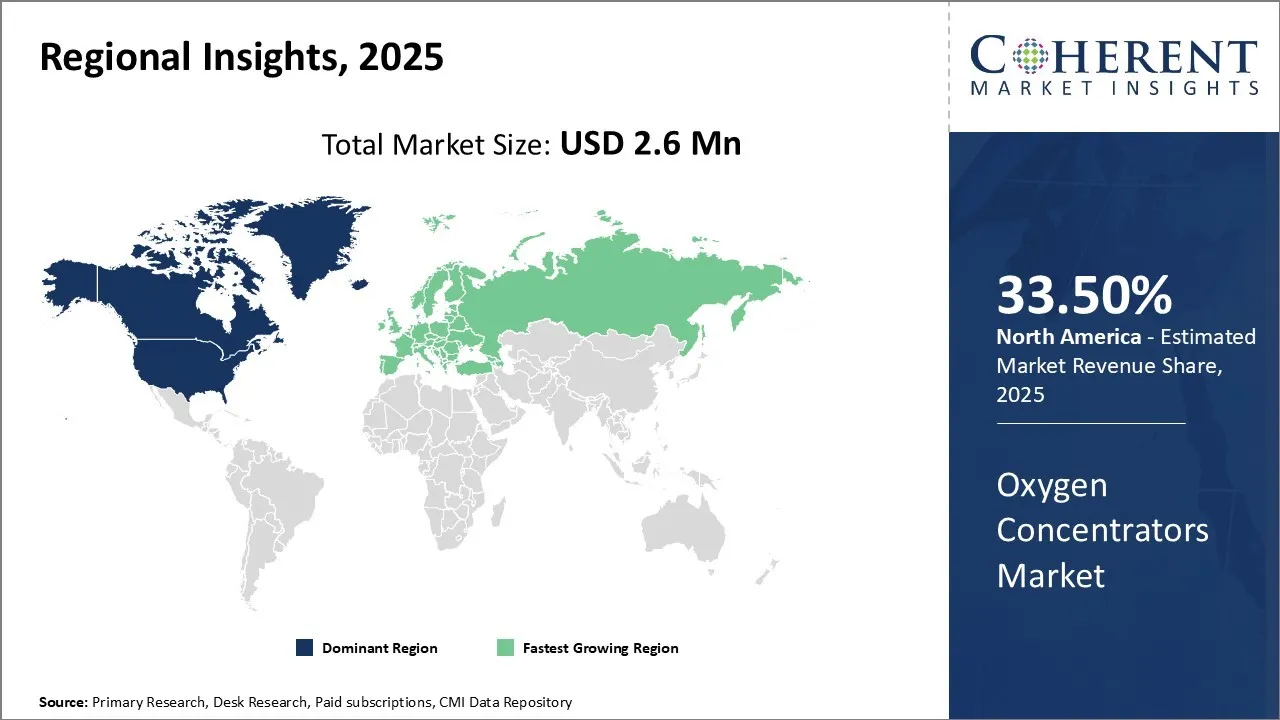
The oxygen concentrators market demand is expected to be highest in North America, which will hold a dominant position globally over the forecast period. North America is estimated to hold 33.50% of the market share in 2026.
The global oxygen concentrators market is expected to witness significant growth in the coming years, driven by increasing inorganic strategies such as acquisition by key players, which is contributing to the growth of the oxygen concentrators market in the North America region.
For instance, in May 2021, OxyGo LLC, one of the leaders in lightweight portable oxygen concentrators based in the U.S., announced that it had acquired LIFE Corporation, a manufacturer of medical devices that specializes in portable emergency oxygen and CPR administration equipment. This acquisition will help OxyGo LLC expand its oxygen expertise even further by providing the best products and services, thereby driving demand for oxygen concentrators in the U.S.
Asia Pacific is the fastest-growing region, supported by improved healthcare infrastructure in countries like China and India, and strategic partnerships expanding local supply chains.
Dominating Countries
- The oxygen concentrators market forecast indicates that the United States, within North America, is expected to lead globally, accounting for approximately 33.5% of the market share in 2023. This dominant position is driven by advanced healthcare infrastructure, strong regulatory support, and major industry activity like acquisitions—e.g., OxyGo LLC’s 2021 acquisition of LIFE Corporation.
- Canada, together with the U.S., reinforces North America’s leadership. The region’s dominance is sustained by high Medicare penetration of portable devices, continuous innovation, and favorable reimbursement policies.
Market Report Scope
Oxygen Concentrators Market Report Coverage
| Report Coverage | Details | ||
|---|---|---|---|
| Base Year: | 2025 | Market Size in 2026: | USD 2.85 Bn |
| Historical Data for: | 2020 To 2024 | Forecast Period: | 2026 To 2033 |
| Forecast Period 2026 to 2033 CAGR: | 9.6% | 2033 Value Projection: | USD 5.41 Bn |
| Geographies covered: |
| ||
| Segments covered: |
| ||
| Companies covered: | Inogen Inc., Invacare Corporation, OxygenToGo, LLC, Koninklijke Philips N.V., ResMed Inc., Drive DeVilbiss Healthcare LLC, Precision Medical, Inc., Besco Medical Co. Ltd., O2 Concepts, LLC, and GCE Group | ||
| Growth Drivers: |
| ||
| Restraints & Challenges: |
| ||
Global Oxygen Concentrators Market- Cross Sectional Analysis
Non-profit organizations are involved in various increasing inorganic strategies, such as partnerships to provide the portable oxygen concentrators, which is also expected to boost demand oxygen concentrators in Asia Pacific region. For instance, In June 2021, O2 Concepts, one of the leading manufacturers of oxygen concentrators, launched the Oxlife Independence portable oxygen concentrator. Known for its durability and reliability, it was designed to meet the needs of active users who require oxygen therapy while on the move.
Oxygen Concentrators Market: Key Developments
- In March 2025, Philips Respironics launched its next-generation portable oxygen concentrator, featuring enhanced battery life and integrated IoT capabilities for remote patient monitoring and telehealth support.
- In January 2025, Inogen introduced the Inogen One G5+, a lightweight, wearable oxygen concentrator with AI-driven oxygen flow adjustment for improved personalized therapy.
- In November 2024, CAIRE Inc. secured FDA clearance for its Elite 5 portable oxygen concentrator, incorporating membrane-based technology to reduce noise and enhance oxygen purity.
- In August 2023, Drive DeVilbiss Healthcare announced a partnership with a digital health startup to develop AI-powered oxygen delivery systems, aiming to optimize dosing through real-time sensor data analysis.
Analyst Viewpoint
- Innovations in IoT connectivity, AI-powered oxygen delivery optimization, and wearable concentrator designs are creating new opportunities for personalized respiratory care, improving patient compliance and monitoring capabilities. Expansion of telehealth services further supports remote management of respiratory conditions.
- Challenges include high upfront costs, regulatory hurdles, and supply chain constraints—particularly semiconductor shortages impacting device manufacturing. Additionally, reimbursement variability and limited awareness in emerging markets may slow adoption.
- North America remains the dominant market due to established healthcare infrastructure and reimbursement frameworks. Meanwhile, Asia-Pacific is poised as the fastest-growing region, fueled by rising respiratory disease burden, increasing healthcare expenditure, and growing access to portable oxygen technologies in developing economies.
Market Segmentation
- Global Medical Oxygen Concentrators Market, By Modality (Revenue, USD Bn, 2021 - 2033)
- Portable
- Stationary
- Global Medical Oxygen Concentrators Market, By Technology (Revenue, USD Bn, 2021 - 2033)
- Pulse Flow
- Continuous Flow
- Global Medical Oxygen Concentrators Market, By End User (Revenue, USD Bn, 2021 - 2033)
- Hospital
- Home Care
- Ambulatory Surgical Centers
- Global Medical Oxygen Concentrators Market, By Region (Revenue, USD Bn, 2021 - 2033)
- North America
- By Modality
- Portable
- Stationary
- By Technology
- Pulse Flow
- Continuous Flow
- By End User
- Hospital
- Home Care
- Ambulatory Surgical Centers
- By Country
- U.S.
- Canada
- By Modality
- Latin America
- By Modality
- Portable
- Stationary
- By Technology
- Pulse Flow
- Continuous Flow
- By End User
- Hospital
- Home Care
- Ambulatory Surgical Centers
- By Country
- Brazil
- Mexico
- Argentina
- Rest of Latin America
- By Modality
- Europe
- By Modality
- Portable
- Stationary
- By Technology
- Pulse Flow
- Continuous Flow
- By End User
- Hospital
- Home Care
- Ambulatory Surgical Centers
- By Country
- Germany
- U.K.
- France
- Italy
- Spain
- Russia
- Rest of Europe
- By Modality
- Asia Pacific
- By Modality
- Portable
- Stationary
- By Technology
- Pulse Flow
- Continuous Flow
- By End User
- Hospital
- Home Care
- Ambulatory Surgical Centers
- By Country
- China
- India
- Japan
- Australia
- South Korea
- ASEAN
- Rest of Asia Pacific
- By Modality
- Middle East
- By Modality
- Portable
- Stationary
- By Technology
- Pulse Flow
- Continuous Flow
- By End User
- Hospital
- Home Care
- Ambulatory Surgical Centers
- By Country
- GCC
- Israel
- Rest of Middle East
- By Modality
- Africa
- By Modality
- Portable
- Stationary
- By Technology
- Pulse Flow
- Continuous Flow
- By End User
- Hospital
- Home Care
- Ambulatory Surgical Centers
- By Region/Country
- South Africa
- Central Africa
- North Africa
- By Modality
- North America
- Company Profiles
- Inogen Inc.
- Invacare Corporation
- OxygenToGo, LLC
- Koninklijke Philips N.V.
- ResMed Inc.
- Drive DeVilbiss Healthcare LLC
- Precision Medical, Inc.
- Besco Medical Co. Ltd.
- O2 Concepts, LLC
- GCE Group
Sources
Primary Research Interviews
- Medical equipment manufacturers and suppliers
- Healthcare providers and hospital administrators
- Online medical equipment retailers and distributors
- Respiratory therapists and healthcare professionals
- Others
Databases
- Global Trade Atlas
- Healthcare Market Research Database
- Medical Device Registration Database
- FDA Medical Device Database
- Others
Magazines
- Medical Equipment & Technology Magazine
- Healthcare Business Magazine
- Respiratory Care Magazine
- Home Healthcare Today
- Others
Journals
- Journal of Medical Internet Research
- Respiratory Care Journal
- International Journal of Medical Devices
- Others
Newspapers
- Healthcare Finance News
- Medical Device Network
- Healthcare IT News
- Modern Healthcare
- Others
Associations
- American Association for Respiratory Care (AARC)
- Healthcare Technology Management Association (HTMA)
- Medical Equipment and Technology Association (META)
- Home Medical Equipment Trade Association (HME)
- Others
Public Domain Sources
- World Health Organization (WHO) publications
- FDA regulatory filings and approvals
- Centers for Medicare & Medicaid Services (CMS) data
- National Institute of Health (NIH) research publications
- Others
Proprietary Elements
- CMI Data Analytics Tool
- Proprietary CMI Existing Repository of information for last 8 years
*Definition: An oxygen concentrator is a medical device designed to extract and concentrate oxygen from the surrounding air. It provides a continuous and reliable source of oxygen for individuals who have low oxygen levels in their blood, typically due to respiratory conditions like chronic obstructive pulmonary disease (COPD), asthma, or other chronic lung disorders.
Get access to 250+ pages report
Every segment, forecast, competitor profile and data table behind the analysis above — available for instant download.
- ESOMAR Member
- ISO 9001:2015 Certified
- D-U-N-S Registered
- GDPR & CCPA Compliant
Missing comfort of reading report in your local language? Find your preferred language:
Transform your Strategy with Exclusive Trending Reports
Frequently Asked Questions
The Oxygen Concentrators Market size is estimated to be valued at USD 2.85 Bn in 2026, and is expected to reach USD 5.41 Bn by 2033.
The CAGR of the global Market is projected to be 9.6% from 2026 to 2033.
Increasing prevalence of chronic respiratory diseases and organic strategies such as regulatory authority milestones are expected to drive the market’s growth.
Portable oxygen concentrators is the leading modality segment in the market.
Yes, Medicare Part B covers the rental of oxygen concentrators when prescribed by a doctor for home use. After meeting the annual deductible, Medicare typically pays 80% of the rental cost, with the beneficiary responsible for the remaining 20%.
Product recalls of oxygen concentrators are expected to hinder the market over the forecast period.
North America and Europe are currently leading the oxygen concentrators market due to advanced healthcare infrastructure, high prevalence of respiratory diseases, and strong adoption of home healthcare technologies.