

Tip Location Devices Market Size and Share Analysis - 2026 To 2033
The tip location devices market is anticipated to grow at a CAGR of 8.8% with USD 2.7 Bn in 2026 and is expected to reach USD 4.5 Bn in 2033. This growth is attributed to the high prevalence of cardiovascular diseases globally (20.5 million in 2025), necessitating more accurate and efficient methods for catheter and guidewire placement during interventional procedures.
Key Takeaways
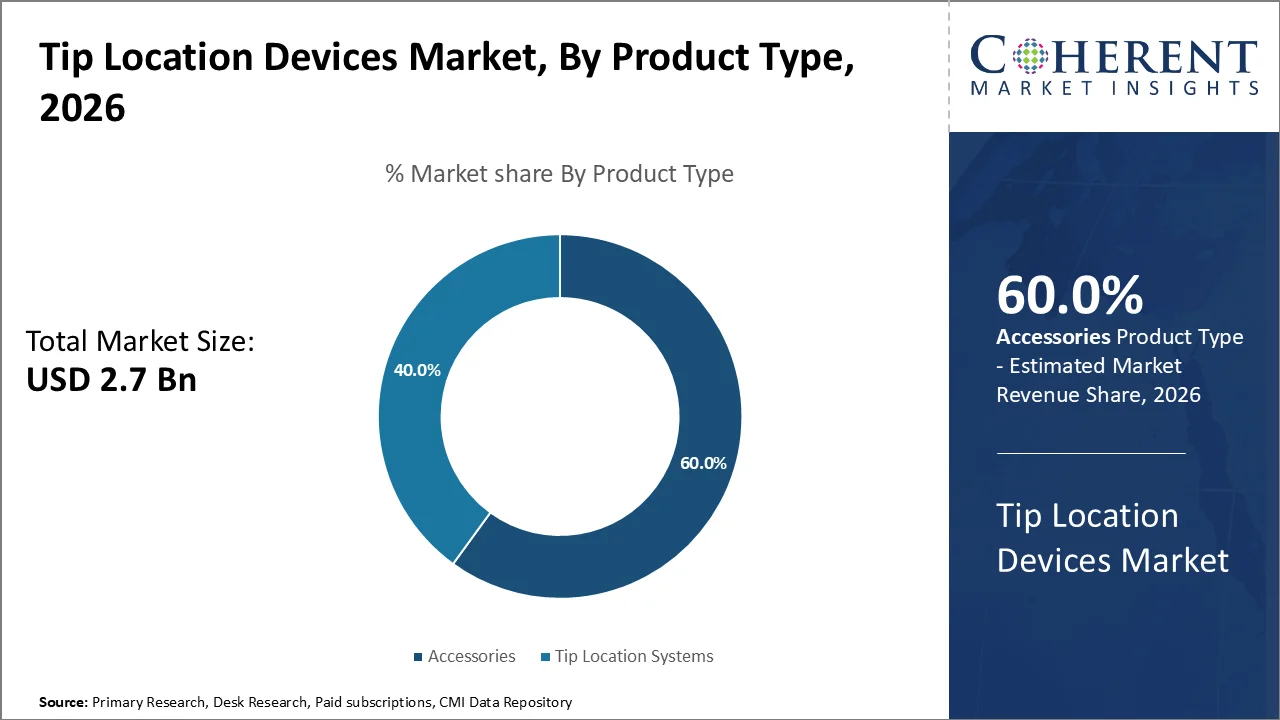
- Accessories (ECG CABLES, ECG CLIP CABLES, ECG LEAD SET) is expected to account the largest share of 60% in 2026, because they are used continuously in hospitals, clinics, and patient monitoring. NCHS hospital surveys indicate that nearly all hospitals (over 95%) maintain ECG monitoring capabilities
- Based on end user, hospitals will dominate with 65% in 2026, hospitals perform the majority of cardiovascular and cardiac monitoring procedures. According to the American Heart Association (AHA) 2024 heart disease and Stroke Statistics, over 70% of invasive cardiac procedures (like catheterizations and device implantations) are performed in hospitals
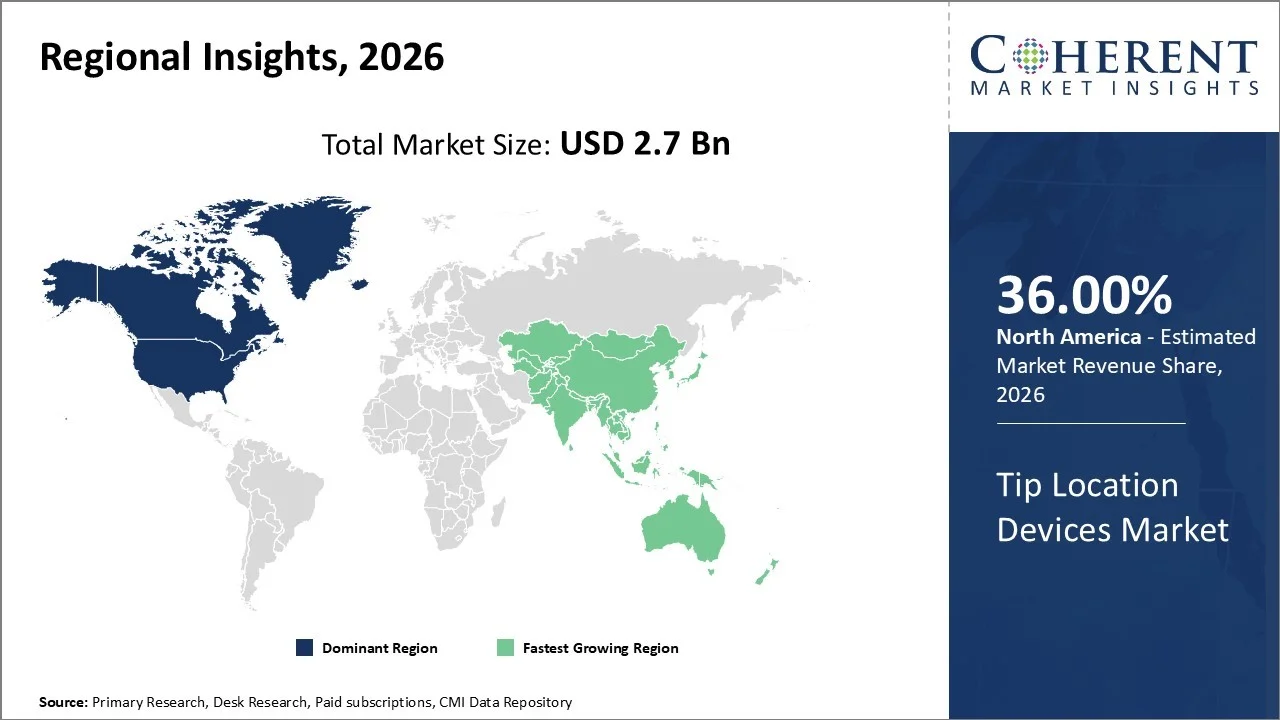
- North America is expected to acquire the dominant share of 36% in 2026, Heart failure causes 1–3 million hospital admissions annually in the U.S., and tip location devices are enabling safer catheter-based procedures.
Segmental Insights
Why is Accessories Segment Acquiring the Largest Market Share?
Accessories are projected to account for the largest share of product type in 2026, representing approximately 60% of the total volume. The dominance of accessories stems from the fundamental operational reality that these components experience regular wear and tear due to consistent patient contact, sterilization procedures, as well as intensive daily utilization in clinical setups.
Healthcare facilities are compelled to alter these accessories frequently to comply with infection control protocols established by the World Health Organization (WHO) and Centers for Disease Control and Prevention (CDC), which recommend regular replacement of patient-contact components to prevent healthcare-associated infections.
In July 2025, AliveCor l launched the Kardia 12L ECG system in India, describing it as the world’s first AI-powered handheld 12-lead ECG with a single-cable design. The CDSCO-approved device can identify 35 cardiac determinations, including acute myocardial infarction, ischemia, as well as multiple arrhythmias, and was placed as a way to expand access to accurate heart data across a broad range of healthcare settings.
- Current Industry Events of 2026
- Market Size Estimation
- Regional Breakdown
- Competitive Landscape
- Customer Intelligence
- Segmental Analysis
- Pricing Analysis
- Key Market Drivers, Challenges & Future Trends
- Customized Insights Section
Hospitals hold the Largest Market Share
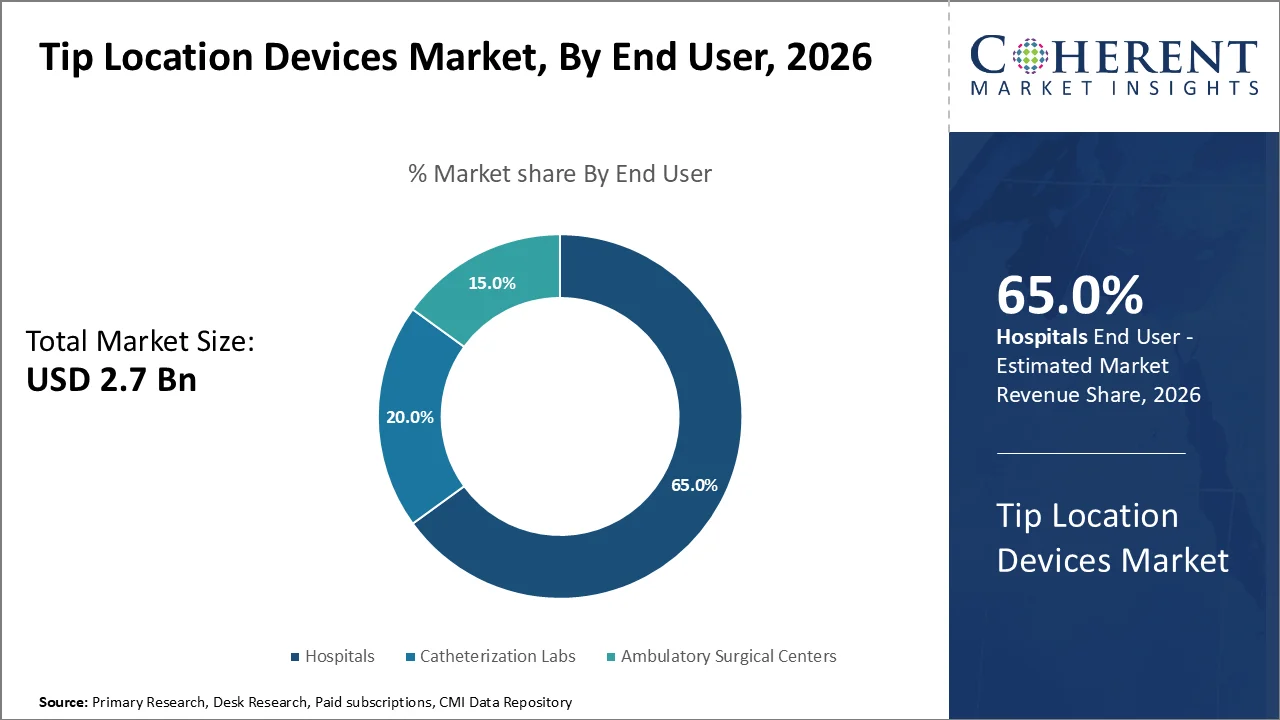
Based on end user, hospitals dominate the market, accounting for a significant 65% in 2026, owing to their better infrastructure, multifaceted patient care services, as well as higher volume of invasive procedures requiring precise catheter tip placement. Hospitals serve as the primary point of care for a broad spectrum of critical, acute, and chronic conditions, necessitating a broad range of catheter-based interventions. Heart failure is the primary or secondary diagnosis for one to three million hospital admissions each year, accounting for up to 2% of the total healthcare budget. By 2030, more than eight million people (one in 33) will have heart failure.
Tertiary care hospitals and academic medical centers often perform complex procedures involving central venous catheterization, peripherally inserted central catheters (PICCs), and other intravascular interventions that rely heavily on reliable tip location technologies. The necessity for real-time, precise catheter placement in these settings is essential to improving patient safety, minimizing infection risk, and enhancing clinical outcomes.
Electromagnetic (EM) Technology is transforming the Tip Location Devices Industry
Electromagnetic tip location systems utilize magnetic fields and sensors to track catheter placement in real-time without radiation exposure. Major players such as, Vygon SA, Teleflex Incorporated, C.R. Bard (BD), have adopted these technologies. Mayo Clinic implemented BD's Sherlock 3CG system across multiple facilities, reporting a 95% success rate in proper tip placement
In October 2025, BD (Becton, Dickinson and Company) India has announced the national launch of its advanced Sherlock 3CG+ system through a four-city roadshow held in Delhi, Mumbai, Chennai, and Kolkata. The innovation is set to transform PICC (Peripherally Inserted Central Catheter) placement procedures across India, making them faster, safer, and more comfortable for patients.
Electrocardiogram (ECG) Guidance Technology: A major breakthrough in Tip Location Devices
ECG-based tip location utilizes intracavitary electrocardiography to identify characteristic P-wave changes as the catheter tip approaches the sinoatrial node. AngioDynamics introduced the BioFlo PICC with ECG guidance to locate characteristic P-wave changes. Massachusetts General Hospital executed overall ECG-guided PICC placement, achieving 98% first-attempt success rates. Kaiser Permanente integrated ECG technology system-wide, helping over 12 million patients.
Current Events and Their Impact on the Tip Location Devices Market (regulatory shifts, government policies)
Current Event | Description and its Impact |
FDA Issues Updated Guidance on Central Venous Catheter Placement (2025) |
|
European Union MDR Rules for Cardiovascular Devices (2026) |
|
Regional Insights
North America dominates owing to advanced healthcare infrastructure
North America accounts for 36% market share in 2026, driven by advanced healthcare infrastructure, cutting-edge technological adoption, as well as the presence of major medical device manufacturers and research institutions. According to the Becker’s Healthcare, AdventHealth Heart, Lung and Vascular Institute annually performs approximately 70,000 cardiovascular, electrophysiology, and catheterization lab procedures, as well as more than 2,600 vascular surgeries.
In the United States and Canada, healthcare providers prioritize improving accuracy as well as efficiency in surgical procedures, which majorly drives demand for sophisticated tip location devices. Moreover, North America’s healthcare systems target minimally invasive procedures, where precision in catheter placement is crucial for patient safety as well as the success of the procedure. This has spurred high integration of electromagnetic and ultrasound-based tip location technologies.
Asia Pacific Tip Location Devices Market Trends
The Asia-Pacific region is poised to be the fastest-growing region through 2026-2033, expanding at a CAGR of approximately 11.5%. Because of prominent factories, better use of advanced medical technology, as well as efforts by government authorities to improve healthcare, countries like China, Japan, South Korea, India, etc., are using tip location devices more in hospitals. These devices are especially important in heart care, critical care, etc., where placing central venous catheters needs accuracy and real-time monitoring.
Bhutan government authorities provide free universal healthcare, integrating traditional and modern medicine through a three-tier system, with 90% of the population living within 2 hours of a health facility.
Advanced Healthcare is Accelerating the Tip Location Devices Market Demand in United States
The U.S. contributes the highest share in the market in North America owing to its advanced healthcare infrastructure, extensive network of hospitals, as well as high investment in medical technology innovation. The United States has over 6,090 hospitals, and big medical centers often use the latest surgical technologies, including advanced tip location devices.
The country's robust regulatory framework established by the FDA, which has streamlined approval processes for medical devices along with maintaining stringent safety standards. For example, the FDA's 510(k) clearance pathway has supported faster market entry for innovative tip location systems, enabling manufacturers to introduce next-generation electromagnetic as well as ultrasound-guided devices.
Japan Tip Location Devices Market Trends
Japan contributes the highest share in the tip location devices market owing to its sophisticated healthcare infrastructure, advanced medical device regulatory framework, as well as widespread adoption of cutting-edge medical technologies across its extensive network of hospitals and medical facilities. Japan's leadership position is fundamentally anchored in its robust healthcare system that serves an aging population of approximately 125 million people, with nearly 30% being over 65 years old according to Japan's Ministry of Health, Labour and Welfare. The Japan Association for Clinical Engineers reports that over 85% of tertiary care hospitals in Japan utilize some form of tip location technology, significantly higher than regional averages.
Who are the Major Companies in Tip Location Devices Industry
Some of the major key players in Teleflex Incorporated, AngioDynamics Inc., Becton, Dickinson and Company, Vygon S.A., and CORPAK MedSystems
Key News
- In April 2026, DeepSight Technology, a company making advanced imaging tools for procedures, is showing its NeedleVue™ platform at the SIR 2026 meeting in Toronto. NeedleVue™ helps doctors place needles and catheters more accurately. The system works on its own, with other machines, or with any ultrasound. By improving precision, it supports safer and faster bedside procedures, which is helping the growth of the tip location devices market.
Market Report Scope
Tip Location Devices Market Report Coverage
| Report Coverage | Details | ||
|---|---|---|---|
| Base Year: | 2025 | Market Size in 2026: | USD 2.7 Bn |
| Historical Data for: | 2020 To 2024 | Forecast Period: | 2026 To 2033 |
| Forecast Period 2026 to 2033 CAGR: | 8.8% | 2033 Value Projection: | USD 4.5 Bn |
| Geographies covered: |
| ||
| Segments covered: |
| ||
| Companies covered: | Teleflex Incorporated, AngioDynamics Inc., Becton, Dickinson and Company, Vygon S.A., and CORPAK MedSystems | ||
| Growth Drivers: |
| ||
| Restraints & Challenges: |
| ||
Analyst Opinion
- The Tip Location Devices market is increasingly being propelled by the shift toward portable, bedside, and AI-enabled catheter placement technologies. Hospitals and outpatient centers are recognizing that reliance on imaging departments for every catheter insertion is inefficient and resource-intensive.
- Innovations such as handheld ECG-integrated tip location systems and real-time EM-guided devices have dramatically improved procedural accuracy, making it possible to reduce complications, cut procedure time, and enhance patient throughput. Companies like Teleflex and C. R. Bard (BD) have launched next-generation bedside solutions in 2025 that underscore this trend.
- The rising awareness of infection control, combined with regulatory encouragement for single-use and precision placement technologies, is making tip location systems a must-have device rather than a luxury, driving adoption even in mid-tier healthcare facilities.
Speak to the analyst
Want personalized insights?
Take the findings above to one of our principal consultants, or have the report rebuilt around the segments, geographies and competitors you actually track.
Market Segmentation
- By Product Type
- Tip Location Systems
- Accessories
- ECG Cables
- ECG Clip Cables
- ECG Lead Set
- By End User
- Hospitals
- Ambulatory Surgical Centers (ASCs)
- Catheterization Labs
- By Region
- North America
- U.S.
- Canada
- Latin America
- Brazil
- Mexico
- Argentina
- Rest of Latin America
- Europe
- Germany
- U.K.
- France
- Italy
- Spain
- Russia
- Rest of Europe
- Asia Pacific
- China
- India
- Japan
- Australia
- South Korea
- ASEAN
- Rest of Asia Pacific
- Middle East
- GCC
- Israel
- Rest of Middle East
- Africa
- South Africa
- Central Africa
- North Africa
- North America
Sources
Primary Research Interviews
- Medical Device Manufacturers & OEMs
- Healthcare Providers & Hospital Administrators
- Interventional Cardiologists & Radiologists
- Medical Technology Distributors
- Others
Databases
- Euromonitor International
- IBISWorld Industry Reports
- Others
Magazines
- Medical Device & Diagnostic Industry (MD+DI)
- Cardiovascular Business Magazine
- Healthcare IT News
- Medical Economics Magazine
- Others
Journals
- Journal of Medical Internet Research
- IEEE Transactions on Biomedical Engineering
- Journal of Healthcare Engineering
- Others
Newspapers
- Healthcare Finance News
- Modern Healthcare
- FierceBiotech
- MedTech Dive
- Others
Associations
- Advanced Medical Technology Association (AdvaMed)
- Medical Device Manufacturers Association (MDMA)
- Society of Cardiovascular Angiography and Interventions (SCAI)
- International Society for Medical Innovation & Technology (iSMIT)
- Others
Public Domain Sources
- U.S. Food and Drug Administration (FDA) 510(k) Database
- European Medicines Agency (EMA) Medical Device Database
- World Health Organization (WHO) Medical Device Reports
- Centers for Medicare & Medicaid Services (CMS) Coverage Database
- Others
Proprietary Elements
- CMI Data Analytics Tool
- Proprietary CMI Existing Repository of information for last 10 years
Get access to 250+ pages report
Every segment, forecast, competitor profile and data table behind the analysis above — available for instant download.
- ESOMAR Member
- ISO 9001:2015 Certified
- D-U-N-S Registered
- GDPR & CCPA Compliant
Missing comfort of reading report in your local language? Find your preferred language:
Transform your Strategy with Exclusive Trending Reports
Frequently Asked Questions
The tip location devices market is expected to reach USD 4.5 Bn in 2033.
Major players operating in the global tip location devices market include Teleflex Incorporated, AngioDynamics Inc., Becton, Dickinson and Company, Vygon S.A., and CORPAK MedSystems
Stringent regulatory approval processes and compliance requirements is the major factor that is expected to hamper growth of the market over the forecast period.
Increasing prevalence of chronic diseases requiring frequent medical procedures is one of the major factors that is expected to propel growth of the market over the forecast period.
The tip location devices market is anticipated to grow at a CAGR of 8.8% between 2026 and 2033.
Among regions, North America is expected to account for a largest market share in the global tip location devices market over the forecast period.
Traditionally, catheter placement was confirmed via chest radiography; however, emerging evidence supports the use of ultrasound-based methods and ancillary tests.