

Digital Mobile X Ray Devices Market Analysis & Forecast: 2026-2033
Digital Mobile X Ray Devices Market is estimated to be valued at USD 4,539.8 Mn in 2026 and is expected to reach USD 7,531.8 Mn in 2033, exhibiting a compound annual growth rate (CAGR) of 7.5% from 2026 to 2033.
Key Takeaways
- By Product Type, The Mobile Devices Segment is projected to dominate the global digital mobile X-ray device market in 2026, holding approximately 68.0% market share due to the increasing demand for portable diagnostic solutions in emergency care, intensive care units, and remote medical settings.
- By Region, North America is expected to lead the global digital mobile X-ray device market with around 32.40% market share in 2026, driven by advanced healthcare infrastructure, high adoption of digital imaging technologies, and strong presence of key market players.
Market Overview
The Global Digital Mobile X-Ray Devices Market is showcasing promising growth as several companies are launching breakthrough and affordable products, thus making the market more competitive. For instance, in December 2022, Innolux, a subsidiary of InnoCare Optoelectronics, stated that the company has been developing digital X-ray flat panel detectors for many years and proactively venturing into smart and precision healthcare. InnoCare will combine AI-assisted diagnosis and digital X-ray detection applications with healthcare to showcase a series of software and hardware integrated solutions for smart and precision healthcare that are accurate and reliable. This includes solutions for human healthcare, mobile healthcare, and pet healthcare, thereby strengthening the implementation of application requirements.
Current Events and Its Impact on the Global Digital Mobile X-Ray Devices Market
Event | Description and Impact |
Semiconductor Supply Chain Disruptions and Component Shortages |
|
Regulatory Evolution in Medical Device Approval and AI Integration |
|
Geopolitical Tensions and Trade Policy Shifts |
|
Pipeline Analysis
The Digital Mobile X-Ray Devices Market is witnessing active development across several specialized segments, including pediatric imaging, chest scans, and use by NGOs and disaster relief teams. Leading manufacturers are focusing on enhancing device portability and battery efficiency, with many innovations centered on digital mobile X-ray devices by rechargeable battery technology, ensuring extended operational time during field use.
Emerging products in the pipeline emphasize rugged designs with longer warranty periods, meeting the demands of challenging environments such as remote clinics and emergency disaster zones. Devices tailored for pediatric imaging incorporate low-dose radiation features, addressing safety concerns for vulnerable populations.
Regulatory approvals (e.g., FDA 510(k)) are ongoing for several next-generation mobile X-ray systems featuring AI-assisted diagnostics and wireless data transfer capabilities. Market entry for these devices is expected within the next 1-2 years, with strong adoption prospects in healthcare NGOs and disaster relief organizations, where rapid bedside diagnostics are critical.
Unlike pharmaceutical pipelines that involve drug compounds and clinical trial phases, digital mobile X-ray devices follow distinct medical device approval pathways focused on safety, efficacy, and technological innovation.
- Current Industry Events of 2026
- Market Size Estimation
- Regional Breakdown
- Competitive Landscape
- Customer Intelligence
- Segmental Analysis
- Pricing Analysis
- Key Market Drivers, Challenges & Future Trends
- Customized Insights Section
Patent Landscape
The market for Digital Mobile X-Ray Devices continues to evolve with respect to device efficiency, ease of use, and image accuracy due to an emerging competitive focus on patent registration. Most recent patent applications seek improvements in device ergonomics for better handling within clinical environments, AI capabilities for automated image interpretation, and image-analysis algorithms for less radiation exposure.
Notable patents relating to exposure control in x-ray machines for mobile use, lightweight frame structures for ease of transport, and battery optimization for extended use added in 2021-2024. Canon Medical, Siemens Healthineers, and GE HealthCare are the biggest patent holders, gaining market advantage through use of proprietary technologies for enhancement of image transfer without cables and wireless interconnection of real-time imaging systems.
There is also an increased patenting activity for specialized x-ray systems such as pediatrics and mobile chest scan units for underserved markets. Other innovations focus on enhancement of device resistance to physical damage, a persistently challenging reliability of operation for use by disaster relief teams and NGOs operating in constrained resources environments. Altogether, this patent activity and the constantly evolving technology demonstrate investment aimed at meeting growing healthcare needs around the world.
Reimbursement Scenario
In the US, reimbursement uses CPT codes (Chest x-ray: 71045, Extremities: 73060) and HCPCS Q0092 for portable X-ray setup. Medicare reimbursements for portable chest X-rays stand at approximately $42.67 (facility rate), with a 15-25% higher reimbursement compared to traditional facility-based procedures. Medicaid reimbursement varies by state, averaging 60-70% of Medicare rates but often needing prior authorization. In the EU, Germany and the UK also have national coding systems G-DRG and OPCS-4; reimbursing € 45-85 and £ 35-65 per procedure respectively, based on type of examination. The Asia Pacific region still abides by country-specific reimbursement frameworks. A Japan example pays for digital and portable radiography between ¥1,200-2,400. Oversight bodies such as CMS in the US, EMA in Europe and MHLW in Japan approve devices and make coverage determinations, impacting reimbursement and access to market. Subsidized reimbursement policies impact the growth of mobile X-ray adoption globally, especially portable and bedside imaging where adoption is easy and cost-effective.
Prescribers’ Preference
Mobile X-ray Technology is now a necessity in everyday clinical work because it sends and receives images during diagnoses in real time at the point of need to facilitate prompt care in many healthcare facilities. Their adoption into management protocols makes a significant difference in fire, Intensive Care Unit (ICU), and distant locations with restricted patient movement. In respiratory care, mobile X-ray devices are popular because they enable prompt imaging and assessment of pneumonia, pneumothorax, and pleural effusions at advanced stages.
Such devices support the initial treatment with antibiotics (Azithromycin, Ceftriaxone) and bronchodilators, enabling changes to be made quickly based on imaging. At more advanced stages, mobile X-rays help escalate to second-line treatment using stronger antibiotics and immunosuppressants. In the management of cardiovascular diseases and mobile X-rays, have been helpful in the determination of cardiac silhouette and pulmonary edema; these are critical for the adjustment of some medications like diuretics, ACE inhibitors, and beta-blockers. In addition, mobile X-ray monitors patients who are on powerful medication regimens that include inotropes, vasopressors, and anticoagulants.
Overall, mobile X-ray technology is the most preferred and prioritized because of its digital capabilities that enable instant access to images during all stages of illness and treatment and during all stages and areas of therapeutics.
Segmental Insights
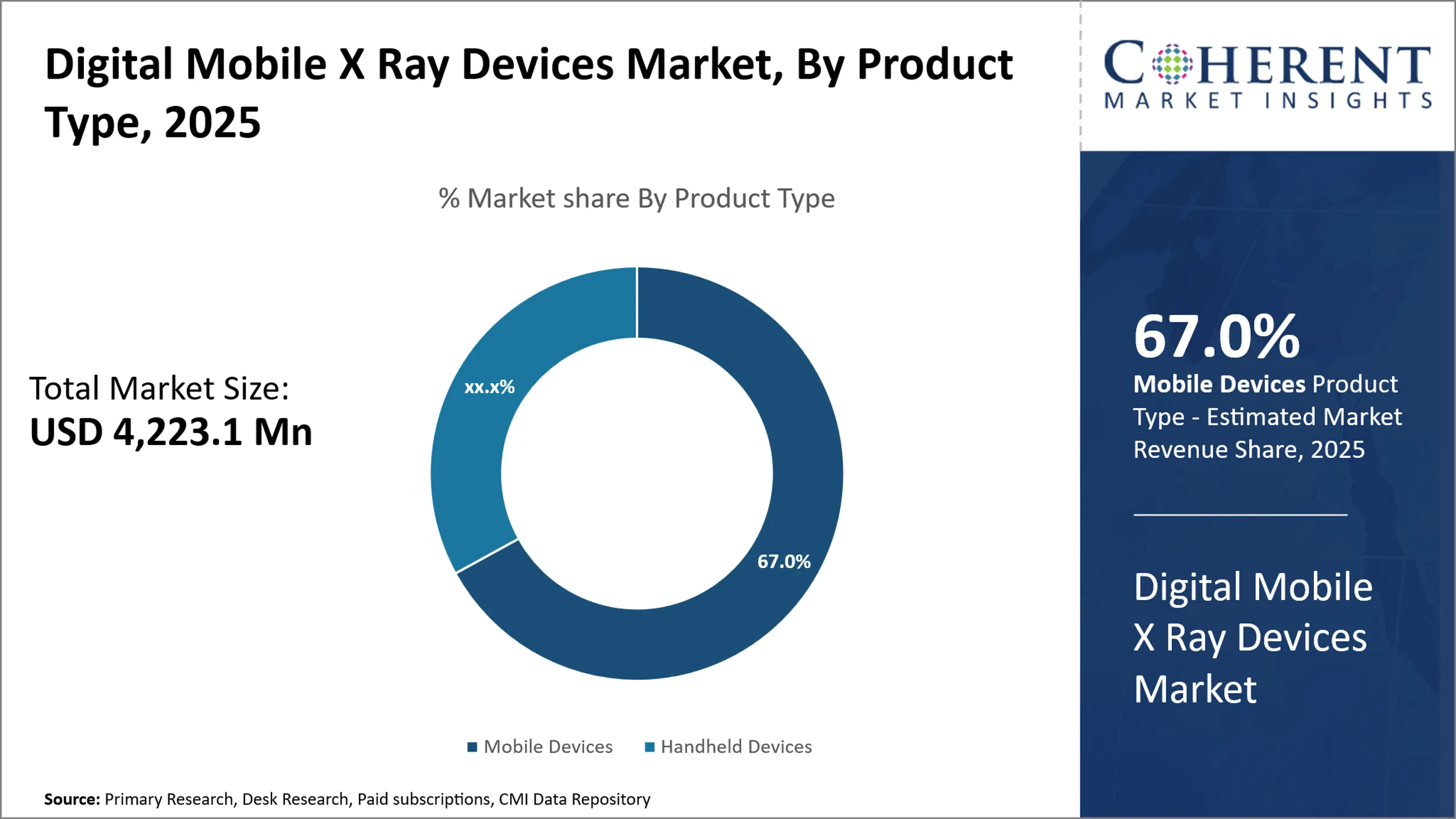
Digital Mobile X-Ray Device Market Insights, By Product Type
The mobile devices segment is expected to dominate the global digital mobile X-ray device market, holding the largest share of 68.0% in 2026. This growth is driven by the increasing demand for fast, efficient, and bedside diagnostic imaging across hospitals and emergency care units.
Mobile X-ray systems eliminate the need for traditional X-ray cassettes and reduce labor by enabling imaging to be performed directly at the patient’s bedside, improving workflow and patient outcomes. The surge in smartphone penetration worldwide has also enhanced the adaptability and functionality of mobile X-ray systems, further supporting their widespread adoption.
In contrast, the handheld devices segment continues to gain traction in decentralized settings, such as home care, dental clinics, and remote healthcare facilities. While currently a smaller portion of the market, the segment is benefiting from innovations in lightweight, portable technologies designed for rapid diagnostics in compact environments.
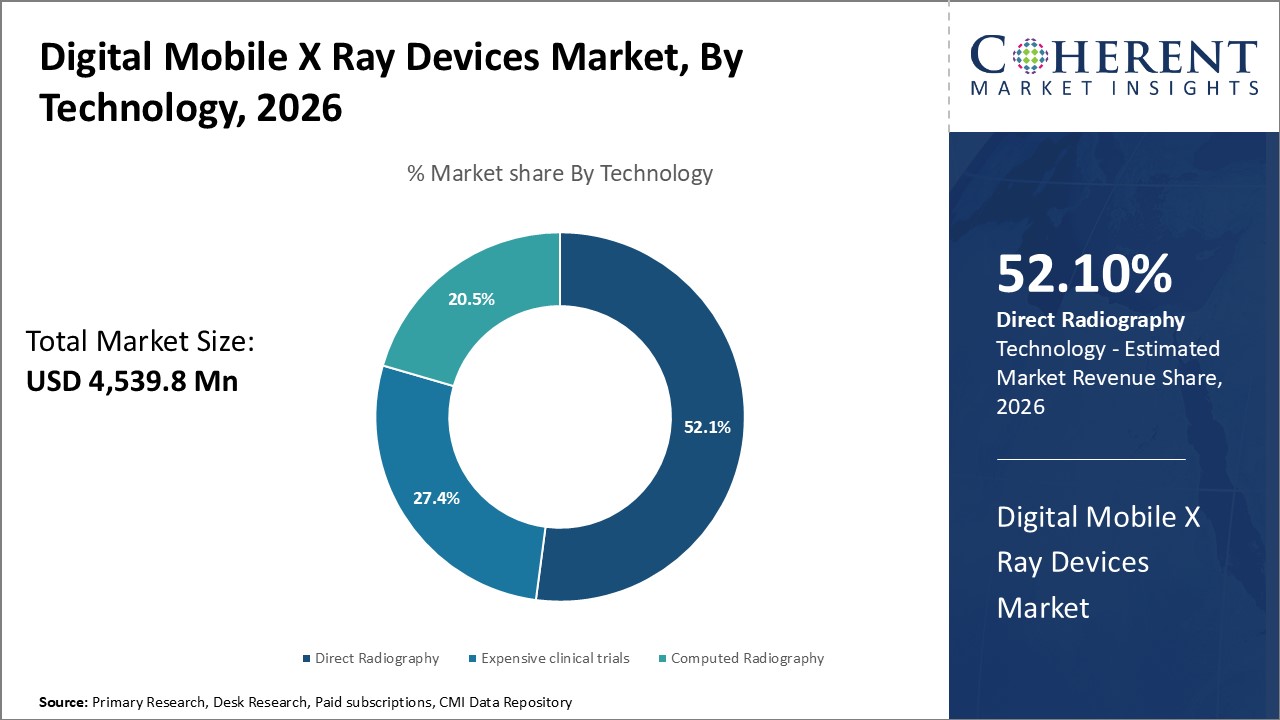
Digital Mobile X-Ray Device Market Insights, By Technology
The direct radiography (DR) segment is projected to maintain a leading market position during the forecast period. Its growth is attributed to several clinical advantages, including enhanced image clarity, faster image acquisition, and significantly lower radiation exposure. DR systems offer real-time imaging and a broader dynamic range, facilitating more accurate diagnoses and faster treatment planning.
The computed radiography (CR) segment, while declining in relative share, remains relevant in transitional markets. CR systems serve as a cost-effective alternative for healthcare providers upgrading from analog systems without fully transitioning to DR technology.
Digital Mobile X-Ray Device Market Insights, By Application
The orthopedic imaging segment is poised to lead the application landscape, supported by a growing global burden of bone-related conditions such as arthritis, osteoporosis, and traumatic injuries. The development of specialized handheld X-ray systems for orthopedic use has further accelerated adoption, particularly in outpatient and trauma care settings where rapid and accurate bone assessments are critical.
Other major segments include chest imaging, essential for respiratory diagnostics; dental imaging, increasingly mobile in nature; and a range of miscellaneous applications such as abdominal and pediatric imaging. All continue to benefit from the expanding role of mobile diagnostics in diverse clinical environments.
Digital Mobile X-Ray Device Market Insights, By End User
The hospitals segment holds the dominant share of the end-user landscape, driven by the need for efficient, high-volume imaging in both inpatient and surgical settings. Mobile X-ray systems provide critical support in emergency rooms, ICUs, and operating rooms, where transporting patients to radiology departments is impractical or risky.
Radiology centers and outpatient clinics are also adopting mobile imaging solutions to meet growing patient demands and reduce turnaround times. These facilities value the flexibility and cost-efficiency that mobile X-ray devices offer. Meanwhile, the others category—including military field units, disaster relief operations, and home healthcare providers—represents a growing niche as mobile systems evolve to serve diverse, on-the-go medical environments.
Regional Insights
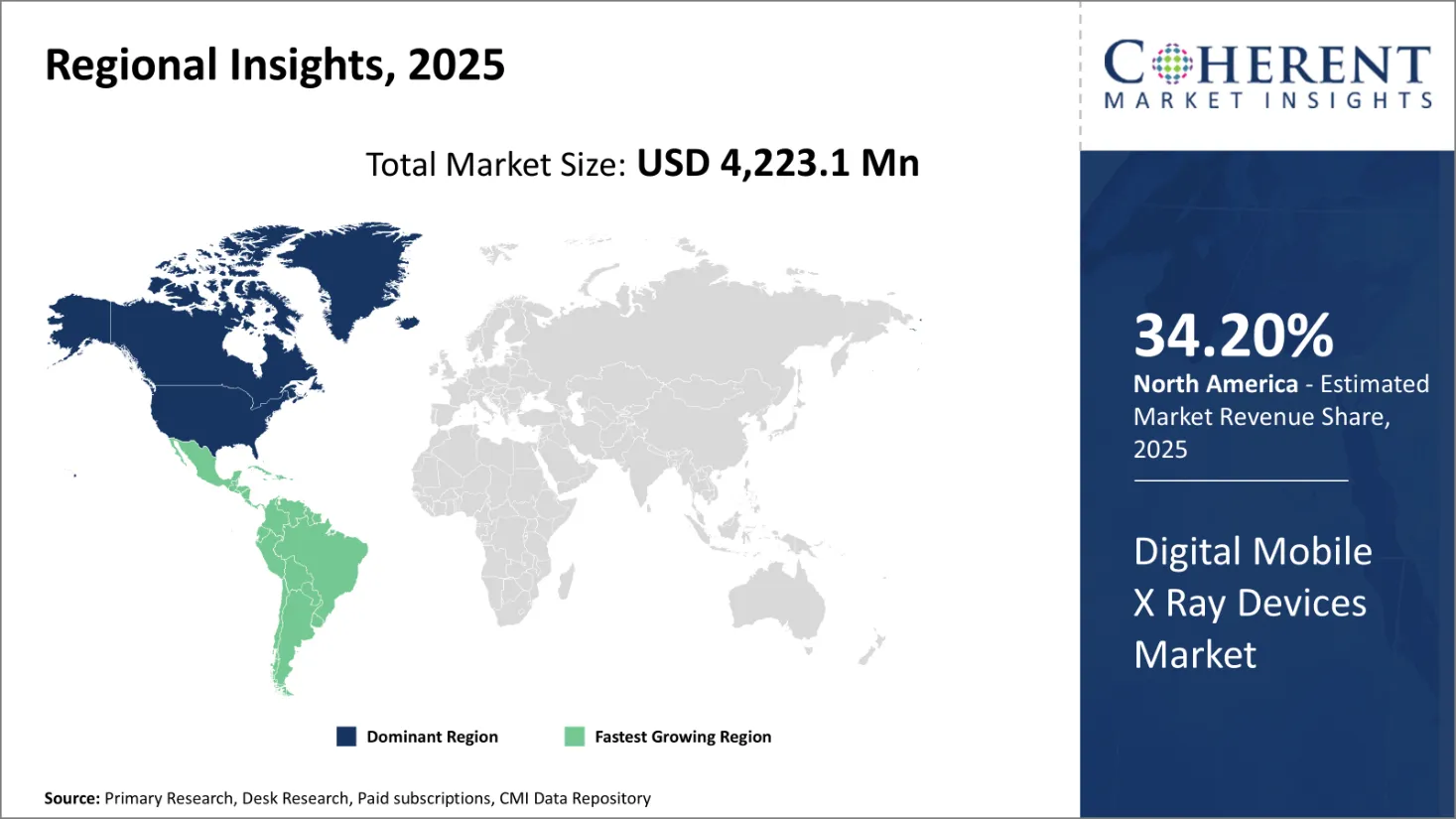
North America Digital Mobile X-Ray Device Market Analysis and Trends
North America is expected to dominate the global digital mobile X-ray device market, capturing approximately 34.20% of the total share in 2026. The region's growth is fueled by the increasing prevalence of chronic diseases, such as arthritis, and the rising demand for point-of-care diagnostic solutions.
In particular, the United States is witnessing strong adoption of mobile X-ray systems, which offer high image quality and are capable of being deployed in diverse clinical settings—including patient rooms, operating suites, and emergency departments.
For instance, Innovations such as the July 2026 launch of the MobileDaRt Evolution MX8 Version V type by Shimadzu Medical Systems USA underscore the region's commitment to advancing digital radiography. With a well-established healthcare infrastructure and growing emphasis on rapid, bedside diagnostics, North America continues to be a key driver of market expansion.
Asia Pacific Digital Mobile X-Ray Device Market Analysis and Trends
Asia Pacific is emerging as a rapidly growing region in the digital mobile X-ray device market, driven by increasing healthcare expenditures, aging populations, and expanding access to medical imaging in countries such as China, India, Japan, and Australia. Mobile X-ray technologies are gaining traction across urban and rural healthcare facilities due to their portability, operational efficiency, and ability to support timely clinical decisions.
Governments and private healthcare providers are investing in modernizing imaging infrastructure to meet the rising demand for decentralized diagnostics. Furthermore, the push toward digital transformation in the healthcare sector, combined with growing awareness of early disease detection, is expected to fuel strong market growth across the region.
Dominating Countries in the Digital Mobile X-Ray Device Market
United States Digital Mobile X-Ray Device Market Analysis and Trends
The United States leads the North American market, supported by a robust healthcare system, high rates of chronic illness, and a strong focus on patient-centered care. The country's demand for digital mobile X-ray systems is rising sharply, particularly in emergency care, intensive care units, and long-term care settings.
U.S.-based medical device companies and subsidiaries—such as Shimadzu Medical Systems USA—are at the forefront of innovation, launching advanced mobile units that enhance diagnostic speed and image precision. These trends position the U.S. as a central force in the global digital mobile X-ray landscape.
China Digital Mobile X-Ray Device Market Analysis and Trends
China is a key contributor to Asia Pacific’s digital mobile X-ray device market, driven by its expanding healthcare infrastructure and strategic investments in medical technology. The country is embracing mobile diagnostic tools to bridge gaps in healthcare access, particularly in rural and underserved areas.
Digital initiatives and government-backed health reforms are accelerating the adoption of mobile imaging units, enabling faster diagnosis and treatment. Local manufacturers are also strengthening their capabilities to compete in both domestic and international markets.
India Digital Mobile X-Ray Device Market Analysis and Trends
India’s digital mobile X-ray device market is witnessing significant momentum due to increasing healthcare digitization, a growing patient population, and heightened demand for portable diagnostic solutions. The widespread use of digital radiography in public health programs, mobile health clinics, and emergency services is contributing to rapid market expansion.
As the country continues to scale up its healthcare infrastructure, mobile X-ray devices are playing a vital role in improving accessibility and efficiency, particularly in remote and semi-urban regions.
Market Report Scope
Digital Mobile X Ray Devices Market Report Coverage
| Report Coverage | Details | ||
|---|---|---|---|
| Base Year: | 2025 | Market Size in 2026: | USD 4,539.8 Mn |
| Historical Data for: | 2020 To 2024 | Forecast Period: | 2026 To 2033 |
| Forecast Period 2026 to 2033 CAGR: | 7.5% | 2033 Value Projection: | USD 7,531.8 Mn |
| Geographies covered: |
| ||
| Segments covered: |
| ||
| Companies covered: | Toshiba Corporation, Carestream Health, General Electric Company, Hitachi Ltd., Siemens Healthcare Private Limited, Koninklijke Philips N.V., Shimadzu Corporation, MinXray Inc., KA Imaging, Samsung Group, OXOS Medical, InnoCare Optoelectronics, Siemens Healthineers, Shimadzu Medical Systems USA, Konica Minolta Healthcare Americas Inc., Canon Inc., Boston Imaging, Nanox, Fujifilm, Scanna-MSC, VUNO, and Canon Medical Systems USA Inc. | ||
| Growth Drivers: |
| ||
| Restraints & Challenges: |
| ||
Global Digital Mobile X-Ray Devices Market – Driver
- New product launches by key market players for product portfolio expansion
To meet the needs of patients and researchers, conducting both primary and secondary research is required, and the key market players are focusing on launching new products to expand their product portfolios. For instance, in July 2022, Siemens Healthineers, a German medical device company, launched Mobilett Impact, its newest mobile X-ray system, at European Congress of Radiology (ECR) 2022, in Vienna. The system combines all the benefits of a mobile X-ray system for imaging at the patient’s bedside with full digital integration at economical prices.
- Global Digital Mobile X-Ray Devices Market Cross Sectional Analysis:
Mobile digital mobile X-ray equipment reduces the need for patient transfers and additional movements. Additionally, these devices lessen the number of times patients with serious medical conditions must undergo uncomfortable chest, skeletal, and abdominal X-ray examinations at the radiology department.
For instance, Institute of Physics and Engineering in Medicine (IPEM) 2022, published an article to study about the mobile x-ray devices. And, it was found that it is possible to carry out effective X-ray imaging without the patient attending either a hospital or diagnostic center. In some cases, this can be done without the patient leaving home.
From a technological perspective, the study has shown that with the use of dedicated image processing, it is generally possible to produce diagnostic images using compact and portable X-ray equipment at exposure settings below those in general use. This has positive implications for both patients and staff dose.
Global Digital Mobile X-Ray Devices Market: Key Trends
- New technologies and higher adoption rate of Digital Mobile X Ray Devices can drive the market growth
New product launches by companies, technologies, and higher adoption rate of Digital Mobile X Ray Devices by hospitals and paitents are driving product expansion in North America. For instance, in July 2022, Konica Minolta Healthcare Americas, Inc. introduced its revolutionary Dynamic Digital Radiography (DDR) technology that enables the visualization of anatomy in motion available on the mKDR Xpress Mobile X-ray System.
The mobile system is also compatible with the newest technology in wireless flat panel X-ray detectors, the AeroDR Glassless High-Definition Detector. Both solutions enable clinicians to realize greater potential with X-ray, the most widely available diagnostic imaging modality and often the first imaging test a patient receives.
Analyst Viewpoint
- The global digital mobile X-ray devices market is experiencing strong growth due to the rising demand for point-of-care diagnostics and portable imaging solutions.
- Increasing incidence of chronic diseases and an aging global population are driving the need for immediate, bedside imaging—especially in emergency rooms and intensive care units where patient mobility is limited.
- Hospitals and clinics are adopting mobile X-ray systems to streamline operations, reduce patient transport, and improve workflow efficiency.
- Technological advancements in wireless communication, longer battery life, and higher image resolution are propelling market expansion.
- High upfront equipment costs and complex regulatory pathways remain barriers, particularly for small facilities and in emerging markets.
- Integration of AI and machine learning is unlocking new potential in automated image interpretation and improved diagnostic accuracy.
- Telehealth and remote healthcare services are creating new growth opportunities for mobile imaging, especially in rural and underserved areas.
- North America continues to lead the market due to robust infrastructure, early tech adoption, and favorable reimbursement frameworks.
- Asia-Pacific is expected to witness the fastest growth, fueled by rising healthcare investments, infrastructure upgrades, and increasing awareness in countries like China and India.
- Ongoing innovation in digital detectors, compact form factors, and expanded clinical applications (e.g., orthopedics, cardiology, trauma care) is expected to sustain market momentum.
Global Digital Mobile X-Ray Devices Market: Key Developments
- In April 2024, GE HealthCare unveiled its next-generation AI-powered mobile X-ray system, designed to enhance diagnostic speed and accuracy in emergency and bedside imaging scenarios across hospitals and clinics.
- In October 2023, Siemens Healthineers announced a strategic partnership with a leading cloud PACS provider to enable seamless remote access and real-time sharing of mobile X-ray imaging data across connected healthcare networks.
- In August 2023, Agfa HealthCare launched a new series of ultra-lightweight mobile X-ray units specifically engineered for rural and under-resourced medical facilities, supporting point-of-care diagnostic expansion.
- In February 2023, Konica Minolta Healthcare Americas Inc, a world-class provider and market leader in diagnostic imaging solutions, debuted the company’s acclaimed KDR Primary U-arm Digital Radiography (DR) and mKDR Xpress Mobile X-ray systems in select Latin America countries.
Market Segmentation
- Global Digital Mobile X-ray Devices Market, By Product Type (Revenue, USD Mn, 2021 - 2033)
- Mobile Devices
- Handheld Devices
- Global Digital Mobile X-ray Devices Market, By Technology (Revenue, USD Mn, 2021 - 2033)
- Computed Radiography
- Direct Radiography
- Global Digital Mobile X-ray Devices Market, By Application (Revenue, USD Mn, 2021 - 2033)
- Orthopedic Imaging
- Chest Imaging
- Dental Imaging
- Others
- Global Digital Mobile X-ray Devices Market, By End User (Revenue, USD Mn, 2021 - 2033)
- Hospitals
- Radiology Centers
- Outpatient Clinics
- Others
- Global Digital Mobile X-ray Devices Market, By Region (Revenue, USD Mn, 2021 - 2033)
- North America
- U.S.
- Canada
- Latin America
- Brazil
- Argentina
- Mexico
- Rest of Latin America
- Europe
- Germany
- U.K.
- Spain
- France
- Italy
- Russia
- Rest of Europe
- Asia Pacific
- China
- India
- Japan
- Australia
- South Korea
- ASEAN
- Rest of Asia Pacific
- Middle East
- GCC Countries
- Israel
- Rest of Middle East
- Africa
- South Africa
- North Africa
- Central Africa
- North America
- Company Profiles
- Toshiba Corporation
- Carestream Health
- General Electric Company
- Hitachi Ltd.
- Siemens Healthcare Private Limited
- Koninklijke Philips N.V.
- Shimadzu Corporation
- MinXray Inc.
- KA Imaging
- Samsung Group
- OXOS Medical
- InnoCare Optoelectronics
- Siemens Healthineers
- Shimadzu Medical Systems USA
- Konica Minolta Healthcare Americas Inc.
- Canon Inc.
- Boston Imaging
- Nanox
- Fujifilm
- Scanna-MSC
- VUNO
- Canon Medical Systems USA Inc.
Sources
Primary Research Interviews
- Medical Device Manufacturers and OEMs
- Hospital Administrators and Radiology Department Heads
- Healthcare Technology Distributors and Suppliers
- Regulatory Affairs Specialists
- Others
Databases
- Global Health Observatory (GHO) Database
- Medical Device Database (FDA)
- Healthcare Equipment and Services Database
- International Trade Administration Healthcare Database
- Others
Magazines
- Medical Device Technology Magazine
- Healthcare IT News Magazine
- Radiology Business Magazine
- Medical Equipment & Technology Magazine
- Others
Journals
- Journal of Medical Internet Research
- International Journal of Biomedical Imaging
- Journal of Digital Imaging
- Others
Newspapers
- Healthcare Finance News
- Modern Healthcare
- Medical Device News
- Healthcare IT News
- Others
Associations
- Medical Device Manufacturers Association (MDMA)
- American College of Radiology (ACR)
- International Association of Healthcare Central Service Materiel Management (IAHCSMM)
- Healthcare Financial Management Association (HFMA)
- Others
Public Domain Sources
- World Health Organization (WHO) Publications
- U.S. Department of Health and Human Services Reports
- Centers for Disease Control and Prevention (CDC) Data
- National Institute of Biomedical Imaging and Bioengineering Reports
- Others
Proprietary Elements
- CMI Data Analytics Tool
- Proprietary CMI Existing Repository of information for last 8 years
Get access to 250+ pages report
Every segment, forecast, competitor profile and data table behind the analysis above — available for instant download.
- ESOMAR Member
- ISO 9001:2015 Certified
- D-U-N-S Registered
- GDPR & CCPA Compliant
Missing comfort of reading report in your local language? Find your preferred language:
Transform your Strategy with Exclusive Trending Reports
Frequently Asked Questions
The Digital Mobile X Ray Devices Market size is estimated to be valued at USD 4,539.8 Mn in 2026, and is expected to reach USD 7,531.8 Mn by 2033.
The CAGR of the global Market is projected to be 7.5% from 2026 to 2033.
The launch of new products by key market players to expand their product portfolios is expected to drive the market growth.
Direct Radiography is the leading segment in the market.
Expensive clinical trials are expected to hinder the market over the forecast period.
The major market players operating in the market include Toshiba Corporation, Carestream Health, General Electric Company, Hitachi Ltd., Siemens Healthcare Private Limited, Koninklijke Philips N.V., Shimadzu Corporation, MinXray Inc., KA Imaging, Samsung Group, OXOS Medical, InnoCare Optoelectronics, Siemens Healthineers, Shimadzu Medical Systems USA, Konica Minolta Healthcare Americas Inc., Canon Inc., Boston Imaging, Nanox, Fujifilm, Scanna-MSC, VUNO, and Canon Medical Systems USA Inc.
Flat-panel detectors enhance performance and image quality by providing high-resolution images with faster acquisition times, reduced radiation dose, and improved diagnostic accuracy.