

Computed Tomography Market Analysis & Forecast - 2026 to 2033
Computed tomography market is estimated to be valued at USD 9.68 Bn in 2026 and is expected to reach USD 15.24 Bn in 2033, exhibiting a compound annual growth rate (CAGR) of 6.7% from 2026 to 2033.
Key Takeaways
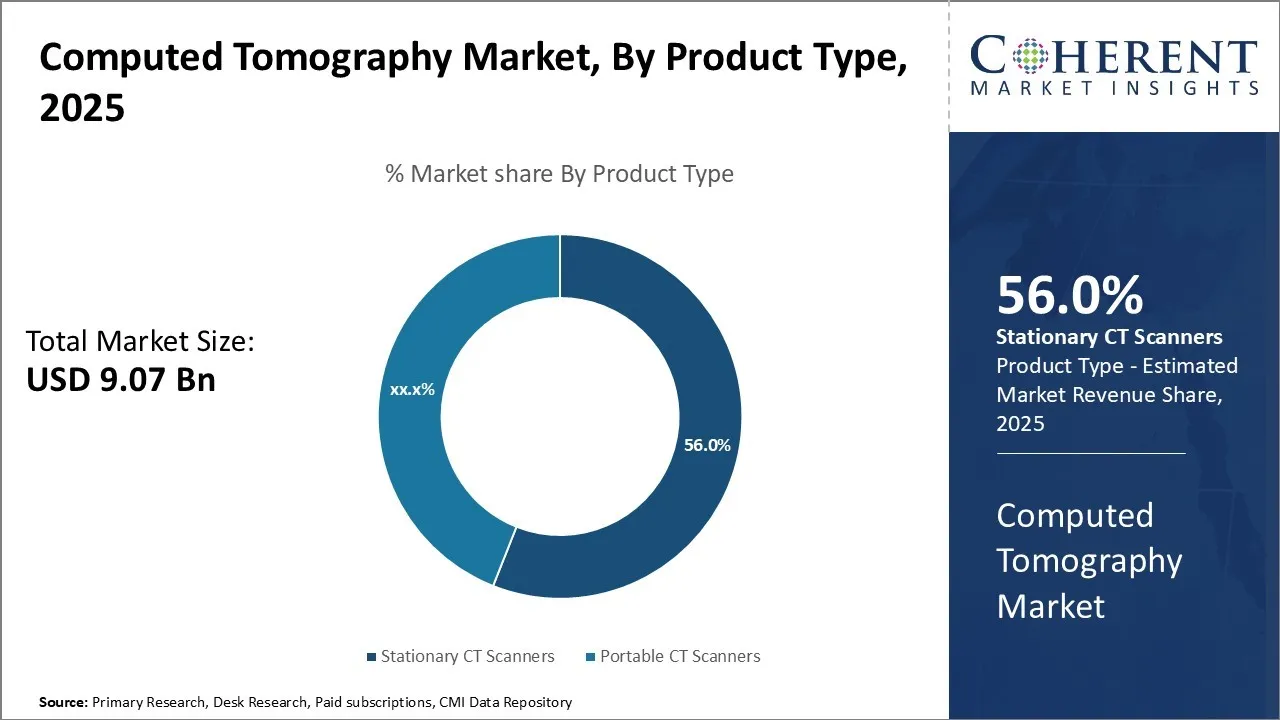
- By Product Type, The Stationary CT Scanners Segment is expected to dominate the global computed tomography market, accounting for approximately 57% share throughout the forecast period.
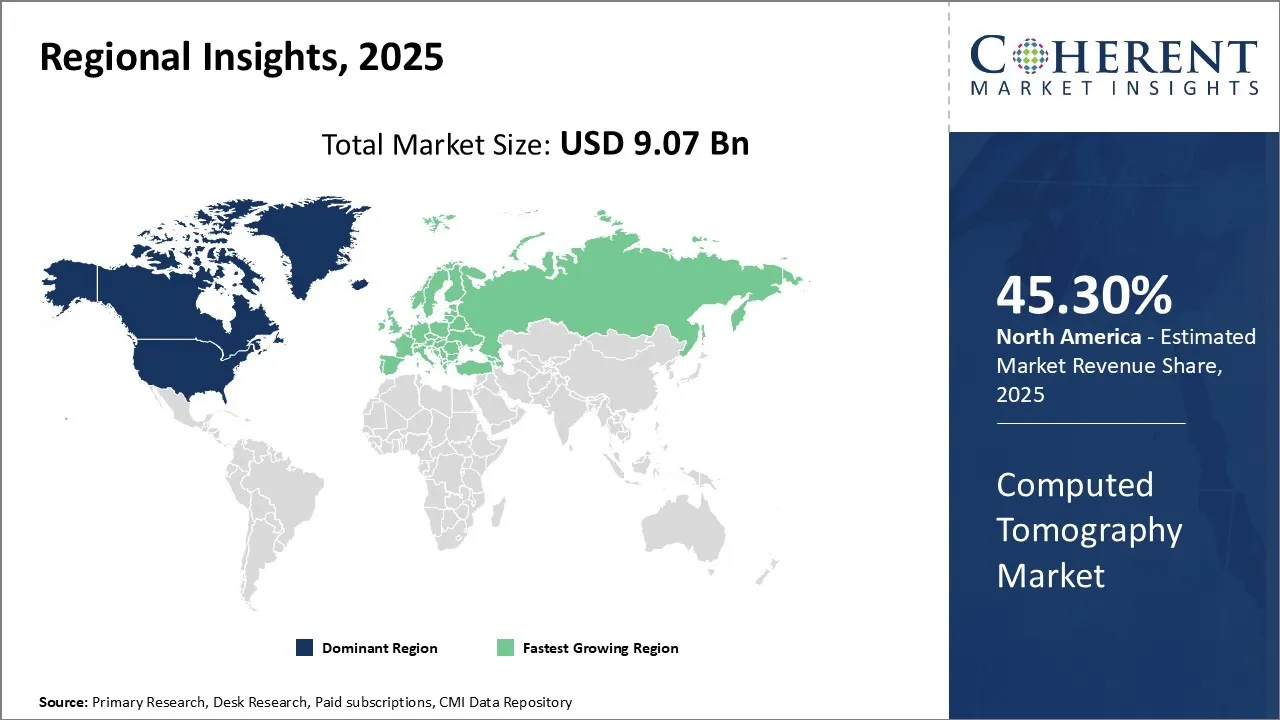
- Based on Region, North America is projected to maintain a leading position in the global CT market, with an estimated 45.30% share of the total market in 2026.
Market Overview
Computed tomography (CT) is a diagnostic device that is used as imaging tool for diagnosing diseases, abnormality, and trauma. These scanners provide various images in the form of 3D images, 2D images, and cross-sectional images. Rising usage of CT scanners for wide range of applications such as oncology, neurology and others. Thus, this offers the opportunity to various manufacturers to offer various kinds of CT scanners such as stationary and portable CT scanners.
Current Events and Its Impact on the Computed Tomography Market
Event | Description and Impact |
Geopolitical Trade Tensions and Tariff Policies |
|
Healthcare Regulatory and Reimbursement Shifts |
|
Supply Chain Disruptions and Component Shortages |
|
Computed Tomography Market Growth Factors
The advance developed technologies that are adopted by the health care sector with faster imaging of the organs, tissues, blood vessels and other with increased diagnosis of the disorder with increased imaging may boost the market of computed tomography.
Enhance development and technologies with various techniques available with increased feature may enhance the market of computed tomography and development of infrastructures in the health care sectors.
Increasing number of chronic disorders with increased imaging disorders such as cardiovascular disorder, orthopedics, oncology disorder, brain injury with increased imaging of the disorder with increased diagnosis helps to boost the market of computed tomography.
Increasing disorder among the geriatric population with increase in demands from the customers with developed technologies in computed technology. Advancements in the computed tomography with quick imaging and diagnosis of the organs, tissues, blood vessel with increased scanning and faster results with increased adoption of the computed tomography from past few years. Decreased cost of the computed tomography led to significant rise of the market. Government with increased interest for development of advance technologies in the medical sectors with increased investment for new developments in the market.
The key market players with introduction of new features in computed tomography with integration of software with increased connectivity and increased investment from the players helps to boost the market to grow at a larger extend during the forecast period.
- Current Industry Events of 2026
- Market Size Estimation
- Regional Breakdown
- Competitive Landscape
- Customer Intelligence
- Segmental Analysis
- Pricing Analysis
- Key Market Drivers, Challenges & Future Trends
- Customized Insights Section
Segmental Insights
Computed Tomography Market Insights, By Product Type
By product type, the stationary CT scanners segment is expected to dominate the global computed tomography market with 57% share throughout the forecast period. Stationary systems remain the cornerstone of diagnostic imaging in hospitals due to their advanced imaging capabilities, higher resolution, and integration with hospital IT systems.
While portable CT scanners are gaining traction—especially for bedside use in intensive care units—their adoption actually complements, rather than replaces, stationary systems. As portable scanners handle urgent, on-site diagnostics, physicians can optimize scheduling and utilization of high-performance stationary CT units for in-depth imaging, improving overall workflow efficiency and patient throughput in clinical settings.
Computed Tomography Market Insights, By Application
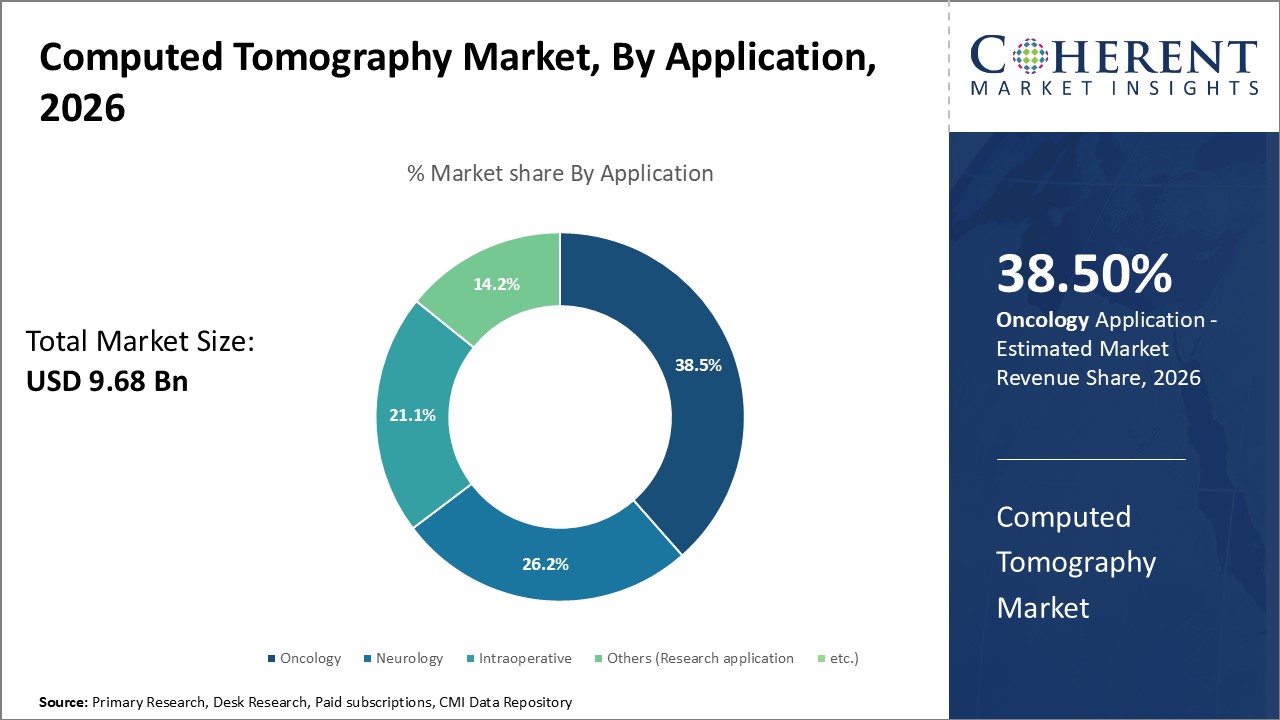
In terms of application, oncology is projected to be the leading segment in the computed tomography market during the forecast period. The rising global burden of cancer and the need for early, accurate tumor detection are major drivers of CT scanner adoption in oncology.
CT systems are widely used for both initial diagnosis and treatment monitoring in cancer patients, often serving as a critical tool in radiotherapy planning and disease staging. As more health systems prioritize cancer screening and precision medicine, demand for CT in oncology continues to surge.
Computed Tomography Market Insights, By End User
Among end-user segments, hospitals are expected to account for the largest share of the global CT market. Hospitals represent the primary point of care for patients requiring advanced imaging, and they typically possess the infrastructure and clinical expertise to operate high-capacity CT systems.
With applications ranging from trauma care to cardiovascular diagnostics and cancer treatment planning, CT scanners are deeply embedded in hospital workflows. Additionally, ongoing investments in hospital infrastructure and the expansion of radiology departments across both developed and emerging economies are supporting sustained demand in this segment.
Regional Insights
North America Computed Tomography Market Analysis and Trends
North America is projected to maintain a dominant position in the global computed tomography (CT) market through the forecast period, accounting for an estimated 45.30% of the total market share in 2026. This regional dominance is driven by increasing diagnostic applications of CT in clinical settings, particularly for cardiovascular, oncology, and emergency imaging.
Furthermore, the presence of leading healthcare providers, robust reimbursement structures, and increasing demand for non-invasive diagnostic tools are contributing to the strong adoption of advanced CT systems across hospitals and imaging centers in the U.S. and Canada.
Asia Pacific Computed Tomography Market Analysis and Trends
Asia Pacific is anticipated to emerge as the fastest-growing region in the global computed tomography market, driven by rapid improvements in healthcare infrastructure, rising healthcare expenditure, and increasing awareness of early disease diagnosis. Countries such as China, India, and South Korea are investing heavily in upgrading their diagnostic imaging capabilities to meet rising patient volumes and improve clinical outcomes.
Public-private partnerships and national health initiatives across the region are supporting broader CT scanner deployment in both urban and rural medical facilities. Additionally, the region’s large aging population and growing burden of chronic diseases are driving demand for high-resolution, low-dose CT imaging technologies.
Dominating Countries in the Computed Tomography Market
United States Computed Tomography Market Analysis and Trends
The U.S. remains the largest market for computed tomography in North America, supported by advanced medical infrastructure, a high volume of diagnostic procedures, and rapid adoption of next-generation imaging systems. Continued investment in research and development, along with favorable reimbursement and regulatory pathways, is enabling manufacturers to introduce cutting-edge CT technologies for a wide range of clinical applications.
China Computed Tomography Market Analysis and Trends
China plays a pivotal role in the Asia Pacific CT market, benefiting from a vast healthcare network and strategic government focus on digital health transformation. Local companies are increasingly innovating CT systems that balance affordability and functionality, helping improve access to diagnostic imaging across tier-2 and tier-3 cities. Ongoing healthcare reforms and the rise of public-private partnerships are further driving the expansion of CT deployment in the country.
Market Report Scope
Computed Tomography Market Report Coverage
| Report Coverage | Details | ||
|---|---|---|---|
| Base Year: | 2025 | Market Size in 2026: | USD 9.68 Bn |
| Historical Data for: | 2020 To 2024 | Forecast Period: | 2026 To 2033 |
| Forecast Period 2026 to 2033 CAGR: | 6.7% | 2033 Value Projection: | USD 15.24 Bn |
| Geographies covered: |
| ||
| Segments covered: |
| ||
| Companies covered: | GE Healthcare, Koninklijke Philips N.V., NeuroLogica Corporation, Neusoft Medical Systems Co. Ltd., Hologic, Carestream Health, Toshiba, Analogic, Arineta Ltd., Eaton, Siemens Healthineers AG, FUJIFIM Corporation, Kromek, Shanghai United Imaging Healthcare Co., Ltd., Lumafield, Xoran Technologies and Koning Corporation | ||
| Growth Drivers: |
| ||
| Restraints & Challenges: |
| ||
Global Computed Tomography Market– Drivers
- Increasing technological advancements by key market players
Increasing adoption of inorganic growth strategies such as technological advancement is expected to drive the market growth over the forecast period. For instance, on April 19, 2023, Kromek, a medical technology company, and Analogic Corporation, a healthcare company, collaborated to develop zinc telluride (CZT) based detector system for photon computed tomography applications in medical imaging and security systems.
- Increasing product approval by regulatory authorities
Increasing approvals from the regulatory authorities such as U.S. Food and Drug Administration (U.S. FDA) is expected to drive the global computed tomography market growth over the forecast period.
Global Computed Tomography Market: Key Trends
- Increasing Investments by government entities
Increasing adoption of inorganic growth strategies such as investments is expected to drive the growth of the global computed tomography market over the forecast period.
Analyst Viewpoint
- The global computed tomography (CT) market is gaining strong momentum, driven by rising demand for precise diagnostic imaging and the growing burden of chronic conditions such as cancer, cardiovascular, and neurological diseases. Technological advancements—particularly in multi-slice CT and AI integration—are enhancing diagnostic speed and accuracy, cementing CT’s role as a core diagnostic tool across healthcare settings.
- Opportunities are expanding with the development of portable CT systems for point-of-care and emergency diagnostics, as well as innovations in machine learning for automated image reconstruction and diagnostics. Additionally, cone-beam CT is unlocking new use cases in dental and orthopedic imaging.
- However, adoption is challenged by high capital costs, ongoing maintenance burdens, and radiation exposure concerns, particularly in cost-sensitive emerging markets. Regulatory complexity and the requirement for trained personnel further limit broader deployment.
- North America is expected to retain market leadership, supported by advanced infrastructure and rapid technology adoption. Meanwhile, the Asia-Pacific region is emerging as the fastest-growing market due to healthcare investments, rising medical tourism, and increasing focus on early disease detection in developing economies.
Key Developments
- In May 2025, Siemens Healthineers launched its SOMATOM Pro.Pulse, a mobile CT scanner designed for emergency and intensive care units, featuring rapid scan speed and low-dose imaging capabilities.
- In June 2024, FUJIFILM Healthcare Americas Corporation, a leading provider of diagnostic and enterprise imaging solutions, announced it had received FDA 510(k) clearance for its new compact, 128-slice computed tomography (CT) system, the FCT iStream.
Market Segmentation
- Global Computed Tomography Market, By Types (Revenue, USD Bn, 2021 - 2033)
- Stationary CT Scanners
- Portable CT Scanners
- Global Computed Tomography Market, By Application (Revenue, USD Bn, 2021 - 2033)
- Diagnostic Applications
- Cardiology Applications
- Oncology Applications
- Neurology Applications
- Other Diagnostic Applications
- Intraoperative Applications
- Veterinary Application
- Research Application
- Global Computed Tomography Market, By End User (Revenue, USD Bn, 2021 - 2033)
- Hospital and Research Centers
- Diagnostic Imaging Centers
- Global Computed Tomography Market, By Region (Revenue, USD Bn, 2021 - 2033)
- North America
- U.S.
- Canada
- Latin America
- Brazil
- Argentina
- Mexico
- Rest of Latin America
- Europe
- Germany
- U.K.
- Spain
- France
- Italy
- Russia
- Rest of Europe
- Asia Pacific
- China
- India
- Japan
- Australia
- South Korea
- ASEAN
- Rest of Asia Pacific
- Middle East
- GCC Countries
- Israel
- Rest of Middle East
- Africa
- South Africa
- North Africa
- Central Africa
- Company Profiles
- United Medical Imaging Inc.
- Siemens Healthineers
- Canon Medical Systems Corporation
- GE Healthcare
- Hitachi Healthcare Americas
- Koninklijke Philips N.V.
- NeuroLogica Corporation
- Neusoft Medical Systems Co. Ltd.
- Shenzhen Anke High-tech Co. Ltd.
- Eaton
- Hologic
- Arineta
- Analogic
- Samsung
- Carestream Health
- Toshiba
Sources
Primary Research Interviews
- Medical Equipment Manufacturers and OEMs
- Radiologists and Medical Imaging Specialists
- Hospital Procurement Managers and Healthcare Administrators
- Medical Technology Distributors and Suppliers
- Others
Databases
- FDA Medical Device Database
- WHO Global Health Observatory Data Repository
- Healthcare Cost and Utilization Project (HCUP)
- Medical Equipment Global Trade Database
- Others
Magazines
- Medical Imaging Technology Magazine
- Healthcare IT News
- Radiology Business Journal
- Medical Device & Diagnostic Industry (MD+DI)
- Others
Journals
- Journal of Medical Imaging and Radiation Sciences
- European Journal of Radiology
- Medical Physics Journal
- Others
Newspapers
- Healthcare Financial News
- Modern Healthcare
- Medical Device Daily
- Healthcare Dive
- Others
Associations
- Radiological Society of North America (RSNA)
- American College of Radiology (ACR)
- Medical Imaging & Technology Alliance (MITA)
- International Society for Computed Tomography (ISCT)
- Others
Public Domain Sources
- Centers for Medicare & Medicaid Services (CMS) Reports
- National Institute of Biomedical Imaging and Bioengineering (NIBIB)
- European Medicines Agency (EMA) Medical Device Reports
- International Atomic Energy Agency (IAEA) Publications
- Others
Proprietary Elements
- CMI Data Analytics Tool
- Proprietary CMI Existing Repository of information for last 8 years
*Definition: Computed tomography (CT) is a diagnostic device that is used as imaging tool that helps in diagnosing diseases, abnormality, and trauma. These scanners create various images in the form of 3D images, 2D images, and cross-sectional images, which study the internal injuries, complicated tissues or abnormalities, which help in taking early prevention measures to avoid further health risk. The major advantage of computed tomography is the ability to scan bone, blood vessels, and soft tissue at the same time.
Get access to 250+ pages report
Every segment, forecast, competitor profile and data table behind the analysis above — available for instant download.
- ESOMAR Member
- ISO 9001:2015 Certified
- D-U-N-S Registered
- GDPR & CCPA Compliant
Missing comfort of reading report in your local language? Find your preferred language:
Transform your Strategy with Exclusive Trending Reports
Frequently Asked Questions
The Computed Tomography Market size is estimated to be valued at USD 9.68 Bn in 2026, and is expected to reach USD 15.24 Bn by 2033.
The CAGR of the global Market is projected to be 6.7% from 2026 to 2033.
Increasing technological advancements by key market players and product approval by regulatory authoritiesare expected to drive the market growth.
Stationary CT scanners is the leading product type segment in the market.
Increasing product recall by regulatory authorities is expected to hinder the market growth over the forecast period.
Major players operating in the market are include GE Healthcare, Koninklijke Philips N.V., NeuroLogica Corporation, Neusoft Medical Systems Co. Ltd., Hologic, Carestream Health, Toshiba, Analogic, Arineta Ltd., Eaton, Siemens Healthineers AG, FUJIFIM Corporation, Kromek, Shanghai United Imaging Healthcare Co., Ltd., Lumafield, Xoran Technologies and Koning Corporation.