

Single Use System in Biopharma Manufacturing Market Analysis & Forecast 2026-2033
The global single use system in biopharma manufacturing market was valued at USD 18,000 Mn in 2026 and is forecast to reach value of USD 68,350 Mn by 2033 at a CAGR of 20.8% between 2026 and 2033, allowing for flexible, cost-effective production while lowering the risk of contamination and speeding up the process of scaling up across different therapeutic pipelines.
Key Takeaways
- Based on Bioreactors, the 1000-2000L range segment is expected to hold 37.4% share of the market in 2026, dominate with scalable, flexible solutions for commercial biologics production.
- Based on Application, the cell culture segment is expected to lead the market with 32.1% share in 2026, streamlining upstream processes with sterility and efficiency.
- Based on Bioprocessing, the mid-scale segment is projected to capture 28% share of the market in 2026, enabling multiproduct flexibility and cost-effective manufacturing.
- Based on Product, the single-use bioreactors segment is projected to account for 36% share of the market in 2026, reducing capital costs and boosting efficiency.
- Based on Modality, the protein monoclonal antibodies (mABs) segment is estimated to dominate the market with 47.6% share in 2026, driven by strong therapeutic pipelines.
- Based on Component, the drug substance segment is estimated to represent 58% share of the market in 2026, relying heavily on disposables for upstream consistency.
- Based on Region, North America is set to lead the Single Use System in Biopharma Manufacturing Market with 44% share in 2026. While, Asia Pacific is anticipated to be the fastest growing region.
Market Overview
The global single use system in biopharma manufacturing market is experiencing strong growth due to the increase in disease burden and increase in demand for drugs/vaccines across the globe. Moreover, rise in demand for biopharmaceutical products is expected to boost the growth of the market. Conversely, the expansion of the global single-use system in biopharma manufacturing market is anticipated to be constrained by factors including the stringent demands of high-end manufacturing and the elevated costs associated with production.
Current Events and their Impacts on the Single Use System in Biopharma Manufacturing Market
Current Event | Description and its Impact |
Regulatory Harmonization and Quality Standards Evolution |
|
Advanced Biomanufacturing Technology Integration |
|
How Much Money Has Biopharma Saved Through Single-Use Systems?
Facility Type / Application | CapEx Savings | OpEx Savings | Time Savings | Example Impact |
Monoclonal Antibody (mAbs) Facilities | 20–30% lower upfront investment vs. stainless steel | 30–40% reduction in cleaning/validation costs | 12–18 months faster facility builds | A $500M stainless steel plant can be replaced with ~$350M SUS facility, saving ~$150M |
Vaccine Manufacturing | 25% lower CapEx | 35% OpEx savings | 12–18 months faster readiness | Billions saved globally by accelerating vaccine supply during pandemic |
Cell & Gene Therapy Facilities | 15–20% CapEx savings (smaller scale) | 40% OpEx savings due to reduced contamination risk | 90% faster batch changeover | SUS adoption >70% in CAR-T manufacturing, saving millions per product launch |
ADC (Antibody-Drug Conjugates) Multiproduct Facilities | 20–25% CapEx savings | 30% OpEx savings | Faster multiproduct changeovers | Enables flexible production, saving ~$100M per facility over lifecycle |
General Mid-Scale Bioprocessing (1000–2000L) | 20–30% CapEx savings | 25–35% OpEx savings | 50–70% faster changeovers | Typical savings ~$100–200M per facility |
- Current Industry Events of 2026
- Market Size Estimation
- Regional Breakdown
- Competitive Landscape
- Customer Intelligence
- Segmental Analysis
- Pricing Analysis
- Key Market Drivers, Challenges & Future Trends
- Customized Insights Section
Segmental Insights
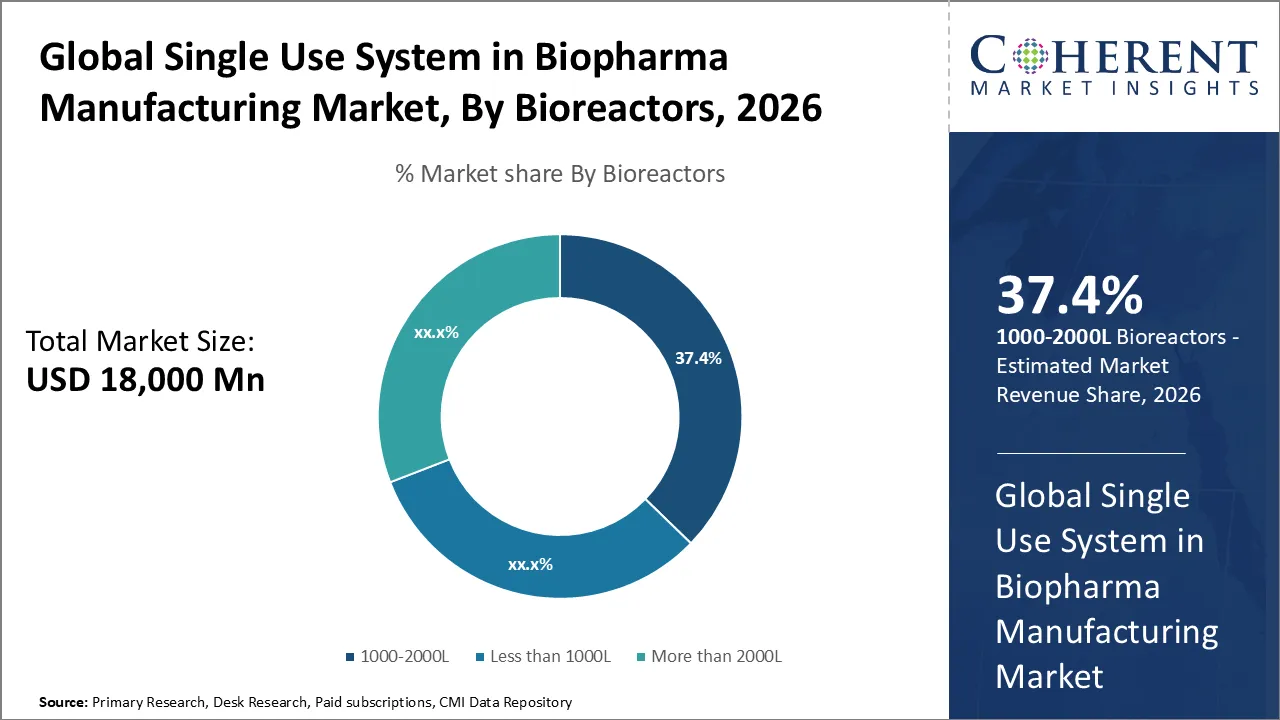
Single Use System in Biopharma Manufacturing Market Insights, By Bioreactors: 1000–2000L dominate with scalable, flexible solutions for commercial biologics production
In terms of bioreactors, the 1000-2000L range segment is expected to hold 37.4% share of the market in 2026, due to its scalability and operational flexibility. It enables the production of biologics on a commercial scale while minimizing contamination risks and expediting turnaround times. This size range strikes a balance between efficiency and cost-effectiveness, making it the most popular choice for facilities that make monoclonal antibodies and other high-demand drugs.
For instance, in May 2025, Bora Biologics added two 2000L Cytiva single-use bioreactors to its San Diego facility, which increased its CDMO capacity. This investment makes it easier to make biologics on a large scale, especially mammalian cell culture processes. It also fits with the 1000–2000L bioreactor segment that is expected to be the most popular in 2026. This shows that the industry prefers single-use technologies that can be scaled up, are flexible, and are resistant to contamination.
Single Use System in Biopharma Manufacturing Market Insights, By Application: Cell culture leads applications, streamlining upstream processes with sterility and efficiency
In terms of application, the cell culture segment is expected to lead the market with 32.1% share in 2026, because single-use systems make upstream processes easier. Disposable bioreactors and containers make it easier to clean, lower the risk of cross-contamination, and speed up production cycles. Biologics manufacturing needs them to be consistent and sterile, so their use is crucial. There is a strong demand for antibody-based therapies and advanced biologics pipelines in this part of the market.
For instance, in March 2026, Green Elephant Biotech made Archimedes One, a one-time-use platform for making cell therapy. It makes cell culture easier, enhance scalability, and lowers the risk of contamination. This new technology directly supports biopharma's growing need for disposable technologies, making cell culture applications even more popular in the single-use system market.
Single Use System in Biopharma Manufacturing Market Insights, By Bioprocessing: Mid-scale bioprocessing prevails, enabling multiproduct flexibility and cost-effective manufacturing
In terms of bioprocessing, the mid-scale segment is projected to capture 28% share of the market in 2026, as it makes it possible to have flexible facilities that can make multiproduct. Manufacturers can switch between therapies without having to make big changes to their infrastructure, which lowers costs and makes them more responsive. At this scale, single-use systems are perfect for biotech companies that need to balance clinical and commercial production. They help speed up the process of scaling up and make it easier to transfer technology between different therapeutic pipelines.
For instance, in September 2025, Rezon Bio started out as a European biologics CDMO, focusing on flexible mid-scale manufacturing. This move highlights the rising reliance on single-use systems to make multiple biologics, which cuts costs and speeds up timelines. It strengthens the dominance of mid-scale bioprocessing in 2026, which supports solutions that can be scaled up and changed to fit different therapeutic pipelines.
Single Use System in Biopharma Manufacturing Market Insights, By Product: Single-use bioreactors remain top products, reducing capital costs and boosting efficiency
In terms of product, the single-use bioreactors segment is projected to account for 36% share of the market in 2026, thanks to improvements in upstream processing that make them more efficient. They cut down on capital costs compared to stainless steel systems and make it easy to quickly set up new facilities. Their leadership is based on their central role in cell culture and protein production, which is only growing as the need for flexible, disposable manufacturing solutions expands.
In April 2026, for example, Thermo Fisher Scientific incorporated the 5L DynaDrive single-use bioreactor into its portfolio of disposable bioprocessing equipment. This addition enhances scalability and flexibility in the manufacturing of biologics by streamlining upstream processes. The introduction of this new concept bolsters the standing of single-use bioreactors. It mitigates the risk of contamination and facilitates the rapid establishment of facilities for the production of advanced therapeutics.
Single Use System in Biopharma Manufacturing Market Insights, By Modality: Protein & monoclonal antibodies dominate modalities, driven by strong therapeutic pipelines
Regarding modality, the protein monoclonal antibodies (mABs) segment is projected to lead the market, capturing an estimated 47.6% share in 2026, owing to the abundance of promising medicines currently under development and the increasing popularity of biosimilars. Single-use systems are extensively utilized in the production of antibodies, owing to their scalability and sterility. mAbs make up a large part of biologics approvals, so this type of technology is still in high demand around the world.
For instance, in October 2025, the BioIndustry Association announced new projects to lower the cost of making monoclonal antibodies. These projects are directly related to single-use systems in biopharma manufacturing. These efforts are meant to make things more scalable, less expensive, and more efficient. By 2026, protein and mAbs will still be the most popular type of disposable bioprocessing technology.
Single Use System in Biopharma Manufacturing Market Insights, By Component: Drug substance manufacturing leads components, relying heavily on disposables for upstream consistency
In terms of component, the drug substance segment is estimated to represent 58% share of the market in 2026, owing to single-use systems are used in the upstream and midstream processes. Disposables are helpful in the cell culture, mixing, and purification stages because they lower the risk of contamination and the operational cost.
For instance, in October 2025, The U.S. FDA inspection of Kemwell Biopharma's Bengaluru facility for making commercial drug products went well. The site has both drug substance and drug product operations and has single-use and stainless-steel bioreactors with capacities greater than 5000L. This milestone shows the significance that single-use systems are for making biologics in a way that is efficient and meets all the rules in global regulated markets.
Regional Insights
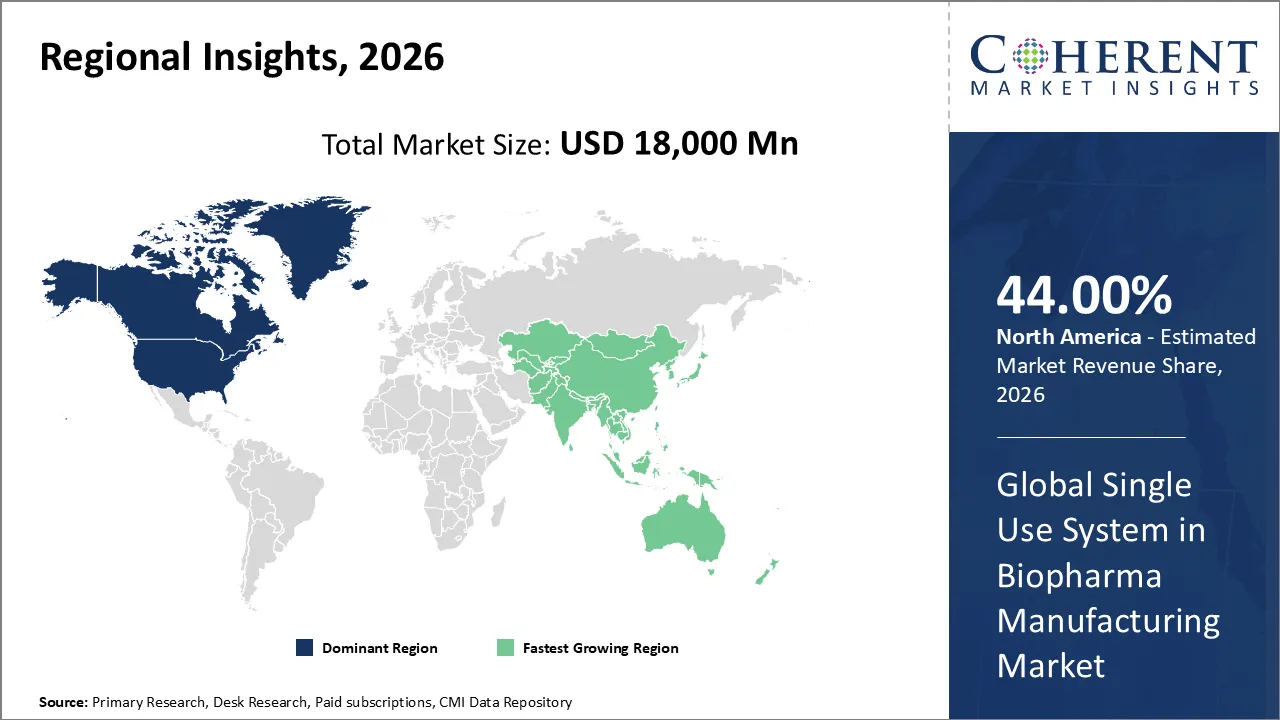
North America Single Use System in Biopharma Manufacturing Market Analysis & Trends
North America is expected to lead the single use system in biopharma manufacturing market with 44% share in 2026. Advanced research and development, a strong presence of CDMOs, and the quick adoption of biologics are all driving North America's demand for Single Use System in the Biopharma Manufacturing Market in 2026. These systems lower the risk of contamination, speed up production cycles, and make personalized medicine possible, which makes them necessary for biopharma manufacturing that is efficient and can be scaled up across the region.
For instance, in August 2025, Cytiva worked with Culture Biosciences to make the Stratyx 250 single-use bioreactor, which can easily go from 250 mL to 2000 L. The platform speeds up the development of biologics, supports cell culture applications, and strengthens the dominance of single-use bioreactors in scalable biopharma manufacturing by combining Cytiva's Xcellerex technology with cloud-native integration.
Asia Pacific Single Use System in Biopharma Manufacturing Market Analysis & Trends
Asia Pacific is expected to exhibit the fastest growth, as China's, India's, and South Korea's biopharma infrastructure is growing quickly. Adoption is driven by more investments, government support, and more biosimilars production. Flexible, affordable, single-use technologies are key to scaling up production, and that's the quickest route to regional growth.
Consider Thermo Fisher's December 2025 expansion: they opened a new center in Hyderabad and upgraded existing hubs in Korea and Singapore, all part of their Asian bioprocessing network. This tri-hub setup accelerates the production of biologics, vaccines, and advanced therapies, leveraging both single-use and hybrid systems. These strategic moves bolster Asia's biomanufacturing ecosystem, resulting in more scalable, efficient, and sustainable biopharma manufacturing.
Single Use System in Biopharma Manufacturing Market Outlook Country-Wise
The U.S. Single Use System in Biopharma Manufacturing Market Trends
In 2026, the United States will have high need for Single Use System in the Biopharma Manufacturing Market because it has a strong biopharma ecosystem, a lot of use of biologics, and a lot of reliance on CDMOs. These systems make things more efficient, lower the risk of contamination, and help make new therapies quickly, driving widely used in the industry.
In April 2025, for example, Merck broke ground on a $1 billion Biologics Center of Excellence in Wilmington, Delaware. This facility will produce KEYTRUDA and other biologics, including antibody-drug conjugates (ADCs). While the announcement didn't mention single-use systems, these types of facilities typically rely on disposable technologies. This reliance makes them even more critical for flexible, scalable biopharma manufacturing, especially for global markets.
India Single Use System in Biopharma Manufacturing Market Trends
India's need for Single Use System in the Biopharma Manufacturing Market will grow in 2026 because biopharma hubs are growing quickly, the government is supporting biotechnology, and the production of biosimilars is increasing. Single-use technologies that are flexible and cost-effective make it possible to scale up production, lower the risk of contamination, and help India play a bigger role in global biologics supply chains.
For instance, in February 2026, Cytiva added more space to its Fast Trak facility in Bengaluru, India, where it now offers services for developing, scaling up, and validating processes both upstream and downstream. The center has ISO-certified labs and single-use bioreactors that can hold up to 200L. It supports mAbs, mRNA, proteins, and viral vectors, which shows the significance single-use systems are for making biopharmaceuticals on a large scale.
Market Report Scope
Single Use System in Biopharma Manufacturing Market Report Coverage
| Report Coverage | Details | ||
|---|---|---|---|
| Base Year: | 2025 | Market Size in 2026: | USD 18,000 Mn |
| Historical Data for: | 2020 To 2024 | Forecast Period: | 2026 To 2033 |
| Forecast Period 2026 to 2033 CAGR: | 20.8% | 2033 Value Projection: | USD 68,350 Mn |
| Geographies covered: |
| ||
| Segments covered: |
| ||
| Companies covered: | Getinge AB, Rentschler Biopharma SE, Kühner AG, Danaher Corporation, Merck KgaA, Lonza, PBS Biotech Inc., ThermoFisher Scientific, Corning Incorporated, Eppendorf, Pall Corporation, Entegris, and Sartorius AG (Sartorius Stedim Biotech), among others | ||
| Growth Drivers: |
| ||
| Restraints & Challenges: |
| ||
Single Use System in Biopharma Manufacturing Market Driver
Increasing demand for biopharmaceuticals across the globe
Due to more chronic diseases, an aging population, and advances in biotechnology, there is a growing demand for biopharmaceuticals in the global healthcare industry. A greater number of individuals are choosing biopharmaceuticals, like monoclonal antibodies, recombinant proteins, and cell therapies, over traditional drugs because they are more effective and have fewer side effects. This trend is making people invest in and develop new ideas for manufacturing technologies. This demand is driving the Single Use System in the Biopharma Manufacturing Market growth. It allows for faster production, more flexibility, and lower costs for global supply chains.
Single Use System in Biopharma Manufacturing Market Opportunity
Vaccine Production
Single-use systems are extremely useful in vaccine production because they are flexible, sterile, and can be quickly scaled up. These systems enable manufacturers to swiftly adapt to varying batch sizes, reduce the need for extensive cleaning, and mitigate contamination risks. As global vaccine demand surges, companies are increasingly relying on disposable bioreactors and filtration units to streamline their processes. The Single Use System in the Biopharma Manufacturing Market forecast shows that this segment will grow quickly because there is a need for safe, cost-effective, and efficient ways to make vaccines.
Analyst Opinion (Expert Opinion)
- Growing percentage biopharma manufacturers are using single-use systems (SUS) because they lower the costs of cleaning validation and the risk of contamination. According to industry data, facilities that use SUS can cut turnaround times by up to 40% compared to stainless steel systems. They can also use significantly less water and energy. This efficiency gain is especially clear in upstream processes like cell culture and fermentation, where disposable bioreactors are becoming increasingly common.
- The use of SUS is also encouraged by the fact that multiproduct facilities are flexible. Reports declare that more than 80% of new biopharma plants use single-use technologies at least once during production. This makes it easier to scale up and transfer technology. Also, the lower capital costs are worth noting. Estimates claim that SUS-based facilities can be built for 25–30% less than traditional ones, which makes them appealing to both established companies and new biotech companies.
Speak to the analyst
Want personalized insights?
Take the findings above to one of our principal consultants, or have the report rebuilt around the segments, geographies and competitors you actually track.
Recent Developments
- In March 2026, HIPRA Biotech increased the number of biologics it can make in Spain by building 2000L microbial fermenters and planning a 2000L single-use mammalian cell culture GMP facility. This investment makes Europe's biopharma manufacturing stronger. It demonstrates the way single-use systems are becoming more popular in scalable mid-scale production and supports advanced therapies in oncology, immunology, and rare disease pipelines.
- In November 2025, Sartorius and Aber Instruments released the BioPAT Viamass single-use sensor, which allows check the density of viable cells in disposable bioreactors in real time. It is designed to scale up easily, so it can handle consistent bioprocessing from development to commercial scale. This new development shows the significance single-use systems are for making biopharmaceuticals and advanced therapies in a way that is both efficient and flexible.
Market Segmentation
- By Bioreactors
- Less than 1000L
- 1000-2000L
- More than 2000L
- By Application
- Filtration
- Storage (Buffer & Media Storage, Freeze & Thaw)
- Cell Culture
- Mixing
- Purification
- Aseptic Filling
- By Bioprocessing
- Small-scale
- Mid-scale
- Large-scale
- By Product
- Sampling Systems
- Bioprocess Containers
- Bioreactors
- Mixers
- Membrane Absorbers
- Bottles
- Equipment
- Transfer Units
- Others (Disposable filter Cartridges (DFC), Depth Filters, Clamps etc.)
- By Modality
- Protein & Monoclonal Antibody (Mab)
- Cell Therapy
- Gene Therapy
- Conventional Vaccine
- mRNA
- By Component
- Drug Substance
- Drug Product
- By Region
- North America
- U.S.
- Canada
- Latin America
- Brazil
- Argentina
- Mexico
- Rest of Latin America
- Europe
- Germany
- U.K.
- Spain
- France
- Italy
- Russia
- Rest of Europe
- Asia Pacific
- China
- India
- Japan
- Australia
- South Korea
- ASEAN
- Rest of Asia Pacific
- Middle East
- GCC Countries
- Israel
- Rest of Middle East
- Africa
- South Africa
- North Africa
- Central Africa
- North America
- Key Players
- Getinge AB
- Rentschler Biopharma SE
- Kühner AG
- Danaher Corporation
- Merck KgaA
- Lonza
- PBS Biotech Inc.
- ThermoFisher Scientific
- Corning Incorporated
- Eppendorf
- Pall Corporation
- Entegris
- Sartorius AG (Sartorius Stedim Biotech)
Sources
Primary Research Interviews
- Biopharma Manufacturers
- Biotech Industry Experts
- Single Use System Manufacturers
- Biopharma Equipment Suppliers
- Manufacturing Engineers
- Others
Databases
- Bloomberg Terminal
- Thomson Reuters Eikon
- Others
Magazines
- Pharmaceutical Manufacturing Magazine
- BioPharm International
- Pharmaceutical Technology Magazine
- Bioprocessing Magazine
- Others
Journals
- Journal of Pharmaceutical Sciences
- Biotechnology Progress
- Bioprocess and Biosystems Engineering
- Journal of Biotech & Bioengineering
- Others
Newspapers
- Financial Times
- The Wall Street Journal
- Reuters
- Bloomberg News
- Others
Associations
- BioProcess International (BPI)
- International Society for Pharmaceutical Engineering (ISPE)
- BioPharma Alliance
- American Association of Pharmaceutical Scientists (AAPS)
- Others
Public Domain Sources
- U.S. Food and Drug Administration (FDA)
- European Medicines Agency (EMA)
- U.S. National Institutes of Health (NIH)
- World Health Organization (WHO)
- National Institute for Bioprocessing Research & Training (NIBRT)
- Others
Proprietary Elements
- CMI Data Analytics Tool
- Proprietary CMI Existing Repository of Information for the Last 8 Years
Definition: Single use system (SUS) refers to a biopharmaceutical manufacturing equipment designed to be used once (or for a single manufacturing campaign) and then discarded. SUS represent the future in biopharmaceutical processing of therapeutic drugs with significant advantages over traditional reusable stainless-steel systems and partly disposable systems.
Get access to 250+ pages report
Every segment, forecast, competitor profile and data table behind the analysis above — available for instant download.
- ESOMAR Member
- ISO 9001:2015 Certified
- D-U-N-S Registered
- GDPR & CCPA Compliant
Missing comfort of reading report in your local language? Find your preferred language:
Transform your Strategy with Exclusive Trending Reports
Frequently Asked Questions
The global Single Use System in Biopharma Manufacturing Market size was valued at USD 18,000 Mn in 2026 and is expected to reach USD 68,350 Mn in 2033.
The global single use system in biopharma manufacturing market size is estimated to be valued at US$ 18,000 Mn in 2026 and is expected to exhibit a CAGR of 20.8% between 2026 and 2033.
Increasing demand for biopharmaceuticals across the globe and increasing demand for safe and effective drugs and vaccines is fueling the growth of the market.
1000-2000L segment is the leading bioreactor segment in the market.
High-end manufacturing requirements and high cost of manufacturing are some major factors restraining growth of the market.
Major players operating in the market are Getinge AB, Rentschler Biopharma SE, Kühner AG, Danaher Corporation, Merck KgaA, Lonza, PBS Biotech Inc., ThermoFisher Scientific, Corning Incorporated, Eppendorf, Pall Corporation, Entegris, and Sartorius AG (Sartorius Stedim Biotech), among others.