

Monoclonal Antibody Therapeutics Market Size and Forecast – 2026 to 2033
Monoclonal Antibody Therapeutics Market is estimated to be valued at USD 331.81 Bn in 2026 and is expected to reach USD 775.31 Bn in 2033, exhibiting a compound annual growth rate (CAGR) of 12.9% from 2026 to 2033.
Key Takeaways
- By Source, Humanized acquired the prominent share of 50% in 2026 as advancements in biotechnology and antibody engineering.
- By Application, Cancer holds the largest market share in 2026 owing to its rising cancer incidence.
- By Distribution Channel, Hospital Pharmacy dominates the overall market share in 2026 owing to the centralized administration and monitoring.
- By Region, North America dominates the overall market with an estimated share of 45.10% in 2026 owing to the strong regulatory support and market approvals.
Market Overview
Advances in biotechnology and rising demand for targeted treatments in diseases like cancer, autoimmune disorders, and infectious diseases are rapidly evolving the Monoclonal Antibody Therapeutics Market. These therapies provide high specificity and improved safety profiles, making healthcare providers prefer them for personalized medicine. Innovations like biosimilars and antibody-drug conjugates are expanding access to and effectiveness of treatments. Strong regulatory frameworks and increased healthcare investments actively support the market’s robust growth and widespread global adoption.
Current Events and their Impact on the Monoclonal Antibody Therapeutics Market
Current Events | Description and its impact |
US-China Trade War and Supply Chain Disruptions |
|
Biosimilar Market Expansion and Patent Cliffs |
|
Geopolitical Shifts in Clinical Trials |
|
End-user Feedback and Unmet Needs in the Monoclonal Antibody Therapeutics Market
- Need for Improved Safety Profiles: Patients and healthcare providers express concerns about adverse effects and immunogenicity related to some monoclonal antibodies. There is ongoing demand for therapies with better safety profiles that minimize side effects while maintaining efficacy, especially for chronic use in autoimmune and cancer treatments.
- Desire for Faster Onset of Action: End-users highlight the need for monoclonal antibodies that act more quickly to provide faster symptom relief. Particularly in acute conditions and aggressive cancers, reducing the time between treatment initiation and clinical response remains a critical unmet need.
- Affordability and Access Challenges: High costs limit patient access to many monoclonal antibody therapies, especially in lower-income regions. Stakeholders seek more affordable options through biosimilars and innovative pricing models to improve equitable access and reduce the financial burden on healthcare systems.
- Current Industry Events of 2026
- Market Size Estimation
- Regional Breakdown
- Competitive Landscape
- Customer Intelligence
- Segmental Analysis
- Pricing Analysis
- Key Market Drivers, Challenges & Future Trends
- Customized Insights Section
Segmental Insights
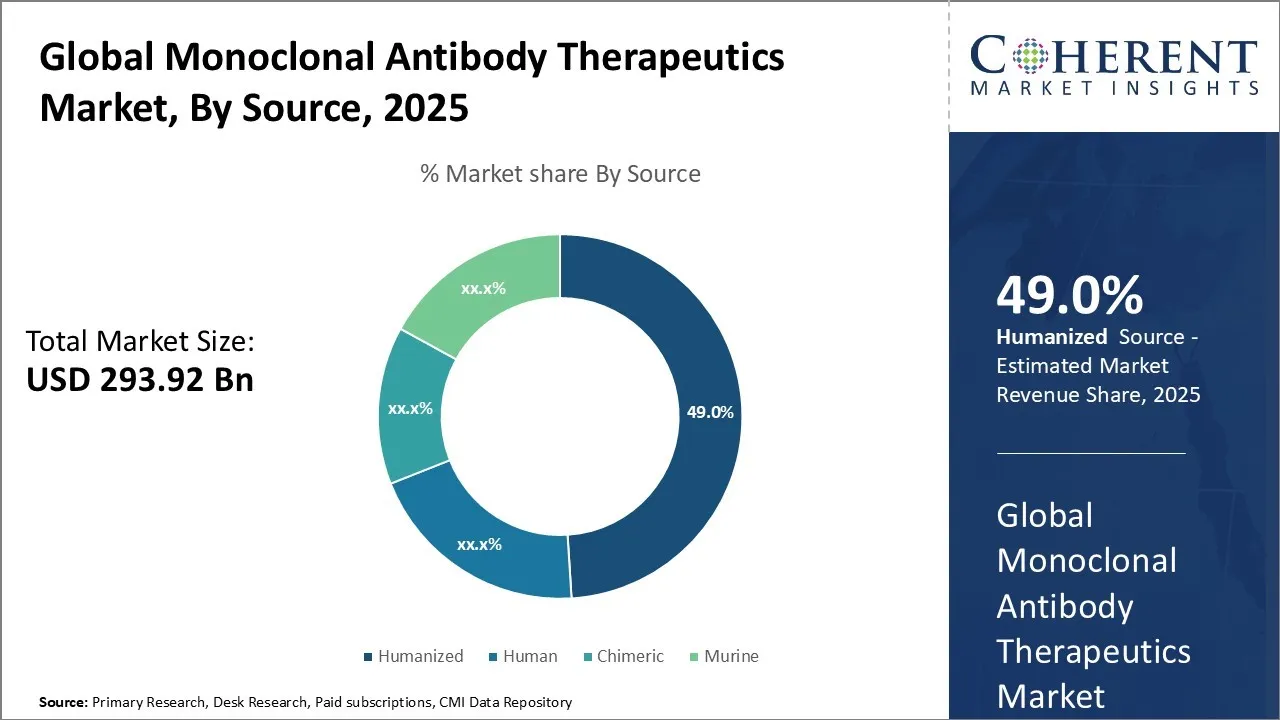
Monoclonal Antibody Therapeutics Market Insights, By Source: Humanized Segment contribute the highest share of the market
Humanized Segment acquired the prominent share of 50.0% in 2026. Researchers and developers are driving the demand for humanized monoclonal antibodies by focusing on their reduced immunogenicity and enhanced compatibility with the human immune system. Advances in genetic engineering and antibody design now allow scientists to create highly specific therapies for cancer, autoimmune diseases, and infectious conditions. Compared to murine or chimeric antibodies, humanized versions deliver improved safety and effectiveness. The growing focus on personalized medicine and positive clinical outcomes continues to promote their use in research, diagnostics, and treatments.
In April 2025, the NIH officially launched a Phase 2 human challenge trial for AV-1 — an investigational monoclonal antibody designed to reduce dengue virus symptoms when administered both before and after infection.
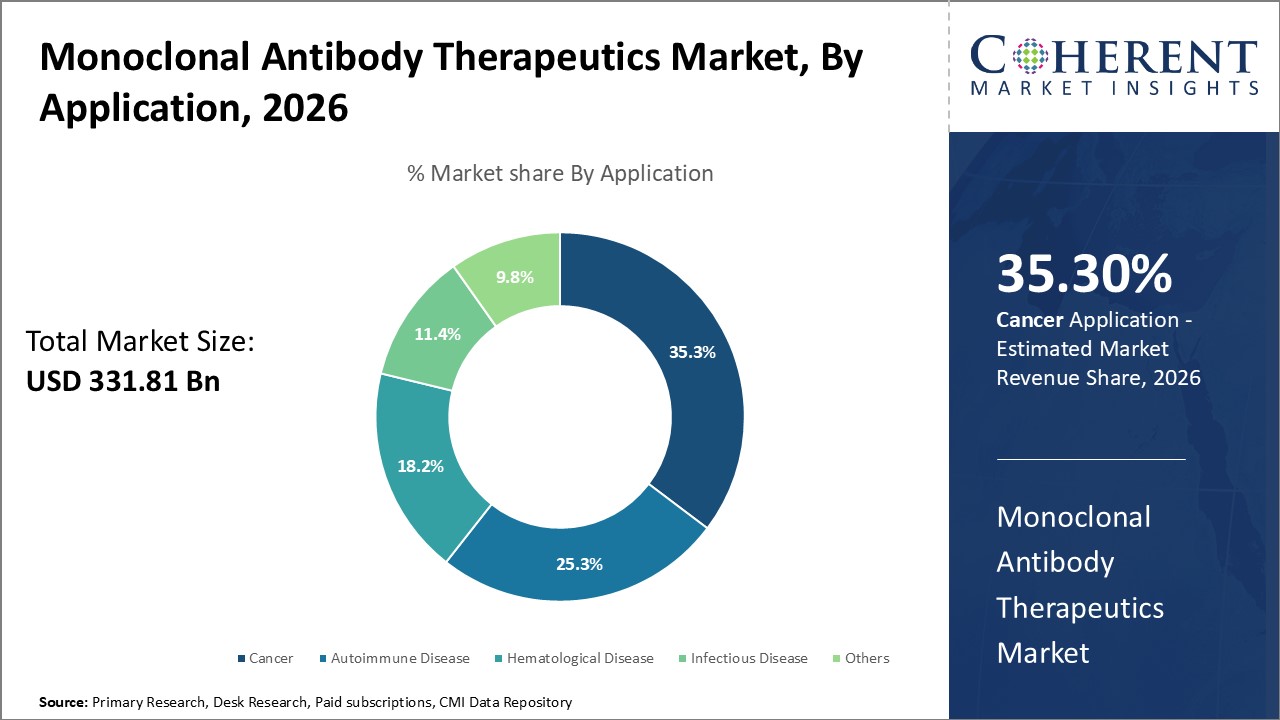
Monoclonal Antibody Therapeutics Market Insights, By Application: Cancer contributes the highest share of the market owing to its personalized medicine approach
The increasing prevalence of cancer is driving growth in the monoclonal antibody therapeutics market, as healthcare providers turn to these targeted treatments for their precision and lower risk of side effects. Researchers are advancing oncology by developing monoclonal antibodies that accurately recognize and destroy cancer cells. These therapies have proven effective in treating cancers such as breast, lung, and blood-related types. Continued innovation and clinical integration are strengthening their role in cancer treatment and advancing the field of immunotherapy. For instance, Swiss drugmaker Roche Pharma unveiled its breast cancer antibody cocktail drug, PHESGO, in India. The new treatment is priced 20% lower and offers greater convenience in administration compared to the current therapy.
Monoclonal Antibody Therapeutics Market Insights, By Distribution Channel: Hospital Pharmacy contribute the highest share of the market owing to its strategic partnerships and distribution
Hospital pharmacies play a critical role in the monoclonal antibody therapeutics market by ensuring safe procurement, storage, compounding, dispensing, and administration of these complex biologic therapies. They provide clinical and pharmacological expertise to physicians and nurses, guiding proper dosing, formulation, and drug monitoring. Equipped to handle sterile injectable drugs, hospital pharmacies manage administration of mAbs for serious conditions like cancer and autoimmune diseases, where careful supervision is essential. Their central position in hospital infrastructure makes them the primary distribution channel and a cornerstone for patient access to these advanced treatments. For instance, Onco360®, the nation’s leading independent specialty pharmacy, serve as a pharmacy provider for Elrexfio™ (elranatamab-bcmm). ELREXFIO is a bispecific CD3 T-cell engager that targets B-cell maturation antigen (BCMA) and is approved for treating adult patients with relapsed or refractory multiple myeloma (RRMM) who have undergone at least four prior lines of therapy, including a proteasome inhibitor, an immunomodulatory agent, and an anti-CD38 monoclonal antibody.
Regional Insights
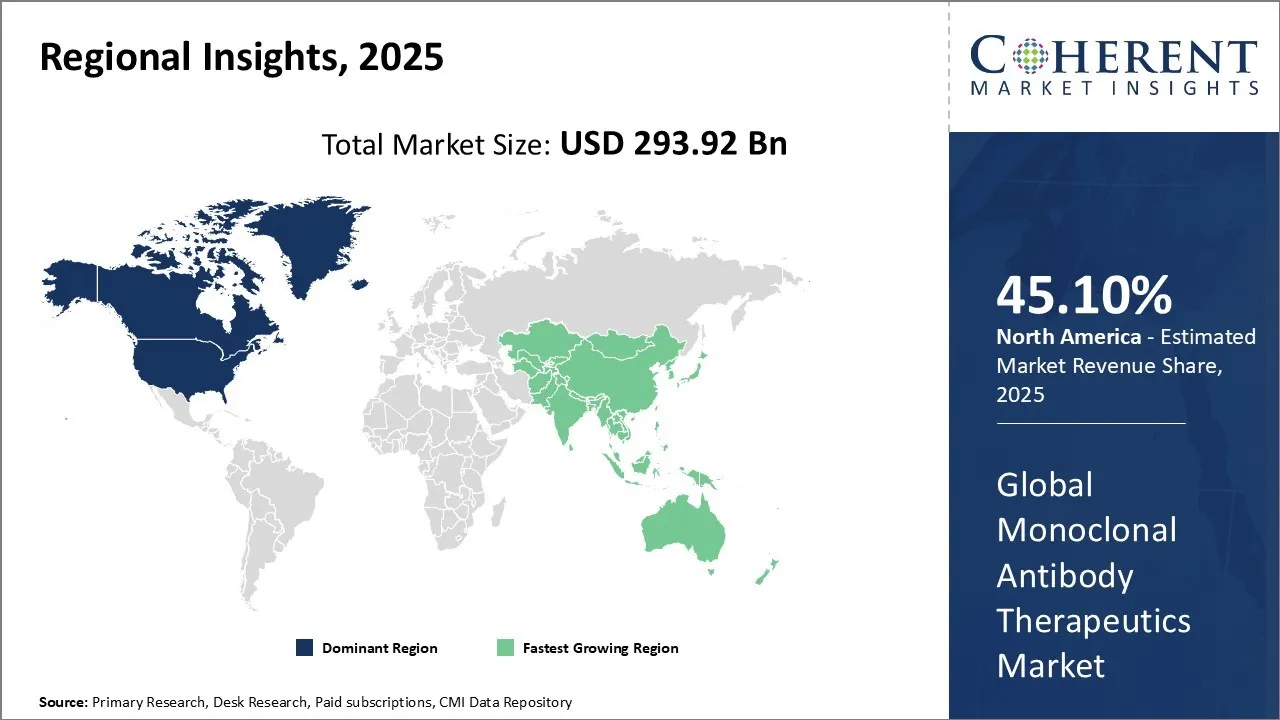
North America Monoclonal Antibody Therapeutics Market Trends
North America acquires the dominant share of 45.10%. Healthcare providers in North America are rapidly expanding the use of monoclonal antibody therapies to treat cancer, autoimmune disorders, and infectious diseases. They are prescribing antibodies targeting RSV and influenza more often in response to increasing infection rates and recent FDA approvals. Hospitals and specialty pharmacies are adopting biosimilars to lower treatment costs and enhance accessibility. Biotech companies and major pharmaceutical firms are actively advancing bispecific antibodies and antibody-drug conjugates to drive progress in precision immunotherapy across the region. For instance, in January 2026, Star Therapeutics, a clinical-stage biotechnology company focused on developing best-in-class antibodies, announced today that the U.S. Food and Drug Administration (FDA) has granted Fast Track designation to VGA039 for von Willebrand disease (VWD). VGA039 is an investigational monoclonal antibody designed to target Protein S and restore blood clotting balance as a universal hemostatic therapy for various bleeding disorders.
Asia Pacific Monoclonal Antibody Therapeutics Market Trends
Governments in the Asia-Pacific region are actively increasing healthcare R&D funding and building biomanufacturing capacity, particularly in China, India, Singapore, and South Korea. These efforts are driving the growth of monoclonal antibody and ADC pipelines while advancing clinical trial activity. Companies like Biocon, Samsung Bioepis, and Henlius are leading the development and adoption of biosimilars for key antibodies such as rituximab and trastuzumab. Regulatory reforms and enhanced local production are making these therapies more accessible and affordable across the region. For instance, in May 2024, Glenmark, a subsidiary of Glenmark Pharmaceuticals Ltd., has partnered with oncology company BeiGene to market and distribute Tislelizumab and Zanubrutinib in India. Tislelizumab, a novel anti-PD-1 monoclonal antibody, has received approval from the NMPA, EMA, and FDA for treating multiple types of cancer.
China Monoclonal Antibody Therapeutics Market Trends
China’s National Medical Products Administration has actively streamlined approval processes for monoclonal antibody therapies, significantly cutting drug lag. These reforms have enabled local producers to obtain faster domestic licenses for innovative mAbs, including PD-1/PD-L1 antibodies, allowing them to compete more effectively with global companies. Leading contract development and manufacturing organizations such as WuXi Biologics have expanded bioreactor capacity across several facilities, boosting large-scale production of antibodies and ADCs while strengthening China’s biologics export capabilities. For instance, in July 2024, China developed the monoclonal antibody HANQUYOU as one of its first mAb biosimilars to enter international markets. The EU granted initial approval, and over the past four years, HANQUYOU has demonstrated consistent international quality. It now offers breast and gastric cancer patients around the world access to affordable, high-quality treatment options.
United States Monoclonal Antibody Therapeutics Market Trends
AbbVie and Pfizer are actively developing antibody-drug conjugates (ADCs) and bispecific antibodies to treat cancers like multiple myeloma and non-small cell lung cancer. The FDA has recently approved therapies such as ELREXFIO and TALVEY, showcasing the U.S.’s leadership in oncology innovation. Following patent expirations of major biologics like Humira, companies like Biocon and Sandoz are launching biosimilars, improving patient access and increasing competition in the market. For instance, in October 2024, City Therapeutics, Inc. launched today with a mission to lead the advancement of RNA interference (RNAi)-based medicine. The company envisions RNAi becoming the next major class of high-impact therapies, potentially matching or surpassing the success of monoclonal antibodies.
Market Report Scope
Monoclonal Antibody Therapeutics Market Report Coverage
| Report Coverage | Details | ||
|---|---|---|---|
| Base Year: | 2025 | Market Size in 2026: | USD 331.81 Bn |
| Historical Data for: | 2020 To 2024 | Forecast Period: | 2026 To 2033 |
| Forecast Period 2026 to 2033 CAGR: | 12.9% | 2033 Value Projection: | USD 775.31 Bn |
| Geographies covered: |
| ||
| Segments covered: |
| ||
| Companies covered: | Pfizer Inc., Novartis AG, Bayer AG, Sanofi, F. Hoffmann-La Roche Ltd, Eli Lilly and Company, Merck KGaA, GSK plc., AbbVie Inc., Bristol-Myers Squibb Company, Regeneron Pharmaceuticals Inc., AstraZeneca, AbCellera Biologics Inc., Molecular Depot LLC, DAIICHI SANKYO COMPANY, LIMITED., Abbott, Biogen, Thermo Fisher Scientific, Inc., Cell Signaling Technology, Inc, Intas Pharmaceuticals Ltd., Avantor Inc., UCB S.A., Merus N.V., GENEXTGENOMICS.COM, Biogenuix | ||
| Growth Drivers: |
| ||
| Restraints & Challenges: |
| ||
Monoclonal Antibody Therapeutics Market Trend
- Growth of Targeted Therapies
The market is shifting towards highly targeted monoclonal antibodies that selectively bind specific antigens, improving treatment precision for diseases like cancer, autoimmune disorders, and infectious diseases. This trend enhances therapeutic effectiveness while minimizing damage to healthy tissues. Advances in antibody engineering have enabled development of bispecific antibodies and antibody-drug conjugates (ADCs), which offer dual targeting or combined therapeutic effects, driving monoclonal antibody market demand for more personalized and effective treatment options globally.
Monoclonal Antibody Therapeutics Market Opportunity
- Development of Next-Generation Antibodies
There is strong potential in innovating next-generation monoclonal antibodies, such as bispecific antibodies, antibody-drug conjugates (ADCs), and immune checkpoint inhibitors. These advanced therapies offer improved efficacy and the ability to target multiple disease pathways simultaneously. Companies investing in cutting-edge research and development can address unmet clinical needs, especially in oncology and autoimmune diseases, driving differentiated product offerings and competitive advantage. This is further accelerating the monoclonal antibody therapeutics market revenue.
Monoclonal Antibody Therapeutics Market News
- In June 2025, Bio-Techne Corporation announced a distribution agreement with the U.S. Pharmacopeia (USP) to offer USP monoclonal antibody (mAb) and recombinant AAV reference standards alongside its analytical tools, including the Maurice system, to support global development of mAb and gene therapies.
- In January 2025, Timberlyne Therapeutics, a clinical-stage biopharmaceutical company developing innovative therapies for autoimmune disorders, announced today that it has closed a $180 million Series A financing round. The company will use the funds to advance CM313, a potentially best-in-class monoclonal antibody targeting CD38, aimed at treating diseases with high unmet medical needs.
- In January 2024, Biocytogen Pharmaceuticals (Beijing) Co., Ltd. unveiled its new sub-brand, RenBiologics™, to represent its antibody discovery business division. The company has built this division around its RenMice technology, which includes platforms such as RenMab™, RenLite®, RenNano®, RenTCR™, and RenTCR-mimic™. These technologies enable the discovery of fully human monoclonal antibodies, bispecific antibodies, bsADCs, nanobodies, fully human T-cell receptors (TCRs), and TCR-mimic antibodies with high specificity and affinity.
Analyst Opinion (Expert Opinion)
- The monoclonal antibody (mAb) therapeutics market is entering a transformative phase, driven less by incremental innovation and more by paradigm-shifting advances in biologic engineering and strategic market positioning. The recent FDA approvals of bispecific antibodies like Amgen’s Blincyto and ADCs such as Seagen’s Enhertu underscore a new era where dual-targeting and payload-delivery mechanisms are redefining oncology treatment protocols. For instance, Enhertu demonstrated an objective response rate exceeding 60% in HER2-positive breast cancer patients, a significant leap over traditional mAbs.
- Furthermore, the biosimilar wave is no longer just a cost-containment tool but a strategic lever that reshapes competitive dynamics. The entrance of biosimilars for blockbuster drugs like rituximab and trastuzumab has catalyzed price competition that’s forcing originator companies to accelerate innovation cycles. Biocon’s Trastuzumab biosimilar launch in India cut treatment costs by over 30%, broadening access while challenging incumbent players to rethink pricing and patient engagement.
Speak to the analyst
Want personalized insights?
Take the findings above to one of our principal consultants, or have the report rebuilt around the segments, geographies and competitors you actually track.
Market Segmentation
- Global Monoclonal Antibody Therapeutics Market, By Source (Revenue, USD Bn, 2021 - 2033)
- Human
- Chimeric
- Murine
- Humanized
- Global Monoclonal Antibody Therapeutics Market, By Application (Revenue, USD Bn, 2021 - 2033)
- Cancer
- Autoimmune Disease
- Hematological Disease
- Infectious Disease
- Others
- Global Monoclonal Antibody Therapeutics Market, By Distribution Channel (Revenue, USD Bn, 2021 - 2033)
- Hospital Pharmacy
- Retail Pharmacy
- Online Pharmacy
- Global Monoclonal Antibody Therapeutics Market, By Region (Revenue, USD Bn, 2021 - 2033)
- North America
- U.S.
- Canada
- Latin America
- Brazil
- Argentina
- Mexico
- Rest of Latin America
- Europe
- Germany
- U.K.
- Spain
- France
- Italy
- Russia
- Rest of Europe
- Asia Pacific
- China
- India
- Japan
- Australia
- South Korea
- ASEAN
- Rest of Asia Pacific
- Middle East
- GCC Countries
- Israel
- Rest of Middle East
- Africa
- South Africa
- North Africa
- Central Africa
- North America
- Key Players Insights
- Pfizer Inc.
- Novartis AG
- Bayer AG
- Sanofi
- Hoffmann-La Roche Ltd.
- Eli Lilly and Company
- Merck KGaA
- GSK plc
- AbbVie Inc.
- Bristol-Myers Squibb Company
- Regeneron Pharmaceuticals Inc.
- AstraZeneca
- AbCellera Biologics Inc.
- Molecular Depot LLC
- DAIICHI SANKYO COMPANY LIMITED
- Abbott
- Biogen
- Thermo Fisher Scientific, Inc.
- Cell Signaling Technology, Inc.
- Intas Pharmaceuticals Ltd.
- Avantor Inc.
- UCB S.A.
- Merus N.V.
- GENEXTGENOMICS.COM
- Biogenuix
Sources
Primary Research Interviews
- Interviews with pharmaceutical industry experts
- Discussions with monoclonal antibody researchers
- Conversations with hospital pharmacists and clinicians
- Insights from biotech company executives
Databases
- ClinicalTrials.gov
- FDA Drug Approvals Database
- PubMed Central
- National Center for Biotechnology Information (NCBI)
- WHO International Clinical Trials Registry Platform (ICTRP)
Magazines
- BioCentury
- Genetic Engineering & Biotechnology News (GEN)
- Pharmaceutical Technology
- BioPharma Dive
- The Scientist
Journals
- Nature Biotechnology
- The Journal of Immunology
- Cancer Immunology Research
- mAbs Journal
- Journal of Clinical Oncology
Newspapers
- The Wall Street Journal (Healthcare Section)
- Financial Times (Pharma & Biotech)
- The New York Times (Health Section)
- The Guardian (Science & Health)
Associations
- American Society of Clinical Oncology (ASCO)
- International Society for Antibody Therapeutics (ISAT)
- Biotechnology Innovation Organization (BIO)
- European Federation of Pharmaceutical Industries and Associations (EFPIA)
Public Domain sources
- U.S. National Institutes of Health (NIH) Reports
- World Health Organization (WHO) Publications
- U.S. Centers for Disease Control and Prevention (CDC) Data
- National Cancer Institute (NCI) Reports
Proprietary Elements
- CMI Data Analytics Tool, and Proprietary CMI Existing Repository of information for last 8 years
Get access to 250+ pages report
Every segment, forecast, competitor profile and data table behind the analysis above — available for instant download.
- ESOMAR Member
- ISO 9001:2015 Certified
- D-U-N-S Registered
- GDPR & CCPA Compliant
Missing comfort of reading report in your local language? Find your preferred language:
Transform your Strategy with Exclusive Trending Reports
Frequently Asked Questions
The Monoclonal Antibody Therapeutics Market is estimated to be valued at USD 331.81 Bn in 2026, and is expected to reach USD 775.31 Bn by 2033.
The CAGR of the Monoclonal Antibody Therapeutics Market is projected to be 12.9% from 2026 to 2033.
Increasing prevalence of infectious diseases is expected to drive the market growth during the forecast period.
Humanized is the leading source segment in the market.
Side effects of using monoclonal antibody therapeutics is expected to hinder the market over the forecast period.
Major players operating in the market include Pfizer Inc., Novartis AG, Bayer AG, Sanofi, F. Hoffmann-La Roche Ltd, Eli Lilly and Company, Merck KGaA, GSK plc., AbbVie Inc., Bristol-Myers Squibb Company, Regeneron Pharmaceuticals Inc., AstraZeneca, AbCellera Biologics Inc., Molecular Depot LLC, DAIICHI SANKYO COMPANY, LIMITED., Abbott, Biogen, Thermo Fisher Scientific, Inc., Cell Signaling Technology, Inc, Intas Pharmaceuticals Ltd., Avantor Inc., UCB S.A., Merus N.V., GENEXTGENOMICS.COM, Biogenuix.