

Clinical Decision and Support System Market Size and Share Analysis: (2026-2033)
The Clinical Decision and Support System Market size is anticipated to grow at a CAGR of 10.1% with USD 4.55 Bn in 2026 and is expected to reach USD 8.91 Bn in 2033. The primary drivers are largely defined by the rising need for evidence-based clinical decision-making and reduction of medication errors. Some of the other factors are increasing adoption of electronic health records, rising chronic disease burden, growing hospital digitalization, and demand for AI-enabled diagnostic and prescription support tools. The WHO estimates medication errors cost around USD 42 billion annually worldwide, while ONC reports that 96% of U.S. non-federal acute care hospitals adopted certified EHRs, supporting CDSS integration across clinical workflows.
Key Takeaways
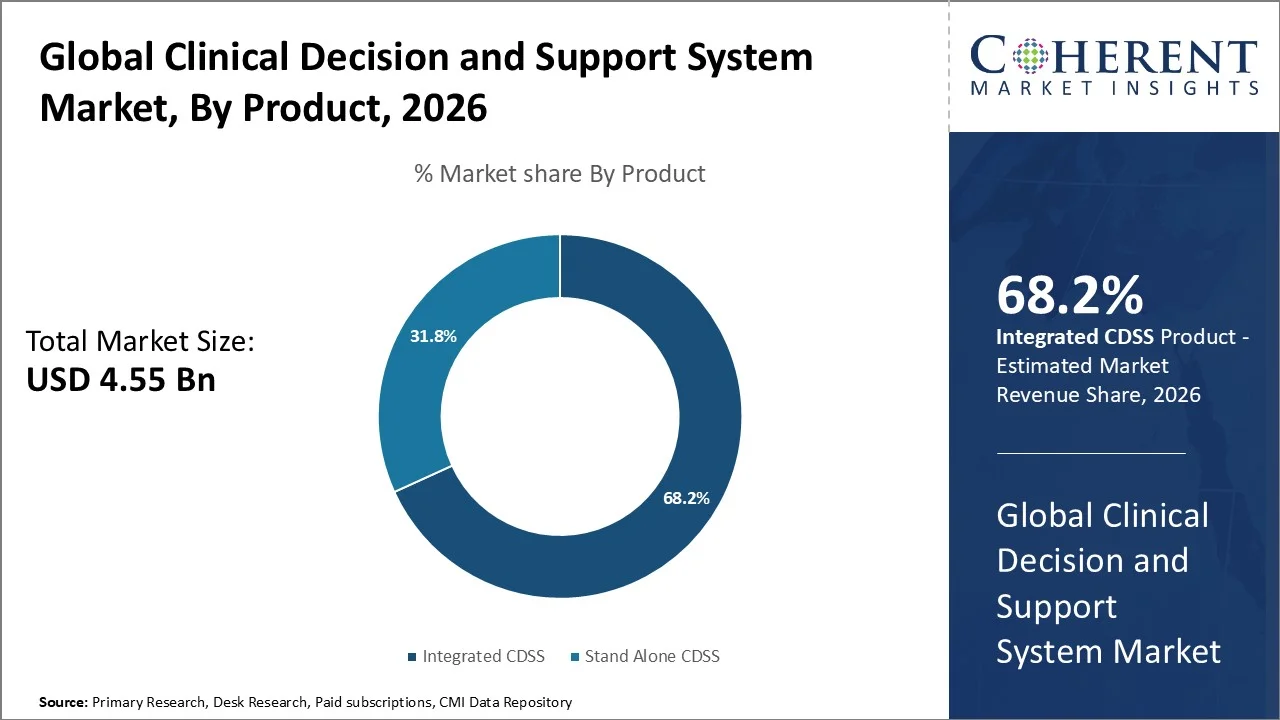
- The integrated CDSS segment is likely to dominate the market with 68.2% in 2026. The segment’s growth is owing to its direct integration with EHR (41% of U.S. hospitals with an EHR, also had a CDSS), CPOE, pharmacy, laboratory, and clinical workflow systems.
- The software segment is set to lead with 48.6% in 2026. The segment’s growth is owing to the rising use of rule engines, clinical alerts, dashboards, diagnostic algorithms, and evidence-based care pathways. AHRQ notes that CDS tools can support order sets, dashboards, diagnosis, and treatment decisions.
- The premise CDSS segment is set to lead with 52.1%in 2026. The segment’s growth is owing to the preference for stronger control over patient data, regulatory compliance, cybersecurity, and integration with legacy hospital IT systems, especially in large healthcare facilities handling sensitive clinical records.
- The clinical alert and guidelines segment is set to lead with 37.4% in 2026. The segment’s growth is owing to the medication safety, care standardization, and real-time warning needs. Medication-related CDSS with computerized provider order entry has been associated with reduced medication errors and adverse drug event prevention. ONC’s 2025 SAFER Guide for CPOE with Decision Support focuses on order structure, alerts, warnings, libraries, and CDS safety practices.
- The hospitals segment is set to lead with 45.80% in 2026. The segment’s growth is owing to the high patient volumes, multi-specialty care, complex medication use, and rapid EHR penetration. Hospitals increasingly use CDSS to reduce clinical variation and improve safety across departments.
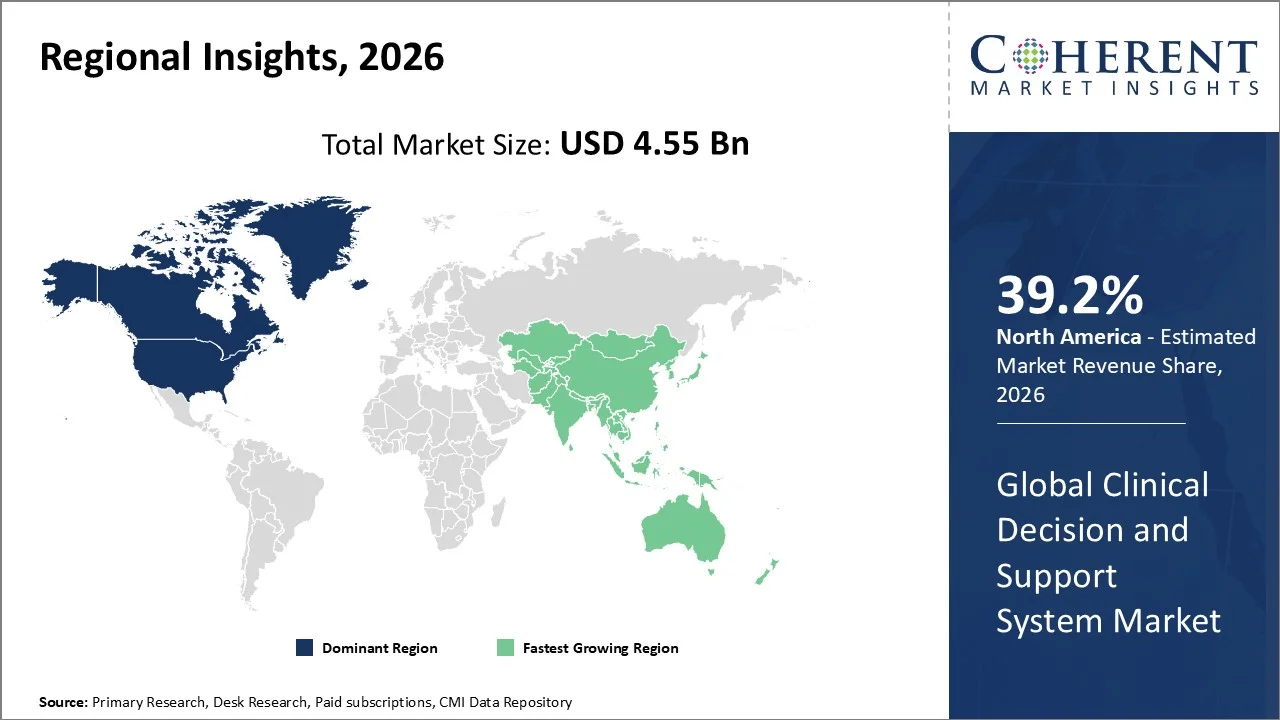
- North America is expected to acquire the prominent share of 39.20% in 2026. The region’s growth is owing to the high healthcare IT spending, mature EHR infrastructure, strong regulatory guidance, and early adoption of AI-enabled clinical tools. S. healthcare spending reached USD 5.3 trillion in 2024, strengthening digital care investments.
AI-Enabled Predictive Decision Support Adoption is Transforming the Clinical Decision and Support System Market in the US
The AI-enabled predictive decision support is strengthening the Clinical Decision and Support System Market in the U.S. This is because the hospitals are embedding risk scoring, early disease detection, readmission prediction, and treatment recommendation tools into EHR workflows.
In 2023, nearly 66% of U.S. hospitals used predictive AI integrated into EHRs, thereby reflecting the growing adoption of AI-driven clinical decision tools. Separately, around 9 in 10 hospitals integrated data from third-party technologies into EHRs for at least one clinical purpose in 2024, thereby supporting the real-time CDS deployment in care settings.
In January 2026, Wolters Kluwer launched UpToDate Expert AI, a generative AI-powered clinical decision support capability. It is designed to help clinicians retrieve evidence-based answers faster at the point of care. The launch also promotes the AI-enabled CDS adoption by improving clinical search, treatment guidance, as well as workflow efficiency within trusted physician decision-support content.
EHR-Native, Interoperable CDSS through FHIR and CDS Hooks: A Major Breakthrough in the Market
The EHR-native, interoperable CDSS is becoming a major breakthrough as providers shift from standalone alerts to workflow-embedded decision support.
In 2024, around 7 in 10 U.S. hospitals used standards-based APIs like HL7 FHIR, thereby creating a stronger base for interoperable CDSS deployment. The ONC also reported that in 2024, nearly all non-federal acute care hospitals participated in electronic public health reporting for core data types. This is strengthening the structured data flows needed for real-time clinical guidance.
In November 2025, the CDC updated its Clinical Decision Support for Immunization (CDSi) resource. It automates ACIP-based vaccine recommendations and delivers patient-specific immunization guidance to the healthcare providers. This strengthens the wider incorporation of interoperable, standards-based CDSS within EHR workflows.
- Current Industry Events of 2026
- Market Size Estimation
- Regional Breakdown
- Competitive Landscape
- Customer Intelligence
- Segmental Analysis
- Pricing Analysis
- Key Market Drivers, Challenges & Future Trends
- Customized Insights Section
Current Events and Their Impact on the Clinical Decision and Support System Market
Current Event | Description and its Impact |
U.S. ONC HTI-1 Algorithm Transparency Requirements
|
|
U.S. FDA Draft Guidance on AI-Enabled Device Software Functions
|
|
Segmental Insights
Why is Integrated CDSS Acquiring the Largest Share?
On the basis of product, the integrated CDSS segment is projected to account for the largest Clinical Decision and Support System Market share of 68.2% in 2026. The segment’s growth is owing to the rising integration of decision support into EHR, computerized physician order entry, medication review, and clinical workflow platforms, which reduces the need for separate standalone systems.
The CDC’s 2024 National Electronic Health Records Survey reported that around 95.0% of U.S. office based physicians had adopted EHR systems, thereby creating a strong digital base for embedded CDSS adoption.
In February 2026, EBSCO Clinical Decisions launched Dyna AI Mode, an AI powered interface within DynaMed, DynaMedex, and Dynamic Health. The solution delivers fast, evidence based answers at the point of care while giving clinicians visibility into reasoning and supporting evidence. This is strengthening demand for integrated clinical decision support tools.
Clinical Alert and Guidelines hold the Largest Market Share
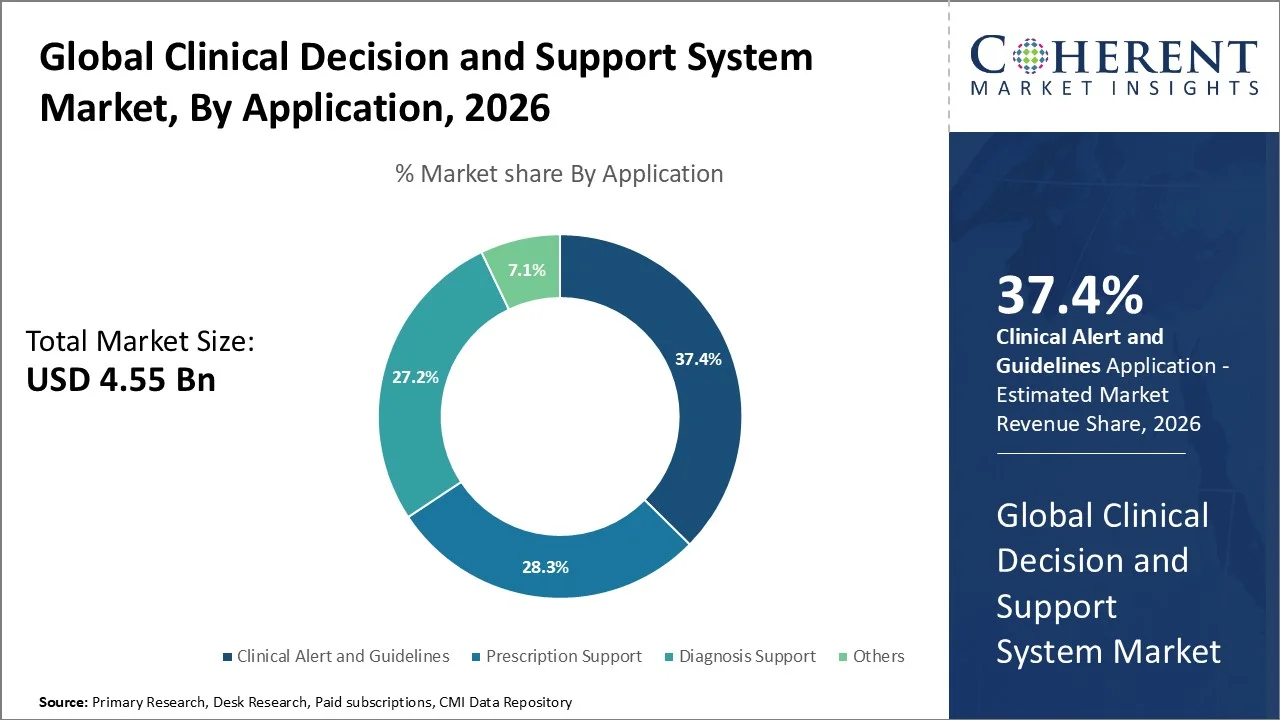
On the basis of application, the clinical alert and guidelines segment lead with a major 37.4% share in 2026. The segment’s growth is owing to the rising use of real-time alerts for medication safety, drug-drug interaction checks, allergy warnings, abnormal laboratory flags, and guideline-based treatment reminders.
AHRQ states that clinical decision support systems have the potential to prevent more than 50% of medication errors and 95% of adverse drug events in operating rooms, supporting adoption in high-risk clinical workflows.
AHRQ also notes that drug-drug interactions are responsible for up to 14% of adverse drug reactions in hospitalized patients and occur in up to 13% of elderly ambulatory patients, strengthening demand for prescription and safety alerts.
In January 2026, the U.S. FDA issued and re issued its Clinical Decision Support Software Final Guidance. The guidance clarifies as of which CDS software functions are excluded from the definition of a medical device under Section 520(o)(1)(E) of the FD&C Act. This regulatory clarity is promoting the faster development and incorporation of compliant clinical decision support tools in healthcare settings.
Clinical Decision and Support System Market Trends
- Rising integration of CDSS with electronic health records improves real-time alerts, clinical workflow efficiency, and evidence-based decision-making.
- AI-enabled CDSS adoption is expanding, helping clinicians with diagnosis support, treatment recommendations, risk prediction, and medical research summarization.
- Cloud-based CDSS platforms are gaining traction as hospitals and clinics seek scalable, remotely accessible, and cost-efficient decision-support tools.
- Growing focus on medication safety, antimicrobial stewardship, and error reduction is increasing demand for prescription support and clinical alert systems. CDC highlights hospital antibiotic stewardship as a key approach to improve patient care and combat antimicrobial resistance, supporting CDSS use in prescribing and guideline adherence.
- Strong digital health infrastructure supports market growth. In the U.S., nearly 96% of non-federal acute care hospitals and 78% of office-based physicians had adopted certified EHR systems by 2021, creating a strong base for integrated CDSS deployment. Physician adoption of AI is also accelerating, with AMA’s 2026 survey showing over 80% of physicians using AI professionally, including tools for care documentation and standards-of-care summaries.
Regional Insights
North America Dominates Owing to the Strong Hospital Digitization and AI-Enabled Clinical Decision Support Adoption
The North America region accounts for 39.2% of the market share in 2026. The region’s growth is owing to the strong hospital digitization, medication safety workflows, and EHR-based decision support adoption.
In the U.S., 84.4% of hospitals used computerized provider order entry for laboratory tests, radiology tests, and medications, up from 69.8%, strengthening the base for order-entry alerts, duplicate-test checks, and medication-related CDSS.
In addition, 84.6% of hospitals used medication reconciliation, up from 76.1%, supporting clinical decision tools that compare inpatient and preadmission medication lists and reduce drug-related risks.
In September 2025, Micromedex launched AI-powered search for clinical decision support, enabling clinicians to ask questions on drug interactions, IV compatibility, toxicology, poison management, dosing calculations, and pediatric care. The tool cites trusted sources and uses a clinical validation process to support faster, accurate, and evidence-based patient care decisions.
Asia Pacific Clinical Decision and Support System Market Trends
Asia Pacific is expected to witness strong growth in Clinical Decision and Support System Market over the forecast period. The region’s growth is owing to the rising digital health infrastructure, interoperable health records, and medication decision-support adoption.
In India, ABDM reported nearly 83.8 crore ABHA accounts and 79.52 crore linked health records as of December 2025, creating a large longitudinal data base for CDSS integration. In Australia, the government’s electronic prescribing framework requires clinical software to comply with privacy, security, PBS, and state/territory rules, strengthening safe prescribing workflows.
In September 2025, Wolters Kluwer Health launched UpToDate Enterprise Edition in APAC, an AI-enhanced CDS solution designed for healthcare systems and hospitals. The platform supports AI-powered search, usage analytics, and enterprise-level clinical guidance, helping administrators and clinicians deliver more consistent, evidence-based care.
AI-Enabled Medication Safety and Workflow Optimization is Accelerating the Clinical Decision and Support System Market in United States
The market in United States is being propelled by safer electronic ordering workflows and stronger CDS optimization needs. ONC states that clinical decision support alerts notify clinicians about drug-allergy, drug-drug, and drug-disease interactions and provide dosing guidance, making CDS central to medication safety and order-entry decisions.
In December 2025, Marathon Health partnered with Avo, an AI-powered clinical decision support platform, to enhance outpatient care delivery across its 1,600+ provider network. The collaboration is expected to support faster evidence-based clinical decisions, improve care consistency, and strengthen the use of AI-enabled CDSS tools in advanced primary care settings across the U.S.
China Clinical Decision and Support System Market Trends
The are key drivers of the Clinical Decision and Support System Market in the China are growing hospital digitization and AI-enabled clinical workflow adoption. China had 1.092 million medical and health institutions and 39,000 hospitals by the end of 2024, creating a large base for CDSS deployment.
In January 2026, Ant Group upgraded the PC platform of its AI health service AQ with DeepSearch for clinicians, a capability designed to support evidence-based clinical decision-making. The service is available free of charge to clinicians and medical students, helping improve access to clinical evidence, support faster information retrieval, and strengthen AI-enabled decision support adoption across China’s healthcare ecosystem.
Who are the Major Companies in Clinical Decision and Support System Industry
Some of the major key players in Clinical Decision and Support System Market are Cerner Corporation, Allscripts Healthcare Solutions, Inc., IBM Watson Health, GE Healthcare, Change Healthcare, Zynx Health, Carestream Health Inc., First Databank, Inc., NextGen Healthcare Information Systems, Agfa Healthcare, Medical Information Technology Inc., Athena Health, Wolters Kluwer NU, Siemens Healthineers, and Philips Healthcare.
Key News
- In May 2026, Roche entered into a definitive merger agreement to acquire PathAI, a U.S.-based digital pathology and AI technology company. The acquisition is expected to strengthen Roche’s digital pathology portfolio, improve laboratory efficiency, and support personalized diagnostics.
- In March 2026, Avo partnered with EBSCO Clinical Decisions to embed DynaMed content into EHR workflows through Ask Avo, its context aware AI consult tool. The integration enables clinicians to ask clinical questions, access evidence based answers, and auto draft notes using real time patient context.
Market Report Scope
Clinical Decision and Support System Market Report Coverage
| Report Coverage | Details | ||
|---|---|---|---|
| Base Year: | 2025 | Market Size in 2026: | USD 4.55 Bn |
| Historical Data for: | 2020 To 2024 | Forecast Period: | 2026 To 2033 |
| Forecast Period 2026 to 2033 CAGR: | 10.1% | 2033 Value Projection: | USD 8.91 Bn |
| Geographies covered: |
| ||
| Segments covered: |
| ||
| Companies covered: | Cerner Corporation, Allscripts Healthcare Solutions, Inc., IBM Watson Health, GE Healthcare, Change Healthcare, Zynx Health, Carestream Health Inc., First Databank, Inc., NextGen Healthcare Information Systems, Agfa Healthcare, Medical Information Technology Inc., Athena Health, Wolters Kluwer NU, Siemens Healthineers, and Philips Healthcare. | ||
| Growth Drivers: |
| ||
| Restraints & Challenges: |
| ||
Analyst Opinion
- The Clinical Decision and Support System Market is driven by growing medical need for safer and faster clinical decisions. In the U.S., diagnostic errors affect more than 12 million adults every year in outpatient care, while nearly 795,000 people may die or become permanently disabled annually due to misdiagnosis. That means the market is not growing only because of digital trends, it is growing because hospitals still need better decision accuracy.
- Medication safety is one of the largest use cases in the world. Globally, medication errors cost nearly USD 42 billion every year, creating strong demand for prescription alerts, drug interaction checks, dosage support, and clinical guideline tools. This makes CDSS highly important for hospitals and clinics that are trying to reduce preventable errors and improve patient outcomes.
- Integrated CDSS is gaining significant traction as healthcare systems are already using digital records at a large scale. In 2024, more than 90.0% of U.S. office based physicians had adopted electronic health record systems, while 83.6% used certified EHR systems. This strong digital base is expected to further drive CDSS adoption, as decision support tools can be embedded directly into diagnosis, treatment planning, prescription support, and clinical workflow systems.
Speak to the analyst
Want personalized insights?
Take the findings above to one of our principal consultants, or have the report rebuilt around the segments, geographies and competitors you actually track.
Market Segmentation
- By Product (Revenue, USD Bn, 2021-2033)
- Stand Alone CDSS
- Integrated CDSS
- By Component (Revenue, USD Bn, 2021-2033)
- Hardware
- Software
- Services
- By Mode of Delivery (Revenue, USD Bn, 2021-2033)
- On Premise CDSS
- Cloud based CDSS
- By Application (Revenue, USD Bn, 2021-2033)
- Diagnosis Support
- Prescription Support
- Clinical Alert and Guidelines
- Others
- By End User (Revenue, USD Bn, 2021-2033)
- Hospitals
- Ambulatory Centers
- Clinics
- Others
- By Region (Revenue, USD Bn, 2021-2033)
- North America
- U.S.
- Canada
- Latin America
- Brazil
- Mexico
- Argentina
- Rest of Latin America
- Europe
- Germany
- U.K.
- France
- Italy
- Spain
- Russia
- Rest of Europe
- Asia Pacific
- China
- India
- Japan
- Australia
- South Korea
- ASEAN
- Rest of Asia Pacific
- Middle East
- GCC
- Israel
- Rest of Middle East
- Africa
- South Africa
- Central Africa
- North Africa
- North America
- Key Players
- Cerner Corporation
- Allscripts Healthcare Solutions, Inc.
- IBM Watson Health
- GE Healthcare
- Change Healthcare
- Zynx Health
- Carestream Health Inc.
- First Databank, Inc.
- NextGen Healthcare Information Systems
- Agfa Healthcare
- Medical Information Technology Inc.
- Athena Health
- Wolters Kluwer NU
- Siemens Healthineers
- Philips Healthcare
Sources
Primary Research Interviews
- Clinical Decision Support System Providers
- Electronic Health Record (EHR) Vendors
- Hospital IT Directors and CIOs
- Clinical Informatics Specialists
- Physicians and Healthcare Practitioners
- Healthcare Data Analytics Solution Providers
- AI-based Healthcare Software Developers
- Regulatory and Compliance Consultants
- Others
Databases
- Bloomberg Terminal
- Thomson Reuters Eikon
- S&P Global Market Intelligence
- IQVIA
- GlobalData Healthcare
- Definitive Healthcare
- Clarivate Analytics
- Others
Magazines
- Healthcare IT News
- HealthTech Magazine
- Becker’s Health IT
- Modern Healthcare
- MobiHealthNews
- Healthcare Dive
- Others
Journals
- Journal of the American Medical Informatics Association
- International Journal of Medical Informatics
- npj Digital Medicine
- Applied Clinical Informatics
- BMJ Health & Care Informatics
- Journal of Biomedical Informatics
- Others
Newspapers
- Financial Times
- The Wall Street Journal
- Reuters
- Bloomberg News
- The New York Times
- Others
Associations
- Healthcare Information and Management Systems Society (HIMSS)
- American Medical Informatics Association (AMIA)
- Health Level Seven International (HL7)
- College of Healthcare Information Management Executives (CHIME)
- American Medical Association (AMA)
- EHR Association
- Others
Public Domain Sources
- U.S. Food and Drug Administration (FDA)
- Office of the National Coordinator for Health Information Technology (ONC)
- Agency for Healthcare Research and Quality (AHRQ)
- Centers for Medicare & Medicaid Services (CMS)
- National Institutes of Health (NIH) / NCBI
- World Health Organization (WHO)
- European Medicines Agency (EMA)
- ClinicalTrials.gov
- NHS England Digital Health Sources
- Others
Proprietary Elements
- CMI Data Analytics Tool
- Proprietary CMI Existing Repository of Information for the Last 10 Years
Get access to 250+ pages report
Every segment, forecast, competitor profile and data table behind the analysis above — available for instant download.
- ESOMAR Member
- ISO 9001:2015 Certified
- D-U-N-S Registered
- GDPR & CCPA Compliant
Missing comfort of reading report in your local language? Find your preferred language:
Transform your Strategy with Exclusive Trending Reports
Frequently Asked Questions
The Clinical Decision and Support System Market is expected to reach USD 8.91 Bn in 2033.
Major players operating in the global Clinical Decision and Support System Market include Cerner Corporation, Allscripts Healthcare Solutions, Inc., IBM Watson Health, GE Healthcare, Change Healthcare, Zynx Health, Carestream Health Inc., First Databank, Inc., NextGen Healthcare Information Systems, Agfa Healthcare, Medical Information Technology Inc., Athena Health, Wolters Kluwer NU, Siemens Healthineers, and Philips Healthcare.
The high capital investments, inadequate interoperability with existing IT infrastructure, and clinician resistance are the key factors hampering growth of the market.
The rising adoption of Electronic Health Records (EHR), advancements in artificial intelligence, and a growing need to reduce medication errors is boosting the demand for Clinical Decision and Support System.
The Clinical Decision and Support System Market is anticipated to grow at a CAGR of 10.1% between 2026 and 2033.
Among regions, North America is expected to account for a largest market share in the global Clinical Decision and Support System Market over the forecast period.