

Europe and Israel Mobile Applications for Melanoma Detection Market Analysis - 2026 To 2033
The Europe and Israel mobile applications for melanoma detection market is anticipated to grow at a CAGR of 19.5% with USD 2.7 Mn in 2026 and is expected to reach USD 9.2 Mn in 2033. Increasing prevalence of melanoma (Melanoma causes more than 20,000 deaths every year in Europe. This means that over 20,000 people die from this type of skin cancer each year) is expected to propel growth of the Europe and Israel mobile applications for melanoma detection market over the forecast period. Furthermore, increasing penetration of internet is expected to offer lucrative growth opportunities for players in the Europe and Israel mobile applications for melanoma detection market.
Key Takeaways
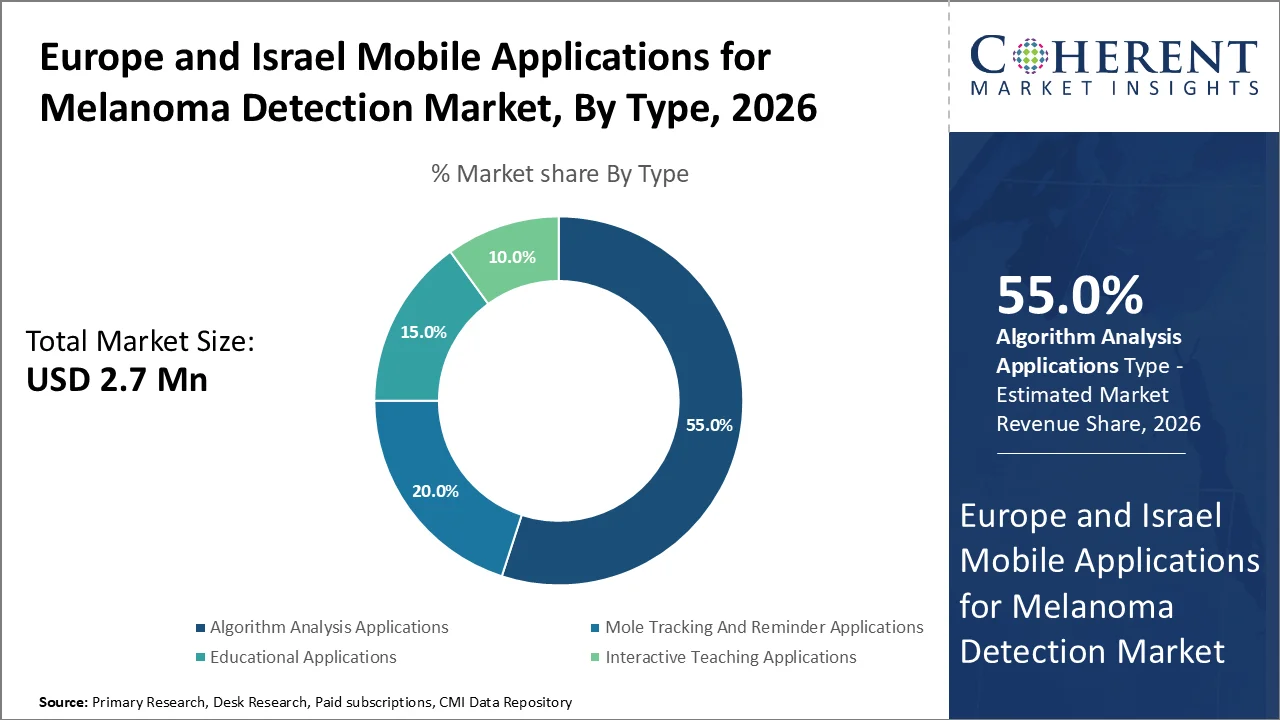
- Algorithm analysis applications segment is expected to account the largest share of 55% in 2026, as they solve the most critical and valuable problem in the market, detecting melanoma early and accurately. The number of deaths from melanoma skin cancer in the UK is expected to decrease by 11% between 2024 and 2026. This means fewer people are expected to die from the disease during this period.
- Hospitals segment will dominate with 45% in 2026, because they are the primary clinical hub for diagnosis, validation, and treatment decisions, making them the most critical and trusted point of use for melanoma detection applications. A survey of experts in 33 European countries found that in Eastern Europe, about 46% of melanoma cases diagnosed were thicker than 2 mm. This shows that many patients are diagnosed at a later stage of the disease.
Segmental Insights
Why is Algorithm Analysis Applications Acquiring the Largest Market Share?
Algorithm analysis applications segment is projected to account for the largest share of type in 2026, representing approximately 55% of the total volume. Primarily because of the increasing adoption of AI-assisted diagnostic tools across European healthcare systems. As per the World Health Organization, according to WHO/Europe, 74% of EU countries already use AI in diagnostics, including medical imaging and disease detection, while countries are expanding AI training for healthcare professionals. This broader acceptance of AI supports the adoption of AI-powered melanoma detection applications.
These applications operate by understanding uploaded or real-time captured images of skin lesions as well as comparing them with a vast database of clinically verified melanoma and non-melanoma cases utilizing deep learning convolutional neural networks.
The reliability as well as precision of these systems have drawn significant endorsement from dermatological bodies across Europe. For example, the European Academy of Dermatology and Venereology (EADV) has consistently targeted the importance of digital diagnostic aids in bridging the gap between patient access and specialist consultation, particularly in regions where dermatologist-to-patient ratios remain critically low.
- Current Industry Events of 2026
- Market Size Estimation
- Regional Breakdown
- Competitive Landscape
- Customer Intelligence
- Segmental Analysis
- Pricing Analysis
- Key Market Drivers, Challenges & Future Trends
- Customized Insights Section
Hospitals holds the Largest Market Share
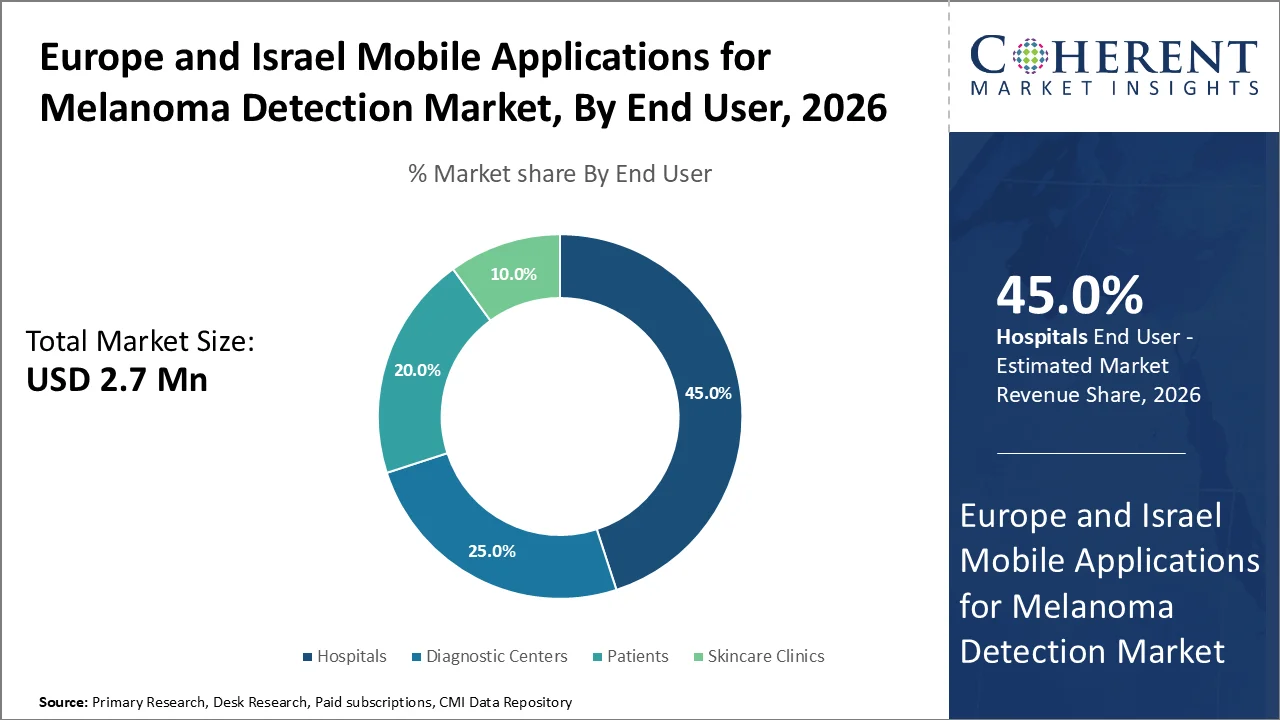
Based on end user, hospitals dominate the market, accounting for a significant 45% share in 2026, hospitals dominate the end-user segment as they have established dermatology services, specialist clinicians, as well as patient management systems that support the use of digital diagnostic tools. Recent NHS trials also show that mobile melanoma detection applications can improve clinical workflows by lowering unnecessary hospital referrals by more than 50%, showing their value within connected healthcare systems.
Their capacity to handle a large volume of dermatological cases simultaneously, is another growth inducing factor, where clinicians can leverage AI-driven mobile applications to support differential diagnosis, triage patients more efficiently, and improve clinical workflows in dermatology departments.
Hospitals are typically equipped with trained dermatologists, oncologists, as well as pathologists who work collaboratively, making the integration of mobile-based dermatoscopy applications particularly valuable in streamlining diagnostic processes.
Market Drivers
AI-Powered Dermoscopic Analysis is transforming the Europe and Israel Mobile Applications for Melanoma Detection Industry
One of the most dominant trends across European and Israeli markets is the integration of convolutional neural networks (CNNs) within mobile dermatology applications. These deep learning architectures are trained on hundreds of thousands of annotated dermoscopic images, making them to classify lesions with a specificity as well as sensitivity approaching that of experienced dermatologists. Applications now utilize multi-class classification models capable of distinguishing between melanoma, basal cell carcinoma, seborrheic keratosis, and benign nevi simultaneously.
Israeli technology companies, particularly those operating within Tel Aviv's thriving health-tech ecosystem, have been instrumental in developing algorithms that process smartphone camera images without requiring clinical dermoscopes. This democratizes early detection, making it available beyond hospital settings.
Current Events and Their Impact on the Europe and Israel Mobile Applications for Melanoma Detection Market
Current Event | Description and its Impact |
EU AI Act and MDR guidance for AI-enabled medical device software (2025–2026) |
|
EU guidance on Medical Device Software (MDSW) apps distributed through app stores (2025) |
|
Europe and Israel Mobile Applications for Melanoma Detection Market Trends
- The single most defining trend reshaping the market is the high adoption of convolutional neural networks (CNNs) as well as deep learning algorithms embedded within mobile applications.
- The post-COVID-19 landscape has permanently accelerated the integration of mobile melanoma detection tools into teledermatology
- The Medical Device Regulation by the European Union (MDR 2017/745), which came into full effect in 2021, is fundamentally rebuilding the competitive landscape. Applications classified as Class IIa or Class IIb Software as a Medical Device (SaMD) must now satisfy rigorous clinical evidence requirements, post-market surveillance obligations, as well as notified body conformity assessments.
- The strategic evolution of consumer wellness apps is another key trend into clinically validated diagnostic tools, supported by real-world data collection, dermatologist review loops, as well as integration with electronic health records (EHRs).
- Next-generation applications are inclining from single-lesion analysis to holistic, longitudinal skin health monitoring, incorporating personal UV exposure data, genetic risk indicators, phototype classification, and time-series lesion tracking.
Who are the Major Companies in Europe and Israel Mobile Applications for Melanoma Detection Industry
Some of the major key players in Europe and Israel mobile applications for melanoma detection market include, SkinVision, DermaCompare, Dermatology Planet, DermLink.MD, Doctor Mole, FotoSkin, iDoc24, iSkin, LoveMySkin, and Melanoma Calculator
Key News
- In June 2026, DERM Zero is the world's first smartphone-based skin cancer detection tool that uses a Class III approved AI medical technology. It can check skin spots and provide a clinical-level assessment using a normal smartphone, without needing extra equipment.
- In December 2025, SkinVision which is a mobile app was launched that helps people check their skin for possible signs of skin cancer at an early stage. The app uses clinically tested AI technology to analyze photos of skin spots taken with a smartphone. It tells users if a spot may be high risk and should be checked by a doctor. The app is designed to support early detection and encourage people to seek medical advice when needed.
Market Report Scope
Europe and Israel Mobile Applications for Melanoma Detection Market Report Coverage
| Report Coverage | Details | ||
|---|---|---|---|
| Base Year: | 2025 | Market Size in 2026: | USD 2.7 Mn |
| Historical Data for: | 2020 To 2024 | Forecast Period: | 2026 To 2033 |
| Forecast Period 2026 to 2033 CAGR: | 19.5% | 2033 Value Projection: | USD 9.2 Mn |
| Geographies covered: |
| ||
| Segments covered: |
| ||
| Companies covered: | SkinVision, DermaCompare, Dermatology Planet, DermLink.MD, Doctor Mole, FotoSkin, iDoc24, iSkin, LoveMySkin, and Melanoma Calculator | ||
| Growth Drivers: |
| ||
| Restraints & Challenges: |
| ||
Analyst Opinion
- The Europe and Israel mobile applications for melanoma detection market is experiencing significant momentum, driven by the increasing prevalence of skin cancer cases across the region and growing consumer awareness regarding early diagnosis. The number of new melanoma skin cancer cases in the UK is expected to increase by 8% between 2024–2026 and 2038–2040. This means more people are expected to be diagnosed with melanoma in the future.
- Advancements in artificial intelligence along with deep learning algorithms have significantly improved the diagnostic accuracy of mobile-based melanoma detection applications, making them highly reliable clinical tools.
- Many people in Europe use smartphones, and Israel has a very advanced healthcare system. Because of this, more patients and doctors are using mobile apps for skin cancer detection.
- Regulatory frameworks, particularly the stringent European Medical Device Regulation (MDR), show a key restraint by imposing rigorous compliance requirements on application developers, potentially delaying product launches as well as high development costs.
- Additionally, concerns surrounding patient data privacy under GDPR make operational complexities for companies developing these diagnostic alternatives. Limited reimbursement policies for digital health tools in several European countries also hinder broader market penetration.
Speak to the analyst
Want personalized insights?
Take the findings above to one of our principal consultants, or have the report rebuilt around the segments, geographies and competitors you actually track.
Market Segmentation
- By Type (Revenue, USD Mn, 2021-2033)
- Algorithm Analysis Applications
- Mole Tracking and Reminder Applications
- Educational Applications
- Interactive Teaching Applications
- By End User (Revenue, USD Mn, 2021-2033)
- Diagnostic Centers
- Patients
- Hospitals
- Skincare Clinics
- By Region
- Europe
- UK
- Germany
- Italy
- France
- Spain
- Russia
- Rest of Europe
- Israel
- Europe
Sources
Primary Research Interviews
- Dermatologists & Oncologists
- Mobile Health Application Developers
- Hospital IT & Digital Health Officers
- Regulatory Affairs Specialists (EU MDR & Israeli MOH)
- Others
Databases
- GlobalData Healthcare Database
- IQVIA Healthcare Analytics
- European Medicines Agency (EMA) Database
- Others
Magazines
- Digital Health Age
- Dermatology Times Europe
- mHealth Intelligence Magazine
- Health Tech World
- Others
Journals
- Journal of the American Academy of Dermatology
- JMIR mHealth and uHealth
- British Journal of Dermatology
- The Lancet Digital Health
- Others
Newspapers
- Financial Times (Health & Technology Section)
- The Guardian (Healthcare)
- Haaretz (Israel Health & Technology)
- European Pharmaceutical Review
- Others
Associations
- European Academy of Dermatology and Venereology (EADV)
- Israeli Society of Dermatology and Venereology (ISDV)
- European Connected Health Alliance (ECHAlliance)
- Skin Cancer Foundation Europe
- Others
Public Domain Sources
- European Commission – Digital Health Strategy Portal
- World Health Organization (WHO) Cancer Reports
- Israel Ministry of Health (MOH) Official Publications
- European Health Data Space (EHDS) Reports
- Others
Proprietary Elements
- CMI Data Analytics Tool
- Proprietary CMI Existing Repository of information for last 10 years
Get access to 250+ pages report
Every segment, forecast, competitor profile and data table behind the analysis above — available for instant download.
- ESOMAR Member
- ISO 9001:2015 Certified
- D-U-N-S Registered
- GDPR & CCPA Compliant
Missing comfort of reading report in your local language? Find your preferred language:
Transform your Strategy with Exclusive Trending Reports
Frequently Asked Questions
The Europe and Israel mobile applications for melanoma detection market is expected to reach USD 9.2 Mn in 2033.
Major players operating in the Europe and Israel mobile applications for melanoma detection market include SkinVision, DermaCompare, Dermatology Planet, DermLink.MD, Doctor Mole, FotoSkin, iDoc24, iSkin, LoveMySkin, and Melanoma Calculator.
Concerns regarding accuracy of and stringent regulations related to mobile applications for melanoma detection is expected to restrain the Europe and Israel Mobile Applications for Melanoma Detection market growth over the forecast period.
Increasing prevalence of melanoma and increasing adoption of smartphones is driving growth of the Europe and Israel mobile applications for melanoma detection market.
The Europe and Israel mobile applications for melanoma detection market is anticipated to grow at a CAGR of 19.5% between 2026 and 2033.
Melanoma detection apps use artificial intelligence (AI) or digital body mapping to track mole changes.
Melanoma is a cancer occurring in melanocytes, which are cells that create melanin pigment, and is a highly heterogeneous disease. Some of the various types of melanomas include cutaneous melanoma (CM), mucosal melanoma (MM), ocular melanoma (OM), melanoma of the internal organs, and melanoma of the soft parts of the body.