

Western Europe Medical Recruitment Market Size and Share Analysis - 2026 To 2033
The Western Europe medical recruitment market is anticipated to grow at a CAGR of 4.7% with USD 26.6 Bn in 2026 and is expected to reach USD 36.2 Bn in 2033. Growth in pharmaceutical sector (the value of pharmaceutical imports increased by 4% from 2023 to 2024, reaching £25.9 Bn in 2024) is expected to propel growth of the Western Europe medical recruitment market over the forecast period. Moreover, increasing prevalence of chronic disorders is also expected to aid in growth of the market. In 2024, more than half (53.7%) of adults in Germany reported living with a chronic or long-term health condition. Large scale pharmaceutical companies are setting up new facilities in European region which creates new opportunities for the growth of Western Europe medical recruitment market.
Key Takeaways
- Nursing/healthcare segment is expected to account the largest share of 40% in 2026, rising healthcare needs, an aging population, workforce shortages, and high employee turnover create continuous recruitment demand, making this the largest vertical. The estimated number of workforce jobs in the UK reached 36.8 million in March 2026. This was an increase of 256,000 jobs (0.7%) compared with December 2025.
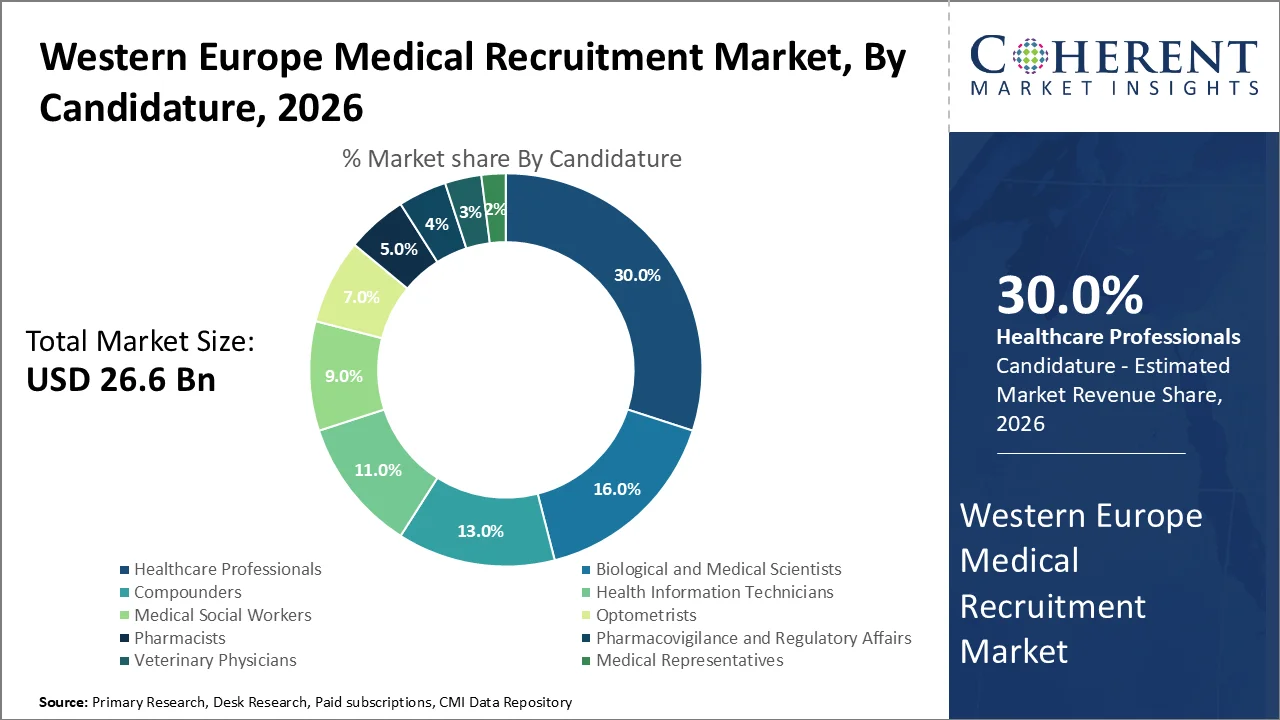
- Healthcare professionals segment will dominate with 30% in 2026, because they form the core workforce of the healthcare industry. Healthcare spending in the UK is about 11.4% of the country’s GDP, which is one of the higher levels in Western Europe.
- Recruitment services segment will dominate with 55% in 2026, ongoing workforce shortages, high staff turnover, and increasing demand for qualified medical personnel make recruitment the primary service required by hospitals, clinics, pharmaceutical companies, and other healthcare organizations. The OECD reports that nearly 1 in 5 doctors in some European countries are aged 55+, indicating upcoming replacement pressure.
Segmental Insights
Healthcare Professionals holds the Largest Market Share
Based on candidature, healthcare professionals dominate the market, accounting for a significant 30% share in 2026, owing to their critical role in the delivery of healthcare services across the region. The profile of healthcare professionals, encompassing physicians, nurses, allied health workers, as well as specialist practitioners, is foundational to the healthcare infrastructure of Western Europe.
This sector’s dominance is driven by several interlinked factors such as demographic shifts, increasing prevalence of chronic diseases, rising patient expectations, and a general emphasis on improving quality of care. In 2026, healthcare spending per person in France is USD 7,332, which is a 2.8% increase from 2025.
Healthcare systems in countries including Germany, France, the UK, etc., have been intensively investing in expanding their skilled healthcare workforce to address the increasing healthcare demands posed by aging populations.
Reports from the Directorate-General European Union for Health and Food Safety show initiatives encouraging member states to develop overall strategies to retain as well as attract Healthcare Professionals through enhanced working conditions and continuous professional development programs.
- Current Industry Events of 2026
- Market Size Estimation
- Regional Breakdown
- Competitive Landscape
- Customer Intelligence
- Segmental Analysis
- Pricing Analysis
- Key Market Drivers, Challenges & Future Trends
- Customized Insights Section
Recruitment Services holds the Largest Market Share
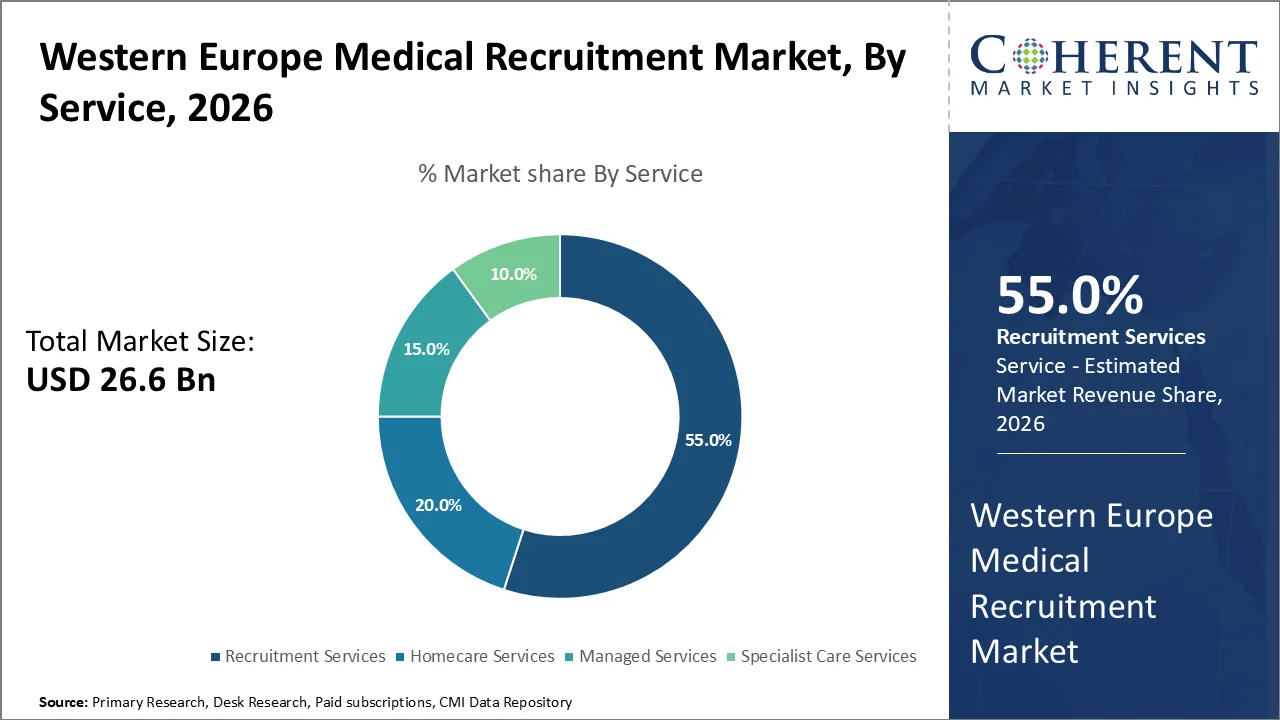
Based on service, recruitment services dominate the market, accounting for a significant 55% share in 2026, owing to the increasing demand for skilled medical professionals across hospitals, clinics, as well as healthcare institutions throughout the region. The healthcare ecosystems in Western European countries including Germany, France, the United Kingdom, etc., have been facing considerable workforce shortages, particularly among nurses, general practitioners, and specialized physicians.
Recruitment Services have been instrumental in scaling the gap by efficiently matching qualified candidates to areas with acute demand, effectively supporting the continuity as well as quality of patient care.
For instance, organizations like the National Health Service (NHS) in the UK have highly invested in international recruitment drives as well as partnerships with recruitment agencies that specialize in sourcing qualified healthcare workers from abroad, especially from the European Economic Area (EEA) and beyond. The NHS long-term workforce plan outlines record recruitment and expanded training for doctors, nurses, dentists, and other healthcare professionals to strengthen the workforce.
Why is Nursing/Healthcare Acquiring the Largest Market Share?
Nursing/Healthcare segment is projected to account for the largest share of vertical in 2026, representing approximately 40% of the total volume. Owing to an unprecedented and sustained demand for qualified nursing professionals across public and private healthcare systems throughout the region.
Aging populations are having escalating demand for long-term care, chronic disease management, as well as acute hospital services. In 2026, in the UK, more than 1 in 3 adults are living with multiple long-term health conditions.
According to the World Health Organization (WHO) European Region office, Europe already hosts some of the oldest populations of the world, with countries such as Germany, Italy, and France recording some of the highest proportions of citizens aged over 65 globally. This aging demographic directly translates into intensified pressure on nursing workforces, as older patients need considerably more healthcare contact hours, home care services, as well as specialized nursing attention compared to younger populations.
Artificial Intelligence (AI) and Machine Learning (ML) is transforming the Western Europe Medical Recruitment Industry
Artificial Intelligence (AI) along with Machine Learning (ML) are making medical recruitment faster as well as more efficient. These technologies aid employers screen as well as rank candidates, match resumes with job requirements, predict candidate success, and use chatbots to answer basic questions. This makes it easy to find the right healthcare professionals for specialized medical roles.
Many healthcare recruiters are already utilizing AI and ML to improve hiring. For example, figured in the UK uses AI to match specialized healthcare professionals with job openings faster, while Huma uses machine learning to analyze candidate data as well as improve recruitment. These technologies can lower hiring time by up to 40%, improve the quality of hires through better candidate matching, and lower recruitment costs by automating routine hiring tasks.
Applicant Tracking Systems (ATS) with Advanced Analytics: A major breakthrough in Western Europe Medical Recruitment
Applicant Tracking Systems (ATS) with advanced analytics aid healthcare recruiters manage the hiring process easily. These systems store candidate information in one place, automatically schedule interviews, connect with job boards and LinkedIn, and provide reports to track recruitment performance. This helps recruiters find and manage candidates more efficiently.
Many healthcare recruitment companies use ATS to improve hiring. For example, Jobmedic in Germany uses a customized ATS to manage thousands of healthcare job applications across several European countries, while Idibu provides recruitment software that aid healthcare agencies source candidates through multiple channels. These systems improve recruiter productivity, provide faster communication with candidates, as well as support better hiring decisions using real-time recruitment data and analytics.
Current Events and Their Impact on the Western Europe Medical Recruitment Market
Current Event | Description and its Impact |
WHO Global Code on the International Recruitment of Health Personnel amended (May 2026) |
|
EU Framework of Action on Recruitment and Retention in Social Services (June 2025) |
|
Western Europe Medical Recruitment Market Trends
- There is a high integration of AI, machine learning, and advanced data analytics within recruitment platforms, improving candidate screening, matching accuracy, as well as reducing time-to-hire.
- The surge of temporary, contract-based, as well as locum tenens roles reflects healthcare providers’ need for adaptable staffing solutions to manage fluctuating patient volumes and specialized skill shortages. In March 2026, nearly 72.5% of patients began treatment against a target of 85%.
- Recruitment strategies increasingly prioritize diverse talent pools, reflecting broader social commitments within healthcare organizations.
Who are the Major Companies in Western Europe Medical Recruitment Industry
Some of the major key players in Western Europe medical recruitment market include, Medacs Healthcare, Euromotion Medical, CPL Healthcare Limited, ProClinical Limited, TFS Healthcare, EGV Recruiting, and CCM Recruitment
Key News
- In 2025, Cpl Healthcare continues expanding permanent recruitment services for hospitals, nursing homes, pharmacies, disability services, and community healthcare across Ireland and international markets.
- In 2025, Medacs Healthcare released permanent opportunities for experienced GMC registered consultants and doctors in the NHS.
Market Report Scope
Western Europe Medical Recruitment Market Report Coverage
| Report Coverage | Details | ||
|---|---|---|---|
| Base Year: | 2025 | Market Size in 2026: | USD 26.6 Bn |
| Historical Data for: | 2020 To 2024 | Forecast Period: | 2026 To 2033 |
| Forecast Period 2026 to 2033 CAGR: | 4.7% | 2033 Value Projection: | USD 36.2 Bn |
| Geographies covered: |
| ||
| Segments covered: |
| ||
| Companies covered: | Medacs Healthcare, Euromotion Medical, CPL Healthcare Limited, ProClinical Limited, TFS Healthcare, EGV Recruiting, and CCM Recruitment | ||
| Growth Drivers: |
| ||
| Restraints & Challenges: |
| ||
Analyst Opinion
- The Western Europe medical recruitment market is poised for steady growth, driven by several key factors shaping the healthcare landscape. Increasing demand for skilled healthcare professionals due to aging populations and rising chronic disease prevalence is a primary driver. The European Union faces a shortage of around 1.2 million doctors, nurses, and midwives.
- Healthcare providers are under pressure to maintain high-quality patient care amidst workforce shortages, hence stimulating demand for specialized recruitment services.
- Additionally, advancements in medical technology need recruitment firms to source professionals with niche skills, which adds complexity as well as value to the recruitment process. Around 74% of European Union (EU) countries are using AI-assisted diagnostics to support medical imaging, detect diseases, as well as aid doctors make clinical decisions.
- However, the market faces certain challenges, including stringent regulations by government authorities as well as visa restrictions impacting the mobility of international healthcare workers.
- Opportunities exist in the high adoption of digital platforms as well as AI-driven recruitment tools that streamline candidate sourcing and advance matching efficiency.
- Enhanced data analytics capabilities provide recruitment firms a competitive edge by identifying talent trends as well as optimizing placement strategies.
Speak to the analyst
Want personalized insights?
Take the findings above to one of our principal consultants, or have the report rebuilt around the segments, geographies and competitors you actually track.
Market Segmentation
- By Vertical (Revenue, USD Bn, 2021-2033)
- Animal Health
- Biotechnology Industry
- Medical Devices
- Medical Capital Equipment
- Medical Consumables
- Surgical Manufacturing & Distribution
- Medical Research/Clinical Research
- Nursing/Healthcare
- Optometry
- Paramedical Staff
- Pharmacy
- Regulatory and Quality
- Scientific Research
- Pharmaceutical Industry
- By Candidature (Revenue, USD Bn, 2021-2033)
- Biological and Medical Scientists
- Compounders
- Health Information Technicians
- Healthcare Professionals
- Anesthesiologist Technicians
- Dentists
- General Physicians
- Lab Assistants
- Mental Health Specialists
- Nurses and Paramedical Staff
- Radiologists
- Surgeons
- Medical Social Workers
- Optometrists
- Pharmacists
- Pharmacovigilance and Regulatory Affairs
- Veterinary Physicians
- Medical Representatives
- By Service (Revenue, USD Bn, 2021-2033)
- Homecare Services
- Managed Services
- Consulting Services
- Recruitment Process Outsourcing (RPO)
- Vendor Management
- Specialist Care Services
- Recruitment Services
- Permanent Positions
- Temporary Positions
- By Region
- Western Europe
- UK
- France
- Germany
- Benelux
- Sweden
- Norway
- Denmark
- Rest of Western Europe
- Western Europe
Sources
Primary Research Interviews
- Medical Recruitment Agencies in Western Europe
- Hospital HR Managers
- Healthcare Staffing Consultants
- Talent Acquisition Specialists
- Others
Databases
- Eurostat
- IBISWorld
- Others
Magazines
- Medical Recruitment Europe
- Healthcare Executive
- HR Magazine
- European Staffing Review
- Others
Journals
- Journal of Healthcare Management
- European Journal of Health Economics
- Human Resource Management Journal
- International Journal of Health Planning and Management
- Others
Newspapers
- Journal of Healthcare Management
- European Journal of Health Economics
- Human Resource Management Journal
- International Journal of Health Planning and Management
- Others
Associations
- European Federation of Healthcare Professionals
- Association of Medical Recruiters Europe
- European Hospital and Healthcare Employers’ Association
- World Medical Association
- Others
Public Domain Sources
- World Health Organization (WHO) Europe Reports
- European Commission Health Data
- OECD Health Statistics
- European Centre for Disease Prevention and Control
- Others
Proprietary Elements
- CMI Data Analytics Tool
- Proprietary CMI Existing Repository of information for last 10 years
Get access to 250+ pages report
Every segment, forecast, competitor profile and data table behind the analysis above — available for instant download.
- ESOMAR Member
- ISO 9001:2015 Certified
- D-U-N-S Registered
- GDPR & CCPA Compliant
Missing comfort of reading report in your local language? Find your preferred language:
Transform your Strategy with Exclusive Trending Reports
Frequently Asked Questions
The Western Europe medical recruitment market is expected to reach USD 36.2 Bn in 2033.
Major players operating in the Western Europe medical recruitment market include Medacs Healthcare, Euromotion Medical, CPL Healthcare Limited, ProClinical Limited, TFS Healthcare, EGV Recruiting, and CCM Recruitment.
Longer medical curriculum and extremely competitive healthcare education system may lead to low number of students opting for medical education is expected to restrain the Western Europe medical recruitment market growth over the forecast period.
Growth in pharmaceutical sector and increasing prevalence of chronic disorders is driving growth of the Western Europe medical recruitment market.
The Western Europe medical recruitment market is anticipated to grow at a CAGR of 4.7% between 2026 and 2033.
The medical field most in demand overall is Nursing, specifically for Registered Nurses (RNs) and Nurse Practitioners (NPs).
Medical recruiting offers recruiting services for the healthcare industry. It offers services in recruitment of hospital doctors, general practitioner, dentists, nurses, physiotherapists and other specialists.