

Medical Authentication System Market Size and Forecast – 2026 to 2033
The Global Medical Authentication System Market is estimated to be valued at USD 900.5 Mn in 2026 and is expected to reach USD 1,484.4 Mn by 2033, exhibiting a compound annual growth rate (CAGR) of 7.4% from 2026 to 2033.
Key Takeaways
- By Type, Biometric Authentication hold the largest market share of 33.1% in 2026 owing to its enhanced patient data security.
- By Application, Medical Record Security & Data Protection expected to hold largest market share of 24.60% in 2026 owing to the surge in cybersecurity threats.
- By End User, Pharmaceuticals companies acquired the market share of 29.62% in 2026 owing to the ensuring regulatory compliance.
- By Deployment, Cloud-Based System dominates the overall market share in 2026 owing to the enhanced security and compliance.
- By Region, North America dominates the overall market with an estimated share of 36.7% in 2026 owing to the high healthcare it expenditure.
Market Overview
The Medical Authentication System Market is quickly advancing to meet the increasing demand for secure and efficient healthcare data access. Rising cybersecurity threats, strict regulatory mandates, and widespread adoption of electronic health records are driving these systems to protect patient privacy and maintain data integrity. Innovations in biometrics, cloud computing, and AI technologies actively enhance authentication processes. Healthcare providers are adopting these solutions more widely to prevent data breaches, optimize operations, and ensure patient safety across diverse medical environments.
Current Events and their Impact on the Medical Authentication System Market
Current Events | Description and its impact |
Geopolitical and Regulatory Developments |
|
Technological Advancements and Integration |
|
Industry Collaborations and Strategic Partnerships |
|
End-user Feedback and Unmet Needs in the Medical Authentication System
- User Experience Challenges: End-users often find medical authentication systems complex and time-consuming. Navigating multiple verification steps disrupts workflow, causing frustration. Simplifying interfaces and reducing authentication steps without compromising security could enhance user satisfaction and efficiency in clinical environments.
- Integration with Existing Systems: Users highlight difficulty in seamless integration of authentication systems with current hospital software. Disjointed systems lead to repeated logins and data silos, impacting productivity. A unified platform that synchronizes authentication across applications is essential to streamline access and improve overall usability.
- Reliability and Downtime Issues: Frequent system outages and slow response times hinder critical access to patient data. Users report that unreliable authentication causes delays in care delivery. Improving system stability and ensuring rapid recovery from failures are necessary to maintain trust and support urgent medical decisions.
- Current Industry Events of 2026
- Market Size Estimation
- Regional Breakdown
- Competitive Landscape
- Customer Intelligence
- Segmental Analysis
- Pricing Analysis
- Key Market Drivers, Challenges & Future Trends
- Customized Insights Section
Role of AI (Artificial Intelligence) in Medical Authentication Industry
AI plays a transformative role in the medical authentication industry by enhancing the accuracy, speed, and reliability of product verification processes. Through technologies like machine learning, computer vision, and neural networks, AI can analyze packaging, track product movement, and detect counterfeits in real time. This helps ensure the authenticity of medical products, protects patients from harmful fakes, and maintains regulatory compliance. AI also enables predictive analytics and forensic insights, supporting proactive risk management.
In February 2025, Systech, a Markem-Imaje and Dover company, launched UniSecure artAI™, a cloud-based AI authentication solution that uses existing packaging artwork and advanced technologies like machine vision and neural networks to protect brands, ensure packaging quality, and enhance patient safety in the life sciences and pharmaceutical sectors.
Segmental Insights
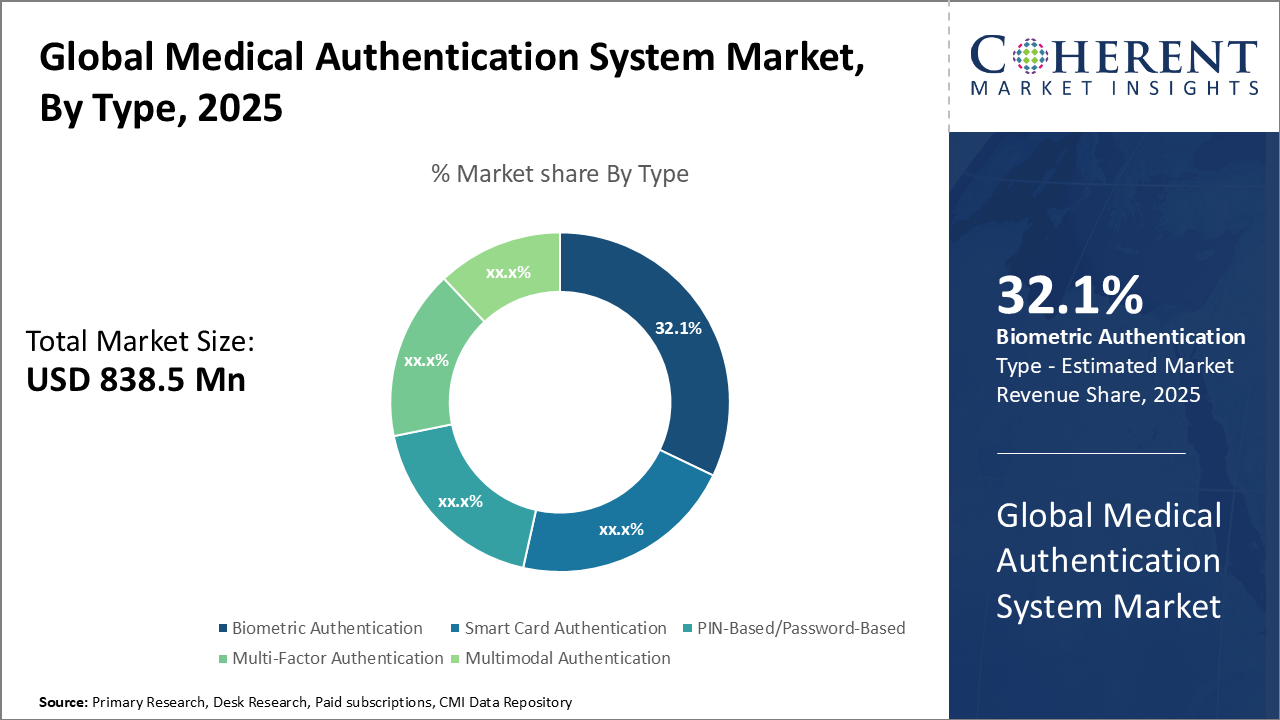
Medical Authentication System Market Insights, by Type: Biometric Authentication contribute the highest share of the market owing to its advancements in biometric technologies.
Biometric authentication hold the largest market share of 33.1% in 2026. Biometric technology drives the Medical Authentication System Market growth by providing secure and accurate identity verification in healthcare environments. Healthcare providers adopt biometric solutions to protect patient data, prevent identity theft, and meet regulatory requirements. Fingerprint scanning, facial recognition, and iris detection strengthen data security and simplify access to medical records. By integrating biometrics with digital health systems, providers enhance operational efficiency and improve patient safety, making these technologies essential to modern healthcare infrastructure. For instance, in March 2025, Amazon introduced its palm biometric payment system, Amazon One, at its Go stores in Seattle and later expanded it to Whole Foods. The company is now extending the system to the healthcare sector.
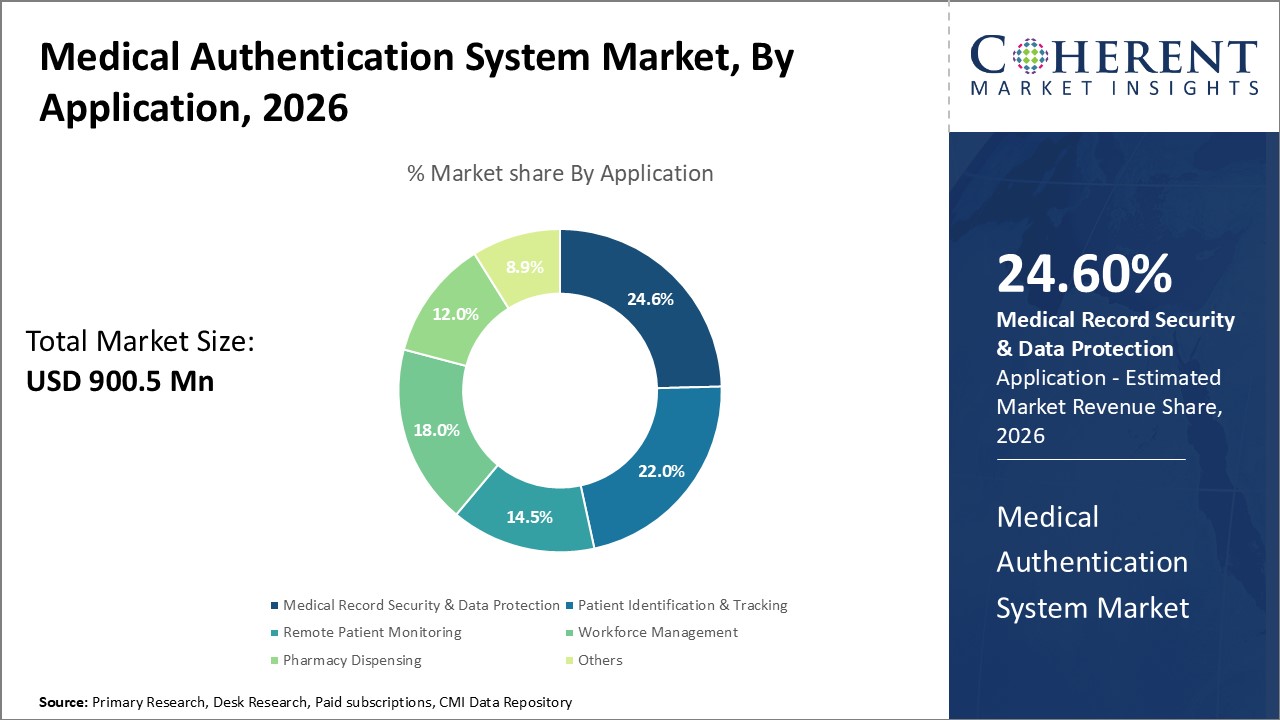
Medical Authentication System Market Insights, by Application: Medical Record Security & Data Protection contribute the highest share of the market owing to its integration of advanced technologies.
Medical Record Security & Data Protection expected to hold largest market share of 24.60% in 2026. Healthcare providers are driving the adoption of authentication systems by prioritizing strong medical record security and data protection. They respond to rising cyber threats, data breaches, and identity theft by implementing advanced security measures. Regulatory bodies enforce strict data privacy laws, prompting organizations to secure electronic health records. Providers use technologies such as encryption, multi-factor authentication, and access controls to protect sensitive patient data. As healthcare operations become more digital, providers actively rely on authentication systems to maintain data integrity, confidentiality, and compliance.
Medical Authentication System Market Insights, by End-User: Pharmaceuticals Companies contribute the highest share of the market owing to its enhancing data security.
Pharmaceuticals companies acquired the market share of 29.62% in 2026. Pharmaceutical companies actively adopt medical authentication systems to strengthen data security, combat counterfeiting, and comply with regulatory standards. They use these systems to verify the authenticity of drugs and safeguard sensitive information from breaches. Regulatory authorities require secure processes, pushing companies to implement reliable authentication measures. These technologies also enable secure access to clinical trial data, streamline operations, and maintain integrity across research, manufacturing, and supply chains. As a result, pharmaceutical firms integrate authentication systems to protect their products and data effectively. For instance, in August 2025, Amala Medical College and Research Centre, Thrissur, partnered with Bengaluru-based tech firm DoctorAssist.AI to launch an AI-powered initiative aimed at transforming the hospital’s pharmacological safety protocols and antibiotic stewardship. Such innovations are accelerating the medical authentication market demand.
Medical Authentication System Market Insights, by Deployment: Cloud-Based System contribute the highest share of the market owing to its scalability and flexibility.
Healthcare providers actively implement cloud-based systems in medical authentication to improve data accessibility, strengthen security, and increase operational flexibility. They use these systems to securely access patient information from any location, which supports telemedicine and remote healthcare services. By adopting cloud platforms, providers reduce infrastructure costs and simplify system maintenance. These solutions also integrate seamlessly with technologies like biometrics and AI. As digital transformation advances in healthcare, providers depend on cloud-based authentication to protect data, optimize workflows, and meet regulatory and technology demands.
BD, a global medical technology leader, launched BD® Research Cloud, a cloud-based tool that streamlines flow cytometry workflows to deliver faster, higher-quality insights for scientists in fields like immunology, oncology, and infectious disease.
Regional Insights
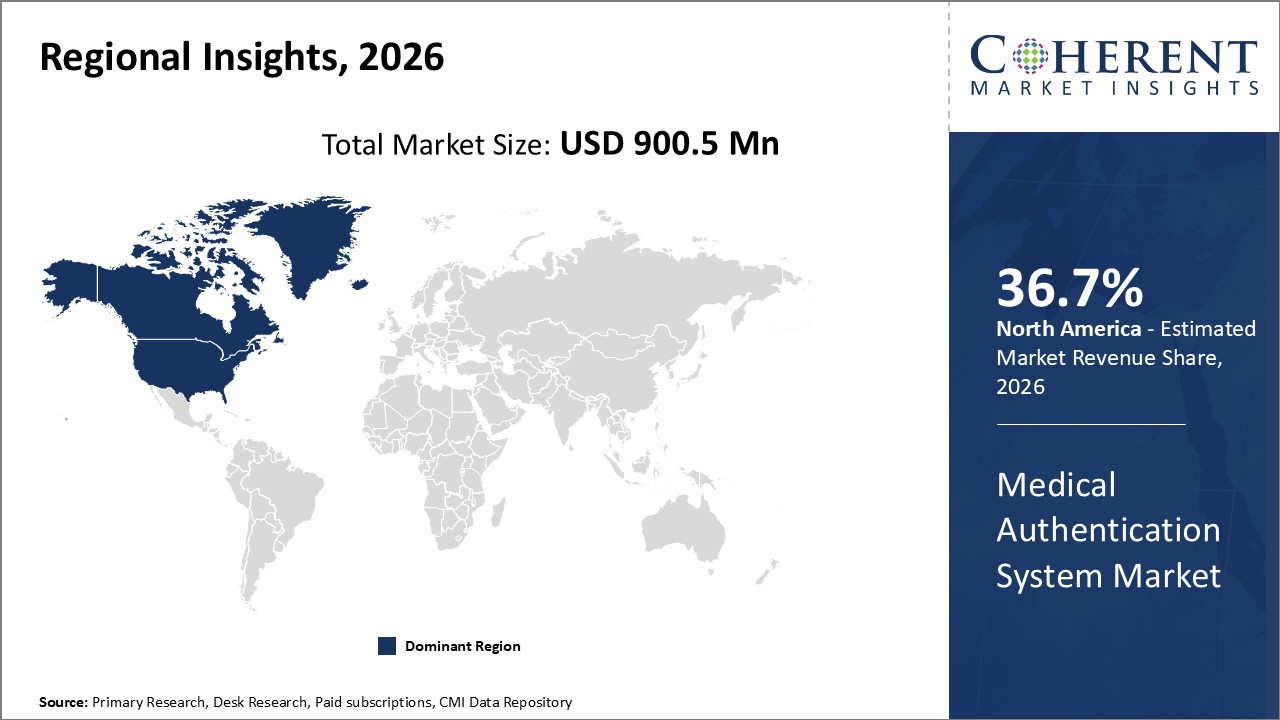
North America Medical Authentication System Market Trends
North America dominates the overall market with an estimated share of 36.7% in 2025. Healthcare providers in North America are increasingly adopting medical authentication systems as they focus on digital health transformation and respond to rising healthcare data breaches. They prioritize secure access to electronic health records and actively implement advanced identity verification methods. Providers and pharmaceutical companies are embracing trends such as biometric authentication, AI-powered security tools, and cloud-based platforms. Government efforts to strengthen health IT infrastructure and enforce compliance are also driving organizations to invest in reliable authentication technologies across the healthcare sector.
In October 2025, healthcare organizations throughout Louisiana united to launch MyChart Central statewide for the first time, providing patients with one secure platform to access medical records, connect with their care teams, and manage their health.
Asia Pacific Medical Authentication System Market Trends
Healthcare providers in the Asia Pacific region are increasing their use of medical authentication systems as digital transformation accelerates across emerging markets. Hospitals and clinics actively deploy secure access tools to handle expanding patient data and reduce the risk of unauthorized access. The rapid rise of telemedicine and government-backed healthcare modernization efforts are fueling the demand for dependable authentication technologies. Both local and international companies are delivering affordable, scalable solutions tailored to regional needs, encouraging broader adoption across public and private healthcare systems. For instance, in September 2024, NEC Corporation introduced a new biometric authentication system designed to quickly verify large crowds, even while they are in motion. The system aims to speed up entry and reduce congestion at high-traffic events and infrastructure sites.
United States Medical Authentication System Market Trends
Healthcare providers in the United States are rapidly advancing medical authentication systems to protect patient data from increasing cyber threats. They are widely adopting biometric technologies and multi-factor authentication to boost security and meet strict regulatory requirements. Providers are integrating these systems with electronic health records and telehealth services to ensure seamless and reliable access control. Additionally, organizations are expanding investments in healthcare IT infrastructure and leveraging government support for cybersecurity, driving widespread implementation of advanced authentication solutions across hospitals and clinics.
Japan Medical Authentication System Market Trends
Healthcare providers in Japan are rapidly adopting advanced technologies to enhance data security and verify patient identities, driving growth in the medical authentication system market. The country’s aging population and rising use of telemedicine are increasing demand for secure, real-time identification. Hospitals and clinics are implementing biometric systems, especially facial and vein recognition, to streamline operations and reduce fraud. Backed by strong government support for digital health infrastructure, these authentication systems are becoming essential to Japan’s evolving healthcare landscape.
In July 2025, Verified Clinical Trials (VCT), a global leader in clinical trial participant registry solutions, expanded into Japan through a partnership with Medical Revolutions Japan (MRJ) and the Japan Association of Contract Institutes for Clinical Pharmacology (JACIC), aiming to tackle the increasing global issue of duplicate and professional participants in clinical trials.
Medical Authentication Market Trend
Surge in Biometric Adoption
Healthcare institutions are increasingly integrating biometric authentication methods, such as fingerprint and facial recognition, to enhance patient identification accuracy. This shift aims to reduce fraud and streamline access to medical records, ensuring that only authorized personnel can retrieve sensitive information. The adoption of biometrics is seen as a critical step towards modernizing healthcare security protocols and improving overall patient safety.
Blockchain Integration for Data Security
Blockchain technology is being explored to secure electronic health records (EHRs) by providing a decentralized and tamper-proof system. This integration ensures that patient data remains unaltered and accessible only to authorized users. Healthcare providers are investing in blockchain solutions to comply with stringent data protection regulations and to foster trust among patients regarding the confidentiality of their medical information.
Market Report Scope
Medical Authentication Market Report Coverage
| Report Coverage | Details | ||
|---|---|---|---|
| Base Year: | 2025 | Market Size in 2026: | USD 900.5 Mn |
| Historical Data for: | 2020 To 2024 | Forecast Period: | 2026 To 2033 |
| Forecast Period 2026 to 2033 CAGR: | 7.4% | 2033 Value Projection: | USD 1,484.4 Mn |
| Geographies covered: |
| ||
| Segments covered: |
| ||
| Companies covered: | Imprivata, aware.com, Authentix, Hideez, ViewSonic, AuthX, Gemalto, JumpCloud, Broadcom, Entrust Datacard, Avatier, RSA Security, and HID Global | ||
| Growth Drivers: |
| ||
| Restraints & Challenges: |
| ||
Medical Authentication Market News
- In July 2025, Himachal Pradesh became the first state in India to implement Aadhaar-based face authentication (FaceAuth) to distribute ration to eligible beneficiaries under the Public Distribution System (PDS).
Analyst Opinion (Expert Opinion)
- The medical authentication market is undergoing a transformative phase driven not merely by technological advancements but by a fundamental shift in how healthcare security is perceived and operationalized. The traditional perimeter-based security models have proven inadequate in addressing the nuanced risks associated with medical data breaches. Recent studies highlight that over 40% of healthcare organizations have experienced data breaches originating from weak or compromised authentication protocols (Source: Verizon Data Breach Investigations Report 2024). This stark reality underscores the urgency for deploying advanced, multi-layered authentication frameworks that move beyond simple password-based access.
- Biometric authentication, in particular, is not a future trend—it is a present necessity. For example, Mayo Clinic’s deployment of facial recognition for staff access control has reduced unauthorized access incidents by 35% within the first six months of implementation. Such real-world deployments illustrate that biometrics are no longer optional but critical components in safeguarding patient data while simultaneously improving workflow efficiency.
- Moreover, the integration of AI-driven behavioral biometrics marks a critical leap forward. Unlike static biometrics, behavioral systems analyze user patterns continuously, identifying anomalies in real time. This approach is already making headway; IBM Watson Health reported a 50% reduction in false positives related to user authentication attempts after integrating AI-based behavioral analytics. This illustrates how AI not only enhances security but also reduces operational friction—a balance healthcare providers have long struggled to achieve.
Speak to the analyst
Want personalized insights?
Take the findings above to one of our principal consultants, or have the report rebuilt around the segments, geographies and competitors you actually track.
Market Segmentation
- By Type Insights (Revenue, USD Mn, 2021 - 2033)
- Biometric Authentication
- Smart Card Authentication
- PIN-Based/Password-Based Authentication
- Multi-Factor Authentication
- Multimodal Authentication
- By Application Insights (Revenue, USD Mn, 2021 - 2033)
- Medical Record Security & Data Protection
- Patient Identification & Tracking
- Remote Patient Monitoring
- Workforce Management
- Pharmacy Dispensing
- Others
- By End User Insights (Revenue, USD Mn, 2021 - 2033)
- Pharmaceutical Companies
- Hospitals & Clinics
- Healthcare Institutions
- Research & Clinical Laboratories
- Others
- By Deployment Insights (Revenue, USD Mn, 2021 - 2033)
- Cloud-Based Systems
- On-Premise Systems
- Regional Insights (Revenue, USD Mn, 2021 - 2033)
- North America
- U.S.
- Canada
- Latin America
- Brazil
- Argentina
- Mexico
- Rest of Latin America
- Europe
- Germany
- U.K.
- Spain
- France
- Italy
- Russia
- Rest of Europe
- Asia Pacific
- China
- India
- Japan
- Australia
- South Korea
- ASEAN
- Rest of Asia Pacific
- Middle East
- GCC Countries
- Israel
- Rest of Middle East
- Africa
- South Africa
- North Africa
- Central Africa
- Key Players Insights
Sources
Primary Research interviews
- IT Security Officers from Tier-1 Hospitals in North America and Europe
- Heads of Digital Health Departments at Public Health Agencies
- Cybersecurity Consultants specializing in healthcare IT infrastructure
- Product Managers from leading Biometric Authentication Solution Providers
- Regulatory Compliance Experts (HIPAA, GDPR)
- Healthcare CIO Roundtable participants
Databases
- U.S. Food & Drug Administration (FDA) Medical Device Database
- WHO Global Health Observatory
- European Medicines Agency (EMA) eSubmission Gateway
- Healthcare Information and Management Systems Society (HIMSS) Analytics
- National Center for Biotechnology Information (NCBI) Medical Informatics section
- National Electronic Health Records Survey (NEHRS)
Magazines
- Healthcare IT News
- Digital Health Magazine
- MedTech Innovation News
- Security Magazine (Healthcare Security Section)
- Biometric Update – Healthcare Applications
Journals
- Journal of Medical Internet Research (JMIR)
- IEEE Journal of Biomedical and Health Informatics
- The Lancet Digital Health
- Journal of the American Medical Informatics Association (JAMIA)
- Health Information Science and Systems
Newspapers
- The Wall Street Journal – Health & Technology Section
- The Guardian – Health and Society
- The New York Times – Healthcare Technology Coverage
- The Economic Times – Healthtech News
- Washington Post – Cybersecurity in Healthcare
Associations
- Health Information and Management Systems Society (HIMSS)
- International Association for Privacy Professionals (IAPP)
- American Medical Informatics Association (AMIA)
- National Health Service (NHS) Digital
- College of Healthcare Information Management Executives (CHIME)
Public Domain sources
- U.S. Department of Health and Human Services (HHS) – Office for Civil Rights Data
- European Union Agency for Cybersecurity (ENISA) – eHealth Reports
- Centers for Medicare & Medicaid Services (CMS)
- HealthIT.gov – Interoperability and Security Insights
- National Institute of Standards and Technology (NIST) – Digital Identity Guidelines
Proprietary Elements
- CMI Data Analytics Tool
- Proprietary CMI Existing Repository of Information for Last 8 Years
Get access to 250+ pages report
Every segment, forecast, competitor profile and data table behind the analysis above — available for instant download.
- ESOMAR Member
- ISO 9001:2015 Certified
- D-U-N-S Registered
- GDPR & CCPA Compliant
Missing comfort of reading report in your local language? Find your preferred language:
Transform your Strategy with Exclusive Trending Reports
Frequently Asked Questions
The Medical Authentication System Market is estimated to be valued at USD 900.5 Mn in 2026, and is expected to reach USD 1,484.4 Mn by 2033.
The CAGR of the Medical Authentication System Market is projected to be 7.4% from 2026 to 2033.
Increasing focus on patient safety and data security and rising prevalence of counterfeit drugs and medical fraud are the major factors driving the growth of the global medical authentication system market.
High implementation costs of authentication systems and concerns regarding patient data privacy and interoperability are the major factors hampering the growth of the global medical authentication system market.
In terms of type, the biometric authentication segment is estimated to dominate the market revenue share in 2026.
Imprivata, aware.com, Authentix, Hideez, ViewSonic, AuthX, Gemalto, JumpCloud, Broadcom, Entrust Datacard, Avatier, RSA Security, and HID Global are the major players.
North America is expected to lead the global medical authentication system market in 2026.