

Drug Discovery Market Size and Share Analysis - 2026 To 2033
The Drug Discovery Market size is anticipated to grow at a CAGR of 6.8% with USD 103.43 Bn in 2026 and is expected to reach USD 164.32 Bn in 2033. The primary drivers are defined by rising research expenditure, growing prevalence of chronic and rare diseases, increasing demand for novel therapeutics, and integration of AI-based drug discovery platforms. According to the U.S. Food and Drug Administration, its Center for Drug Evaluation and Research approved 46 novel drugs in 2025, thereby demonstrating innovation and the need for efficient discovery pipelines. This is strengthening demand for target identification, high-throughput screening, lead optimization, medicinal chemistry, pharmacokinetics, toxicology, and preclinical research services.
Key Takeaways
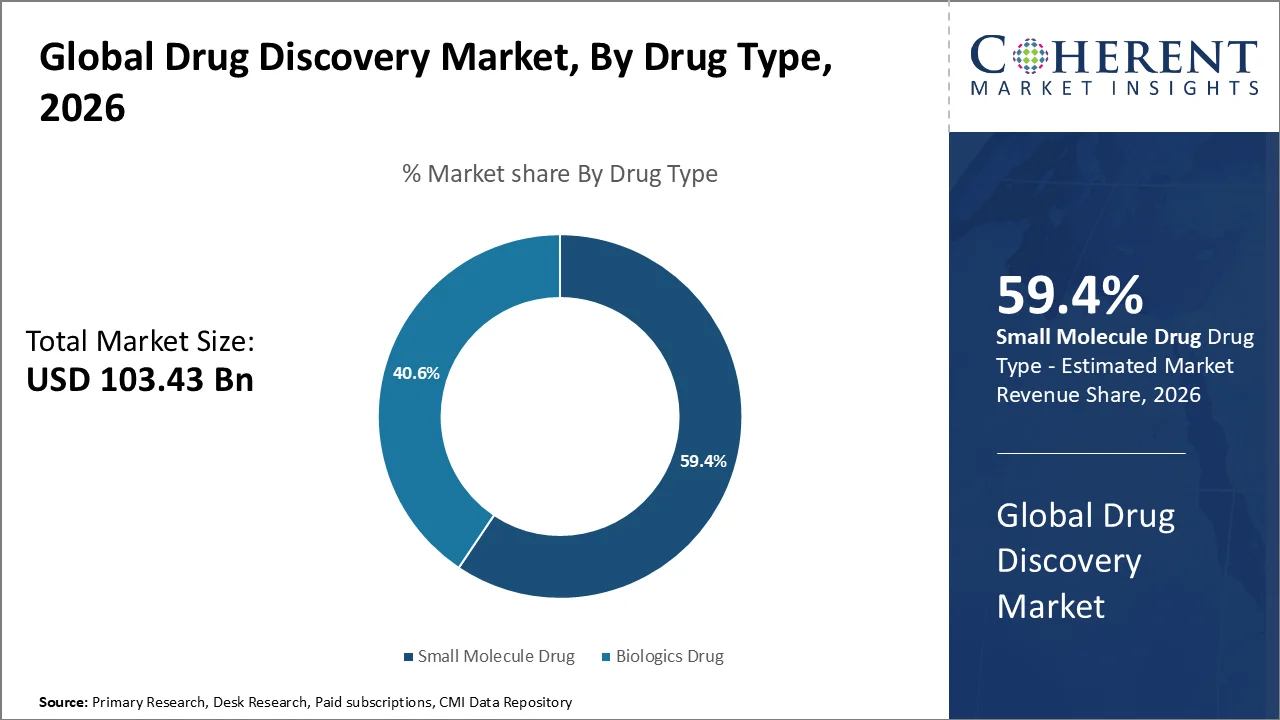
- The small molecule drug segment is likely to dominate the market with 59.4% in 2026. The segment’s growth is owing to the established synthesis platforms, oral dosage advantages, and broad therapeutic applicability. In 2025, the U.S. FDA approved 34 new molecular entities compared with 12 biologics among 46 novel approvals.
- The high throughput screening segment is set to lead with 42% in 2026. The segment’s growth is owing to the automated assay systems, large compound libraries, and faster identification of promising leads. Conventional HTS can screen around 10,000 compounds daily, while ultra-high-throughput systems can conduct up to 100,000 assays per day.
- The chemical services segment is set to lead with 34.5% in 2026. The segment’s growth is owing to the rising outsourcing of medicinal chemistry, compound synthesis, hit-to-lead optimization, and analytical testing.
- The pharmaceutical companies segment is set to lead with 39.2% in 2026. The segment’s growth is owing to the extensive discovery pipelines, strong capital availability, and increasing external research partnerships. S. pharmaceutical and medicines manufacturers recorded an R&D intensity of 17.8% in 2023, among the highest across manufacturing industries.
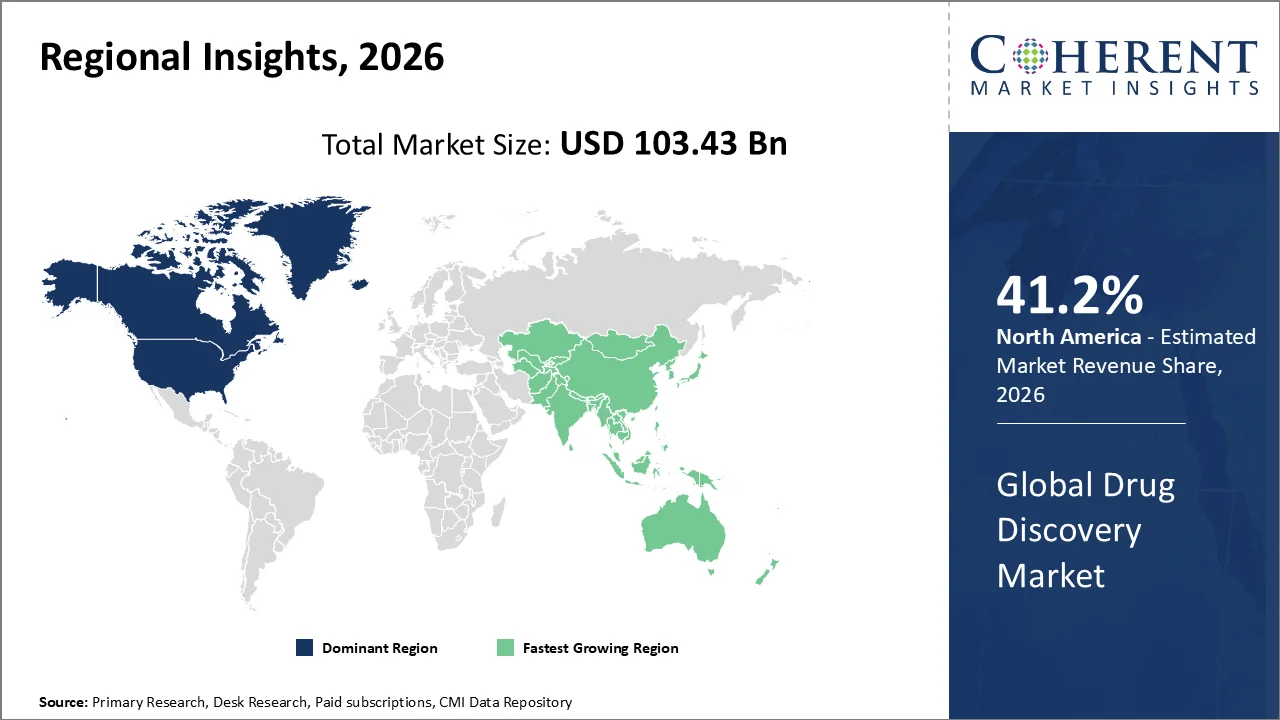
- North America is expected to acquire the prominent share of 41.2% in 2026. The region’s growth is owing to the substantial biomedical funding, advanced research infrastructure, and strong biotechnology-pharmaceutical collaboration. The U.S. performed an estimated USD 940 Bn in R&D during 2023.
Segmental Insights
Why is Small Molecule Drug Segment Acquiring the Largest Share?
On the basis of drug type, the small molecule drug segment is projected to account for the largest Drug Discovery Market share of 59.4% in 2026. The segment’s growth is owing to the broad therapeutic applicability, well-established development processes, potential for oral administration, scalable manufacturing, and ability to interact with intracellular disease targets.
The segment benefits from extensive chemical libraries and mature high-throughput screening systems. The NCATS Genesis collection contains approximately 126,400 compounds, while the NCATS Pharmaceutical Collection contains around 2,900 approved small molecular entities suitable for screening and drug-repurposing research.
In July 2026, Evogene and Tel Aviv University’s Blavatnik Center for Drug Discovery launched a joint initiative to accelerate AI-driven small molecule drug discovery. The collaboration combines ChemPass AI with advanced experimental infrastructure to reduce early-stage risks, validate candidates, and commercialize academic research.
- Current Industry Events of 2026
- Market Size Estimation
- Regional Breakdown
- Competitive Landscape
- Customer Intelligence
- Segmental Analysis
- Pricing Analysis
- Key Market Drivers, Challenges & Future Trends
- Customized Insights Section
Chemical Services hold the Largest Market Share
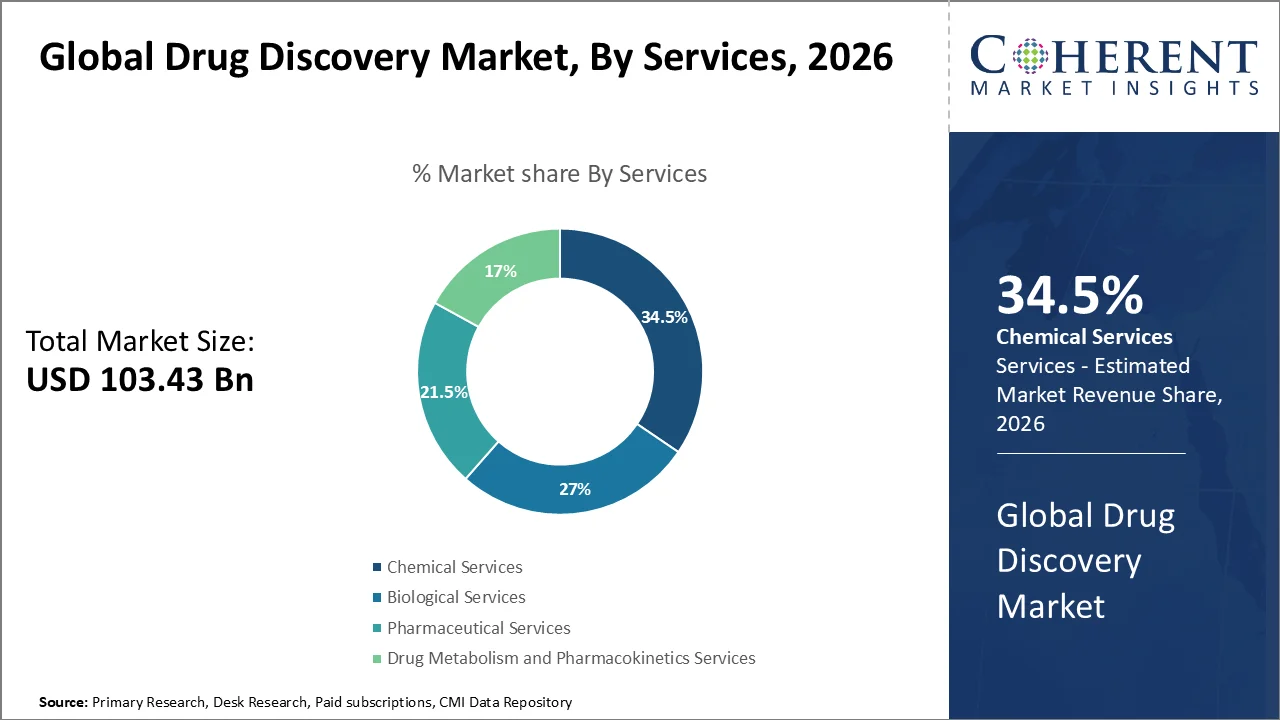
On the basis of services, the chemical services segment lead with a major 34.5% share in 2026. The growth is owing to the sustained demand for medicinal chemistry, custom synthesis, analytical chemistry, compound purification, structure–activity relationship studies, and lead optimization. These capabilities are essential for converting screening hits into candidates with improved potency, selectivity, solubility, metabolic stability, and manufacturability.
The PubChem Reference Collection contained 932,952 live substances as of June 1, 2026, thereby illustrating the expanding volume of curated chemical information available for compound identification and design.
In June 2025, Eurofins Discovery expanded its global chemistry services by integrating Eurofins Advinus into its network across the U.S., U.K., Europe, and India. The expansion strengthens the medicinal, synthetic, computational, and analytical chemistry capabilities to speed up the drug discovery and development.
Market Drivers
Rising AI-Based Innovations are Transforming the Drug Discovery Market in the U.S.
The U.S. drug discovery ecosystem is undergoing substantial transformation through artificial intelligence, automated laboratories, genomic analysis, spatial biology, real-world clinical data, and predictive molecular modelling. AI-enabled platforms are being used to identify disease targets, generate new molecular structures, predict protein–ligand interactions, evaluate absorption and toxicity characteristics, as well as prioritize compounds before laboratory synthesis.
In February 2026, Merck and Mayo Clinic announced an R&D collaboration combining AI, advanced analytics, clinical insights, genomic data, medical imaging, and multimodal datasets. The initial research areas include inflammatory bowel disease, atopic dermatitis, and multiple sclerosis. The collaboration is expected to improve target validation along with early development decisions.
Generative Artificial Intelligence: A Major Breakthrough in the Drug Discovery Market
Generative artificial intelligence represents a major technological breakthrough. This is because it can propose new molecules based on predefined biological, chemical, efficacy, safety, and pharmacokinetic criteria. Generative systems can create previously untested molecular structures and prioritize them before chemical synthesis. These platforms are being applied across target discovery, protein structure prediction, virtual screening, hit generation, lead optimization, drug repurposing, toxicology prediction, and biomarker identification.
In January 2026, NVIDIA and Eli Lilly announced an AI co-innovation laboratory involving planned investment of up to USD 1 billion over five years. The initiative will use NVIDIA BioNeMo, accelerated computing, robotics, agentic laboratories, and physical AI to develop continuous-learning drug discovery systems.
Current Events and Their Impact on the Drug Discovery Market
Current Event | Description and its Impact |
EU Pharmaceutical Reform and 2025 Critical Medicines Act Proposal |
|
2025 FDA Draft Guidance on AI Use in Drug Development |
|
Drug Discovery Market Trends
- The rising adoption of artificial intelligence and machine learning is speeding up the target identification, molecule screening, lead optimization, and predictive toxicity assessment.
- Personalized drug discovery using genomics, proteomics, biomarkers, and real-world data is improving the candidate selection and treatment precision across therapeutic areas.
- High-throughput screening, automation, organ-on-chip models, and advanced bioinformatics expand, thereby allowing for faster compound evaluation and reducing early-stage development timelines.
- The growing prevalence of cancer, neurological disorders, metabolic diseases, and rare conditions is strengthening the demand for innovative pipelines as well as novel therapeutic mechanisms. gov currently lists more than 593,000 registered studies across all U.S. states and 226 countries and territories, thereby highlighting global clinical research.
- Supportive regulatory pathways, public research funding, and pharmaceutical-biotechnology collaborations is broadening access to discovery technologies and accelerate commercialization. In fiscal year 2025, the U.S. National Institutes of Health received a total appropriation of USD 48.5 billion and awarded USD 35.3 billion through research grants.
Regional Insights
North America Dominates Owing to the Strong Pharmaceutical R&D Infrastructure
The North America region accounts for 41.2% of the market share in 2026. The region’s growth is owing to substantial pharmaceutical R&D spending, strong public research financing, major biotechnology clusters, established contract research organizations, advanced academic medical centers, and early adoption of AI-enabled discovery technologies.
In June 2026, Anthropic launched an internal AI-driven drug discovery program targeting neglected diseases, alongside Claude Science for pharmaceutical companies. The initiative aims to generate practical feedback, accelerate life sciences innovation, and develop treatments overlooked by traditional commercial biopharmaceutical markets.
Asia Pacific Drug Discovery Market Trends
Asia Pacificis expected to witness strong growth in Drug Discovery Market over the forecast period. The region’s growth is owing to increasing pharmaceutical R&D expenditure, government innovation programs, improving regulatory pathways, expanding clinical research infrastructure, lower operating costs, and growth of biotechnology startups.
China is strengthening its innovative-drug environment through accelerated review mechanisms. The NMPA reported that China approved 48 first-in-class innovative drugs in 2024, compared with 40 in 2023 and 21 in 2022.
In June 2026, Insilico Medicine announced a USD 2.5 billion collaboration with SK Biopharmaceuticals to discover AI-enabled treatments for neuroimmune disorders. Using Pharma.AI, Insilico is set to lead target validation and molecule development while SK Biopharmaceuticals manages clinical development and global commercialization efforts.
Extensive Biomedical Funding and AI-Enabled Research Technologies are Accelerating the Drug Discovery Market in United States
The United States Drug Discovery Market is driven by the extensive biomedical funding, advanced research infrastructure, and rapid adoption of proteomics, multiomics, automation, and artificial intelligence. The National Institutes of Health received 62,592 research project grant applications in fiscal year 2025 and allocated USD 26.50 billion to research project grants, thereby demonstrating a strong national innovation pipeline.
In May 2026, Thermo Fisher Scientific unveiled next-generation Orbitrap mass spectrometers and AI-enabled analytics to speed up the drug discovery and development. The platforms improve sensitivity, speed, molecular detection, proteomics analysis, regulatory readiness, and identification of therapeutic targets across complex research applications.
China Drug Discovery Market Trends
China’s drug discovery market is strengthening through rising research investment, expanding scientific talent, and deeper multinational collaboration. China’s National Bureau of Statistics reported R&D expenditure of RMB 3.93 trillion in 2025, up 8.1%, while basic research funding reached RMB 277.8 billion, thereby supporting target identification, molecular biology, and translational science.
In October 2025, AstraZeneca opened its sixth strategic R&D center in Beijing, marking the company’s second such facility in China. The center will leverage Beijing’s scientific ecosystem and artificial intelligence capabilities to accelerate next-generation drug discovery, clinical development, and commercialization.
Who are the Major Companies in Drug Discovery Industry
Some of the major key players in Drug Discovery Market are Pfizer Inc., GlaxoSmithKline LLC, Merck & Co. Inc., Agilent Technologies Inc., Eli Lilly and Company, F Hoffmann-La Roche Ltd, Bayer AG, Abbott Laboratories Inc., AstraZeneca PLC, and Shimadzu Corp.
Key News
- In July 2026, Illumina expanded its Billion Cell Atlas alliance by adding Formation Bio and other AI-driven drug developers. The partners will use large-scale genome-wide perturbation data to improve target validation, patient selection, clinical trial design, and development of medicines.
- In July 2026, Insilico Medicine and Takeda announced a strategic collaboration using Pharma.AI to discover differentiated drug candidates across Takeda’s therapeutic areas. Insilico will lead AI-driven molecule design, while Takeda advances selected candidates through clinical development, manufacturing, and worldwide commercialization.
Market Report Scope
Drug Discovery Market Report Coverage
| Report Coverage | Details | ||
|---|---|---|---|
| Base Year: | 2025 | Market Size in 2026: | USD 103.43 Bn |
| Historical Data for: | 2020 To 2024 | Forecast Period: | 2026 To 2033 |
| Forecast Period 2026 to 2033 CAGR: | 6.8% | 2033 Value Projection: | USD 164.32 Bn |
| Geographies covered: |
| ||
| Segments covered: |
| ||
| Companies covered: | Pfizer Inc., GlaxoSmithKline LLC, Merck & Co. Inc., Agilent Technologies Inc., Eli Lilly and Company, F Hoffmann-La Roche Ltd, Bayer AG, Abbott Laboratories Inc., AstraZeneca PLC, and Shimadzu Corp. | ||
| Growth Drivers: |
| ||
| Restraints & Challenges: |
| ||
Analyst Opinion
- Drug discovery is sustained by unmet medical need. More than 300 million people worldwide live with over 7,000 rare diseases, and around 70% of these conditions begin in childhood. This creates demand for molecular targets, precision treatments, gene therapies, and disease-modifying medicines.
- Biomedical research funding provides a foundation for innovation. The U.S. National Institutes of Health has budget exceeding USD 47 billion and remains the world’s largest single public funder of biomedical research, supporting academic laboratories, translational programs, and industry-linked discoveries.
- Drug development also carries substantial scientific and commercial risk. Research indicates that around 90% of drug candidates entering clinical development ultimately fail during trials or regulatory review. This high attrition rate is accelerating adoption of artificial intelligence, predictive biomarkers, organoid models, and advanced screening technologies to identify stronger candidates and reduce late-stage failures.
Speak to the analyst
Want personalized insights?
Take the findings above to one of our principal consultants, or have the report rebuilt around the segments, geographies and competitors you actually track.
Market Segmentation
- By Drug Type (Revenue, USD Bn, 2021-2033)
- Small Molecule Drug
- Biologics Drug
- By Technology (Revenue, USD Bn, 2021-2033)
- High Throughput Screening
- Biochips
- Bioinformatics
- Pharmacogenomics and Pharmacogenetics
- Combinatorial Chemistry
- Nanotechnology
- Spectroscopy
- Metabolomics
- Others
- By Service (Revenue, USD Bn, 2021-2033)
- Drug Metabolism and Pharmacokinetics (DMPK) Services
- Pharmaceutical Services
- Chemical Services
- Biological Services
- By End User (Revenue, USD Bn, 2021-2033)
- Research Institutes
- Pharmaceutical Companies
- Biotechnology Companies
- Others
- By Region (Revenue, USD Bn, 2021-2033)
- North America
- U.S.
- Canada
- Latin America
- Brazil
- Mexico
- Argentina
- Rest of Latin America
- Europe
- Germany
- U.K.
- France
- Italy
- Spain
- Russia
- Rest of Europe
- Asia Pacific
- China
- India
- Japan
- Australia
- South Korea
- ASEAN
- Rest of Asia Pacific
- Middle East
- GCC
- Israel
- Rest of Middle East
- Africa
- South Africa
- Central Africa
- North Africa
- North America
Sources
Primary Research Interviews
- Pharmaceutical R&D executives
- Medicinal chemists
- Molecular biologists
- Pharmacologists and toxicologists
- Bioinformatics and computational chemistry specialists
- Clinical research organization (CRO) executives
- Biotechnology company representatives
- Academic researchers
- Regulatory affairs professionals
- Key opinion leaders (KOLs) in drug discovery and development
Databases
- World Health Organization (WHO)
- U.S. Food and Drug Administration (FDA)
- European Medicines Agency (EMA)
- National Institutes of Health (NIH)
- National Center for Biotechnology Information (NCBI)
- PubChem
- ChEMBL
- DrugBank
- Organisation for Economic Co-operation and Development (OECD)
Magazines
- Drug Discovery Today
- Drug Discovery & Development
- Pharmaceutical Technology
- GEN – Genetic Engineering & Biotechnology News
- The Medicine Maker
Journals
- Nature Reviews Drug Discovery
- Journal of Medicinal Chemistry
- Drug Discovery Today
- European Journal of Medicinal Chemistry
- Journal of Chemical Information and Modeling
- Clinical Pharmacology & Therapeutics
Newspapers
- The New York Times
- The Guardian
- The Wall Street Journal
- Financial Times
Associations
- Pharmaceutical Research and Manufacturers of America (PhRMA)
- Biotechnology Innovation Organization (BIO)
- International Federation of Pharmaceutical Manufacturers & Associations (IFPMA)
- European Federation of Pharmaceutical Industries and Associations (EFPIA)
- Society for Laboratory Automation and Screening (SLAS)
- American Association of Pharmaceutical Scientists (AAPS)
Public Domain Sources
- Company annual reports and investor presentations
- Government health ministry publications
- Regulatory agency publications
- Patent databases
- Scientific research publications
- Clinical trial registries such as ClinicalTrials.gov
- University and research institute publications
Proprietary Elements
- CMI Data Analytics Tool
- Proprietary CMI Existing Repository of Information for the Last 10 Years
Get access to 250+ pages report
Every segment, forecast, competitor profile and data table behind the analysis above — available for instant download.
- ESOMAR Member
- ISO 9001:2015 Certified
- D-U-N-S Registered
- GDPR & CCPA Compliant
Missing comfort of reading report in your local language? Find your preferred language:
Transform your Strategy with Exclusive Trending Reports
Frequently Asked Questions
The Drug Discovery Market is expected to reach USD 164.32 Bn in 2033.
Major players operating in the global Drug Discovery Market include Pfizer Inc., GlaxoSmithKline LLC, Merck & Co. Inc., Agilent Technologies Inc., Eli Lilly and Company, F Hoffmann-La Roche Ltd, Bayer AG, Abbott Laboratories Inc., AstraZeneca PLC, and Shimadzu Corp.
The high astronomical R&D costs, high clinical attrition rates (up to 90% of drugs fail), and prolonged development timelines are the key factors hampering growth of the market.
The rising investments in pharmaceutical R&D, the increasing global prevalence of chronic and rare diseases, and a shift towards precision medicine is boosting the demand for Drug Discovery.
The Drug Discovery Market is anticipated to grow at a CAGR of 6.8% between 2026 and 2033.
Among regions, North America is expected to account for a largest market share in the global Drug Discovery Market over the forecast period.
The Drug Discovery Market encompasses the tools, technologies, and outsourced services used by pharmaceutical and biotechnology companies to identify and develop new medicines.