

Electroporation Instruments Market Size and Forecast: 2026-2033
The Electroporation Instruments Market is estimated to be valued at USD 1.7 Bn in 2026 and is expected to reach USD 4.2 Bn by 2033, exhibiting a compound annual growth rate (CAGR) of 9.2% from 2026 to 2033.
Key Takeaways
- By Product Type, Accessories hold the largest market share of 53.3% in 2026 owing to the growth in electroporation applications across life sciences.
- By Application, Protein Production expected to hold largest market share of 36.6% in 2026 owing to its role in efficient delivery of genetic material for protein expression.
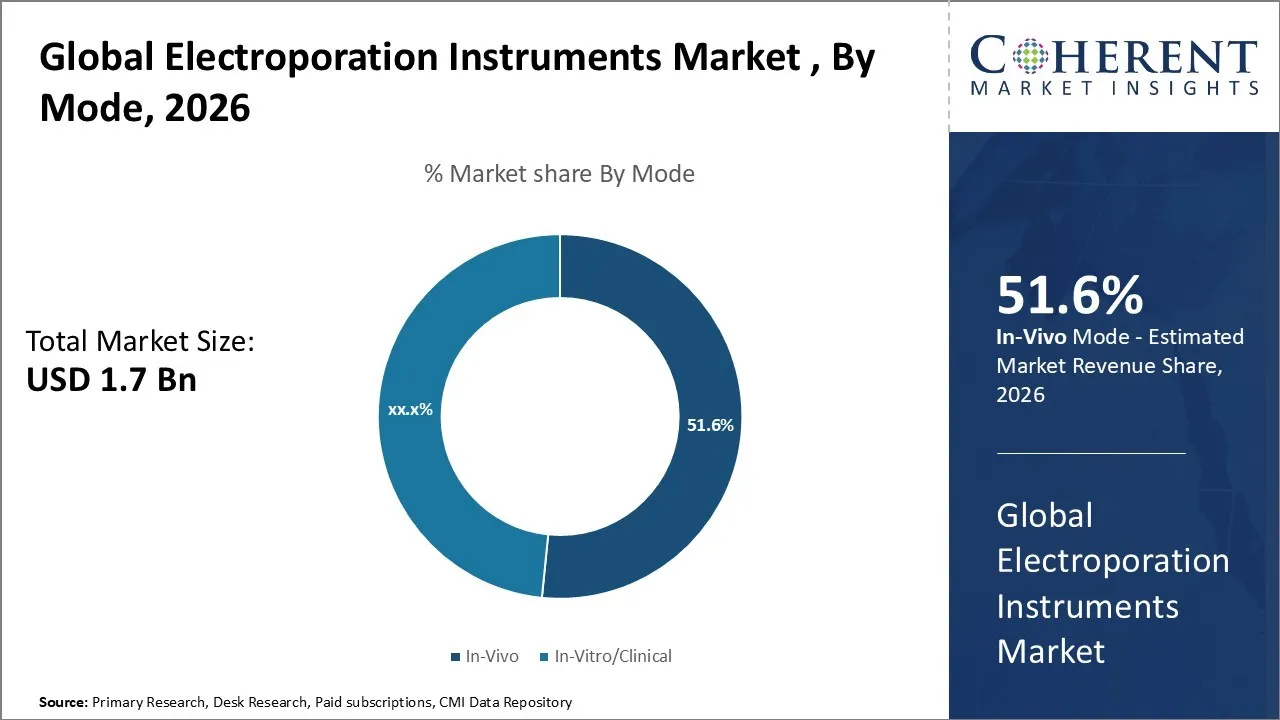
- By Mode, In-Vivo acquired the prominent market share of 51.6% in 2026 owing to the growing demand for non‑viral gene delivery in therapeutics.
- By End User, Hospitals capture the largest market share of 36.3% in 2026 owing to the expansion of clinical therapeutic applications.
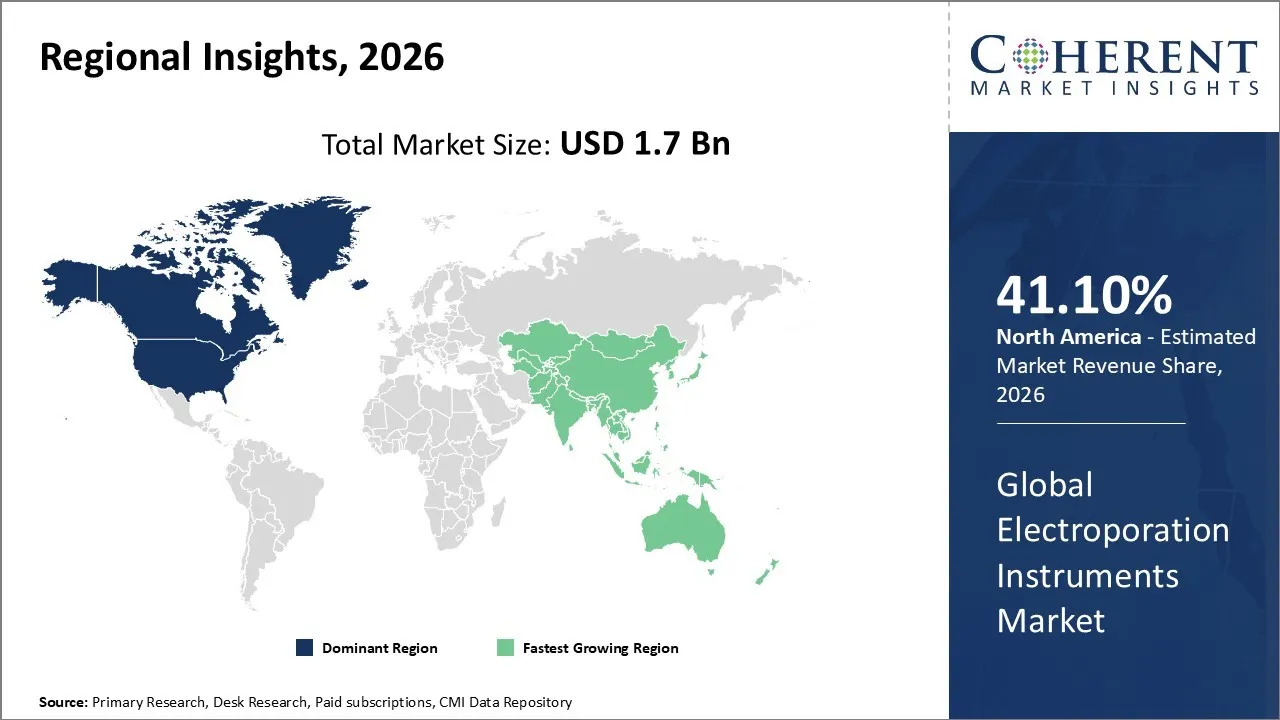
- By Region, North America dominates the overall market with an estimated share of 41.1% in 2026 owing to the strong biotechnology & pharmaceutical ecosystem.
Market Overview
The Electroporation Instruments Market is rapidly expanding as researchers, clinicians, and therapeutic developers increasingly rely on these systems for efficient gene and drug delivery. Biotechnology, pharmaceutical, and healthcare organizations actively use them for protein production, gene therapy, vaccine development, and cell-based treatments. Hospitals, research institutes, and biopharma R&D centers are adopting these instruments at a growing pace, while advancements in device design and automation drive market growth. The rising emphasis on personalized medicine and innovative therapies further accelerates their global adoption.
Current Events and their Impact on the Electroporation Instruments Market
Current Events | Description and its impact |
Technological Advancements in Electroporation Techniques |
|
Geopolitical and Economic Factors |
|
Expansion of Clinical and Research Applications |
|
Segmental Insights
- Current Industry Events of 2026
- Market Size Estimation
- Regional Breakdown
- Competitive Landscape
- Customer Intelligence
- Segmental Analysis
- Pricing Analysis
- Key Market Drivers, Challenges & Future Trends
- Customized Insights Section
Electroporation Instruments Market Insights, By Mode - In-Vivo contribute the highest share of the market owing to its expansion of gene therapy and immunotherapies
In-Vivo acquired the prominent market share of 51.6% in 2026. Researchers and clinicians are increasingly driving the demand for in‑vivo applications in the Electroporation Instruments Market by using these systems to deliver genes, drugs, and vaccines directly into living tissues without viral vectors. They apply in‑vivo electroporation to improve therapeutic outcomes in gene therapy, cancer treatment, and immunization. Advanced device designs and optimized pulse technologies enhance tissue targeting and safety, while expanding clinical trials and translational research broaden its use. The growing focus on personalized therapies and innovative treatment approaches further accelerates adoption.
Electroporation Instruments Market Insights, By Product Type - Accessories contribute the highest share of the market owing to its increasing research & development activities
Accessories hold the largest market share of 53.3% in 2026. The Electroporation Instruments Market experiences growing demand for accessories as researchers and clinicians increasingly apply electroporation in diverse studies and therapies. Laboratories and healthcare facilities rely on consumables like cuvettes, electrodes, and specialized adapters to enhance transfection efficiency and accommodate various cell types and protocols. Frequent replacement of single-use components, along with innovations in high-throughput and automated systems, sustains steady accessory sales. Rising investments in gene therapy, protein production, and personalized medicine further drive the adoption of application-specific, reliable accessories. For instance, MaxCyte, a global clinical-stage cell therapy and life sciences company, has launched its new ExPERT™ technology platform. The ATx, STx, and GTx instruments deliver the next-generation Flow Electroporation® technology for advanced cellular engineering.
Electroporation Instruments Market Insights, By Application - Protein Production contribute the highest share of the market owing to its adoption in biopharmaceutical R&D and manufacturing
Protein Production expected to hold largest market share of 36.6% in 2026. The Electroporation Instruments Market is expanding in protein production as researchers and biopharmaceutical companies actively use these systems to deliver genetic material efficiently into host cells for high-yield protein expression. Scientists employ electroporation to produce therapeutic proteins, enzymes, and antigens for drug development and vaccine research. Its compatibility with advanced gene-editing tools and support for high-throughput workflows make it a preferred method. Growing emphasis on biologics, cell-based therapies, and innovative R&D further drives the adoption of electroporation for protein production. For instance, in February 2026, MaxCyte, Inc. a leading cell-engineering company, launched ExPERT DTx, a high-throughput transfection platform for research and drug discovery. Validated for protein production, cell and gene therapy development, it allows seamless transfer of optimized processes to other ExPERT instruments, simplifying scale-up to cGMP-compliant manufacturing.
Electroporation Instruments Market Insights, By End Users - Hospitals contribute the highest share of the market owing to its support for clinical trials and translational medicine
Hospitals capture the largest market share of 36.3% in 2026. Hospitals are actively adopting electroporation instruments to enhance clinical services and provide advanced therapies. Oncology and immunotherapy departments use these systems to deliver targeted drugs, perform gene therapy, and carry out electrochemotherapy treatments. Hospitals integrate electroporation into patient care to support clinical trials and translational research programs. Automated features and user-friendly designs allow staff to use these instruments in routine procedures, while the increasing focus on personalized medicine and innovative treatment methods drives further hospital investment in electroporation technology.
Regional Insights
North America Electroporation Instruments Market Trends
North America dominates the overall market with an estimated share of 41.1% in 2026. Research institutions and healthcare providers across North America are actively driving the Electroporation Instruments Market through widespread adoption in both laboratory and clinical environments. The United States leads the region with its strong biotechnology network and large base of pharmaceutical and gene therapy companies. Organizations are integrating electroporation into cell and gene therapy development, clinical trials, and translational research, supported by robust funding and regulatory backing. Continuous innovation in device functionality and automation, along with rising demand for personalized and advanced therapies, further accelerates market growth. For instance, Thermo Fisher Scientific launched a new large-volume electroporation system designed to help cell therapy developers transition more efficiently from clinical development to commercial manufacturing.
Asia Pacific Electroporation Instruments Market Trends
Researchers and healthcare providers across Asia Pacific are accelerating the growth of the Electroporation Instruments Market by expanding biotechnology research and strengthening healthcare infrastructure. Countries including China, Japan, India, and South Korea are investing heavily in life sciences, encouraging wider use of electroporation for gene editing, protein production, and biomedical studies. Universities, hospitals, and emerging biotech companies are actively implementing these systems in clinical and translational research. Government support and increasing international collaborations further stimulate demand and technology adoption across the region. For instance, in June 2024, Porton Advanced added the MaxCyte cGMP-grade ExPERT GTx Flow Electroporation system to its cell therapy platform, becoming China’s first cell therapy CDMO to use this clinical-grade technology.
United States Electroporation Instruments Market Trends
Research institutions, biopharmaceutical firms, and clinical centers across the United States are actively expanding the Electroporation Instruments Market by adopting these systems for advanced applications. They use electroporation extensively in gene therapy development, cell engineering, and vaccine research, supported by strong funding and a well-established healthcare infrastructure. Continuous innovation in device features and integration with automated workflows improves performance and ease of use. Active involvement in clinical trials and emphasis on personalized, cutting-edge treatments further accelerate nationwide adoption of electroporation technologies.
India Electroporation Instruments Market Trends
Researchers and biotechnology companies in India are accelerating the growth of the Electroporation Instruments Market by expanding research programs, clinical studies, and investments in advanced molecular biology tools. Academic institutions and private laboratories are increasingly adopting electroporation systems for gene editing, cell therapy processes, and biomedical research. Strengthening healthcare infrastructure and active collaborations between Indian and international research organizations are widening application areas. Government initiatives that promote biotech innovation and rising clinical trial participation further drive market development across the country. For instance, Thermo Fisher Scientific recently launched the Bigfoot Spectral cell sorter in India, offering fast, user-friendly cell sorting by combining conventional and spectral analysis.
End-user Feedback and Unmet Needs in the Electroporation Instruments Market
- Demand for Improved Transfection Efficiency: End users frequently report variability in transfection outcomes across different cell types, particularly primary and stem cells. Researchers seek instruments that deliver consistently high efficiency without compromising cell viability. There is a strong need for optimized preset protocols, adaptive pulse control, and better parameter guidance to reduce trial-and-error experimentation and improve reproducibility in both research and clinical workflows.
- Need for Greater Cell Viability and Safety: Clinicians and laboratory professionals emphasize the importance of minimizing cell damage during electroporation procedures. Excessive heat generation and improper pulse settings can reduce cell survival rates. Users request advanced safety features, real-time monitoring, and refined waveform technologies that protect sensitive cells while maintaining effective gene or drug delivery performance.
- Simplified Workflow and Automation: Many laboratories express the need for streamlined workflows and greater automation to handle increasing sample volumes. Manual setup, parameter adjustments, and accessory handling can slow productivity. Users look for integrated systems with intuitive interfaces, automated optimization tools, and compatibility with high-throughput platforms to enhance operational efficiency and reduce hands-on time.
Electroporation Instruments Market Trend
Expansion of Gene and Cell Therapy Applications
The increasing development of gene and cell-based therapies is significantly influencing the electroporation instruments market. Researchers and biopharmaceutical companies are utilizing electroporation to introduce genetic material into primary cells, stem cells, and immune cells for therapeutic modification. The technology supports non-viral delivery approaches, making it valuable in controlled gene editing workflows. As more therapies advance through clinical pipelines, demand for reliable, scalable electroporation platforms continues to strengthen across research and translational settings.
Shift Toward Automated and High-Throughput Systems
Laboratories are adopting automated and high-throughput electroporation systems to manage rising sample volumes and complex workflows. Advanced instruments now integrate programmable protocols, touchscreen interfaces, and compatibility with multi-well formats to improve efficiency. Automation reduces manual intervention, enhances reproducibility, and minimizes procedural errors. This trend reflects the broader movement toward laboratory digitization, where precision, speed, and standardized processes are essential for accelerating research and development activities.
Electroporation Instruments Market Opportunity
Growing Demand in Vaccine and Immunotherapy Research
Electroporation is increasingly used to enhance DNA and RNA vaccine delivery and improve immunotherapy outcomes. Laboratories and clinical centers are exploring electroporation to boost antigen expression and immune responses in both preclinical and translational studies. This trend opens opportunities for instrument providers to offer advanced devices, consumables, and optimized protocols specifically designed for immunology and vaccine research, enabling faster development of next-generation therapeutics and supporting global efforts in pandemic preparedness and novel treatment strategies.
Market Report Scope
Electroporation Instruments Market Report Coverage
| Report Coverage | Details | ||
|---|---|---|---|
| Base Year: | 2025 | Market Size in 2026: | USD 1.7 Bn |
| Historical Data for: | 2020 To 2024 | Forecast Period: | 2026 To 2033 |
| Forecast Period 2026 to 2033 CAGR: | 9.2% | 2033 Value Projection: | USD 4.2 Bn |
| Geographies covered: |
| ||
| Segments covered: |
| ||
| Companies covered: | Bio-Rad Laboratories, Inc, Thermo Fisher Scientific Inc., BTX ( a division of Harvard Bioscience), Celetrix, LLC., Gamma Biosciences, Merck KgaA, Eppendorf SE, MaxCyte, Inc. BEX CO.,LTD., Lonza, Altogen Biosystems, Ala Scientific Instruments, Inc., BioEra Life Sciences Pvt. Ltd., and Ichor Medical Systems | ||
| Growth Drivers: |
| ||
| Restraints & Challenges: |
| ||
Electroporation Instruments Market News
- In February 2026, MaxCyte launched ExPERT DTx™, a 96-well high-throughput electroporation platform for research and drug discovery, capable of processing up to 96 samples in a single three-minute run using the R-50x96™ assembly and 12 detachable 8-well strips.
Analyst Opinion (Expert Opinion)
- The current trajectory of the electroporation instruments landscape reflects a decisive shift from niche laboratory tools to foundational technologies in translational biotech workflows. Electroporation no longer resides solely within basic cell biology; it is increasingly the de facto mechanism for non‑viral gene delivery across high‑impact applications such as CAR‑T development, DNA/RNA vaccine campaigns, and precision immune engineering. This is evident in adoption patterns where high‑throughput systems and automated platforms are becoming standard in sophisticated R&D settings, not optional peripherals, and multiple technology roadmaps now emphasize real‑time parameter optimization and digital control to reduce variability in outcomes.
- The value proposition of electroporation instruments is no longer defined solely by throughput or raw performance metrics but by integration into broader production and clinical frameworks. Case in point: organizations outsourcing into contract research and manufacturing are incorporating electroporation suites to benchmark non‑viral delivery against lipid nanoparticles and viral vectors, a testament to how entrenched electroporation has become in decision matrices for genetic medicine workflows. This aligns with observable trends where consumables, protocol libraries, and software analytics increasingly account for recurring revenue and deeper client engagement, rather than one‑off hardware sales.
- The competitive landscape underscores material differentiation, with leaders like Thermo Fisher and Bio‑Rad maintaining significant device footprint while newer entrants are capturing value through miniaturization, AI‑augmented control, and single‑cell capability enhancements. Real‑world examples of these innovations such as AI‑enabled feedback loops reducing experimental error and microfluidic interfaces improving transformation accuracy highlight how electroporation is no longer a static technology but a rapidly evolving platform interfacing with digital biology.
- However, adoption disparities persist, particularly in emerging markets where capital intensity and requisite infrastructure create tangible barriers. Electroporation platforms priced in the six‑figure range (and associated service contracts) place them out of reach for many academic and smaller biotech entities, a structural limitation that underscores how market potential remains unevenly distributed globally.
Speak to the analyst
Want personalized insights?
Take the findings above to one of our principal consultants, or have the report rebuilt around the segments, geographies and competitors you actually track.
Market Segmentation
- By Product Type
- Systems
- Accessories
- Electrodes
- Cuvettes
- Chambers
- Kits
- Others
- By Application
- Protein Production
- Drug Delivery
- Biomedical Research
- Gene Therapy
- Ablation
- Oncology
- Cardiology
- Others
- Others
- By Mode
- In-Vitro/Clinical
- In-Vivo
- By End user
- Biopharmaceutical Companies
- Hospitals
- Research & Academic
- Institutes
- Others
- By Regional Insights
- North America
- U.S.
- Canada
- Latin America
- Brazil
- Argentina
- Mexico
- Rest of Latin America
- Europe
- Germany
- U.K.
- Spain
- France
- Italy
- Russia
- Rest of Europe
- Asia Pacific
- China
- India
- Japan
- Australia
- South Korea
- ASEAN
- Rest of Asia Pacific
- Middle East
- GCC Countries
- Israel
- Rest of Middle East
- Africa
- South Africa
- North Africa
- Central Africa
- North America
- Key Players Insights
- Bio-Rad Laboratories, Inc
- Thermo Fisher Scientific Inc.
- BTX ( a division of Harvard Bioscience)
- Celetrix, LLC.
- Gamma Biosciences
- Merck KgaA
- Eppendorf SE
- MaxCyte, Inc.
- BEX CO.,LTD.
- Lonza
- Altogen Biosystems
- Ala Scientific Instruments, Inc.
- BioEra Life Sciences Pvt. Ltd.
- Ichor Medical Systems
Sources
Primary Research interviews
- Key opinion leaders in biotechnology and life sciences
- R&D heads of pharmaceutical and biotech companies
- Laboratory managers and technical staff using electroporation instruments
- Academic researchers in molecular biology and gene therapy
Databases
- PubMed
- Scopus
- ClinicalTrials.gov
- EMBL-EBI (European Molecular Biology Laboratory – European Bioinformatics Institute)
Magazines
- The Scientist
- GEN (Genetic Engineering & Biotechnology News)
- BioTechniques
- Lab Manager Magazine
Journals
- Nature Biotechnology
- Journal of Biotechnology
- Molecular Therapy
- Electroporation Methods and Protocols
Newspapers
- The New York Times (Science Section)
- The Guardian (Science Section)
- Science Daily News Updates
Associations
- International Society for Cell & Gene Therapy (ISCT)
- American Society of Gene & Cell Therapy (ASGCT)
- European Society of Gene & Cell Therapy (ESGCT)
- Biotechnology Innovation Organization (BIO)
Public Domain sources
- World Health Organization (WHO) reports
- National Institutes of Health (NIH) publications
- U.S. Food & Drug Administration (FDA) guidelines and approvals
- Centers for Disease Control and Prevention (CDC) research briefs
Proprietary Elements
- CMI Data Analytics Tool
- Proprietary CMI Existing Repository of information for last 8 years
Get access to 250+ pages report
Every segment, forecast, competitor profile and data table behind the analysis above — available for instant download.
- ESOMAR Member
- ISO 9001:2015 Certified
- D-U-N-S Registered
- GDPR & CCPA Compliant
Missing comfort of reading report in your local language? Find your preferred language:
Transform your Strategy with Exclusive Trending Reports
Frequently Asked Questions
The Electroporation Instruments Market is estimated to be valued at USD 1.7 Bn in 2026 and is expected to reach USD 4.2 Bn by 2033.
Increasing prevalence of cancer and increasing product approvals are the major factors that are expected to drive growth of the market over the forecast period.
Accessories segment is expected to hold a major market share during the forecast period
High cost associated with electroporation instruments, lack of skilled professionals, and stringent government regulations are expected to hinder growth of the market over the forecast period.
Major players operating in the market are Bio-Rad Laboratories, Inc, Thermo Fisher Scientific Inc., BTX ( a division of Harvard Bioscience), Celetrix, LLC., Gamma Biosciences, Merck KgaA, Eppendorf SE, MaxCyte, Inc. BEX CO.,LTD., Lonza, Altogen Biosystems, Ala Scientific Instruments, Inc., BioEra Life Sciences Pvt. Ltd., and Ichor Medical Systems