

Microelectromechanical Systems (MEMS) Market Size and Share Analysis - Growth Trends and Forecast (2026 - 2033)
The global microelectromechanical systems (MEMS) market size is expected to reach approximately USD 36,700 Mn in 2026 and is projected to grow at a compound annual growth rate (CAGR) of 9% during the forecast period (2026-2033), reaching USD 67,100 Mn by 2033. This growth is attributable to rising adoption of MEMS-based sensors across consumer electronics, automotive, telecommunications, and industrial applications.
Key Takeaways from the Microelectromechanical Systems (MEMS) Market Report
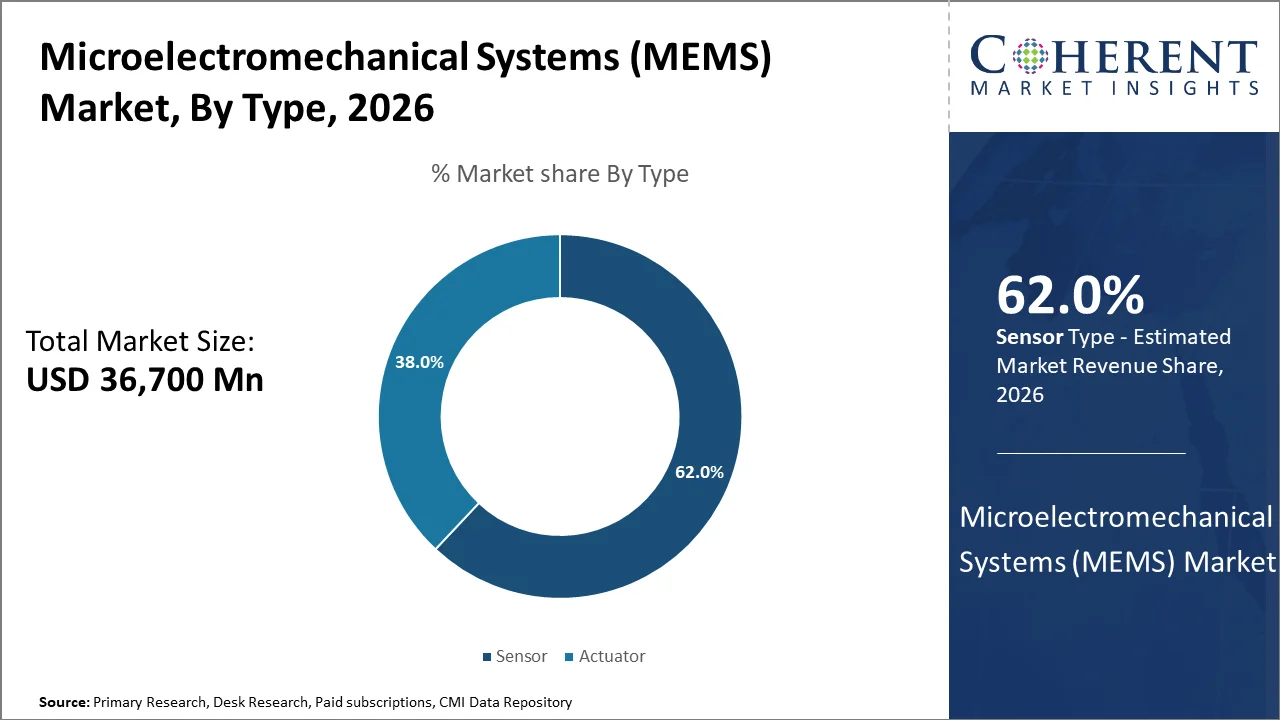
- Sensor segment is expected to dominate the market with a share of 62% in 2026 because of high adoption in smartphones, automotive ADAS, wearables, and industrial IoT applications. For example, modern smartphones universally include built-in MEMS sensors such as accelerometers and gyroscopes, which are essential for functions like screen rotation, motion tracking, gaming, and navigation.
- Consumer electronics segment is slated to account for the largest market share of 38% in 2026 as a result of rising demand for smartphones, wearables, tablets, and AR/VR devices.
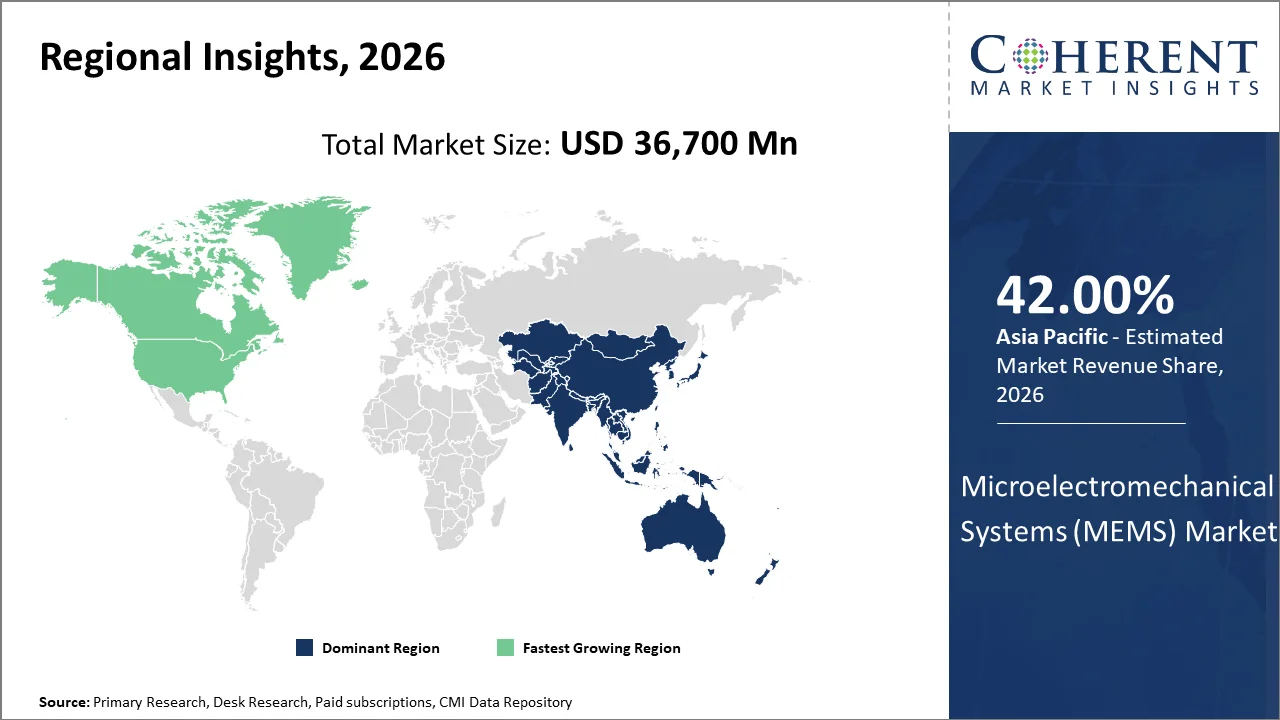
- Asia Pacific is projected to lead the global MEMS market with a share of 42% in 2026, owing to strong semiconductor manufacturing presence, rapid adoption of consumer electronics, expanding automotive production, and increasing investments in IoT and industrial automation across nations like China, Japan, South Korea, and Taiwan.
- North America, with a market share of 25% in 2026, is anticipated to emerge as a hotbed for microelectromechanical system manufacturers during the forecast period, thanks to rising demand for MEMS in automotive, consumer electronics, and healthcare devices.
Microelectromechanical Systems (MEMS) Market Overview
The global medical micro-electro mechanical systems (MEMS) market is expected to grow rapidly during the forecast period. This is primarily due to increasing adoption of MEMS-based sensors in consumer electronics like smartphones and wearable devices, advanced driver-assistance systems (ADAS), healthcare devices, and IoT-enabled smart systems. Similarly, ongoing miniaturization of electronic components and advancements in semiconductor manufacturing technologies are supporting market expansion.
MEMS (microelectromechanical systems) are miniaturized devices that integrate mechanical and electronic components on a single chip. MEMS technology is widely used in sensors, actuators, microphones, and other electronic devices due to its compact size and high precision.
Rising adoption of IoT and smart devices is expected to boost sales of microelectromechanical systems during the forecast period. MEMS sensors are being increasingly used in smartphones, wearables, smart home devices, and industrial IoT systems because of their compact size, low power consumption, and high precision.
In addition, increasing healthcare and medical device applications are fueling demand for microelectromechanical systems. MEMS technology is gaining traction in diagnostic devices, patient monitoring systems, implantable devices, biosensors, and minimally invasive surgical equipment due to the trend toward portable and connected healthcare solutions.
Advancements in RF MEMS, optical MEMS, and microfluidics are supporting market expansion. Emerging technologies such as optical switches, lab-on-chip devices, and RF MEMS are opening new opportunities in telecommunications, biomedical applications, and high-speed data transmission.
Segmental Insights
Which Type Segment Dominates the MEMS Market?
Sensor Segment to Account for Largest Market Share in 2026
According to Coherent Market Insights’ latest microelectromechanical systems (MEMS) market analysis, sensor segment is expected to lead the market, accounting for a prominent share of 62% in 2026. This can be attributed to rising adoption of gyroscopes, accelerometers, pressure sensors, inertial combos, microphones, and magnetometers across smartphones, automotive ADAS, wearables, and industrial IoT applications. Increasing demand for smartphones is accelerating the market growth. Global smartphone shipments rose 6% year over year to nearly 1.24 billion units in 2024.
Advancements in miniaturization, low-power consumption, and high-performance sensing technologies are also supporting the segment’s growth. MEMS sensors are increasingly being integrated into next-generation consumer electronics, autonomous vehicles, smart healthcare devices, and connected industrial systems owing to their compact size, reliability, and cost-effectiveness. Rising demand for real-time monitoring, motion detection, navigation, and environmental sensing applications is expected to further accelerate adoption during the forecast period.
- Current Industry Events of 2026
- Market Size Estimation
- Regional Breakdown
- Competitive Landscape
- Customer Intelligence
- Segmental Analysis
- Pricing Analysis
- Key Market Drivers, Challenges & Future Trends
- Customized Insights Section
Which is the Most Lucrative Application of Microelectromechanical Systems?
Consumer Electronics to Remain the Most Remunerative Application
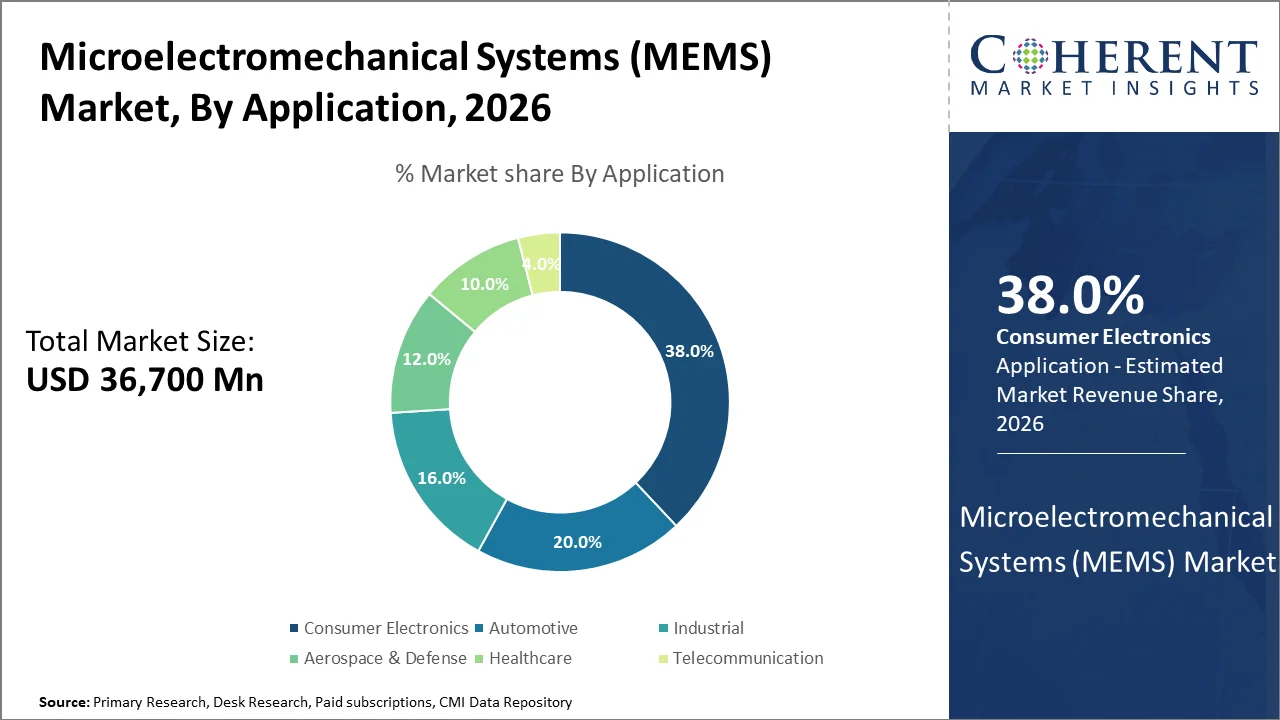
Based on application, consumer electronics segment is projected to account for the largest market revenue share of 38% in 2026. This dominance is mostly due to increasing integration of microelectromechanical systems (MEMS) in smartphones, tablets, wearable devices, gaming consoles, and smart home products. Global smartphone users increased from 3.67 billion in 2016 to 7.2 billion in 2025, bringing smartphone access to nearly 90% of the population.
MEMS sensors such as accelerometers, gyroscopes, microphones, and pressure sensors are widely used to enhance device functionality as well as improve user experience and support advanced features including motion detection, navigation, voice recognition, and health monitoring. In addition, rising demand for compact, energy-efficient, and high-performance electronic devices and rapid advancements in IoT-enabled consumer products are expected to fuel adoption of MEMS technology in the consumer electronics industry.
Market Dynamics
Microelectromechanical Systems (MEMS) Market Growth Drivers
- Expansion of Consumer Electronics and Wearables: The global adoption of consumer electronic devices such as smartphones, earbuds, fitness trackers, gaming consoles, and AR/VR devices is increasing rapidly. For instance, according to the This trend is expected to drive demand for microelectromechanical systems (MEMS), as MEMS-based accelerometers, gyroscopes, microphones, and pressure sensors are widely integrated into consumer electronics to enhance functionality and user experience.
Microelectromechanical Systems (MEMS) Market Opportunities
- Rising MEMS Demand in Automotive Applications: Expanding use of MEMS in automotive applications is creating lucrative growth opportunities for the microelectromechanical systems (MEMS) market. MEMS sensors are increasingly utilized in Advanced Driver Assistance Systems (ADAS), electric vehicles (EVs), autonomous driving technologies, airbag systems, tire pressure monitoring systems (TPMS), and vehicle stability control systems. Rising adoption of connected, electrified, and autonomous vehicles is slated to fuel demand for MEMS-based sensors due to their compact size, high accuracy, low power consumption, and cost-effectiveness.
Microelectromechanical Systems (MEMS) Market Trends
- Increasing Miniaturization Trend: Shift towards miniaturized sensors is a key-growth shaping trend in the microelectromechanical systems market. Leading microelectromechanical system manufacturers are focusing on developing smaller, multifunctional, and energy-efficient devices integrated with CMOS and AI-enabled technologies to enhance performance and reduce manufacturing costs.
- For example, in January 2025, Infineon Technologies introduced an integrated one-chip MEMS ultrasonic transducer with a smaller footprint and enhanced functionality for industrial and medical applications. The development reflects the growing emphasis on miniaturization and high integration in MEMS technology.
Current Events and Their Impact
Current Event | Description and its Impact |
Expansion of MEMS sensor investments for automotive and industrial applications (2026) |
|
Rising adoption of MEMS sensors in ADAS and smart mobility systems (2026) |
|
Regional Insights
Expanding Consumer Electronics Industry Fueling Demand in Asia Pacific
Asia Pacific is expected to retain its dominance over the global MEMS market, capturing a share of 42% in 2026. This can be attributed to the expansion of consumer electronics sector, rising popularity of electric vehicles, and increasing adoption of IoT-enabled devices. Similarly, rising adoption of MEMS sensors in smartphones, wearable devices, automotive safety systems, and industrial automation equipment is supporting Asia Pacific microelectromechanical systems (MEMS) market expansion in the region.
According to the China Association of Automobile Manufacturers (CAAM), total automobile production in China reached 34.53 million units in 2025. This expanding vehicle production, especially EVs, is fueling demand for microelectromechanical systems as they are often used in modern electric vehicles for navigation, battery management, airbag systems, and vehicle stability control.
Expanding Healthcare Applications Boosting Growth in North America
North America is anticipated to create lucrative growth opportunities for manufacturers of microelectromechanical systems (MEMS) during the forecast period, holding a 25% share of the global market in 2026. This is mostly due to increasing use of microelectromechanical systems (MEMS) in healthcare and automotive applications.
Microelectromechanical systems are widely used in medical devices to enhance patient monitoring as well as enable faster, more accurate detection of physiological signals. Rising adoption of wearable technologies such as smartwatches is driving growth of the microelectromechanical systems (MEMS) market, as these devices use MEMS sensors to track motion and physiological signals.
For example, in September 2024, Apple launched the Apple Watch Series 10, which includes MEMS-based sensors such as an electrical heart sensor, optical heart sensor, high These sensors allow ECG recording, heart rate monitoring, blood oxygen tracking, and irregular rhythm alerts, showing how modern smartwatches boost demand for MEMS technology.
Adoption of MEMS in implantable and therapeutic devices is set to fuel growth in North America microelectromechanical systems (MEMS) market during the forthcoming period. MEMS components are increasingly used in implantable sensors, and robotic-assisted surgical tools. In addition, smart manufacturing and predictive maintenance systems are increasing the deployment of MEMS sensors in industrial environments. MEMS-based pressure, motion, and vibration sensors help improve operational efficiency, equipment monitoring, and automation precision.
Microelectromechanical Systems (MEMS) Market Outlook – Country-wise
U.S. Microelectromechanical Systems (MEMS) Market Trends
The U.S. is expected to remain a prominent market for microelectromechanical (MEMS) systems during the forecast period. This is mostly due to strong semiconductor innovation, rising adoption of wearable healthcare devices, and increasing use of MEMS sensors in automotive safety and industrial automation.
The country is also witnessing significant investments in domestic chip manufacturing. According to the U.S. Semiconductor Industry Association, private companies have announced more than USD540 billion in semiconductor and electronics-related investments since the CHIPS and Science Act was introduced. This is creating strong growth opportunities for MEMS-based technologies across healthcare, consumer electronics, and smart manufacturing applications.
China Microelectromechanical Systems (MEMS) Market Forecast
China is emerging as a key growth market for MEMS systems owing to rapid expansion of consumer electronics production, rising electric vehicle manufacturing, and growing deployment of IoT-enabled technologies. The country is increasingly using MEMS sensors in smartphones, wearables, autonomous vehicles, and industrial automation systems. These expanding applications are expected to drive demand for microelectromechanical systems in the nation during the assessment period.
Who are the Major Companies in the MEMS Market?
Some of the major players in Micro-electro Mechanical Systems (MEMS) Market are Nxp Semiconductors N.V., Analog Devices, Inc., and Knowles Corporation
Key Strategies Adopted by Industry Players
Leading companies in the microelectromechanical systems (MEMS) market are adopting various strategies to strengthen their market presence as well as gain a competitive advantage. These include AI-enabled MEMS innovations, strategic partnerships with semiconductor and IoT companies, acquisitions to expand sensor portfolios, investments in advanced miniaturization technologies, and new product launches for automotive, healthcare, wearable, and consumer electronics applications.
Companies are also focusing on expanding manufacturing capabilities, developing energy-efficient MEMS sensors, and accelerating commercialization of next-generation MEMS microphones, resonators, and cooling solutions for AI-powered devices. For example, in September 2025, SiTime launched new MEMS Resonators to support edge AI and IoT applications.
- In October 2025, Knowles Corporation introduced the MM60 MEMS microphone at the EUHA Congress 2025 in October 2025. The MM60 microphone was designed to improve sound quality and support AI-enabled hearing aids.
- In June 2025, TDK Corporation launched the Tronics AXO315T0 MEMS accelerometer in June 2025. The sensor is designed to operate in high-temperature environments for energy and industrial applications.
- In April 2025, STMicroelectronics launched MEMS Studio to simplify machine learning and sensor configuration in 2025. The tool helps engineers with little or no experience in sensing and data science design and configure MEMS devices more easily.
Market Report Scope
Microelectromechanical Systems (MEMS) Market Report Coverage
| Report Coverage | Details | ||
|---|---|---|---|
| Base Year: | 2025 | Market Size in 2026: | USD 36,700 Mn |
| Historical Data for: | 2020 To 2024 | Forecast Period: | 2026 To 2033 |
| Forecast Period 2026 to 2033 CAGR: | 9% | 2033 Value Projection: | USD 67,100 Mn |
| Geographies covered: |
| ||
| Segments covered: |
| ||
| Companies covered: | Nxp Semiconductors N.V., Analog Devices, Inc., and Knowles Corporation | ||
| Growth Drivers: |
| ||
| Restraints & Challenges: |
| ||
Analyst Opinion (Expert Opinion)
- The MEMS market is witnessing strong growth due to rising integration of miniaturized sensors and actuators in smartphones, wearables, gaming devices, and other connected consumer electronics.
- According to the World Health Organization (WHO), nearly 2.5 billion people are projected to have some degree of hearing loss by 2050, significantly increasing demand for MEMS microphones used in hearing aids, earbuds, and smart audio devices.
- The automotive sector is emerging as a key growth area for MEMS technology as vehicles increasingly incorporate ADAS, electronic stability control, tire pressure monitoring systems, and autonomous driving features.
- The rapid expansion of Industrial IoT (IIoT), smart manufacturing, and factory automation is accelerating the deployment of MEMS pressure sensors, accelerometers, and gyroscopes across industrial applications.
Speak to the analyst
Want personalized insights?
Take the findings above to one of our principal consultants, or have the report rebuilt around the segments, geographies and competitors you actually track.
Market Segmentation
- By Type Insights ( Revenue, USD Mn, 2021 - 2033)
- Sensor
- Gyroscopes
- Accelerometers
- Pressure Sensor
- Inertial Combos
- Microphones
- Magnetometers
- Others
- Actuator
- Inkjet Systems
- Optical MEMS
- Oscillators & Resonators
- Microfluidic & Biochip
- RF MEMS
- Others
- Sensor
- By Application Insights ( Revenue, USD Mn, 2021 - 2033)
- Consumer Electronics
- Automotive
- Industrial
- Aerospace & Defense
- Healthcare
- Telecommunication
- By Region Insights ( Revenue, USD Mn, 2021 - 2033)
- North America
- U.S.
- Canada
- Latin America
- Brazil
- Argentina
- Mexico
- Rest of Latin America
- Europe
- Germany
- U.K.
- Spain
- France
- Italy
- Russia
- Rest of Europe
- Asia Pacific
- China
- India
- Japan
- Australia
- South Korea
- ASEAN
- Rest of Asia Pacific
- Middle East & Africa
- GCC Countries
- Israel
- Rest of Middle East & Africa
- North America
- Key Players
- Nxp Semiconductors N.V.
- Analog Devices, Inc.
- Knowles Corporation
- Others
Sources
Primary Research interviews
- Industry experts, MEMS device manufacturers, semiconductor component suppliers, sensor technology providers, distributors, research scientists, technology consultants, automotive OEMs, healthcare device manufacturers, consumer electronics companies, and senior executives from the microelectronics ecosystem
Databases
- IEEE Xplore Digital Library
- ScienceDirect
- SpringerLink
- Scopus
- Web of Science
- SEMI Industry Statistics Database
- USPTO Patent Database
- Eurostat
- OECD Database
- World Bank Database
- UN Comtrade Database
- Government trade databases
Magazines
- Semiconductor Engineering
- Electronic Products Magazine
- Sensors Magazine
- Micromachine Magazine
- Electronics For You
- EE Times
- Design World
- Semiconductor Digest
Journals’
- Journal of Microelectromechanical Systems
- Microsystems & Nanoengineering
- Sensors
- IEEE Sensors Journal
- Journal of Micromechanics and Microengineering
- Microelectronics Journal
- Nature Electronics
- Advanced Functional Materials
Newspapers
- The Wall Street Journal
- Financial Times
- The Economic Times
- Business Standard
- Nikkei Asia
- The New York Times
- The Guardian
Associations
- IEEE
- SEMI
- MEMS Industry Group
- ASME
- Sensors Council
- IPC
Public Domain sources
- U.S. Census Bureau
- World Bank
- OECD
- European Commission
- UN Comtrade Database
- National Institute of Standards and Technology (NIST)
- NASA
- U.S. Patent and Trademark Office (USPTO)
Proprietary Elements
- CMI Data Analytics Tool, Proprietary CMI Existing Repository of information for last 10 years
Get access to 250+ pages report
Every segment, forecast, competitor profile and data table behind the analysis above — available for instant download.
- ESOMAR Member
- ISO 9001:2015 Certified
- D-U-N-S Registered
- GDPR & CCPA Compliant
Missing comfort of reading report in your local language? Find your preferred language:
Transform your Strategy with Exclusive Trending Reports
Frequently Asked Questions
The global market is estimated to be valued at USD 36,700 Mn in 2026.
The global Microelectromechanical Systems (MEMS) Market value is expected to reach USD 67,100 Mn by 2033.
The global market is poised to exhibit a CAGR of 9% from 2026 to 2033.
Major growth factors include rising adoption of MEMS-based sensors across various applications and rising miniaturization trend.
Sensor segment, with about 62% market share in 2026, dominates the market.
Some major companies in the Microelectromechanical Systems (MEMS) Market include Nxp Semiconductors N.V., Analog Devices, Inc., and Knowles Corporation.
Asia Pacific, with 42% share in 2026, is set to lead the market during the forecast period.