

Grid Connected Battery Energy Storage Market Size and Forecast – 2026-2033
Grid Connected Battery Energy Storage Market size is estimated to be valued at USD 3,194.9 Mn in 2026 and is expected to reach USD 17,025.1 Mn in 2033, exhibiting a compound annual growth rate (CAGR) of 27.0% from 2026 to 2033.
Key Takeaways
- Based on Technology, The lithium-ion battery segment holds 61% of the Grid Connected Battery Energy Storage Market share, owing to increasing energy density, drop in costs, and greater scalability.
- Based on Application, during the transition to renewables, the need for reliable energy makes utility-scale powered storage the fastest growing segment.
- Based on Region, Asia Pacific is leading the market region, with China and South Korea as leaders, because of the supporting government policies and extensive battery production.
Market Overview
The Global Grid-Connected Battery Energy Storage Market value is expanding quickly due to increased use of renewable sources like wind and solar energy. These systems enhances grid stability and lowers emissions by storing excess energy and releasing it during peak demand hours. Increased storage deployment from government incentives in technology as well as renewables, especially in the U.S. and China, are key to the growth drivers. For example, the U.S. Department of Energy’s Long Duration Storage Shot looks to reduce the cost of grid-scale storage from 90 cents to $30 by 2030. In the same way, South Korea’s initiative for Energy Storage System has put the country as a global leader in deployment.
Current Events and Its Impact on the Grid-Connected Battery Energy Storage Market
Event | Description and Impact |
Increasing Renewable Energy Adoption |
|
Advancements in Battery Technology |
|
Segmental Insights
- Current Industry Events of 2026
- Market Size Estimation
- Regional Breakdown
- Competitive Landscape
- Customer Intelligence
- Segmental Analysis
- Pricing Analysis
- Key Market Drivers, Challenges & Future Trends
- Customized Insights Section
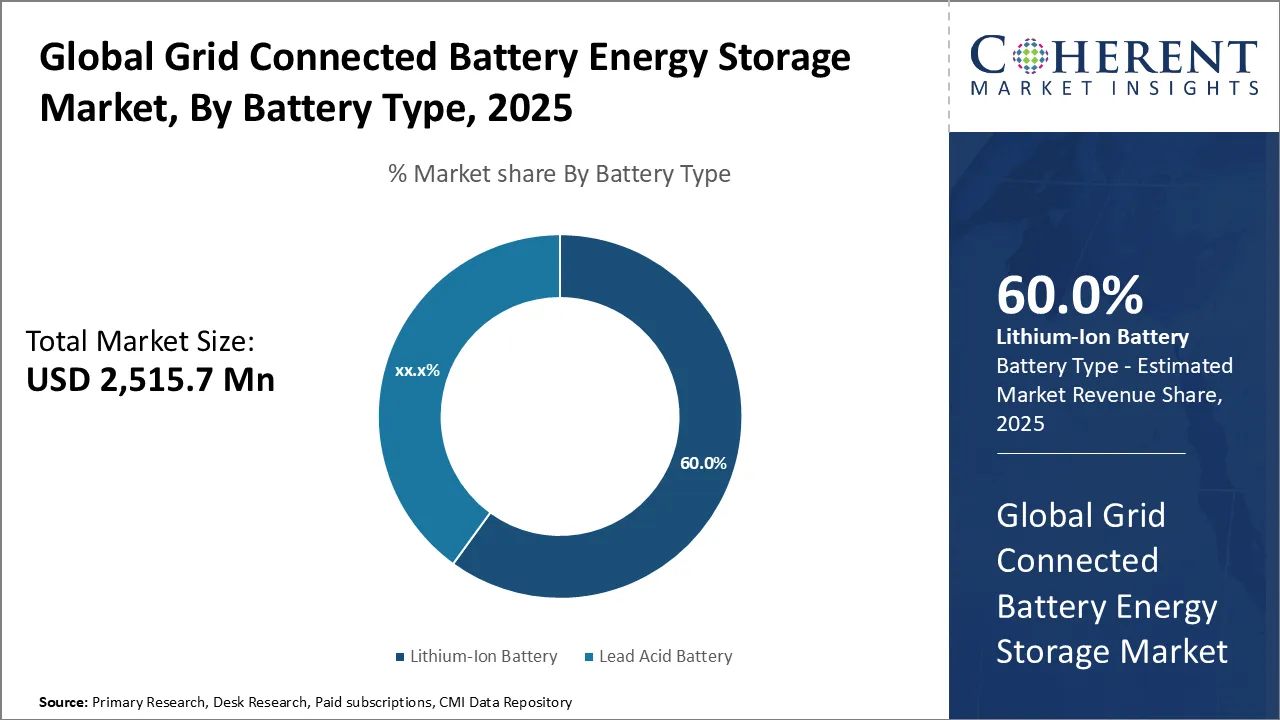
Global Grid Connected Battery Energy Storage Market Insights by Battery Type: Lithium-ion Batteries Lead Due to High Efficiency and Longevity in Energy Storage Systems
By Battery Type, the lithium-ion battery segment holds 61% share in Global Grid-Connected Battery Energy Storage Market value in 2026 and will retain its top position due to its high energy density, longer life cycle, and efficacy in both residential and industrial Energy Storage Systems (ESS). The charging will be propelled by the grid connected lithium-ion batteries and the pickup in consumption of renewable power sources. All these avenues for growth are expected to see significant funding. They can be used for large scale grid connected energy storage and permanently coupled with renewable energy. These batteries are the best choice for widespread application due to their light weight, low maintenance, and high performance and very economical. The lead-acid segment is assuming a more important role with the latest projection around adding a new area of specialization with mobility wheelchairs and portable power for aids of the elderly and disabled. Also, sustaining popularity for secondary transportation mechanisms from golf buggies to marine leisure vehicles like seacraft now. Enduring powerful competition from emerging technologies, the degree of superlative appropriation one can expect with lead-acid batteries in zero-emission vehicles is astonishing. For American markets, maintaining performance is critical and these procedures in a blasting sea of technology provided make this approach relevant.
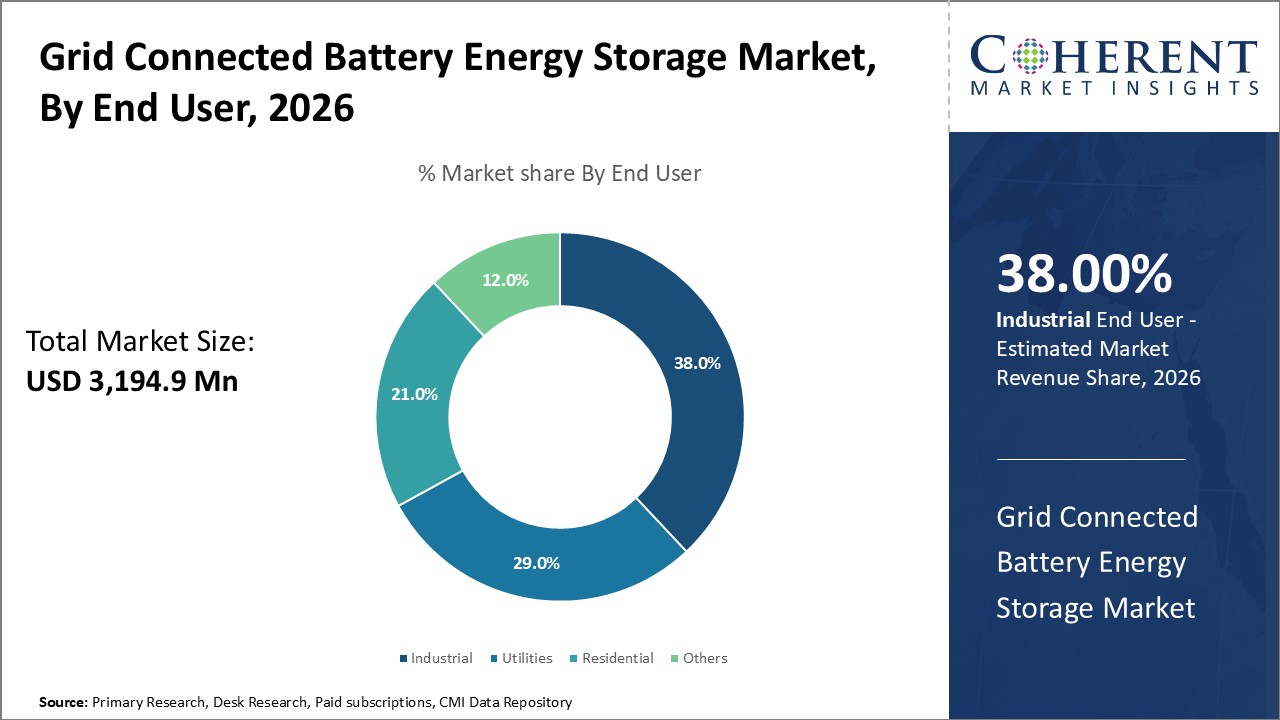
Global Grid Connected Battery Energy Storage Market Insights by End User: Industrial and Utility Segments Drive Market Growth
By End User, Increased need for large-scale energy storage facilities is anticipated to boost the industrial and utility segments. They use grid-based storage technology to provide electricity, firm renewables, and provide back-up energy for the reliable energy system. Utility companies are now switching to renewables because of the globalization and adopting energy storage technologies to relieve renewable energy sources driven supply-demand imbalance and improve dependability of the grid. Moreover, industries are now switching to energy storage systems to optimize operational efficiency and minimize expenses.
There is also expected growth for this segment as the Residential segment, powered by the need of households to integrate other forms of energy such as solar power and store it, pushes the demand for energy storage solutions. As more homeowners install battery storage systems, this segment will especially experience growth in areas with greater utilization of renewables.
Regional Insights
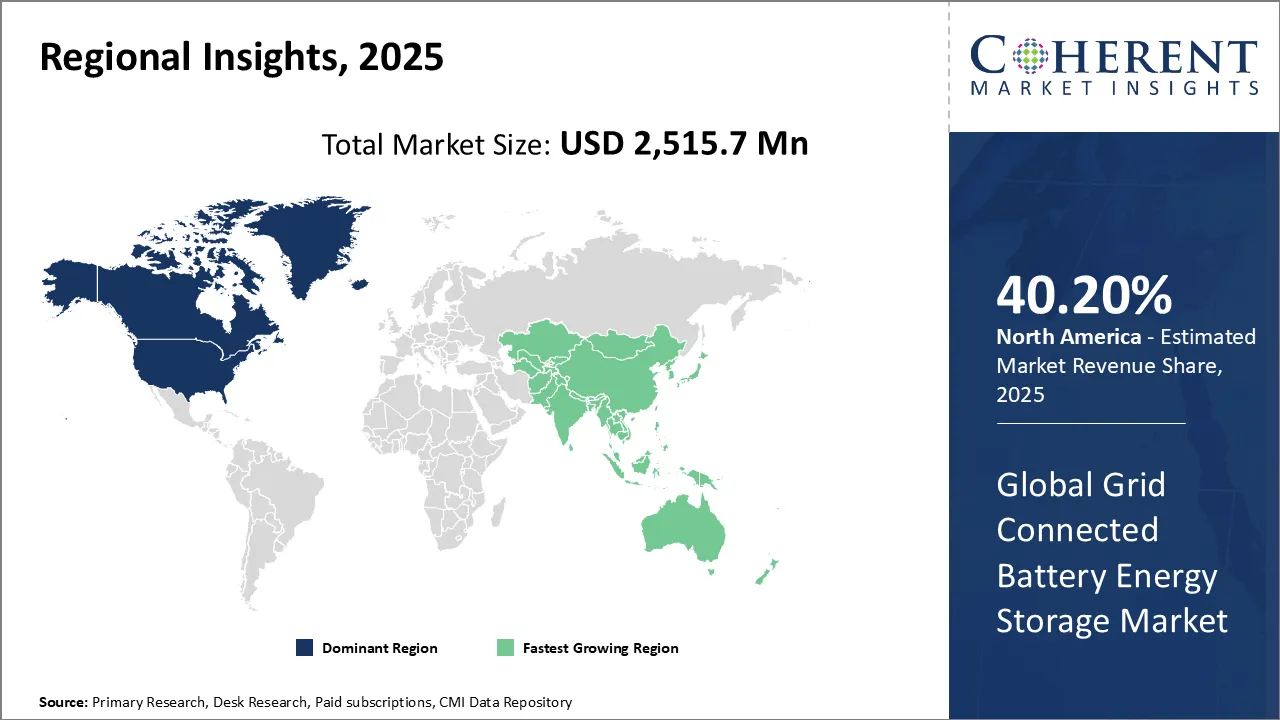
North America Grid Connected Battery Energy Storage Market
In 2026, the North America Grid Connected Battery Energy Storage market growth is set to hold 40.2% market share. This is attributed to the rising need in the region for Lithium-ion battery storage systems. The region possesses the most sophisticated and easily accessible battery storage systems which can harness energy from renewable sources like solar, wind, etc. It is also expected that the region will maintain clean energy policies which in turn will optimize spending toward infrastructure capable of integrating with renewable power as well as energy, further supporting the growth of the market. Adoption of these technologies is also supported by government policies and incentives like tax credit and subsidy provision for renewable energy and storage. The IRA has stimulated capital for battery storage systems making them available for adoption in other areas besides industrial, residential, and sustainable energy solutions.
Asia Pacific Grid Connected Battery Energy Storage Market
The Asia Pacific region is expected to undergo the highest increase in the Compound Annual Growth Rate (CAGR) of the market during the forecast period. The driver of the region’s growth comes from the increasing investment within the emerging economies and government initiatives towards expanding the infrastructure for storage of renewable energy. For instance, the government of China has made proclamations to deploy more than 30 GW of power storage by 2026 in order to put renewable energy on the grid effectively. Moreover, the announcement made in February 2026 from India with regards to the 4,000 MWh battery energy storage system under Viability Gap Funding further cements the commitment of the region towards augmenting its power storage system. The growing amount of energy storage projects along with the government backing are likely to support substantial growth in the Grid Connected Battery Energy Storage Market Forecast.
Europe Grid Connected Battery Energy Storage Market
Europe continues to work on strengthening energy autonomy alongside striving to achieve complete climate neutrality, which has led to multi-faceted endeavors in the development of grid-formed battery energy storage systems. The European Green Deal as well as sustainability targets seek to motivate the region toward adopting large-scale storage systems for renewable energy to be used more effectively. A number of countries, such as Germany, France, and the UK, are increasing their activity aimed at creating and using battery storage systems within the framework of energy transition strategies. For example, along with energy storage, Germany also advances initiatives towards energy security improvement and carbon emission reduction. The emphasis Europe increasingly puts on a circular economy for batteries and their second-life applications distinguishes it further in the global market—and European investment in battery recycling and reuse is already considerable.
China Grid Connected Battery Energy Storage Market
China's still surpasses the grid-connected battery energy storage market due to increase in renewable energy integration and energy storage technology integration. China has placed itself in the map of battery manufacturing and its growing ambitions for energy storage capacity expansion are fostering growth in Grid Connected Battery Energy Storage Market Outlook. China's strategies to add over 30 GW power storage by 2026 is yet another addition to enhance renewable energy initiatives targets. In addition the role of government policies along with warrants subsidies in developing energy storage systems is also vital to shun China away from other regions of this market.
India Grid Connected Battery Energy Storage Market
The increasing focus on renewable energy and energy storage solutions are propelling India’s prominence in the grid-connected battery energy sector. The Indian government is eager to advance the country's energy storage capabilities, planning multi-project efforts, such as a 4000 MWh battery energy storage system planned to be announced in February 2026. The government's gap-funding viability, along with the FAME-II initiatives aimed at promoting electric vehicles, is giving significant momentum to the development of electric battery storage in India. Coupled with India's growing energy needs, the need to curtail emission levels enhances India's attractiveness as a market for energy storage systems. The development of energy storage systems will facilitate the use of renewable sources of energy in India, which in turn, will propel the country's market growth.
Pricing Analysis
- Lithium-ion battery storage system costs have declined from ~$1,200/kWh in 2010 to <$150/kWh in 2024.
- Regional price variations exist due to:
- Import duties
- Material sourcing costs
- Government subsidies
- Large-scale projects achieve economies of scale with installation costs as low as $300/kWh.
- Maintenance and software optimization costs contribute significantly to lifetime expenditure.
Market Report Scope
Grid Connected Battery Energy Storage Market Report Coverage
| Report Coverage | Details | ||
|---|---|---|---|
| Base Year: | 2025 | Market Size in 2026: | USD 3,194.9 Mn |
| Historical Data for: | 2020 To 2024 | Forecast Period: | 2026 To 2033 |
| Forecast Period 2026 to 2033 CAGR: | 27.0% | 2033 Value Projection: | USD 17,025.1 Mn |
| Geographies covered: |
| ||
| Segments covered: |
| ||
| Companies covered: | NGK Insulators Ltd, BYD Company, NEC Corporation, Samsung SDI Co., LG Electronics Inc., Xtreme Power, Saft Groupe S.A., AES Energy Storage, Alevo, Delco, Altair Nanotechnologies Inc., EnerDel, GNB Corporation, Ecoult, and Powertree Services Inc. | ||
| Growth Drivers: |
| ||
| Restraints & Challenges: |
| ||
Global Grid Connected Battery Energy Storage Market- Drivers
Increasing demand for energy
Increasing demand for electricity due to population growth, urbanization, and industrialization is expected to drive the market growth. Grid-connected battery energy storage systems can help utilities meet this demand by providing a means to store energy during periods of low demand and release it during periods of high demand. According to the latest forecast from research company Bloomberg NEF (BNEF), in 2021, energy storage installations around the world are projected to reach a cumulative 411 gigawatts by 2030. That is 15 times the 27GW/56GWh of storage online.
Increasing Government Initiatives
Many countries are turning to renewable energy storage to reduce dependency on energy imports, enhance the reliability and resiliency of their systems, and shift toward environmental and de-carbonization targets. For instance, India and Japan, in March 19, 2022, agreed to extend clean energy partnership to cover electric vehicles, battery storage, and green hydrogen as the two Asian economic power house pivot net zero carbon emission pathways.
Grid Modernization
Growing battery storage along with grid modernization efforts including the transition to smart grids is expected to drive the market growth. Batteries help to unlock the full potential of smart technologies. For instance, in April 2025, India Grid, a leading infrastructure investment trust, announced the launch of the country's first battery energy storage system that is linked to solar panels. This innovative system is designed to store excess solar power generated during the day and then distribute it during periods of high demand such as in the evening or at night.
Global Grid Connected Battery Energy Storage Market- Opportunities
Increasing Number of Rural Electrification Projects Worldwide
Rural electrification is the process of making electrical power accessible in rural or remote areas. Battery energy storage systems are effective for rural electrification. Various countries in the world are trying to develop their remote areas such as isolated rural areas and peri-urban areas, especially in developing countries; and small islands separated from the national grids. As such, they require to have a reliable and uninterrupted power supply from renewable and conventional sources of energy that increases the overall system efficiency and ensures economic savings across the system life cycle. The installation of battery energy storage systems in rural areas would act as a solution to serve the businesses and local communities with a reliable and safe power supply.
Global Grid Connected Battery Energy Storage Market- Trends
Increasing Number of Large-Scale Battery Storage Projects
One of the Grid Connected Battery Energy Storage Market Trends is increasing number of large-scale battery storage projects is expected to drive the market growth. These initiatives support grid stability and support during peak period demand because they are frequently situated close to renewable energy sources. For Instance, on January 19, 2023, Solar Energy Corporation of India awarded JSW Energy, an energy company, two storage projects of 500 megawatts (MW), with a 1,000 megawatt-hour (MWh) output, which can provide power backup for two hours.
Extension of Energy Storage Applications
Battery energy storage systems are being used for a variety of applications outside of grid support such as electric vehicle charging infrastructure, industrial and commercial energy management, and residential energy management. The market is expanding as a result of the expansion of applications, which is also presenting new business opportunities for battery and energy storage companies. For instance, in April 2025, the Government of India reported that under the PM Electric Drive Revolution in Innovative Vehicle Enhancement (PM E-DRIVE) scheme—approved by the Union Cabinet on 29 September 2024 with a total outlay of ₹10,900 crore (US $1.33 billion) for the period 1 October 2024 to 31 March 2026—an allocation of ₹2,000 crore (US $245 million) was earmarked exclusively for public charging infrastructure, resulting in the installation of 25,202 EV charging stations nationwide as of 17 December 2024.
Key Market Players, Manufacturing Facilities, and Production Capacities
- Tesla, Inc.: Tesla’s Giga factory is located in Nevada, United States. It has an energy storage capacity greater than 40 GWh annually. The factory focuses on the manufacturing of energy storage systems to further Tesla’s initiatives towards electric vehicles and their integration with renewable energy storage technologies.
- LG Energy Solution: LG Energy Solution has a number of production facilities including South Korea, Poland, and Michigan (U.S). These factories have more than 100 GWh in combined production capacity for residential and commercial energy storage systems. The company continues to grow its manufacturing infrastructure to supply energy storage systems and lithium-ion batteries in contention with the increasing international market demand.
- Contemporary Amperex Technology Co. Limited (CATL): One of the largest battery makers globally is CATL. They have an exceeding global production capacity of 300 GWh. The company has committed considerable resources to implementing grid energy storage systems with supply chains specialized in making energy storage technologies more efficient and scalable across the globe.
- Fluence Energy: Based in the US, Germany and Australia along with operating facilities across the countries, Siemens and AES collectively form a company called Fluence Energy. “Fluence” takes pride in being the frontrunner with integrating stored energy with generation systems built alongside renewables. With cutting edge manufacturing plants, Fluence is capable to support the construction and execution of expansive grid-connected storage systems. The company's primary focus involves resolving matters towards improving the grid stability and its efficiency.
- Samsung SDI: Hungaria and South Korea will now be home to new Samsung SDI production plants as the company intends to broaden their lead in manufacturing. The new facilities will assist in meeting the needs of the corresponding world surge. This is done with the aim of enhancing performance for lithium-ion batteries which are utilized in not only grid energy storage but EVs too and other energy solutions. To enable a worldwide transition towards cleaner and sustainable energy, the company strategically decided to boost its production capacity.
Global Grid Connected Battery Energy Storage Market: Key Developments
- In March 2025, Tesla, in collaboration with Arevon, completed the second phase of the Eland Solar-plus-Storage Project in Kern County. This expansion added 172 Megapacks, totaling 1.2 GWh of storage capacity, supporting 758 MW of solar power—sufficient to power approximately 200,000 homes annually.
- In March 2025, a global energy technology company, Fluence Energy, established new manufacturing and assembling units in Southeast Asia. These facilities are designed to serve the increasing worldwide need for energy storage systems.
- In February 2025, the U.S. government initiated another new funding program under the Infrastructure Investment and Jobs Act. This initiative is focused on providing aid for the development of grid energy storage projects throughout the country and transitions the country to renewable energy.
- In December 2024, the Chinese-based battery behemoth, Contemporary Amperex Technology Co. Limited (CATL), further cemented its jurisdiction in the global power market by launching a high-capacity battery system targeting the national grid in developing economies.
Analyst Viewpoint
- The market for battery energy storage systems that are integrated with the grid is critical for modern power systems to seamlessly incorporate renewable energy while ensuring reliability and flexibility of the grid.
- Experts in the field consider battery storage as one of the most important technologies in transforming the energy sector, especially now that utilities require immediate balancing solutions and defenses against variable power supply.
- Due to various grid use cases, lithium-ion batteries will most likely keep their dominance because of their diversity, high efficiency, and ease of integration.
- Global deployment is accelerating due to regions setting and actively investing in large scale clean energy targets and battery storage infrastructure.
- Supported by national policies and energy system reforms, China, South Korea, the US and EU members are at the forefront of the race to industrialize and deploy grid-connected storage systems.
Market Segmentation
- Global Grid Connected Battery Energy Storage Market, By Battery Type (Revenue, USD Mn, 2021 - 2033)
- Lithium-Ion Battery
- Lead Acid Battery
- Global Grid Connected Battery Energy Storage Market, By End User (Revenue, USD Mn, 2021 - 2033)
- Residential
- Industrial
- Utilities
- Others
- Global Grid Connected Battery Energy Storage Market, By Region (Revenue, USD Mn, 2021 - 2033)
- North America
- U.S.
- Canada
- Latin America
- Brazil
- Argentina
- Mexico
- Rest of Latin America
- Europe
- Germany
- U.K.
- Spain
- France
- Italy
- Russia
- Rest of Europe
- Asia Pacific
- China
- India
- Japan
- Australia
- South Korea
- ASEAN
- Rest of Asia Pacific
- Middle East
- GCC Countries
- Israel
- Rest of Middle East
- Africa
- South Africa
- North Africa
- Central Africa
- North America
- Company Profiles
- NGK Insulators Ltd.
- BYD Company
- NEC Corporation
- Samsung SDI Co.
- LG Electronics Inc.
- Xtreme Power
- Saft Groupe.SA.
- AES Energy Storage
- Alevo, Delco
- Altair Nanotechnologies Inc.
- EnerDel
- GNB Corporation
- Ecoult
- Powertree Services Inc.
Sources
Primary Research Interviews from the following stakeholders
Stakeholders
- Interviews with energy storage system manufacturers, grid operators, and battery technology developers.
- Specific stakeholders: Utility-scale storage project managers, renewable energy system integrators, government energy policy advisors, and experts in battery performance optimization.
Databases
- Energy Storage Association (ESA)
- International Energy Agency (IEA) – Energy Storage Reports
- U.S. Department of Energy (DOE) – Energy Storage Grand Challenge
- World Bank – Energy Storage Partnership (ESP) Database
- Bloomberg New Energy Finance (BNEF) – Battery Pricing and Storage Market Reports
Magazines
- Energy Storage News
- Greentech Media – Energy Storage Section
- Renewable Energy World – Energy Storage Insights
- Solar Power World – Storage Market Coverage
- Battery Power Online
Journals
- Journal of Energy Storage
- Renewable and Sustainable Energy Reviews
- Energy Storage Materials
- Journal of Power Sources
- Energy
Newspapers
- The Guardian – Environment & Sustainability Section
- Financial Times – Energy Section
- The New York Times – Climate and Energy
- Reuters – Clean Energy Insights
- The Wall Street Journal – Energy & Environment
Associations
- Energy Storage Association (ESA)
- International Renewable Energy Agency (IRENA)
- U.S. Energy Information Administration (EIA)
- The International Battery Materials Association (IBMA)
- National Renewable Energy Laboratory (NREL)
Public Domain Sources
- International Energy Agency (IEA)
- U.S. Department of Energy (DOE)
- European Commission – Energy Storage Policy
- World Bank – Energy Storage Insights
- National Renewable Energy Laboratory (NREL)
Proprietary Elements
- CMI Data Analytics Tool, and Proprietary CMI Existing Repository of information for the last 8 years
- In-house market surveys and feedback reports from key industry players and customers
*Definition: The grid connected battery energy storage system is an integration of battery with a two way power converter that connects the direct current battery to the alternate current grid, and a real-time control software that helps to balance the frequency and power flows, while optimizing the efficiency and service life of the system.
Get access to 250+ pages report
Every segment, forecast, competitor profile and data table behind the analysis above — available for instant download.
- ESOMAR Member
- ISO 9001:2015 Certified
- D-U-N-S Registered
- GDPR & CCPA Compliant
Missing comfort of reading report in your local language? Find your preferred language:
Transform your Strategy with Exclusive Trending Reports
Frequently Asked Questions
The Grid Connected Battery Energy Storage Market size is estimated to be valued at USD 3,194.9 Mn in 2026, and is expected to reach USD 17,025.1 Mn by 2033.
The CAGR of the global Market is projected to be 27.0% from 2026 to 2033.
Increasing demand for grid connected solutions is one of the major factors that is expected to propel growth of the market over the forecast period.
Increasing Number of Rural Electrification Projects Worldwide.
Perceptions of high prices, outdated regulatory policy and market design, the high cost of investment are expected to restrict the market growth.